Key takeaways
- Datasheets quote 90% for AC-coupled batteries and 89% for Powerwall 3, on different bases: AC to battery to AC, and solar to battery to home.
- With a 97% inverter, stored solar reaches the home at 87.3% AC-coupled and 89.0% DC-coupled in our example.
- Grid charging flips it. It gives 90.0% AC-coupled against 86.3% for DC-coupled. That DC figure is our estimate, because Tesla states no AC-to-AC figure.
- At a DC/AC ratio of 1.5, 313 kWh a year clips (1.8% of array output). Battery-first charging recovers 22 kWh. Clipped-only charging stores all 313.
- For a retrofit, AC coupling leaves the existing PV inverter in place. A DC-coupled battery usually means new DC-side hardware.
To model a battery layout in software, see the best solar battery storage design software.
AC coupling vs DC coupling at a glance
An AC-coupled battery sits on the AC side, behind the PV inverter. A DC-coupled battery sits on the DC side. It shares an inverter with the array.
| Item | AC-coupled | DC-coupled |
|---|---|---|
| Battery joins | The AC bus, through its own inverter. | The DC side, on a hybrid inverter. |
| Solar to battery to home | Three conversions (DC to AC, AC to DC, DC to AC). | Stored without first converting to AC. |
| Clipped DC power | Lost: the PV inverter clips before the AC bus. | Can charge the battery if there is room and the charge rule allows. |
| Retrofit | Adds a battery to existing solar. | Usually replaces or adds DC-side hardware. |
| Standard or rule | No single standard. | Efficiency figures come from each datasheet’s own footnote. |
Why AC and DC coupling matter for installers
The layout decides which hardware you replace. It decides whether you can save clipped solar. It also decides which datasheet figures you can compare. A wrong assumption shows up in the quote or the yield estimate.
On scope and cost, an AC-coupled retrofit keeps the existing PV inverter. NLR (formerly NREL)’s Q1 2020 cost study modelled DC coupling at 2.8% higher total cost for a commercial system. It modelled 1% for utility-scale.
How do AC-coupled and DC-coupled layouts move energy?
They differ in two ways. One is how many conversions stored solar passes through. The other is which inverter limit applies to the array. Aurora’s help describes DC coupling as storing solar without first converting it to AC.
- AC-coupled: the array feeds a PV inverter. The AC bus feeds the home. A battery inverter turns surplus AC into DC. It turns it back to AC on discharge.
- DC-coupled: the array and battery share a DC side and one inverter. Stored solar is not converted to AC first.
- Clipping: in an AC-coupled system the PV inverter cap is final. NREL says a shared inverter lets a DC-coupled hybrid send PV power to the battery. That power would otherwise be clipped (NREL TP-5C00-77917).
- Grid charging: both layouts turn grid AC into DC and back. NREL’s footnote 14 says energy charged straight from PV avoids the inverter loss that grid charging incurs. So the DC advantage applies to solar charging.
- Inverter count: an NREL utility-scale cost study lists one bidirectional inverter for DC coupling and two for AC coupling.
See DC/AC ratio for ratio limits and inverter clipping for the loss curve.
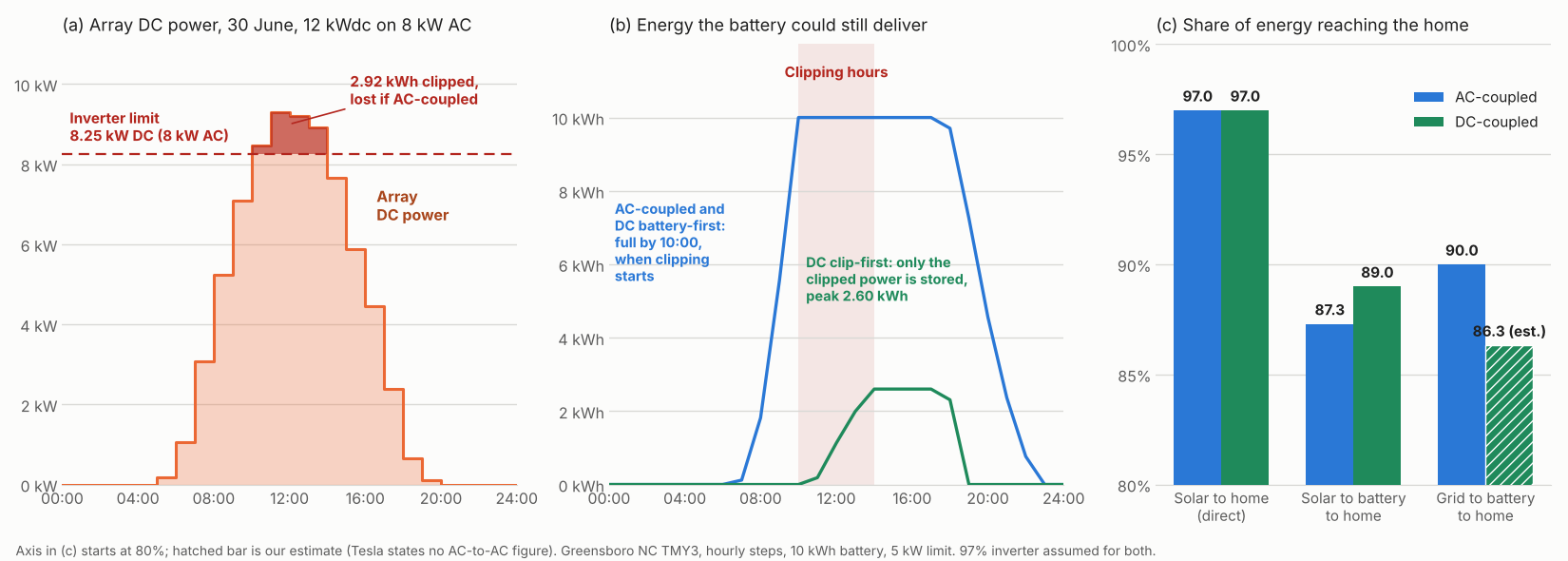
Figure 1. (Panel c starts its axis at 80%, the hatched bar is our estimate.) On a clear June day the battery is full by 10:00, when clipping starts. A DC-coupled battery then recovers nothing unless it is kept free for clipped power.
What do the datasheets say about efficiency?
Each sheet states one efficiency figure on its own basis. Read the footnote before comparing. The three figures below are not like for like.
| Product and variant | Layout the sheet states | Efficiency as printed | Sheet |
|---|---|---|---|
| Tesla Powerwall 3, North America, model 1707000-xx-y | Six MPPT solar inputs. The sheet does not label Powerwall 3 itself as AC- or DC-coupled. | "Solar to Battery to Home/Grid Efficiency 89%". Footnotes: typical solar shifting use case, 25°C, beginning of life, 3.3 kW. No separate round trip. | 2024, no revision date |
| Tesla Powerwall 2 AC, North America | "Fully-integrated AC battery system". | 90% round trip, "AC to battery to AC, at beginning of life", 25°C, 3.3 kW. | Marker NA - BACKUP - 2023-06-21 |
| Enphase IQ Battery 5P, IQBATTERY-5P-1P-NA | "All-in-one AC-coupled system". | 90% AC round trip, "AC to the battery to AC at 50% power rating". | DSH-00010-8.0, 27 August 2024 |
| Enphase IQ8+, IQ8PLUS-72-2-US | Microinverter. | CEC weighted efficiency 97%. Peak 97.7%. | DSH-00378-5.0, 13 July 2026 |
| SolarEdge Home Battery 400V, BAT-10K1P (EU) | "DC coupled battery". | 94.5% "Peak Roundtrip Efficiency". The sheet does not say which side it is measured on. | DS-000164-EU, 9 July 2024 |
The SolarEdge figure is a peak value for the EU model, so we leave it out of the maths. Tesla’s design guide calls solar connected directly to Powerwall 3 DC-coupled and says it is "strongly preferred", with higher efficiency as a reason. The sheet itself does not label the product, so our example uses its 89% as a stand-in.
Worked example: one clear day and one typical year
We modelled a 12 kWdc array on an 8 kW AC limit (ratio 1.5) with pvlib. Both layouts ran through the same day and year. We used the efficiencies above.
| Input | Value | Source or status |
|---|---|---|
| Site and weather | Greensboro NC, NREL TMY3 station 723170, hourly | pvlib sample file. The stated day is 30 June, the clearest June day in the file. |
| Array and inverter | 12 kWdc south at 25°. 8 kW AC. DC input limit 8.25 kW. 14% system loss | Assumed. Array output peaks at 9.31 kW and exceeds the limit in 4 hours. |
| Inverter efficiency | 97% for both layouts | IQ8+ CEC weighted value, used as a stand-in. |
| AC-coupled battery | 90% round trip, split equally | IQ Battery 5P and Powerwall 2 AC sheets. |
| DC-coupled battery | 89% solar to battery to home. 0.97 on discharge, 0.9175 on charge | Powerwall 3 solar-path figure used as a stand-in, since the sheet does not label it AC or DC. The split is our assumption. |
| Battery size and power | 10 kWh delivered to the home. 5 kW each way | Assumed, not a product. |
| Home load | 29.4 kWh a day, evening peak | Invented, repeated daily. |
| Rules | Load first, then battery, then export. Battery starts empty. | Model rule. "Clipped-only" charges the battery only from power the inverter cannot pass. |
Table 1 gives the stated day. Array output is 73.70 kWh. All figures are in kWh.
| Table 1. Stated day | AC-coupled | DC-coupled, battery first | DC-coupled, clipped-only |
|---|---|---|---|
| Clipped (lost) | 2.92 | 2.92 | 0.00 |
| Direct to the home | 14.64 | 14.64 | 14.64 |
| Battery to the home | 10.00 | 10.00 | 2.60 |
| Exported | 42.90 | 43.11 | 54.01 |
| Imported from the grid | 4.76 | 4.76 | 12.16 |
With battery-first charging the battery fills before clipping starts. So the DC layout clips the same 2.92 kWh. Charging only from clipped power saves all of it. But the battery then supplies 2.60 kWh to the home instead of 10.00. The rule matters more than the layout.
Grid charging reverses the DC edge. Table 2 needs no sun. It charges the battery from the grid overnight. It discharges the battery from 17:00 to 22:00, when the load is 12.3 kWh.
| Table 2. Grid-charge path | AC-coupled | DC-coupled (estimate) |
|---|---|---|
| End to end | 90.0% | 86.3% |
| Grid kWh to deliver 10 kWh | 11.11 | 11.58 |
The DC figure is the 89% solar path times the 97% inverter, because grid power must be rectified first. With a 96% to 98% inverter it is 85.4% to 87.2%, or 11.47 to 11.70 grid kWh. Tesla publishes no AC-to-AC figure. So treat 86.3% as our estimate.
Clipping rises fast with the ratio, and the charge rule decides how much a DC battery recovers. Over the typical year the array makes 17,577 kWh DC. Table 3 shows clipped energy in kWh a year.
| Table 3. Ratio and battery | AC-coupled | DC, battery first | DC, clipped-only |
|---|---|---|---|
| 1.3, 10 kWh | 22 | 22 | 0 |
| 1.5, 10 kWh | 313 | 291 | 0 |
| 1.7, 10 kWh | 956 | 833 | 6 |
| 1.5, 5 kWh | 313 | 313 | 10 |
| 1.5, 13.5 kWh | 313 | 245 | 0 |
Hourly steps hide short peaks, so clipping is probably low. At 1.5 and 10 kWh the DC layout delivers 94 kWh more useful AC energy a year (0.58%). That is with battery-first charging. Useful means direct use, battery output and export. A parity run with equal efficiency gives 23 kWh of that from recovered clipping. The other 71 kWh comes from the 89% against 87.3% gap.
AC vs DC coupling calculator
Enter 24 hourly values for array DC power and load. The button reproduces Table 1.
What changes for backup and retrofit?
AC coupling suits adding a battery to existing solar. DC coupling suits new systems. Tesla cites outage energy management as a reason to prefer it. Our backup power and critical loads page has load lists and surge checks.
- Retrofit: PV*SOL’s help says AC coupling is "easy to retrofit". DC generator coupling is simple to retrofit. DC intermediate coupling "cannot be easily integrated". An NREL cost study says DC coupling means replacing the existing PV inverter with a bidirectional one. Tesla says Powerwall 3 meets AC-coupled solar "most commonly" on a site with existing AC solar.
- Outage: Tesla says that with more PV than the battery can absorb, the system will "frequency shift" to cut PV power. Production may shut down completely. Tesla lists "low energy management during a grid outage" as a reason to prefer DC coupling.
- Sizing: an AC-coupled system needs a PV inverter and a battery inverter. Each has its own rating. A DC-coupled system shares one inverter. See battery storage design.
How solar software handles AC and DC coupling
PV*SOL and Aurora name the coupling types in their help and give no efficiency or clipping figures. SAM’s coupling detail comes from NREL material, and PVsyst never uses the terms. We rate "Yes" only where the company’s own pages say the tool models it.
| Software | Models AC and DC coupling? | What the company documents | Limits |
|---|---|---|---|
| PV*SOL premium | Partly | Help names AC coupling, DC generator coupling and DC intermediate coupling. One coupling type per system. | No efficiency or clipping figures. Pages undated, read October 2026. |
| Aurora Solar | Partly | Help article "Storage system types and outputs" defines AC-coupled and DC-coupled storage. | No figures or clipping. Shows 17 August 2026. Unclear if that is the update date. |
| SAM | Partly | NREL’s May 2025 PySAM workshop slides list "Detailed PV + Battery" as DC or AC connected. | Source is NREL material, not SAM’s own help. Clipping recovery not addressed. |
| PVsyst | Not stated | The "Grid systems with storage" help page never uses the terms AC-coupled or DC-coupled. It models charging and discharging with generic converters. | One page read, undated, October 2026. It mentions version 8.0.17. |
Partly: the company names or models the coupling types but gives no efficiency or clipping figures. Not stated: the page we cite does not use the terms. For tools that model batteries and coupling inside a design, see the best solar battery storage design software list.
Common mistakes with AC and DC coupling
FAQs
Is DC coupling more efficient than AC coupling?
Yes for stored solar in our example: 89.0% against 87.3%, with the same 97% IQ8+ figure applied to both stacks. The gain reverses for grid charging, where our estimate puts DC at 86.3% against 90.0% for AC. The gap is small either way.
Can an AC-coupled battery store clipped solar?
No. The PV inverter caps output before power reaches the AC bus. So the clipped energy is lost. A DC-coupled battery can take that power. It needs room, and the charge rule must allow it.
Which layout is better for a retrofit?
AC coupling usually is, because the existing PV inverter stays in place. A DC-coupled retrofit usually means new DC-side hardware, and an NLR (formerly NREL) cost study says it replaces the existing PV inverter with a bidirectional one. Confirm the exact hardware in the product’s design guide before you quote.
Why do round-trip figures differ between datasheets?
Each sheet sets its own boundary and test power. Powerwall 3 quotes 89% at 3.3 kW from solar. The IQ Battery 5P quotes 90% AC to AC at 50% power. They are not like for like.
Related terms
- Battery storage design: choosing battery kWh and kW for a goal.
- Inverter clipping: energy lost above the inverter’s AC limit.
- DC/AC ratio: array kWp divided by inverter kW.
- Self-consumption: solar used on site.
- Backup power and critical loads: what a battery runs in an outage.
- AC vs DC power: the two kinds of current in a PV system and where each sits.
Next step: if you are quoting a battery retrofit, compare how each tool models the layout in the best solar battery storage design software.
Sources
- Tesla Powerwall 3 datasheet, North America, 2024 (checked October 2026).
- Tesla Powerwall 2 AC datasheet, North America (checked October 2026).
- Tesla Powerwall 3 design guide, AC-coupled sizing, modified 11 September 2025 (checked October 2026).
- Enphase IQ Battery 5P data sheet (checked October 2026).
- Enphase IQ8 series data sheet (checked October 2026).
- SolarEdge Home Battery 400V datasheet, distributor copy (checked October 2026).
- NREL, DC-coupled PV+battery hybrids, April 2021 (checked October 2026).
- NREL, PV and storage cost benchmark, Q1 2020, January 2021 (checked October 2026).
- Aurora Solar, storage system types and outputs (checked October 2026).
- PV*SOL help, battery systems and battery system (checked October 2026).
- PVsyst help, grid systems with storage (checked October 2026).
- NREL, batteries in SAM and PySAM, 15 May 2025 (checked October 2026).
- NREL, DC-connected storage in SAM, preprint, 2018 (checked October 2026).
- NREL TMY3 file, station 723170, from the pvlib sample data (checked October 2026).
Last updated 30 October 2026. Next scheduled review: 30 January 2027.