Key takeaways
- Modules, strings and DC isolators carry DC. The AC breaker, meter and grid carry AC. On a string layout the inverter is the boundary.
- A microinverter layout moves the boundary to the module, so the roof wiring is AC. See microinverter.
- A "240 V" AC figure is an rms value. Its peak is 1.414 times higher: 339.4 V at 240 V and 325.3 V at 230 V.
- The same power gives different currents. In our invented example, 5,000 W of AC at 240 V is 20.8 A. The DC side at 350 V carries 14.7 A.
- Of six tools, three label DC and AC results separately, two label only part, and Aurora’s page shows no label.
To size an inverter against an array and see DC and AC results, see the best solar design software.
AC vs DC power at a glance
AC reverses its flow in regular cycles. DC does not. A PV array makes DC, the grid uses AC, and an inverter sits between them.
| Item | Detail |
|---|---|
| Shape | DC holds one voltage and direction. AC follows a sine wave. One cycle lasts 16.7 ms at 60 Hz and 20 ms at 50 Hz. |
| Datasheet rows | DC side: "Max. DC voltage" and "MPP voltage range". AC side: nominal AC power, AC voltage and grid frequency (SMA sheets). |
| Where it sits | DC runs from the modules to the inverter input. AC runs from the inverter output to the grid. |
| Standard or rule | Your datasheet and local code decide. |
| In software | Tools label DC and AC capacities, results and losses. See the software table below. |
Why does the AC and DC split matter for installers?
Each side has its own voltage, current, protection and labels. Mix them up and you size a cable from the wrong current. Using the 20.8 A AC figure when the DC string carries 14.7 A (example) gives the wrong cable and protection.
On the DC side, string voltage sets the limits: see Voc and Isc. DC faults are harder to stop. Sandia’s 2016 draft arc-fault primer says a DC fault has no natural current zero. So a DC fault is harder for a fuse to interrupt, and the circuit’s L/R time constant matters. This is why DC isolators and arc-fault protection have their own pages.
On the AC side, breakers and cables follow the AC current and the grid operator’s rules. See overcurrent protection and wire and conductor sizing. The size you quote also depends on the side: see wattage, kW and kWp.
Where do DC and AC sit in a PV system?
Power is DC from the module to the inverter input. It is AC from the inverter output to the grid. The US Department of Energy describes an inverter as a device that "converts direct current (DC) electricity, which is what a solar panel generates" into the alternating current the grid uses.
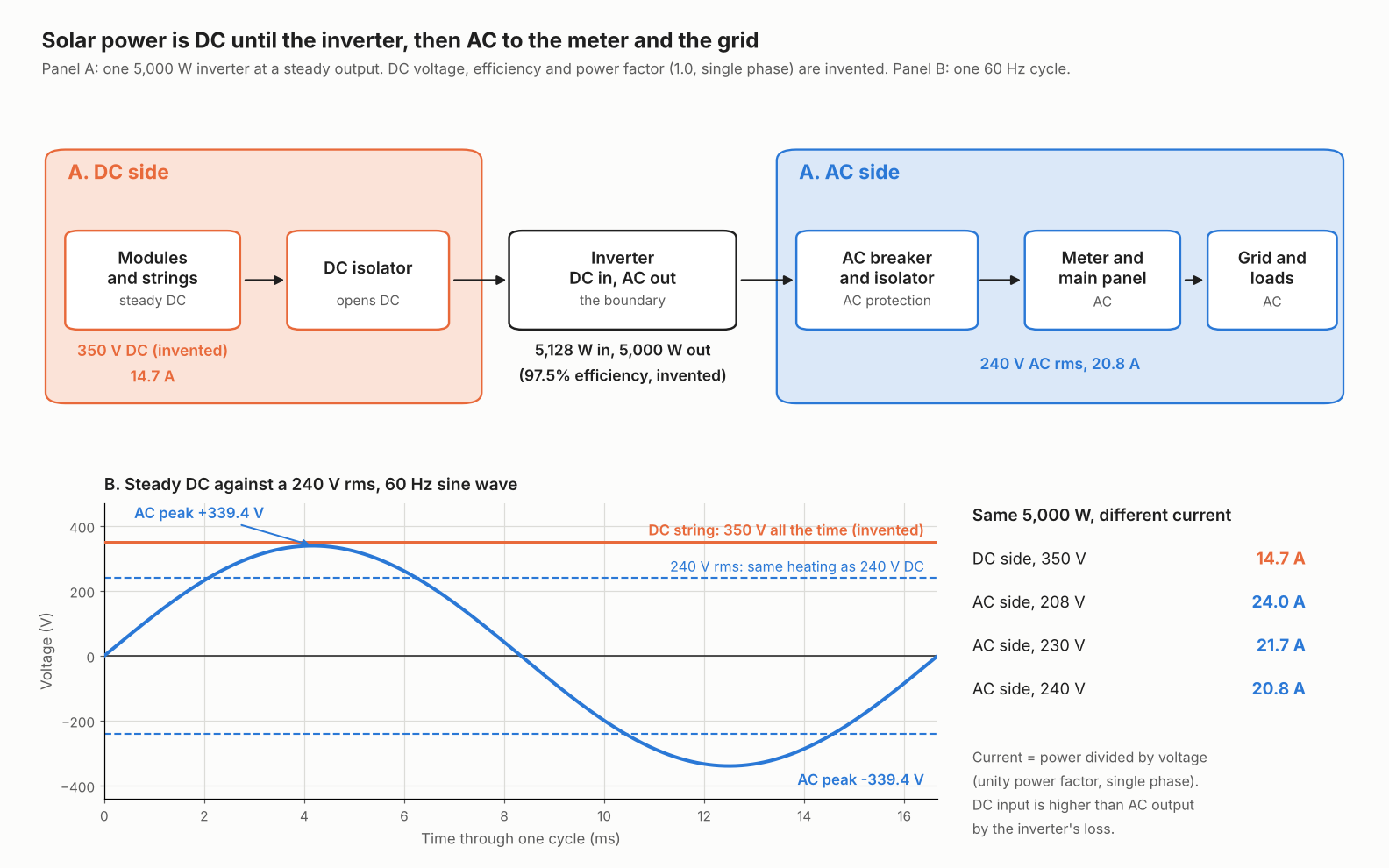
Figure 1. In our example the DC string holds 350 V and carries 14.7 A, while the 240 V rms AC side swings to plus and minus 339.4 V and carries 20.8 A for the same 5,000 W.
The boundary moves with the layout. Each row below points to the page that owns the detail.
| Layout | Where DC ends | What runs on the roof |
|---|---|---|
| String inverter (page) | At the inverter input. | DC string cable. |
| Power optimiser (page) | At the inverter. Each optimiser is a DC-DC converter. | DC. |
| Microinverter (page) | At the module, or at a pair of modules. | AC branch circuit. |
| Hybrid inverter (page) | At the inverter, which takes DC from the panels and the battery. | DC. |
| AC-coupled battery (page) | The battery sits after the PV inverter, on the AC side. | Depends on the PV layout. |
How do you convert between AC and DC figures?
Convert power with the inverter’s efficiency. Then find each current from its own voltage. Voltage and current do not pass across the inverter one for one.
- Read the nominal AC power and the AC voltage on the inverter datasheet.
- Divide the AC power by the efficiency to get the DC input power. Use the datasheet efficiency, or state your assumption.
- Divide the DC power by the DC operating voltage to get the DC current. Use the working voltage, not a label: see nominal voltage.
- For single-phase AC, divide the AC power by the AC voltage times the power factor. For three-phase, divide by 1.732 times the line-to-line voltage times the power factor.
- Multiply the AC rms voltage by 1.414 for its peak. Analog Devices gives Vpk = √2 × VRMS. It says the RMS value equals the DC voltage that gives the same heating effect.
Worked example: one 5,000 W inverter on two datasheets
The same SMA 5 kW inverter family has a US and an EU sheet. Table 1 reads the DC-side and AC-side rows. Table 2 then runs the sums at an example 350 V DC string.
The 350 V DC string, the 97.5% efficiency and the unity power factor in our example are example. The 5,000 W rating and the voltage windows come from the SMA datasheets in the Sources. Peak voltages, currents and cycle times are our own arithmetic. This page is a design aid, not a datasheet.
Table 1. DC-side and AC-side rows on two SMA sheets.
| Row | US: SB5.0-US | EU: SB5.0-1AV-41 |
|---|---|---|
| Max. DC input voltage | 600 V | 600 V |
| MPP voltage range | 220 to 480 V | 175 to 500 V |
| Nominal AC power | 5000 W | 5000 W at 230 V, 50 Hz |
| AC voltage | 208 V or 240 V (nominal) | 230 V (rated grid voltage) |
| Grid frequency | 60 Hz (the row also lists 50 Hz) | 50 Hz (rated) |
Table 2. The same 5,000 W of AC output at an example 350 V DC string. The assumptions are:
- The efficiency is example. 97.5% is the US sheet’s peak at 240 V. The EU peak is 97.0% and its weighted efficiency is lower, so the 128 W loss is a best case.
- The 350 V string and unity power factor are example. 350 V sits inside both MPP ranges.
- AC rows are treated as single-phase. US 240 V is two 120 V legs.
| Side | Voltage | Calculation | Current | Peak voltage |
|---|---|---|---|---|
| DC input | 350 V | 5,000 ÷ 0.975 = 5,128 W. 5,128 ÷ 350 | 14.7 A | Steady 350 V |
| AC, US 208 V | 208 V rms | 5,000 ÷ 208 | 24.0 A | 294.2 V |
| AC, EU 230 V | 230 V rms | 5,000 ÷ 230 | 21.7 A | 325.3 V |
| AC, US 240 V | 240 V rms | 5,000 ÷ 240 | 20.8 A | 339.4 V |
The DC input power is 128 W higher than the AC output. That gap is the inverter’s loss at that efficiency. Yet the DC current is lower, because the DC voltage is higher. At 240 V the AC current is 1.42 times the DC current. The EU sheet’s footnote gives 4,600 W for this model under VDE-AR-N 4105, or 20.0 A at 230 V. A three-phase 400 V supply (example, line to line) would carry 7.2 A per phase.
These totals are not input limits. Current per MPPT input, string voltage and breaker size are separate checks: see string sizing and the maker’s datasheet.
AC and DC current calculator
Enter the AC output, the efficiency, the DC voltage and the AC voltage. The calculator returns the DC input power, both currents and the AC peak voltage. Its 240 V preset reproduces Table 2.
How solar software handles AC and DC power
PVWatts, pvlib and HelioScope label DC and AC results or losses separately. SAM and OpenSolar label only part, and Aurora’s tool page has no label. The table covers result and loss labels only, as read in October 2026. It leaves out the size input: see the wattage page for that.
| Software | Labels DC and AC separately? | Wording on the page read |
|---|---|---|
| PVWatts (NLR, formerly NREL) | Yes | V8 API (version 8.0.0 in its example response) outputs "Monthly DC array output" (kWhdc) and "Monthly AC system output" (kWhac). |
| SAM | Partly | Names "Total AC capacity" in kWac and says to "specify any DC or AC losses" as an input. No DC or AC results page. |
| pvlib | Yes | "ModelChainResult includes the following attributes: solar_position, effective_irradiance, dc, ac." |
| HelioScope | Yes | Loss rows "Optimal DC Output" (DC wiring losses) and "Energy to Grid" (AC losses). |
| OpenSolar | Partly | Labels the "DC/AC ratios" and gives warning bands. No DC or AC result or loss label. |
| Aurora Solar | Not stated | The help page names DC optimizers and has no DC or AC result label. Aurora’s AC vs DC article explains terms, not a tool label. |
Not stated means the page we read shows no DC or AC result label. Partly means only some of the DC or AC results carry a label.
Common mistakes with AC and DC power
FAQs
Do solar panels produce AC or DC?
Solar modules produce DC. The Department of Energy page describes an inverter as the device that converts that DC into the AC the grid uses. A so-called AC panel is a DC module with a microinverter added, so the conversion happens at the panel.
Why does a 240 V supply peak at 339 V?
The 240 V is an rms value, the DC voltage that would give the same heating. A sine wave peaks 1.414 times higher, so 240 V rms reaches 339.4 V. A 230 V supply reaches 325.3 V.
Is kWp AC or DC?
kWp is a DC figure, the module rating at test conditions. kWac is the inverter’s AC rating. The two sizes usually differ, so label which one you quote. See wattage, kW and kWp and DC/AC ratio.
Why do inverter datasheets list 50 Hz or 60 Hz?
Frequency belongs to AC. So the AC side of a sheet lists it, and the DC side does not. The SMA US sheet’s grid-frequency row lists 60 Hz and 50 Hz. The EU manual prints a rated grid frequency of 50 Hz. Check the variant for your market.
Related terms
- Inverter: the device that converts DC to AC and ties the system to the grid.
- Wattage, kW and kWp: DC and AC sizes and which to quote.
- Nominal voltage: the label voltage, not the working voltage.
- DC disconnect (isolator): the switch that opens the DC circuit.
Next step: take your inverter datasheet, find the DC and AC rows from Table 1, and check that your design tool reports both before you quote.
Sources
- Energy: US Department of Energy, Solar Integration: Inverters and Grid Services Basics (no date printed, replaces a dead energy.gov/node/1758071 link, checked November 2026). Analog Devices, VRMS glossary (no date printed, could not be re-fetched this pass, checked October 2026).
- Faults: Sandia National Laboratories, Arc-Fault Primer (draft), OSTI 1813682 (draft, title page dated December 2016, SAND2017-1019, re-checked 30 October 2026).
- Datasheets: SMA Sunny Boy 3.0 to 7.7-US datasheet, footer code SB3.0-7.7-US-DUS170619 (distributor copy, no date). SMA online manual, Sunny Boy 5.0 / 6.0 (SBxx-1AV-41), technical data (no date or revision on the page).
- Tools (checked October 2026): PVWatts V8 API. SAM help, PV System Design. pvlib, The ModelChain (moved from its old URL, checked November 2026). HelioScope, Loss Factors. OpenSolar, Inverter sizing and stringing recommendations. Aurora, Designing with Aurora configuration checklist. Aurora, What’s the difference between AC and DC in solar?
Last updated 30 October 2026. Next scheduled review: 30 January 2027.