Key takeaways
- Bifacial gain is about bifaciality × rear/front irradiation, minus rear losses. At 0.70 and a 9.8% rear share, that is 6.8% before losses.
- IEA PVPS Task 13 (2021) found that 13 modelling teams predicted gains up to a factor of two apart.
- In our pvlib run, two 2D models gave 9.8% and 13.6% rear share for the same row, a 1.4 times spread.
- In ANTS-2D at 2.0 m, rear irradiation grew 2.8 times as albedo rose from 0.20 to 0.65 (grass to snow).
- Only ANTS-2D reacted to row height, rising from 7.1% at 1.2 m to 12.0% at 3.0 m.
To run a bifacial gain simulation in software, see the best solar simulation software.
Bifacial modelling at a glance
Bifacial modelling turns site layout and ground reflectance into a rear-side energy gain. Then it cuts that gain for rear losses.
| Item | Detail |
|---|---|
| Formula | Gain ≈ bifaciality × (rear irradiation ÷ front irradiation) × (1 − extra rear losses) |
| Inputs | Albedo, row height, tilt, ground coverage ratio (GCR), bifaciality factor, rear mismatch and structure shading |
| Published range | Trackers over albedo 0.2 to 0.3: under 10% (IEA PVPS, 2021). Modelled 4% to 15% for 1-axis trackers, global average about 9% (NREL, now NLR, preprint) |
| Standard | No single standard covers the calculation. IEA PVPS Task 13 says standard test cases help check models |
| In software | Yield tools use two-dimensional view-factor models. Research tools add ray tracing |
Why bifacial modelling matters for installers
The gain you model sets the yield you promise, and published models disagree. Assume too much rear gain and the array can miss its target at commissioning. Assume too little and you can lose the bid on price.
The spread is real. In the IEA PVPS Task 13 2021 comparison, 13 research and commercial teams predicted gains. Some differed by a factor of two. In our run below, two models in one library differ by 1.4 times for one row.
Take a 500 kWp array with a front-side yield of 1,500 kWh/kWp (an assumed figure). Our two models are 2.7 points apart in gain at the bifaciality used in the first takeaway. That gap is about 20,200 kWh a year. See energy yield simulation for how the result feeds a bankable estimate.
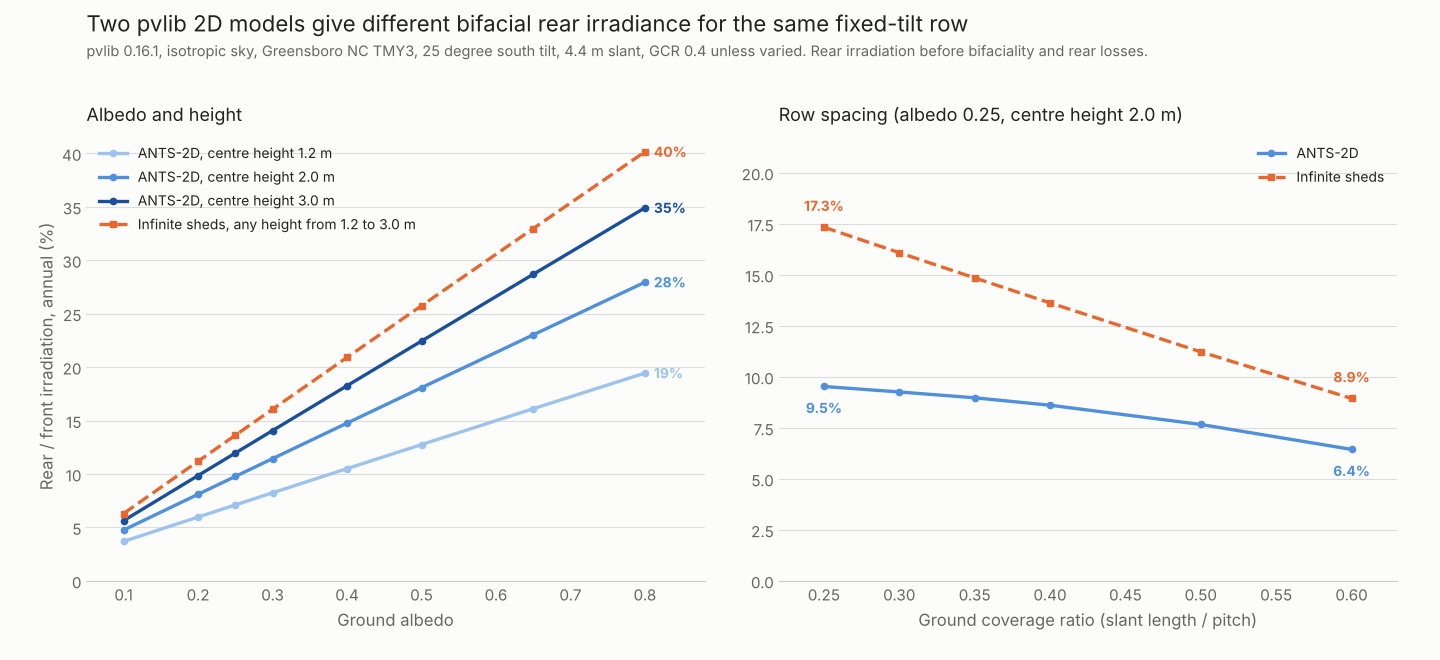
Figure 1. For one fixed-tilt row, pvlib’s two 2D models differ by 1.4 times in rear irradiance (9.8% against 13.6% of front irradiation). Both rise with albedo and fall as rows close up.
How does bifacial modelling work?
A model finds the light that reaches the rear face from the ground and the sky. It scales that light by the bifaciality factor. Then it takes off rear losses.
- Start with front-side plane-of-array irradiance from weather data (see weather and solar resource data).
- Estimate the light the ground reflects. That is albedo times ground irradiance, minus the row shadows.
- Work out how much of that light the rear face sees. A view-factor model uses geometry. A ray tracer follows single rays.
- Add the sky diffuse light that reaches the rear. Multiply rear irradiance by the bifaciality factor, which is rear efficiency divided by front efficiency.
- Subtract rear losses. These are mismatch across the module, shade from the racking, and edge effects (see mismatch loss).
View factor or ray tracing? IEA PVPS names these two model types. View-factor models cost less to run. But they usually assume rows of endless length. For detailed work, the report advises ray tracing, even though it needs more computing power.
A Sandia deck adds that a 2D view-factor model runs in seconds. It suits large, even arrays. The deck calls 3D ray tracing slow. But it can include racking and ballast.
What gain ranges do published sources report?
Published tracker gains are mostly under 15%, and they rise with albedo. Each figure below says if it was measured or modelled.
- IEA PVPS Task 13, April 2021: trackers over albedo 0.2 to 0.3 gain less than 10%, and more over snow. Gain rises with albedo, diffuse fraction, array height, row spacing and module gaps. Edge effects dominate small research systems. A survey of 27 test systems found no one factor that tracked gain well. The summary gives no numeric fixed-tilt range.
- NREL preprint (WCPEC-7, June 2018, revised July 2019): modelled gains of 4% to 15% for 1-axis trackers, with a global average of about 9%. Those global runs assumed 100% bifaciality and no extra bifacial losses. Treat them as an upper-end estimate. Sandia in Albuquerque measured 11% over seven months (configuration-factor model: 12.3%). Oregon measured a corrected 7.0% (model: 6.7%).
- NREL single-axis tracker geometry, same preprint: a rear/front irradiance ratio of 8% to 9% in Albuquerque and 9.5% to 11% in Seattle. Albedo was 0.25 and normalised height was 0.75.
- Marion et al., 2018: at 21% albedo, the centre module of a large array made up to 7% less energy than a single module. Large systems can have a best tilt up to 20 degrees higher than a single module.
Albedo values come from pvlib’s table: grass 0.20, concrete 0.30, sand 0.40, snow 0.65, fresh snow 0.75 and asphalt 0.12.
Bifaciality depends on cell type. The Sandia deck gives about 90% for n-type and heterojunction cells. It gives 60% to 75% for PERC. A 2025 paper in MDPI’s Solar (Malgaroli et al.) gives 65% to 75% for PERC and above 90% for heterojunction. It reports a different range for IBC, so read the module datasheet. The pvlib infinite sheds function uses 0.8 by default. See bifacial module for hardware.
Worked example: albedo, height and row spacing in pvlib
We ran pvlib 0.16.1 on one fixed-tilt row. We changed albedo, height, spacing and bifaciality. Read the results as a range, because the two models disagree.
Setup.
- Site: Greensboro, North Carolina, from the TMY3 file bundled with pvlib (1,566 kWh/m² global horizontal).
- Row: south-facing, 25 degree tilt, 4.4 m slant (two 2.2 m modules, assumed), GCR 0.4 so 11 m pitch. Height is the row centre, as pvlib sets it.
- Models:
bifacial.infinite_sheds.get_irradianceandbifacial.ants2d.get_irradiance. - Sky model: both use an isotropic sky, so the sky model is the same. Front irradiation was 1,678 kWh/m² in both.
- Rear losses: the infinite sheds figures use poa_back. That leaves out pvlib’s default 2% rear structure shading, which only enters poa_global. So both models show results before rear losses.
Rear share rises with albedo in every column, and with height only in ANTS-2D.
Table 1: Annual rear irradiation as a share of front irradiation.
| Albedo | ANTS-2D, 1.2 m (%) | ANTS-2D, 2.0 m (%) | ANTS-2D, 3.0 m (%) | Infinite sheds, any height (%) |
|---|---|---|---|---|
| 0.20 (grass) | 6.0 | 8.1 | 9.9 | 11.2 |
| 0.25 (base case) | 7.1 | 9.8 | 12.0 | 13.6 |
| 0.30 (concrete) | 8.2 | 11.4 | 14.1 | 16.1 |
| 0.40 (sand) | 10.5 | 14.8 | 18.3 | 20.9 |
| 0.65 (snow) | 16.1 | 23.0 | 28.7 | 33.0 |
Quote this row as a range of 9.8% to 13.6% rear share, not one number. The two models differ by 1.4 times, and only ANTS-2D reacts to height. At albedo 0.25 it goes from 7.1% at 1.2 m to 12.0% at 3.0 m. Infinite sheds gave the same result at every height from 1.2 m to 3.0 m, and a check up to 10 m also showed no change.
This is how the model is built, not an error. pvlib’s documentation says infinite sheds assumes endless rows and an isotropic sky. It does not explain the height result. In our own tests the integrated sky view of the ground between rows was the same at every height (checked at 1.2 to 10 m). ANTS-2D splits the ground into segments (pvlib’s ground_segments setting), so it does respond to height. Part of the 1.4 times spread in Figure 1 therefore comes from how each model treats height, and your own tool may treat it differently again.
Row spacing acts the same way in both models. From GCR 0.25 to 0.60, ANTS-2D falls from 9.5% to 6.4%. Infinite sheds falls from 17.3% to 8.9%. NREL’s preprint also reports less rear gain at higher GCR. Tilt matters least. From 10 to 40 degrees, ANTS-2D stayed between 9.8% and 11.2%. See ground coverage ratio and row spacing and pitch.
Table 2 adds the module. It gives bifacial energy gain at albedo 0.25, 2.0 m and GCR 0.4, before and after 10% extra rear losses.
| Bifaciality | ANTS-2D gain (%) | Infinite sheds gain (%) | ANTS-2D, 10% losses (%) | Infinite sheds, 10% losses (%) |
|---|---|---|---|---|
| 0.65 | 6.3 | 8.9 | 5.7 | 8.0 |
| 0.70 | 6.8 | 9.5 | 6.2 | 8.6 |
| 0.80 | 7.8 | 10.9 | 7.0 | 9.8 |
| 0.90 | 8.8 | 12.3 | 7.9 | 11.0 |
At 0.70, the gain is 6.8% or 9.5% before extra losses. The 10% figure is the default rear mismatch in PVsyst and HelioScope. Here it hits the rear gain only.
The results pass the usual checks. At albedo 0 the rear share fell to 0.9% (ANTS-2D) and 1.4% (infinite sheds). That is sky light only. Rear ground-reflected light in infinite sheds (205 kWh/m²) stayed below the 373 kWh/m² upper bound for unobstructed ground. ANTS-2D with a Perez sky gave 8.6% at the base case. Infinite sheds with Hay-Davies gave 12.8%. No measured data for this site was used, so neither model is validated here.
Bifacial gain calculator
Open the bifacial gain calculator below to turn a rear/front ratio into gain, energy and value. Fill in a ratio from Table 1 or enter your own simulation result.
How solar software handles bifacial modelling
Of the six tools we read, PVsyst, HelioScope, SAM, pvlib python and bifacial_radiance model bifacial gain, and PVcase Yield does so in part. We compared the model type, how albedo is entered, and whether rear losses and edge effects are modelled or left to you. Ratings follow each company’s own pages, as of October 2026.
| Software | Models bifacial gain? | Method |
|---|---|---|
| PVsyst | Yes | 2D cross-section: unlimited sheds or unlimited trackers |
| HelioScope | Yes | 2D view factor |
| SAM | Yes | Configuration-factor model, infinite-length rows |
| PVcase Yield | Partly | Not stated |
| pvlib python | Yes | Infinite sheds, ANTS-2D, pvfactors |
| bifacial_radiance | Yes | Ray tracing with RADIANCE |
Not stated means the company page we cite does not say. Partly means the page lists bifacial modelling but not how it works. Inputs, limits and sources:
- PVsyst. Albedo constant, monthly or time series. Height entered by hand. Rear mismatch default 10%, structure shading 5%. Edge effects ignored. No east-west fixed tilt. (Source: PVsyst help, Bifacial Systems and procedure pages)
- HelioScope. Fixed tilt and single-axis trackers only. Monthly albedo. You enter rear mismatch (default 10%) and rear shading (default 5%) by hand. (Source: HelioScope help, What are bifacial modules (September 2026), company-reported Accuracy Study (September 2025))
- SAM. The slides list ground clearance, bifaciality and transmission fraction as inputs. GCR, tilt and albedo appear in the sensitivity runs. They call edge effects insignificant beyond about a dozen modules per row. (Source: SAM bifacial webinar slides, August 2018, no current help page is cited)
- PVcase Yield. The pricing page lists "bifacial system modeling" in the Essentials and Professional plans. Method and inputs are not stated on the pages read. (Source: PVcase Yield pricing page)
- pvlib python. Open-source library, not a design tool. Infinite sheds assumes endless rows on level ground and an isotropic sky. (Source: pvlib 0.16.1 documentation)
- bifacial_radiance. NREL-supported Python library built from weather, ground, module and scene objects. It handles complex scenes and tracker shading, but it needs scripting. (Source: bifacial_radiance docs, NREL preprint (2018))
For a wider comparison, read the best solar simulation software and best open-source solar design software lists.
Common mistakes with bifacial modelling
FAQs
How much extra energy do bifacial panels make?
IEA PVPS Task 13 says trackers over typical ground (albedo 0.2 to 0.3) gain less than 10%. Gain is higher over snow. An NREL paper on single-axis tracking reports 11% measured at Sandia in Albuquerque and 7.0% in Oregon.
What albedo should I use for bifacial modelling?
Use the ground under the array, not a site average. The pvlib table gives grass 0.20, concrete 0.30 and snow 0.65. Use monthly values if the ground changes with the seasons. Your tool’s own default may differ.
Is bifacial gain the same as the rear irradiance share?
No. Multiply the rear share by the bifaciality factor, then subtract rear losses. In Table 2, a 9.8% share became 6.8% gain at 0.70, and 6.2% after 10% rear losses.
Should I use view factor or ray tracing?
For large, regular arrays, 2D view-factor models run in seconds. PVsyst, HelioScope and SAM use that kind of model. Use ray tracing for racking, ballast, edges or odd layouts. IEA PVPS advises it for detailed work.
Does wider row spacing increase bifacial gain?
Yes, in both models here. From GCR 0.60 to 0.25, the rear share rose from 6.4% to 9.5% in ANTS-2D. In infinite sheds it rose from 8.9% to 17.3%.
Related terms
- Bifacial module: a module that collects light on both faces.
- Albedo: the share of sunlight the ground reflects.
- Ground coverage ratio: row slant length divided by pitch.
- Single-axis tracker: a tracker that rotates modules about one axis.
Next step: test your own rear/front ratio in a tool that states its rear-loss inputs, such as PVsyst, HelioScope or SAM. Compare more in the best solar simulation software list.
Sources
- IEA PVPS T13-14:2021, Bifacial Photovoltaic Modules and Systems, executive summary (checked October 2026).
- Ayala Pelaez et al., Model and Validation of Single-Axis Tracking with Bifacial Photovoltaics, NREL/CP-5K00-72039 (checked October 2026).
- Marion et al., IEEE Journal of Photovoltaics 8(3), 2018, abstract (checked October 2026).
- Stein et al., Comparison of modeling methods and tools for bifacial PV performance, Sandia slides. Undated. The date of 2017 is inferred, not stated (checked October 2026).
- pvlib get_ground_diffuse, which points to the albedo table in pvlib’s source (checked October 2026).
- pvlib python 0.16.1, bifacial reference and infinite_sheds.get_irradiance (checked October 2026).
- PVsyst help, Bifacial Systems and procedure (checked October 2026).
- HelioScope help, What are bifacial modules? and Bifacial Modeling Accuracy Study (checked October 2026).
- SAM webinar, Preview of SAM’s New Model for Bifacial PV Modules, 2018 (checked October 2026).
- Malgaroli et al., Quantification of Yield Gain from Bifacial PV Modules in Multi-Megawatt Plants with Sun-Tracking Systems, MDPI Solar 5(4), 49, 2025 (checked 30 October 2026).
- PVcase Yield pricing plans and bifacial_radiance documentation (checked October 2026).
Last updated 30 October 2026. Next scheduled review: 30 January 2027.