Key takeaways
- Bifaciality is rear power divided by front power, both at STC (Canadian Solar sheet wording). One sheet prints 70% and another 80%, each with a tolerance of 5 points.
- A datasheet gain column is front Pmax × (1 + gain): a 635 W module reads 667, 699 and 762 W at 5%, 10% and 20%.
- Our simplification is gain = bifaciality × rear/front irradiance. At 70%, the 10% column needs rear light of 14.29% of front light.
- The site sets real gain. NREL’s (now NLR) 75 kW tracker field measured a cumulative 7% (PERC) and 9% (SHJ) from July 2019 to April 2020.
- For an example 254 kWp array with rear light at 10% of front light, 70% gives 26,670 kWh a year. The 5 point tolerance moves that by 1,905 kWh either way.
To model rear gain for a bifacial array in software, see the best solar simulation software.
Bifacial module at a glance
A bifacial module adds rear power to its front rating. The datasheet gives the factor and a gain table, not the gain you will get on site.
| Item | Detail |
|---|---|
| Formula | Bifaciality = rear Pmax ÷ front Pmax at STC (Canadian Solar footnote). Simplified gain = bifaciality × rear/front irradiance (our assumption, see below). |
| Printed values | 70 ± 5% (Canadian Solar CS7N, V1.6C1_AU, June 2021) and 80 ± 5% (Jinko JKM560N, F3-EN). |
| Company range | Sandia and NREL slides (August 2018) chart company values of 65% to 95%. |
| Where it matters | Yield models, kWp convention (specific yield), DC/AC and clipping checks, row layout, tracker choice. |
| Standard | IEC TS 60904-1-2 covers I-V measurement of bifacial devices (VDE preview: edition 2.1, 2026-03). Neither sheet names it. |
| In software | PVsyst, HelioScope, SAM and PV*SOL document rear gain. Aurora Solar says it does not model it. |
Why bifacial modules matter for installers
The sheet factor does not set site gain, so choosing a module on the factor alone can give wrong energy figures. Rear gain adds kWh but no kWp, as proposals quote front-side kWp. See specific yield and performance ratio. It also raises peak DC power. See DC/AC ratio and inverter clipping.
Gain tables list power, not current, so the maker is the source for current and string limits. See Voc and Isc.
What do bifacial datasheets print?
Two things: a bifaciality factor with a tolerance, and a table of Pmax at set gain levels. The two sheets read here differ in label, gain levels and test words.
| Item | Canadian Solar CS7N-630 to 670MB-AG | Jinko JKM560-580N-72HL4-BDV |
|---|---|---|
| Footer "V1.6C1_AU", "June 2021" (Australia). A US print, "v2.0_F43M_J1_NA", "Dec. 2021", shows the same 70% and 635 W row. | English sheet in a distributor PDF. Code "JKM560-580N-72HL4-BDV-F3-EN", "©2022". No revision label printed. | |
| Front Pmax at STC | 635 W (CS7N-635MB-AG) | 560 W (JKM560N) |
| Factor | "Power Bifaciality" 70%, tolerance ± 5% | "Refer. Bifacial Factor" 80 ± 5% |
| Gain table | "Bifacial Gain" at 5%, 10%, 20%: 667, 699, 762 W | "BIFACIAL OUTPUT-REARSIDE POWER GAIN" at 5%, 15%, 25%: 588, 644, 700 W |
| Rear conditions | Not stated. A footnote defines the gain only. | Not stated. Only STC is printed: 1,000 W/m², AM 1.5, cell 25 °C. |
Not stated means the sheet prints no rear irradiance or rear-side test standard. The Canadian Solar footnote says two things.
- Gain: "The additional gain from the back side compared to the power of the front side at the standard test condition."
- Site: it "depends on mounting (structure, height, tilt angle etc.) and albedo of the ground."
The gain columns are arithmetic. 635 W × 1.05 = 666.75 W, printed as 667 W. The table says what power results from a set gain.
The Canadian Solar sheet defines the factor as "Power Bifaciality = Pmaxrear / Pmaxfront", both tested at STC. The IEC TS 60904-1-2 preview’s Table 1 caption names a "rear irradiance driven power gain yield, BiFi". Its contents list shows 6.2 bifaciality and 6.3 rear-irradiance power gain. This page cites that preview, not the standard text. See also standard test conditions and equipment datasheets.
What sets rear gain on site: height, GCR and trackers?
The layout sets the rear light. The module only turns it into power. Rear light is mostly ground-reflected, so albedo, height, row spacing and tracking all count.
| Factor | What the dated sources say | Source |
|---|---|---|
| Albedo and height | Canadian Solar’s footnote names both. Rear light is "mostly ground reflected" and not proportional to front light. | Canadian Solar sheet. Sandia and NREL slides, August 2018 |
| Row spacing (GCR) | One modelled SAM case (2 m clearance, 40° tilt) gave a rear-side gain of 12.2% at GCR 0.2 and 11.1% at 0.3. | NREL, 11 September 2018 |
| Trackers | A 75 kW tracker field measured a cumulative 7% (PERC) and 9% (SHJ), July 2019 to April 2020, and above 15% under snow in February. | DOE report, 15 July 2020. Sandia and NREL slides, 2018 |
| Array size | A single 30° module showed about 20% gain. Four fixed-tilt string arrays reported 12.2% to 18%. | Sandia and NREL slides, 2018. DOE report, 15 July 2020 |
One modelled result: an isolated module sees over 45% more rear irradiation than the centre of a full row (Sandia and NREL slides, 2018, DOE report). These studies differ in site and set-up, so do not average them. See albedo, ground coverage ratio, row spacing and pitch, solar tracker, single-axis tracker and backtracking. Bifacial modelling covers how tools compute the rear light.
How do you turn a bifaciality factor into rear gain?
Multiply the factor by the rear-to-front irradiance ratio, then take off rear losses. This simple method treats rear light as one even value that scales power in a straight line.
- Read the factor and its tolerance from the current sheet and note the print code.
- Take the rear/front irradiation ratio R from a layout simulation, not from the sheet.
- Gain = factor × R × (1 − L), where L is extra rear loss as a share of rear gain.
- Check a sheet column: R needed = gain column ÷ factor.
- Extra kWh = front kWh × gain. Peak DC = front kWp × (1 + gain).
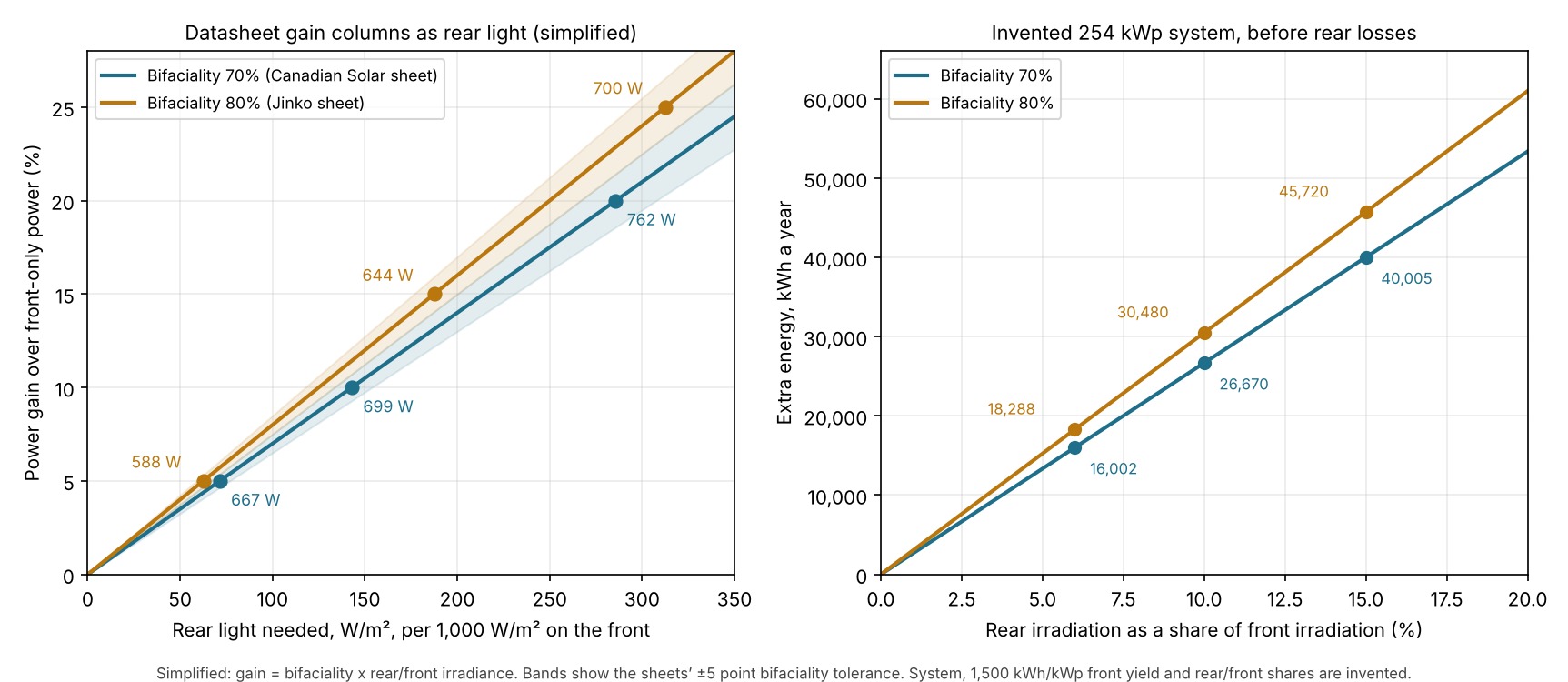
Figure 1. In a simplified model, the Canadian Solar 10% column needs 142.9 W/m² of rear light per 1,000 W/m² of front light. The Jinko 15% column needs 187.5 W/m².
Worked example: an example 254 kWp array
The array is example: 400 CS7N-635MB-AG modules, 254.0 kWp at STC. Front yield is 1,500 kWh/kWp (assumed), or 381,000 kWh. Rear/front shares of 6%, 10% and 15% are example stand-ins for simulation results.
Table 1. Each printed gain column, checked and converted to rear light.
| Sheet and column | Printed Pmax (W) | Front Pmax × (1 + gain) (W) | Rear light needed (W/m², per 1,000 W/m² front) | Range at ± 5 points |
|---|---|---|---|---|
| CS7N-635, 5% | 667 | 666.75 | 71.4 | 66.7 to 76.9 |
| CS7N-635, 10% | 699 | 698.50 | 142.9 | 133.3 to 153.8 |
| CS7N-635, 20% | 762 | 762.00 | 285.7 | 266.7 to 307.7 |
| JKM560N, 5% | 588 | 588.00 | 62.5 | 58.8 to 66.7 |
| JKM560N, 15% | 644 | 644.00 | 187.5 | 176.5 to 200.0 |
| JKM560N, 25% | 700 | 700.00 | 312.5 | 294.1 to 333.3 |
Table 2. Gain and extra energy for the same example 254 kWp array, before extra rear losses.
| Rear/front irradiation | Gain at 70% | Extra kWh at 70% | Gain at 80% | Extra kWh at 80% |
|---|---|---|---|---|
| 6% | 4.2% | 16,002 | 4.8% | 18,288 |
| 10% | 7.0% | 26,670 | 8.0% | 30,480 |
| 15% | 10.5% | 40,005 | 12.0% | 45,720 |
At the same rear light, an 80% factor adds 1.0 point over 70%, which is 3,810 kWh a year here. Table 2 holds kWp fixed and changes only the factor.
Tolerance matters too. At 10% rear light, 65% to 75% gives 6.5% to 7.5%, or 24,765 to 28,575 kWh. That is 1,905 kWh either side of 26,670 kWh. An extra rear loss of 10% (assumed) cuts the 70% case to 24,003 kWh.
At the 7.0% gain in Table 2, 254.0 kWp rises to 271.8 kW, so DC/AC against an example 200 kWac inverter moves from 1.27 to 1.36. The 10% datasheet column would give 279.4 kW and 1.40.
Bifacial rear gain calculator
Enter the sheet’s factor and a rear/front share from your simulation. Starting values reproduce Table 2 (example).
How solar software handles bifacial modules
Four of the 5 tools we read model rear gain, and Aurora Solar says it does not. We looked at where the factor enters the model and whether albedo, height and rear losses are typed in. Ratings follow each company’s own page.
| Software | Models rear gain? | Page read |
|---|---|---|
| PVsyst | Yes | PVsyst help, Bifacial Systems (no date shown) |
| HelioScope | Yes | HelioScope help, What are bifacial modules? (no date shown) |
| SAM | Yes | NREL, Bifacial Simulation in SAM, 11 September 2018 (not current SAM help) |
| PV*SOL | Yes | PV*SOL help, Bifacial modules (© 2026, no page date) |
| Aurora Solar | No, per its help page | Aurora help, Bifacial modules (no date printed, re-read 30 October 2026) |
How the module’s factor enters, and the other inputs each page names:
- PVsyst. Help defines it as "the ratio of the nominal efficiency at the rear side, with respect to the nominal efficiency of the front side". Rear mismatch default 10%. Other inputs as in bifacial modelling.
- HelioScope. "Module data sheets define the bifaciality factor of a module." Bifacial modules sit in its library. A Condition Set toggle turns rear gain on or off. Fixed tilt and single-axis trackers only. Rear mismatch default 10.0%. Others as in bifacial modelling.
- SAM. NREL’s presentation says rear irradiance "(weighted by bifaciality)" adds to front-side irradiance. Ground clearance, GCR, tilt and albedo are studied variables. One-axis tracking is modelled.
- PV*SOL. Effective irradiation is front irradiation plus rear irradiation times the bifacial factor. The page calls the factor a module database item, "typical values" 0.7 to 0.8. Albedo, height above ground and module spacing are inputs. Roof-parallel and façade-integrated systems get no rear radiation.
- Aurora Solar. "Aurora simulations currently do not model rear side power gain for bifacial modules." Use is "not officially supported". Front-side-only bifacial modules can be imported as custom components.
The open-source tools pvlib and bifacial_radiance are in bifacial modelling. To compare tools that model rear gain, read the best solar simulation software list. Ground-mount plants fit the best utility-scale solar design software list, and rooftops the best commercial solar design software list.
Common mistakes with bifacial modules
FAQs
What is the bifaciality factor of a bifacial module?
It is rear maximum power divided by front maximum power, both at STC, per the Canadian Solar sheet. PVsyst words it as an efficiency ratio. The two sheets print 70% and 80%, each with 5 points of tolerance.
Is bifacial gain the same as bifaciality?
No. Gain depends on the rear light at your site. Under our simplification it is the factor times the rear/front ratio. At 70% and 10% rear light, the gain is 7.0%.
How much more energy does a bifacial array make?
Gain on site depends on albedo, height and spacing. NREL’s tracker field measured a cumulative 7% (PERC) and 9% (SHJ) from July 2019 to April 2020. Sandia and NREL slides from 2018 report 12.2% to 18% for four fixed-tilt arrays. These are not forecasts for your project.
How much does a tracker add compared with a bifacial module?
In the one NREL SAM case we read, a tracker added more than bifacial modules did, and NREL’s slide says "(in this case)". A tracker on monofacial modules gained 26.0%, against 8.0% for bifacial fixed tilt. Both together gained 31.3%. All figures are DC energy against monofacial fixed tilt in that single modelled case, so they do not show which is better for your site.
Related terms
- Bifacial modelling: how software computes rear irradiance.
- Albedo: the share of sunlight the ground reflects.
- Ground coverage ratio: row slant length divided by row pitch.
- Equipment datasheets: the maker’s rated values and print revisions.
Next step: use the sheet factor and tolerance as inputs, then simulate your layout with the best solar simulation software.
Sources
- VDE Verlag preview, IEC TS 60904-1-2, edition 2.1, 2026-03 (checked October 2026). A preview page, not the standard text.
- Canadian Solar CS7N-630 to 670MB-AG datasheet, V1.6C1_AU, June 2021 and the US print, Dec. 2021. Third-party copies (checked October 2026).
- Jinko JKM560-580N-72HL4-BDV datasheet, code F3-EN, ©2022. A distributor copy (checked October 2026).
- Sandia and NREL, Optimized Bifacial PV Systems, progress report, 15 July 2020 (checked October 2026).
- Hansen and others, Field Performance of Bifacial PV Modules and Systems, NREL Silicon Workshop slides, 13 August 2018 (checked October 2026).
- DiOrio and Deline, Bifacial Simulation in SAM, NREL, 11 September 2018 (checked 30 October 2026).
- VDE Verlag listing, IEC TS 60904-1-2:2024/AMD1:2026 (checked 30 October 2026). A shop page, not the standard text.
- Company help pages: PVsyst, HelioScope, PV*SOL and Aurora Solar (checked October 2026).
Last updated 30 October 2026. Next scheduled review: 30 January 2027.