Key takeaways
- PF = kW ÷ kVA. Our example inverter (10 kVA, not a real product) gives 9.5 kW at PF 0.95 and 8.0 kW at PF 0.8.
- If a kVA rating is the limit, a lower PF lowers the kW cap. In our example a 9.31 kW peak loses nothing at PF 0.95 and loses 0.31 kW at PF 0.9.
- Most inverter documents cited list adjustable limits of 0.8 to 0.85. The Fronius Argeno manual allows 0.3.
- Set PF as your utility’s approval states. An NREL slide lists constant-PF mode as a mandatory capability under IEEE 1547-2018 for both categories.
- Write the PF value you set into the commissioning report, so the utility can see it is not a factory default.
To record PF settings at handover, see the best solar commissioning software.
Power factor and reactive power at a glance
Reactive power (kvar) moves back and forth with the grid voltage. It does no net work. It still uses inverter current, so it competes with kW for the same kVA.
| Item | Detail |
|---|---|
| Formula | PF = kW ÷ kVA = cos φ. kvar = kVA × sin φ = kW × tan φ. |
| Unit and range | PF has no unit and runs from 0 to 1. Most datasheets here list adjustable limits of 0.8 to 0.85. One manual allows 0.3. |
| Where it matters | Interconnection settings, commissioning records, inverter sizing near the kVA limit. |
| Standard or rule | No single standard. IEEE 1547-2018 (US), ENA G99 (UK) and AS/NZS 4777.2 (Australia) are covered below. |
| In software | You set it in the inverter’s own settings. |
Why power factor matters for installers
The utility can ask for a setting. The setting can cost you output. Both show up after the design is signed off, so decide early.
Approval: your interconnection application may need a power factor or volt-var setting. Rules vary by country, so see the grid-code section.
Output: reactive power uses inverter current. The SMA Sunny Tripower STP 50-40 manual says that at 100% reactive power from its Q on Demand 24/7 function, feed-in power is 0%. Fronius says active power drops in line with the P-Q range at its limit.
Records: write the setting in the commissioning report. It is easy to miss a setting left at its factory value.
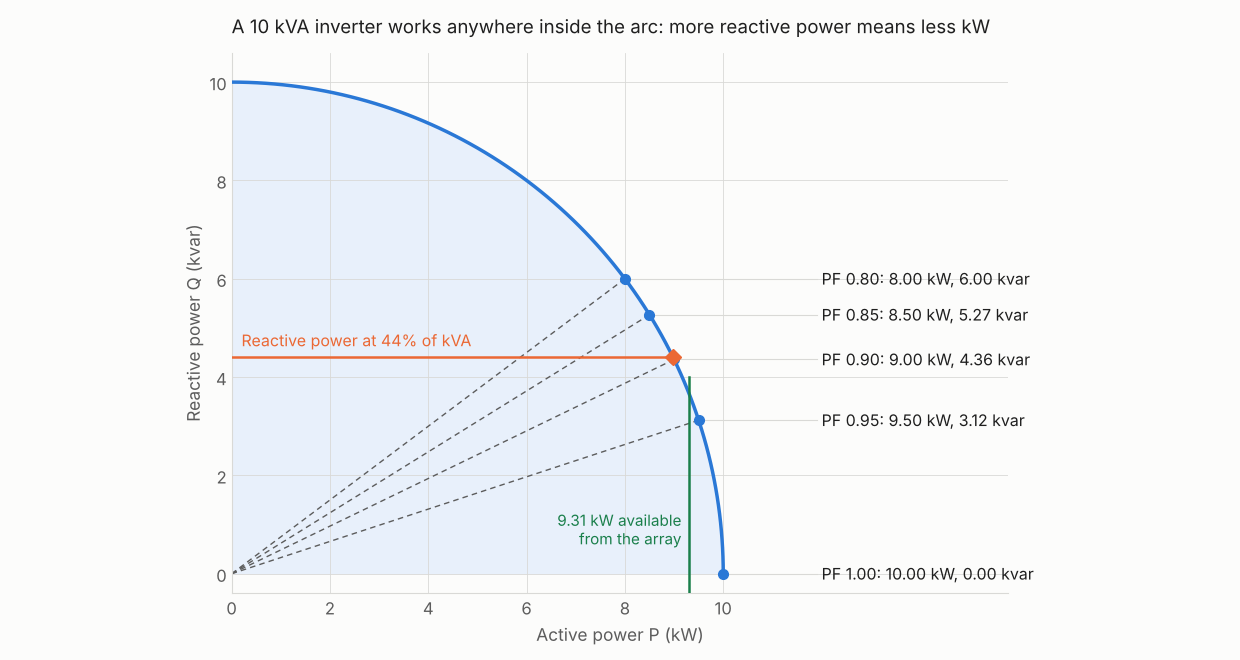
Figure 1. At the kVA limit, a lower power factor trades kW for kvar: 10.00 kW at PF 1.00, 9.00 at 0.90 and 8.00 at 0.80.
How do you calculate kW, kVA and kvar?
Use the right-angled triangle. kW and kvar are the short sides. kVA is the long side. Take a 10 kVA inverter at PF 0.9. Then kW = 10 × 0.9 = 9.00. Then kvar = √(10² − 9²) = 4.36.
- Find the inverter’s apparent power rating in kVA on its datasheet.
- Multiply by the PF. This gives the most kW it can deliver at that PF.
- Take the square root of kVA² minus kW². This gives kvar at that point.
- Compare that kW with what the array can supply at peak.
| PF (10 kVA inverter) | Max kW | kvar at that kW | kvar as % of kVA |
|---|---|---|---|
| 1.00 | 10.00 | 0.00 | 0.0% |
| 0.95 | 9.50 | 3.12 | 31.2% |
| 0.90 | 9.00 | 4.36 | 43.6% |
| 0.85 | 8.50 | 5.27 | 52.7% |
| 0.80 | 8.00 | 6.00 | 60.0% |
The same maths turns a percentage into a PF. Reactive power at 44% of kVA leaves 8.98 kW, a PF of 0.898. At 25% it leaves 9.68 kW. At 60% it leaves exactly 8.00 kW, PF 0.8.
How do inverters supply or absorb reactive power?
Inverter firmware offers a few control modes. They differ in what sets the reactive power. It can be a fixed PF, the active power, the grid voltage or a fixed kvar value.
- Fixed PF: SMA lists a constant cos φ mode. Fronius lists a constant cos φ range of 0.3 to 1 on its Argeno manual page. SolarEdge’s note gives 0.8 leading to 0.8 lagging.
- PF by power: SMA and SolarEdge both describe cos φ as a function of active power. SolarEdge uses a six-point graph.
- Fixed kvar: SolarEdge’s note lists a constant Q from -100 to 100% of nominal reactive power.
- Volt-var: reactive power follows the voltage. Fronius allows up to 10 voltage and reactive power nodes. SolarEdge uses a six-point graph.
Lagging (inductive) means absorbing vars. Leading (capacitive) means injecting vars. Makers differ on signs, so check each manual. SA Power Networks pairs leading with sourcing vars and lagging with sinking vars. SolarEdge’s note has a polarity table. In it, positive cos φ is inductive and positive Q is capacitive. Read each manual before you type a minus sign.
Some inverters also work at night. The STP 50-40 Q on Demand 24/7 page says the inverter stays connected overnight. It also says the function blocks cos φ modes. Sungrow’s SG110CX datasheet lists a Q at night function.
What do grid codes ask for?
Rules differ by country and by utility. The sources cited give only parts of each code. Treat this as a map to the source. Read the current document before you design.
- US, IEEE 1547-2018: the standard text is paywalled and was not read. The figures below come from two slide decks. An EPRI slide deck (Huque, 2 May 2018, on the Sandia PVPMC site) reports minimum reactive capability as a share of nameplate kVA.
- Category A: 44% injection and 25% absorption. Category B: 44% each way.
- It reports constant PF mode as mandatory for both. An NREL presentation (Ingram) also marks it mandatory for both. Only the EPRI deck gives unity PF as the default.
- Its volt-var curve end points are 44% on the Category B slide and 25% on the Category A slide. A default curve can inject less than the 44% capability.
- US, utility choice: IREC’s matrix (updated 17 September 2024) says you can use only one of these functions. They are off by default. PPL Electric’s undated guideline makes volt-var the default for inverter-based DERs. It uses 44% end points. The utility decides, not the standard.
- UK, ENA G99: G99’s main text is not among the sources cited.
- An Electricity North West slide (27 January 2021) says G99 requires 0.95 lead and 0.95 lag at the point of connection, with some flexibility. It names no module type.
- The Form A2-1 page for Type A units (National Grid copy) lists a power factor limit of above 0.95 at three voltage levels. It does not say lead or lag.
- A Power Systems UK article (12 April 2019) gives the same 0.95 for modules between 1 MW and 10 MW.
- Australia, AS/NZS 4777.2: Energy Networks Australia says Amendment 2 came out in August 2024. The sources cited do not include it.
- The SA Power Networks page is undated and cites the 2020 edition.
- For the Australia A region it prints volt-var end points: 44% leading at 207 V, 0% from 220 V to 240 V, 60% lagging at 258 V.
Worked example: a kVA-limited inverter
When kVA is the limit, a lower PF cuts the kW the inverter can deliver. It costs energy only if the array could supply more than that cap.
Assumptions: a 10 kVA inverter (illustrative, not a product) holds the set PF at all power levels. The array peaks at 9.6 kW DC. We use a flat 97% efficiency. That gives 9.31 kW AC available.
| PF setting | kW cap (10 × PF) | Delivered kW | Held back kW | kvar at delivered kW | kVA used |
|---|---|---|---|---|---|
| 1.00 | 10.00 | 9.31 | 0.00 | 0.00 | 9.31 |
| 0.95 | 9.50 | 9.31 | 0.00 | 3.06 | 9.80 |
| 0.90 | 9.00 | 9.00 | 0.31 | 4.36 | 10.00 |
At PF 0.9 the inverter hits its kVA limit. It holds back 0.31 kW at the peak. Treat the cap as a lower AC rating. The effective ratio is array kWp ÷ (kVA × PF). The DC/AC ratio page covers sizing, and inverter clipping covers the yearly energy cost. Fronius’s Argeno page says reactive power has priority by default. You can turn that off. Priority changes which kW is lost.
Power factor and kVA limit calculator
Enter your inverter kVA, PF and array peak. You will see the kW cap, kvar and held-back kW. The table inside reproduces the one above.
How solar software handles power factor
Power factor is set in the inverter, so the table below lists inverter makers, not design or monitoring tools. Each of the five documents adjustable PF limits and control modes, in full or in part, in documents read in October 2026. Tesla is covered in the list below only.
| Inverter family | Documents PF or reactive control? |
|---|---|
| SMA | Yes (Sunny Tripower STP 50-40 manual). Partly for the others |
| SolarEdge | Yes |
| Fronius | Yes |
| Enphase | Partly |
| Sungrow | Yes |
Partly: the document lists some limits or modes but not all. Tesla is rated Partly for the same reason.
- SMA: The STP 50-40 Q on Demand 24/7 manual says the inverter can give up to 100% of its power as reactive power. The Operating Parameters description (version 6.0, undated, older models) lists constant cos φ and cos φ by active power. The Sunny Boy 3.0 to 5.0 datasheet (February 2017, distributor copy for Europe and Australia, no US version) lists 0.8 overexcited to 0.8 underexcited.
- SolarEdge (Power Control Options v10, April 2024, P-Q note v1.1, November 2025): CosPhi 0.8 leading to 0.8 lagging, CosPhi(P), Q from -100 to 100%, Q(U) and Q(P). A commercial three-phase note says the inverters stay within the 0.85 PF limits.
- Fronius (Argeno manual 001-08052025, Primo GEN24 help page): Argeno (international model, not US) has constant cos φ 0.3 to 1, Q(U), Q(P) and default reactive priority. Primo GEN24 10.0 Plus page: 10 kW, 10 kVA, 0.8 to 1 ind./cap., certification depends on the country.
- Enphase: IQ8M and IQ8A North America data sheet DSH-00243-3.0 (2024-12-10): PF adjustable from 0.85 leading to 0.85 lagging, nominal 1.0. Footnote 3 says to use an IQ Gateway for region-specific grid changes during installation. The sheet does not tie the PF setting to it.
- Sungrow: SG110CX datasheet, version 1.4 (2019, check the current version) (international model, not US, IEC and AS/NZS 4777.2:2015): PF above 0.99 at nominal power. It is adjustable 0.8 leading to 0.8 lagging, with reactive power control and Q at night.
- Tesla Powerwall (no solarsoftwares profile): North America 2024 datasheet lists output PF "0 to 1", configurable under the grid code. It gives no kVA or kvar figure.
For platforms that track a fleet of inverters, see the best solar monitoring software.
Common mistakes with power factor
FAQs
What power factor should a solar inverter be set to?
Use the value your utility’s approval states. If it gives none, ask the utility before commissioning. Unity is the default in an EPRI slide deck on IEEE 1547-2018, and Enphase lists a nominal 1.0. No neutral benchmark for a best value is cited here.
What is the difference between kW, kVA and kvar?
kW is real power, kvar is reactive power and kVA is their vector sum. At PF 0.9, 10 kVA is 9 kW and 4.36 kvar. PF is kW divided by kVA.
Can a solar inverter absorb and supply reactive power?
Yes, if its firmware allows it. The makers cited list fixed PF, PF by power, fixed kvar and volt-var modes. Two of the models cited list night-time reactive power. Your model’s limits are on its datasheet.
Does reactive power reduce solar output?
It can when the kVA limit binds. In our example PF 0.9 holds back 0.31 kW at a 9.31 kW peak. PF 0.95 holds back nothing. So it matters most when the inverter is sized close to the array peak.
What does volt-var do?
It sets reactive power from the local voltage. In the SA Power Networks table the inverter injects vars at 207 V. It absorbs them at 258 V. It does neither from 220 V to 240 V.
Related terms
- DC/AC ratio: array kWp divided by inverter kW, and how limits cap it.
- Inverter clipping: energy lost when array power exceeds the AC rating.
- IEEE 1547: the US standard for connecting distributed generation to the grid.
Next step: get the required PF in writing from your utility, then file it with the application using the best solar interconnection software.
Sources
- Huque, EPRI: Smart Inverters and Grid Support Requirements (IEEE 1547-2018), 2 May 2018 (checked October 2026).
- IREC, Decision Options Matrix for IEEE 1547-2018 Adoption, updated 17 September 2024 (checked October 2026).
- PPL Electric, Volt/VAR Curve and Ride-Through Settings Guidelines, undated (checked October 2026).
- NREL presentation by Michael Ingram, undated (checked 30 October 2026).
- National Grid copy of ENA G99 Form A2-1 (Type A) (checked 30 October 2026).
- Electricity North West, EREC G98 and G99 update workshop, 27 January 2021 (checked October 2026, slide wording rechecked 30 October 2026).
- Power Systems UK, G99 article, 12 April 2019 (checked October 2026).
- SA Power Networks, Solar inverter settings, undated (checked October 2026).
- Energy Networks Australia, Changes to Inverter Standards, page modified 22 August 2025 (checked October 2026).
- SMA, Operating Parameters, version 6.0 (checked October 2026).
- SMA, Configuring Q on Demand 24/7 (Sunny Tripower STP 50-40, product named from the URL path) (checked October 2026).
- SMA, Sunny Boy 3.0 to 5.0 datasheet, February 2017, distributor copy (checked October 2026).
- SolarEdge, Power Control Options, version 10, April 2024 and P-Q Diagram note, version 1.1, November 2025 (checked October 2026).
- Fronius, Argeno Advanced Settings, 001-08052025 and Primo GEN24 10.0 Plus help page (checked October 2026).
- Enphase, IQ8M and IQ8A data sheet, DSH-00243-3.0, December 2024 (checked October 2026).
- Sungrow, SG110CX datasheet, version 1.4 and Tesla, Powerwall 3 datasheet, 2024 (checked October 2026).
Last updated 30 October 2026. Next scheduled review: 30 January 2027.