Key takeaways
- The 2003 edition said DER "Shall NOT actively regulate voltage". The 2018 edition says "Shall be capable of actively regulating voltage".
- A standard is optional until adopted. IREC’s matrix lists the choices adopters must make.
- Each grid owner sets its own numbers. Below 0.50 per unit voltage, one printed clearing time is 0.32 s and another is 1.1 s.
- IEEE’s series page shows a new revision in ballot, as of April 2026.
- This page is not the standard. It prints no default table from it.
To prepare the utility filing and the settings sheet, see the best solar interconnection software.
IEEE 1547 at a glance
It is the US base standard for connecting generators and storage to the distribution grid. It says what a device must be able to do. Utilities and regulators pick the values.
| Item | Detail |
|---|---|
| Full title | IEEE Standard for Interconnection and Interoperability of Distributed Energy Resources with Associated Electric Power Systems Interfaces (IEEE’s page for 1547-2018). |
| Scope | "Specifies functional requirements for all DERs connected to typical primary or secondary distribution voltage levels" (NREL slides, 30 to 31 July 2019). |
| Editions | 2003, an amendment in 2014, the 2018 edition and an amendment on 15 April 2020. See the editions table below. |
| Companion standards | IEEE 1547.1 (conformance tests, 2020), 1547.9 (guide for storage, 2022), 1547.2 (application guide, 2023) and 1547.3 (cybersecurity guide, 2023). Years are as IEEE’s series page lists them (as of April 2026). |
| Who must meet it | Optional until adopted. NREL’s slides say regulatory action from state energy commissions is needed to make it part of local interconnection practice. |
| In software | Inverter apps load a utility’s settings. The design tool pages read do not mention it. |
Why IEEE 1547 matters for installers
It shapes which inverters a utility accepts and how they act on the grid. One Maryland utility says settings outside its defaults need its OK.
Potomac Edison’s Maryland sheet shows how this works. From 1 January 2024 it takes only UL 1741-SB inverters, or ones that pass site tests. The UL 1741 page explains that certification. See also hybrid inverters.
Two other pages cover related topics. The anti-islanding page has the Clause 8 trip times. The grid-connected system page has the connection steps.
Which IEEE 1547 edition applies?
Your utility’s rule names the version. The table shows what each source prints.
| Source item | What the source prints | Source |
|---|---|---|
| IEEE 1547-2003 | "Shall NOT actively regulate voltage". "Shall trip on abnormal voltage/frequency." | NREL slides, July 2019 |
| Amendment 1547a-2014 | "May actively regulate voltage". "May ride-through abnormal voltage/frequency". | NREL slides, July 2019 |
| IEEE 1547-2018 | "Shall be capable of actively regulating voltage". "Shall ride-through abnormal voltage/frequency". "Shall be capable of frequency response". "May provide inertial response." Published April 2018. | NREL slides. NLR About page |
| Amendment 1547a-2020 | Published 15 April 2020. Revises the ranges of allowable trip clearing time settings in Table 13, to give more flexibility in adopting Category III. | IEEE 1547a-2020 page |
| IEEE 1547.1-2020 | Conformance test procedures. NREL’s primer says it was approved in March 2020. It says UL 1741 was updated too, with revised tests in Supplement B, published 3 August 2020. | NREL primer |
IEEE’s series page lists IEEE 1547 as 2018 with a revision in ballot (as of April 2026). An amendment to 1547.1 is in ballot too. A new version applies only once a utility or regulator adopts it.
What does IEEE 1547-2018 require?
It has 11 clauses. They cover voltage control, ride-through, islands, data and tests. The NLR (formerly NREL) guide sums up each one.
| Clause | Topic, per the NLR guide (updated 6 December 2025) |
|---|---|
| 1 to 3 | Scope, purpose, definitions, and the device categories for normal and abnormal conditions. |
| 4 | General specifications, configurability, defaults and optional configurations. |
The middle clauses cover the grid behaviour that installers see most.
| Clause | Topic, per the NLR guide |
|---|---|
| 5 | Reactive power and voltage and power control, with four control modes. |
| 6 | Response to abnormal conditions: voltage and frequency ride-through. |
| 7 | Power quality. |
The last four clauses cover islands, networks, communication and tests.
| Clause | Topic, per the NLR guide |
|---|---|
| 8 | Islanding, intentional and unintentional, including black-start capability. |
| 9 | Secondary and spot networks. |
| 10 | Interoperability: communication protocols, monitoring, control and information exchange. NREL’s slides say a DER "Shall support at least one of these protocols": IEEE Std 2030.5, IEEE Std 1815 or SunSpec Modbus. |
| 11 | Test and verification. |
The standard puts DER into five categories. Two are for normal operation. Three are for abnormal conditions.
| Normal category | NREL slide wording |
|---|---|
| A | "Meets minimum performance capabilities needed for area EPS voltage regulation". |
| B | "Meets all requirements in Category A plus" supplemental capabilities for high DER penetration. |
The abnormal categories add a printed rate-of-change ride-through value.
| Abnormal category | NREL slide wording | Printed ROCOF ride-through |
|---|---|---|
| I | "Essential bulk system needs". "Attainable by all state-of-the-art DER technologies". | 0.5 Hz/s |
| II | "Full coordination with all bulk system power system stability/ reliability needs". | 2.0 Hz/s |
| III | "Designed for all bulk system needs and distribution system reliability/power quality needs". | 3.0 Hz/s |
ROCOF means rate of change of frequency. Slides dated 30 to 31 July 2019 print these values. The authority that governs grid connection picks the category.
Who sets the numbers? Same standard, different grid owners
The utility or regulator does, not the installer. IREC’s matrix lists the choices. NREL’s slides name one more.
| Decision and source | Wording |
|---|---|
| Abnormal category (IREC) | "Category III Ride-Through capabilities must be supported for inverter-based DERs", or Category II "at minimum". |
| Normal category (IREC) | Inverter-based DERs must meet Category B reactive power requirements, or all DER types Category A. |
| Trip settings (IREC) | Use the standard’s defaults, or select other settings within the allowed ranges. |
| Voltage control modes (NREL slides, 26 August 2021) | "The area EPS operator shall specify the required voltage regulation control modes and the corresponding parameter settings". |
The same voltage dip gets a different trip time under each set of settings. The test points are examples. They are not field data. Here pu means per unit of nominal voltage. Times are the clearing times of the most severe trip function crossed.
| Test point | Potomac Edison | ISO-NE document, 2021 slide (Cat. II) | ISO-NE 2021 proposal (Cat. III) |
|---|---|---|---|
| Sag to 0.45 pu | UV2, 0.32 s | UV2, 1.1 s | UV2, 1.1 s |
| Sag to 0.80 pu | UV1, 2.0 s | UV1, 2.0 s | UV1, 3.0 s |
| Swell to 1.15 pu | OV1, 2.0 s | OV1, 2.0 s | OV1, 2.0 s |
| 0.95 pu | No trip function crossed | No trip function crossed | No trip function crossed |
| 58.0 Hz | UF1, 300.0 s | UF1, 300.0 s | UF1, 300.0 s |
Potomac Edison’s sheet is dated 19 December 2023 and starts 1 January 2024. It labels its frequency section Category III. The ISO-NE columns come from slides dated 11 February 2021 in a Massachusetts roadmap. They may not match ISO-NE’s current document. The sets also differ in grid owner, date and category, so read the table as printed settings, not a like-for-like test.
The trip settings above are grid owners’ settings for abnormal conditions. The NLR summary puts these in Clause 6. They are not the Clause 8 islanding rule.
In this table the three sets differ only on two rows. The UV2 time is 0.32 s for Potomac Edison and 1.1 s in both ISO-NE columns. The UV1 time is 2.0 s except in the ISO-NE proposal, which shows 3.0 s.
Potomac Edison adds that it may ask for other settings case by case.
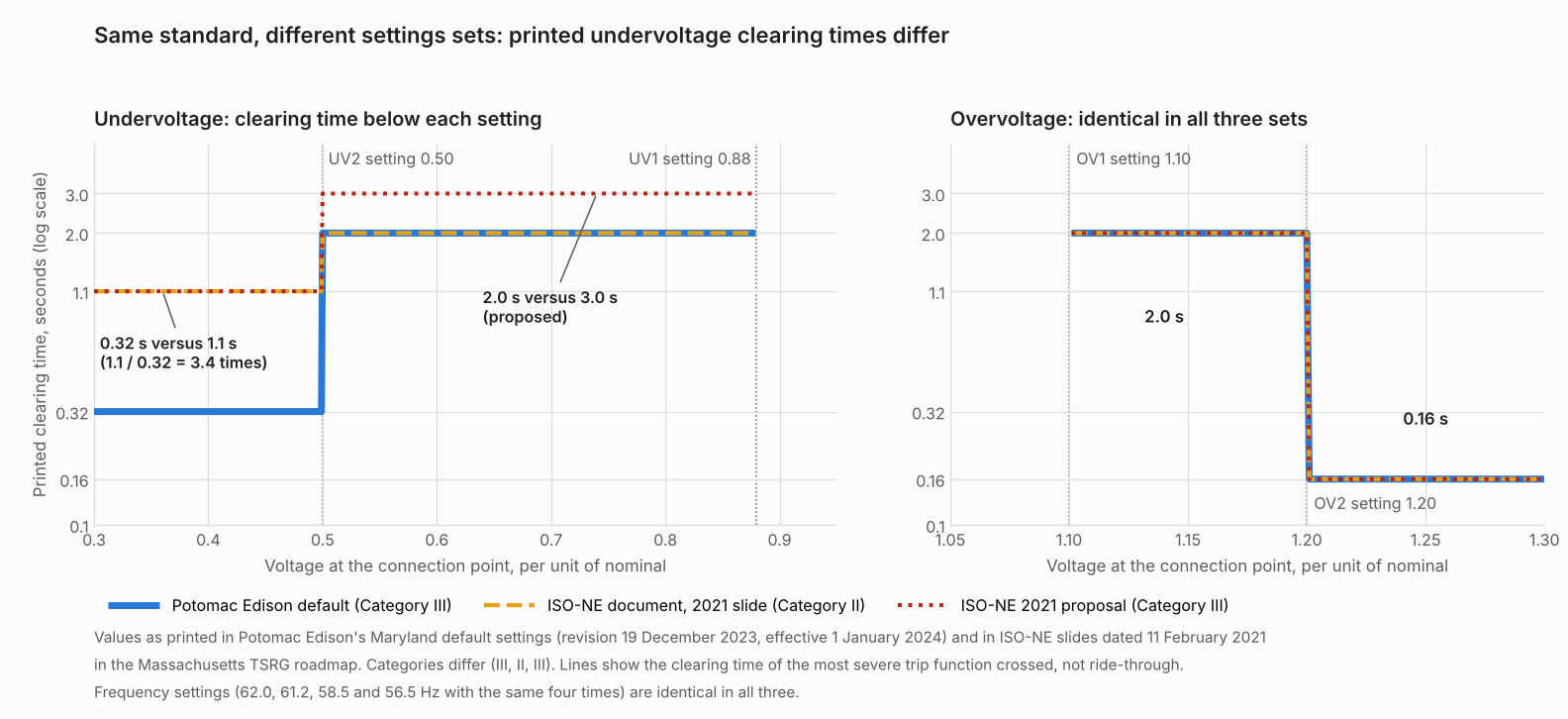
Figure 1. Below 0.50 per unit voltage, two printed settings sets differ by 3.4 times (0.32 s against 1.1 s), while their overvoltage and frequency settings match.
Try your own values below. The tool looks up printed settings only. It does not model ride-through.
How solar software handles IEEE 1547
Of the six tools read, only SolarEdge SetApp documents applying the utility’s settings in full, and the design tools read do not mention the standard.
| Software | Documents applying IEEE 1547-2018 settings? | Method | How / where |
|---|---|---|---|
| SolarEdge SetApp | Yes | On-site app | The "Country & Grid" menu lists utility grid codes, each applying predefined settings from the utility-required profile. |
| Enphase installer tools | Partly | On-site app | Notes a default IEEE 1547 profile. Where the utility requires another (for example Hawaii utilities, which the manual names), the installer sets a grid profile with an IQ Gateway. |
| Tesla Powerwall 2 Backup Gateway 2 | Partly | Factory set | Tables are labelled IEEE 1547-2018. Settings "must be configured in advance by Tesla". Changes need approval from the authority having jurisdiction. |
| SMA Sunny Tripower US inverters | Not stated | Inverter interface | Technical Information v1.3 (version read) names UL 1741 SA and lists grid support functions. It does not mention IEEE 1547. |
| Aurora Solar | Not stated | Modelled | The grid export limits help page does not mention IEEE 1547. No help-site page for the term was found. |
| PVsyst | Not stated | Modelled | The inverter and array sizing help page does not mention IEEE 1547 or grid codes. No help-site page for the term was found. |
Sources and checks for each row:
- SolarEdge SetApp: Application note MAN-01-01235-1.0, version 1.0, January 2025, checked October 2026.
- Enphase installer tools: IQ8 manual, November 2023, page 24. A manualslib.com copy. Checked October 2026.
- Tesla Powerwall 2 Backup Gateway 2: Installation manual page, undated, checked October 2026.
- SMA Sunny Tripower US inverters: Undated PDF on files.sma.de, checked October 2026.
- Aurora Solar: Undated page, checked October 2026.
- PVsyst: Undated page, checked October 2026.
Not stated means the company page we cite does not say. Partly means the page describes the profile step for some cases or says the company sets it. Tools that handle the utility application and settings sheet are listed in our best solar interconnection software guide.
Common mistakes with IEEE 1547
FAQs
Is IEEE 1547 mandatory?
Not by itself. NREL’s slides say "All IEEE standards are voluntary". State energy commissions must act first. Then it becomes local practice. On 12 February 2020 NARUC’s board approved a resolution. It recommends that states adopt IEEE 1547-2018.
Is IEEE 1547 the same as UL 1741?
No. IEEE 1547 sets the grid rules. With 1547.1 it also sets the test steps. UL 1741 is a separate UL standard that certifies products. See the UL 1741 and UL 9540 page.
Does IEEE 1547 cover batteries?
Yes. Its scope takes in all DERs at distribution voltage. IEEE lists a 2022 guide, 1547.9, on using the standard with storage. For sizing, see battery storage design.
Which states have adopted IEEE 1547-2018?
IREC’s adoption tracker, which NLR describes (page updated 31 March 2025), is the place to find a state’s status. This page does not list states. The utility can confirm the rule that applies to your application.
Related terms
- Anti-islanding: the inverter function that stops it energising a dead grid section.
- UL 1741 and UL 9540: the product certifications that test against IEEE 1547.1.
- Distributed energy resource (DER): the generators and storage the standard applies to.
- Interconnection application: the filing where the utility checks the gear.
Next step: before commissioning, ask the utility which edition and category it requires and get its settings sheet. For the filing itself, compare tools in the best solar interconnection software list.
Sources
Dates are as each page prints them. All were checked in October 2026, and the main pages were re-opened on 30 October 2026.
| Source | Date and use |
|---|---|
| Highlights of IEEE Standard 1547-2018, NREL/PR-5D00-75105, PJM workshop | 30 to 31 July 2019. Scope, editions, categories, protocols, voluntary status. Link moved to the nlr.gov domain after the lab’s 2025 rename. The old nrel.gov address stopped resolving. |
| Implementation Considerations, NREL slides | 26 August 2021, revised 21 September 2021. Voltage control wording. |
| NLR guide to the clauses of IEEE 1547-2018 | Updated 6 December 2025. Clause topics. |
| NLR page on IEEE 1547 | Now shows Updated 6 December 2025 (was 27 March 2025 at last check). Publication in April 2018. |
| NREL primer on unintentional islanding, TP-5D00-77782 | April 2022. 1547.1-2020 approval in March 2020. |
| IEEE 1547a-2020 page and IEEE 1547 page | Published 15 April 2020. Table 13 change. Revision project P1547. |
| IEEE SCC21 series page and revision and adoption page | As of April 2026, and adoption status January 2024. Companion documents, ballot status, NARUC resolution. |
| IREC decision options matrix | Updated 17 September 2024. Adopter decisions. |
| NLR page for IREC’s adoption tracker and Renewable Energy World | 31 March 2025 and 9 May 2024. State adoption. |
| Potomac Edison default smart inverter settings, Maryland | Revision 19 December 2023. Printed settings. |
| MA-IEEE 1547 adoption roadmap, Massachusetts TSRG | ISO-NE slides dated 11 February 2021. Printed settings. |
| SolarEdge application note | January 2025. SetApp grid codes. |
| Enphase IQ8 manual, page 24 | November 2023, distributor copy. Grid profile. |
| Tesla Powerwall 2 manual page | Undated. Factory settings. |
| SMA Technical Information v1.3 | Undated. Grid support functions. |
| Aurora help page and PVsyst help page | Both undated. No IEEE 1547 mention. |
Last updated 30 October 2026. Next scheduled review: 30 January 2027.