Key takeaways
- From the 2017 NEC on, sources print 30 V outside and 80 V inside a 1 ft array boundary, within 30 seconds. None of the sources we read describes a change to the voltage or time limits through 2026.
- Sources differ on a few older details, listed under the edition table. Confirm the code year with your AHJ.
- Example: 24 modules in 2 strings need 24 module-level devices, or 12 dual-input devices, under the 2023 NEC. Microinverters add none.
- A string inverter alone fails the example, where it sits 40 ft away. A listed UL 3741 system can pass. Under the 2014 NEC, an inverter within 10 ft of the array could pass.
- Plan sets show the initiation device, the method and the labels.
To check rapid shutdown at the permit stage, see the best solar permitting software.
Rapid shutdown at a glance
Rapid shutdown has four parts: controlled wiring, voltage limits, an initiation device and labels. GreenLancer and the SolarAPP+ example document both expect the method, initiator and labels on the plan set. Device cost depends on the method, so pick it at quote stage. The worked example below counts the devices for 24 modules in 2 strings.
| Item | Detail |
|---|---|
| What it controls | PV dc circuits, and inverter output circuits from inverters inside the array boundary (NACE, November 2024). |
| Limits as printed | One limit outside and one inside the array boundary. Values by edition are in the table below. NEC 690 gives the code context. |
| Ways to meet it | Module-level devices, microinverters, or a listed UL 3741 PV hazard control system. |
| Where it is documented | Site plan, one-line diagram, plan-set notes and labels. |
| In software | Rarely documented as a design check. See the software table below. |
What does the rapid shutdown requirement ask?
It sets two voltage limits: one outside the array boundary and one inside it. A device must start the shutdown. Labels must show where it is.
The boundary is 1 ft around the array in the 2017 NEC, as GreenLancer states. GreenLancer says the 2014 edition set no boundary. IAEI (January 2015) says 2014 covered conductors over 5 ft inside a building or over 10 ft from the array.
The sources agree on the 2017 limits. The table lists what each edition prints, and the list under it shows where sources differ.
| Edition | What the opened sources print |
|---|---|
| 2014 | 30 V and 240 VA within 10 seconds, quoted from the code text (IAEI, 22 Jan 2015). IAEI (3 Jan 2023) and the SolarEdge UL 3741 note also say 10 seconds. |
| 2017 | 1 ft boundary. 80 V inside and 30 V outside, within 30 seconds (GreenLancer, SolarEdge). IAEI (2023): the 240 VA limit was dropped. |
| 2020 | GreenLancer: 80 V and 30 s stayed, and a UL 3741 path arrived. NACE and Solar Builder also place UL 3741 here. |
| 2023 | SolarEdge: language largely unchanged. Fronius author (Solar Power World, 9 Jan 2024): inside-boundary option (3) deleted, carport exceptions added. |
| 2026 | Electrical License Renewal excerpt of 690.12(C): initiation devices are the service disconnecting means, PV system disconnecting means or listed switches, "as specified" in the equipment instructions. |
Where the sources differ:
- 2014: GreenLancer (7 Oct 2026) and EC&M (8 Oct 2016) print 30 seconds. IAEI quotes the code text as 10 seconds, and SolarEdge agrees, so we use 10.
- 2020: a SolarEdge ETL letter (17 May 2021) lists 240 VA with both limits, as the test lab reports them. IAEI says 240 VA went away in 2017.
- 2023: Solar Power World, GreenLancer and EC&M put marking in 690.12(D), moved from 690.56(C). Solar Permit Solutions (Dec 2025) lists 2023 label wording under 690.56(C).
- 2026: neither source describes a change to the limits.
More detail by edition:
- 2017 detail: IAEI (2023) says time went from 10 to 30 seconds. The inside rule applies from 1 Jan 2019 (GreenLancer), while Solar Power World says "certain jurisdictions".
- 2023 detail: Solar Builder says a PV hazard control system is named in 690.4(B).
- 2026 detail: for dwellings, the switch goes outdoors. GreenLancer says the on/off indication rule was removed.
The NEC 690 page covers the 2026 switch changes in more detail. The NFPA text is not cited. Each row names its source and is not the standard.
Why can a string inverter alone usually not qualify?
Usually not from the 2017 NEC on, because wiring inside the boundary stays at string voltage. Listed UL 3741 systems are the exception. The 2014 NEC had a distance route.
- 2014 NEC: IAEI says string inverters within 10 ft of the array need no remote switches. EC&M lists exterior string inverters within 10 ft of the array among the fixes.
- UL 3741 (2020 NEC on): Solar Builder (2022) describes an SMA string inverter on non-conductive racking. It passed UL 3741 up to 1,000 V with the inverter inside the boundary. Mayfield (2023) says all parts must be in the listed system.
- Residential limits: NACE (2024) says listings allow up to 1,000 V without module-level devices, or 600 V for residential flush-mount. Circuits that leave the boundary need string isolation devices, unless the inverter sits with the array.
SolarAPP+’s example approval document says its rapid shutdown check cannot use the "no exposed wiring or conductive parts" method.
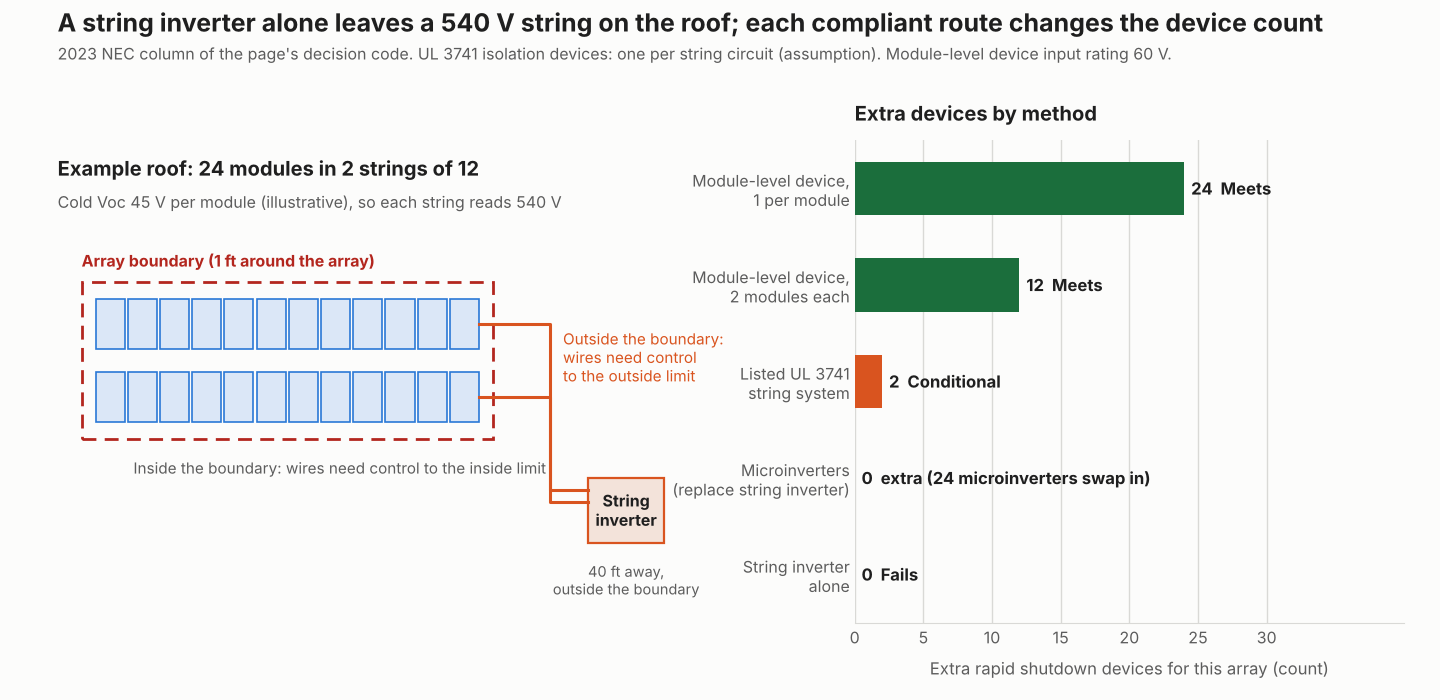
Figure 1. For 24 modules in two 540 V strings, a string inverter alone fails. The compliant routes need 24, 12, 2 or no extra devices.
Worked example: how many devices does this roof need?
Under the 2023 NEC, 24 modules need 24 module-level devices, one per module. Dual-input devices halve that. Microinverters add none.
Assumptions: 24 modules in 2 strings of 12. Cold Voc is 45 V per module (illustrative), so 540 V per string. The inverter is 40 ft from the array, outside the boundary. Device inputs are rated 60 V, the per-input figure SolarEdge gives for its two-input P960. The count follows from these inputs.
| Method | Extra devices | Meets as printed? | Why |
|---|---|---|---|
| String inverter alone | 0 | No | 540 V cold against the 30 V figure for wiring outside the boundary. |
| Microinverters, 1 per module | 0 (24 microinverters replace the string inverter) | Yes | Solar Power World (2018): they ship compliant and the AC breaker is the only switch. |
| Listed UL 3741 string system | 2 isolation devices | Conditional | All parts must be in one listing. One per string circuit is our assumption. |
| Module-level device, 2 modules each | 12 (6 per string) | Yes | 45 V is under the 60 V per-input rating. |
| Module-level device, 1 per module | 24 | Yes | 45 V is under the 60 V input rating. |
Add one initiation device (assumed) and the plan-set labels. Change the inputs and the results move. Under the 2014 NEC with the inverter 8 ft away, the string inverter alone qualifies by the IAEI wording. With cold Voc at 65 V, both module-level rows fail the 60 V rating.
Rapid shutdown device count calculator
The calculator below repeats the table for your array. It gives the same results as the page code. It warns you about impossible inputs.
What must installers document for rapid shutdown?
Show the initiation device, the method and the labels on the plan set. Cite the code year your AHJ enforces.
- Plan-set notes: GreenLancer (7 Oct 2026) advises three things. Show the initiation device on the site plan and one-line diagram. Name the method, module-level device or hazard control system. State any exception and the code year.
- Service label: EC&M (July 2024) says a permanent label must show where all initiation devices are, under 690.12(D). Put it near the service equipment or at an approved location.
- Switch label wording: Tesla’s manual and the SolarAPP+ example both print "RAPID SHUTDOWN SWITCH FOR SOLAR PV SYSTEM". Both cite 690.56(C). The SolarAPP+ example is NEC 2017 and sets the label within 3 ft of the switch.
- Section conflict: GreenLancer calls 690.56(C) the wrong citation for 2023 and 2026 jurisdictions. Solar Permit Solutions prints 2023 wording under 690.56(C). The AHJ decides which citation applies.
See permit plan sets, three-line diagrams and labels and placards.
How solar software handles rapid shutdown (thin documentation)
Rapid shutdown is rarely documented as a design check. SolarAPP+ is the only tool rated Partly, and it covers the permit review. Partly: the page names a rapid shutdown check but not a full design workflow. A design tool would place the initiation device, count devices and print labels. None of the pages read says it does all three.
| Software | Documents rapid shutdown? | Pages we read cover |
|---|---|---|
| SolarAPP+ | Partly | Permit review |
| Aurora Solar | Not stated | Plan sets |
| Solargraf | Not stated | Plan sets |
| OpenSolar | Not stated | Design |
What each page says and when it was read is listed below.
- SolarAPP+: Example approval document lists a rapid shutdown label check and a method, such as a module-level converter, and refuses the exposed-wiring method. NEC 2017 document, eligibility dated 09/07/2021 as printed. Technical FAQ (undated): its own database covers rooftop converters.
- Aurora Solar: No mention on Instant Plan Sets (updated 27 Jan 2026), NEC 2026 support (8 Oct 2026) or Plan Sets (22 Jul 2025). Pages read 26 Oct 2026. Sibling pages rate its plan sets separately.
- Solargraf: No mention in permit settings (19 Mar 2026) or its plan-set guide (10 Sep 2026). The guide says plan sets in general must show the initiator type. Pages read 26 Oct 2026.
- OpenSolar: No mention in stringing guidance (updated 24 Jul 2025) or the stringing, microinverters and optimizers article (no date shown). Pages read 26 Oct 2026.
Aurora Solar, Solargraf and OpenSolar are marked Not stated because the pages read do not mention rapid shutdown. That does not mean the tool lacks the feature. To compare tools that handle permits, see the best solar permitting software. For outsourced drawings, see the best solar plan set services.
Common mistakes with rapid shutdown
FAQs
Does a string inverter alone meet rapid shutdown?
No, not under the 2017 NEC or later in our example. There, a 540 V string stays live inside the boundary. A listed UL 3741 string system can qualify. Sources for the 2014 NEC describe a within-10-ft route.
Do microinverters need extra rapid shutdown devices?
Usually not. Solar Power World (2018) says microinverters and AC modules ship compliant. The AC breaker is the only switch. You still need the initiation device location and labels on the plan set.
How many rapid shutdown devices do I need?
In the worked example, 24 modules need 24 module-level devices, 12 dual-input devices, or none extra with microinverters. No source read gives a code count, so use the manufacturer’s instructions and listing.
Does rapid shutdown apply to ground mounts?
Some are exempt. EC&M (July 2024) quotes an exception for ground-mounted conductors that enter buildings used only for PV equipment. Solar Power World (2024) adds a second case. Circuits from arrays not attached to buildings are not controlled conductors if they end on the outside of buildings.
Related terms
- NEC 690: the code article that holds 690.12.
- MLPE: module-level electronics that can meet the inside-boundary limit.
- Permit plan set: the drawings that show initiator and labels.
- Three-line diagram: shows each conductor and the rapid shutdown block.
Next step: to catch rapid shutdown errors at permit review, compare the best solar permitting software, or the best solar plan set services to outsource drawings.
Sources
- Code commentary. IAEI Magazine, Rapid Shutdown of PV Systems (22 January 2015, 2014 NEC). EC&M, Rapid Shutdown Requirements (8 October 2016) and NEC Requirements for Solar, Part 2 (17 July 2024). IAEI, NEC Rapid Shutdown Requirements and UL 3741 (3 January 2023). Solar Power World, How to meet NEC 2017 (23 April 2018) and 2023 code changes (9 January 2024). GreenLancer (7 October 2026). Electrical License Renewal, 2026 690.12(C).
- UL 3741. Solar Builder: Mayfield (27 February 2023) and Crowell (18 April 2022). NACE, Woodruff (15 November 2024).
- Company documents. SolarEdge UL 3741 application note (version 1.3, dated February 2023 and February 2024 inside the document) and ETL letter (17 May 2021). SolarAPP+ example approval document and technical FAQ. Tesla initiator label page. Solar Permit Solutions (3 December 2025).
- Software pages read. Aurora Instant Plan Sets, NEC 2026 support and Plan Sets. Solargraf permit settings and plan-set guide. OpenSolar stringing and optimizers. All checked October 2026.
Last updated 30 October 2026. Next scheduled review: 30 January 2027.