Key takeaways
- The edition your AHJ adopted applies, not the newest. Minnesota says permits filed on or after 17 August 2026 follow the 2026 NEC. Earlier ones follow the 2023 NEC.
- Trackers lag. IAEI lists Minnesota and Texas on the 2023 NEC. Both states’ own pages say 2026.
- Five city checklists name four edition years: 2014, 2017, 2019 and 2023.
- Conductor size, overcurrent protection, grounding, labels and the panel connection appear on all five checklists. Only two ask about arc-fault protection.
- Of five tools, only SolarAPP+ documents code calculations in its own help pages.
To check a plan set against the adopted code in software, see the best solar permitting software list.
NEC 690 electrical code compliance at a glance
The AHJ decides compliance against the edition it adopted. You show it with a plan set, then an inspection.
| Item | Detail |
|---|---|
| What it is | A design and install that passes the AHJ’s review. It is checked against Article 690 and the related articles it cites. |
| Who decides | The AHJ. IAEI says "The adopted electrical code can vary by state or local jurisdiction." |
| Evidence | Plan set (single line diagram, calculations, cut sheets, labels), then inspection. |
| Standard | NFPA 70, the NEC. The checklists below name editions from 2014 to 2023, and two states now cite 2026. |
| In software | Few tools document code checks. See the software table. |
Why does NEC 690 compliance matter for installers?
Plan reviewers and inspectors judge your design against the edition they enforce. Build to another edition and you face correction rounds before work can start. See AHJ and permit plan set for who reviews what.
A checklist does not guarantee approval. Atlanta’s says its list "is not an all-inclusive list" and should be used "as a guide only".
What does Article 690 cover?
Article 690 covers photovoltaic systems: array circuits, inverters and controls. Mike Holt (EC&M, 2016) says it applies to "photovoltaic (PV) electrical energy systems". Solar Permit Solutions (October 2025) adds disconnect switches and grid-connected, standalone and hybrid systems.
These topics come up in plan review. Holt (EC&M, July 2024) walks through the first five, with arc-fault protection under his overcurrent heading. Montana’s Building Standards Division training slides (West Coast Code Consultants, 6 March 2024) also cover grounding and the point of interconnection. They add wiring methods, which our grid does not isolate.
- Maximum voltage: the highest voltage the strings can reach, which sets equipment ratings. See string sizing and cold-temperature voltage correction.
- Circuit current and conductor size: the wire must carry the corrected current without overheating.
- Overcurrent protection: fuses and breakers stop a fault from overheating wire. See overcurrent protection.
- Arc-fault protection: detects a dangerous arc in DC wiring. See arc-fault protection.
- Rapid shutdown: lowers rooftop wiring voltage for firefighters. See rapid shutdown.
- Disconnects: switches that isolate equipment for service. See DC disconnect.
- Grounding and bonding: give fault current a safe path. See grounding.
- Labels and signs: warn others of the hazards. See labels and placards.
- Point of connection: where the PV system joins the building supply. Checklists cite Article 705 here. See the busbar 120% rule.
What do real plan-review checklists ask?
Real checklists agree on the basics. They differ on the rest. Five documents from four states all name five things: conductor size or derating, overcurrent protection, grounding, labels and the panel connection.
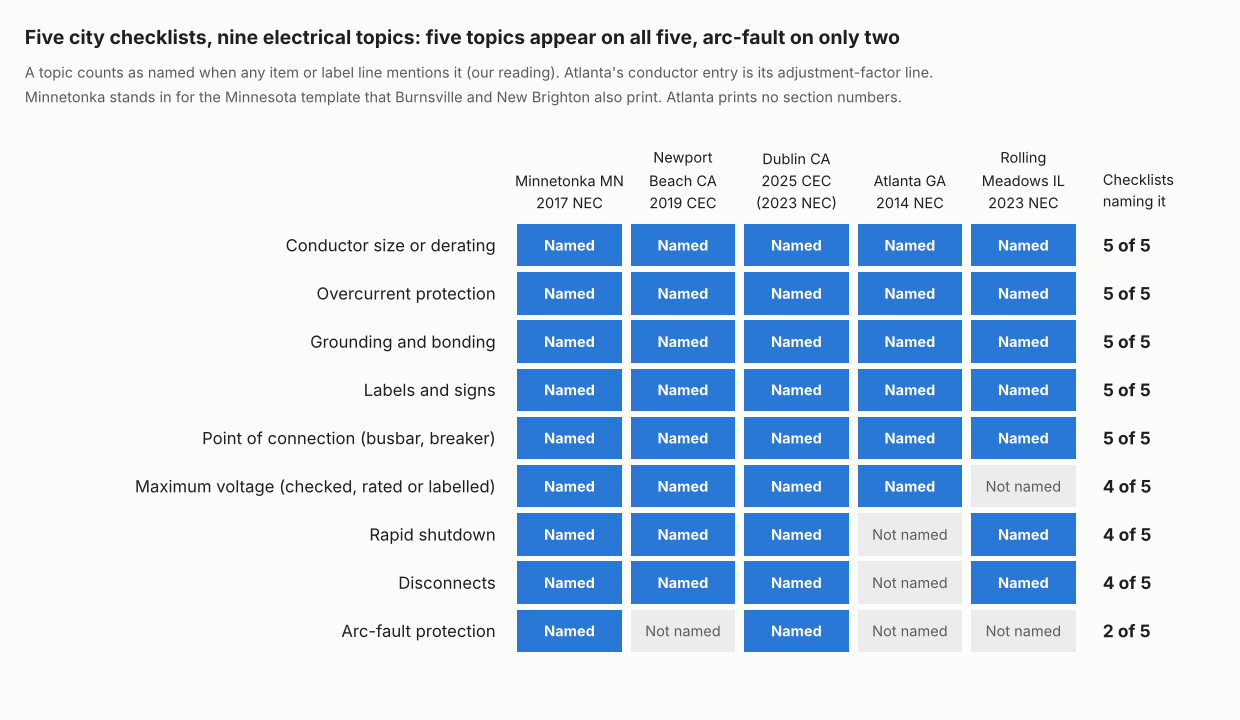
Figure 1. Five of nine electrical topics appear on all five checklists. Arc-fault protection appears on only two.
| Document | Date as printed | Edition named | Section numbers? |
|---|---|---|---|
| Minnetonka MN, Solar PV Inspection Checklist | None shown | 2017 NEC | Yes |
| Newport Beach CA, plan review comments | 8-2020 in the file label. No date in the body | 2019 California Electrical Code | Some |
| Dublin CA, submittal checklist | None printed ("Rev 2026" in file name) | 2025 California Electrical Code (2023 NEC) | Yes |
| Atlanta GA, plan review and inspection checklist | "Rev. 08/07" | 2014 NEC Article 690 | No |
| Rolling Meadows IL, field inspection checklist | None shown | 2023 NEC | Some |
Burnsville MN (09/09/2019) and New Brighton MN carry an item list like Minnetonka’s. They name no edition. Atlanta’s list has no rapid shutdown item. A topic counts when any item names it. Atlanta’s conductor item is its adjustment-factor line. Newport Beach’s AFCI item covers wiring for a backup load panel or subpanel, not PV circuits, so it is not counted.
Checklist text can lag behind the code. Dublin names the 2023 NEC but prints rapid shutdown as "30 volts and 240 volt-amperes within 10 seconds". Our rapid shutdown page shows sources that give other limits. Mayfield (Solar Builder) says the 2026 NEC moves disconnect rules to 705.20. Minnetonka and Dublin list the PV disconnect under 690.13.
Which NEC edition applies to your job?
The edition your state or local AHJ adopted applies. That body also sets the trigger date. Minnesota’s Board of Electricity says permits filed before 17 August 2026 "must comply with the 2023 NEC". Permits filed on or after that date must comply with the 2026 NEC.
That is Minnesota’s rule as printed: the filing date decides. Other AHJs may use the issue date or another trigger, so ask.
Texas’s TDLR adopted the 2026 NEC as the state electrical code from 1 September 2026. The rule includes "a limited exception pertaining to ground-fault circuit interrupter requirements for certain outdoor outlets". IAEI’s undated table lists Minnesota and Texas on the 2023 NEC, but their own pages say 2026. It lists Illinois as local adoption. For California it lists the 2025 California Electrical Code (2023 NEC) from 1 January 2026, matching Dublin. Use the state or AHJ page, not a tracker.
What should you ask the AHJ before you design?
These questions go to the AHJ before you draw, and the answers belong on the plan set. Each one comes from a gap in the checklists above.
| No. | Question | Why it matters |
|---|---|---|
| 1 | Which NEC edition applies, and is there a local amendment? | The edition sets numbers and limits. Texas adopted 2026 with an amendment. |
| 2 | Which date picks the edition: filing, issue or start of work? | Minnesota uses the filing date. |
| 3 | Is there a current PV checklist, and what date is on it? | The five documents show "Rev. 08/07", 8-2020, a 2026 file name or no date. |
| 4 | Is the checklist’s AFCI item about PV circuits or other wiring? | Newport Beach’s AFCI item covers new wiring for a backup load panel or subpanel, not PV circuits. |
| 5 | Which drawings and calculations must the plan set carry? | Dublin asks for a single line diagram and load calculations when the main is 125 A or less. |
| 6 | Is an automated review such as SolarAPP+ used, and which code years are set? | SolarAPP+ says jurisdictions select the edition. |
| 7 | Which items do the fire authority or utility check separately? | Utilities approve interconnection separately. See AHJ. |
| 8 | What must be ready at inspection? | Atlanta wants an electrician or authorised representative there. Rolling Meadows starts with PV disconnects open. |
How do you run a code compliance check on a job?
Work from the AHJ’s edition and checklist. Then make every sheet agree.
- Get the adopted edition and its date rule in writing. Put the edition on the plan set.
- Get the AHJ’s checklist and mark each item against a sheet.
- Check voltage and current against the datasheets. See string sizing.
- Check protection, disconnects, grounding and the panel connection.
- Make model numbers, string counts and breaker sizes match across sheets. See single line diagram.
- After a rejection, ask for the section and edition cited. Then fix the cause.
What changed in the 2026 NEC for solar?
Ryan Mayfield (Solar Builder, no date printed) calls the 2026 Article 690 changes clarifications. They are not the major changes of past cycles. The section numbers below are as Mayfield printed them, and a GreenLancer article (5 October 2026) prints the same ones. We did not check them against the NFPA text.
- Rounding: a new section, 690.4(G), says fractions below 0.5 are dropped in calculations, after all correction factors are applied.
- Engineer calculations: 690.7(A)(3) and 690.8(A)(1)(a)(3) allow an engineer to do the maximum voltage and current calculations for systems of any size. He says earlier editions limited this to larger systems.
- Module instructions: 690.8(A)(1)(a)(2) allows maximum circuit current from the module’s instructions. He expects this to help with bifacial modules.
- Disconnects: 690.13 now directs installers to 705.20. He says the requirements are effectively unchanged.
How solar software handles NEC 690
Only SolarAPP+ documents code calculations in its own words. Aurora and Solargraf document part of the work, and HelioScope and OpenSolar name no code on the help pages read. Not stated means the pages read do not name NEC checks. Partly means the page covers some checks, not the whole job.
| Software | Documents NEC checks? | Page read |
|---|---|---|
| SolarAPP+ | Yes | Technical FAQ (no date shown). Code years page, updated 1 April 2026 |
| Aurora Solar (Instant Plan Sets) | Partly | Help page, no date shown |
| Solargraf | Partly | Permit settings article, 19 March 2026 |
| HelioScope | Not stated | Stringing help page, no date shown |
| OpenSolar | Not stated | Stringing help page, no date shown |
- SolarAPP+: "SolarAPP+ performs calculations required by code including overcurrent protective devices, wire size." It lists string voltage. It runs the 100% and 120% busbar checks. It supports the 2023, 2020 or 2017 NEC, for jurisdictions that enforce those editions.
- Aurora Solar (Instant Plan Sets): shows an OCPD column and only appropriately sized disconnects. It hides a subpanel tie-in that would break the 120% rule. It does not describe the sizing method, string voltage or rapid shutdown, and it covers pitched-roof US homes up to 25 kW AC.
- Solargraf: recalculates wire sizes "as per NEC standards" when a breaker size is excluded. String voltage, the 120% rule and rapid shutdown are not on the page.
- HelioScope: sets string lengths from ASHRAE temperatures to stay in the inverter’s MPP range. The page does not name NEC or 600 V.
- OpenSolar: warns on Voc and Vmp limits using site temperatures. The page calls the warnings "guidance" and names no code.
Pages read 28 and 29 October 2026. For permit-ready plan sets, see the best solar permitting software list. Related lists: solar design software, plan set services and SLD software.
Common mistakes with NEC 690 compliance
FAQs
Is the NEC a law?
Not by itself. The NEC is a standard that becomes enforceable where a state or local body adopts it. IAEI calls NFPA 70 "a regionally adoptable standard".
How do I find which NEC edition my AHJ uses?
Ask the AHJ, or read the state board’s page. Minnesota and Texas each publish their adoption and effective dates. A tracker can lag, so confirm there.
Can software or a complete checklist guarantee NEC compliance?
No. No page in the table promises approval. They describe calculations or settings, such as SolarAPP+ checking wire size and overcurrent devices. A checklist is a guide too, and Atlanta says its list "is not an all-inclusive list" and should be used "as a guide only".
Which NEC edition applies in Minnesota?
Permits filed on or after 17 August 2026 follow the 2026 NEC. Earlier permits follow the 2023 NEC, per Minnesota’s Board of Electricity.
Where can I read the 2026 NEC?
HeatSpring (posted 3 November 2025) says NFPA offers free read-only access to the 2026 edition. You need an NFPA account. You cannot download or print it.
Related terms
- AHJ: the body that adopts the code and approves the permit.
- Permit plan set: the drawings and calculations you submit.
- Rapid shutdown: the function that cuts rooftop wiring voltage.
- SolarAPP+: an online platform that automates permit review.
Next step: get your AHJ’s adopted edition in writing, then use the best solar permitting software list to see which tools document code checks.
Sources
- Adoption. Minnesota Department of Labor and Industry (no date shown). Texas TDLR (1 September 2026). IAEI, code adoption by state (no date shown).
- Checklists. Minnetonka MN. Burnsville MN. New Brighton MN. Newport Beach CA. Dublin CA. Atlanta GA. Rolling Meadows IL.
- Article 690. Mike Holt, EC&M (20 June 2016, 2014 NEC). Mike Holt, EC&M (17 July 2024). Solar Permit Solutions (27 October 2025). Montana DLI training slides (6 March 2024, 2020 NEC). Ryan Mayfield, Solar Builder (no date shown). HeatSpring (3 November 2025). GreenLancer, 2026 NEC solar changes (5 October 2026, checked 30 October 2026).
- Software. SolarAPP+ technical FAQ and code years (1 April 2026). Aurora Instant Plan Sets. Solargraf permit settings (19 March 2026). HelioScope stringing. OpenSolar stringing.
All sources opened October 2026. Last updated 30 October 2026. Next scheduled review: 30 January 2027.