Key takeaways
- No national label list exists. The eight documents cited here differ in wording, size and colour: four city checklists, one fire district standard, two utility sheets and the SolarAPP+ example.
- Invented example: 1 service, 2 PV disconnects, 45 ft of DC conduit and 1 battery give 26 labels under rules from those documents. Without the battery, its disconnect, cabinet sign and directory entry drop out and the count is 23.
- Most counts follow devices and locations. DC conduit markings follow length: at most 10 ft apart, so 45 ft needs 7 markings and 90 ft needs 11.
- Utility placards can be the strictest. DEMCO does not accept decals or labels, and for Oncor the contractor supplies the Class 3 placards.
- Aurora Solar, Solargraf and SolarDesignTool document placards in their plan sets. None of the pages read documents a label count.
To print and check labels as part of a permit package, see the best solar permitting software.
Labels and placards at a glance
The documents use both words for permanent signs, from small labels to a directory plaque.
| Item | Detail |
|---|---|
| Who sets the list | The AHJ through its adopted electrical, residential and fire codes. A fire district or utility may add signs. |
| Standard or rule | No single standard. The SolarAPP+ example is headed NEC 2017 PV. The Milpitas handout cites California codes and says they are "based on the 2025 and 2026 editions of those documents, respectively". |
| In software | Plan-set tools print a placards sheet. SolarAPP+ puts label checks on an inspection checklist. |
Why do labels and placards matter for installers?
Missing labels are an inspection item. Minnetonka’s checklist asks if all required labels are on. SolarAPP+’s example checklist lists the rapid shutdown switch label. It sits under inverter checks.
A design change moves labels with the equipment. Update the sheet. Then record the final set in the handover pack and your site photos. The permit plan set shows where each label goes.
Who decides which labels a solar job needs?
Three layers decide: the AHJ through its adopted code, the fire district and the utility. SolarAPP+ adds a review path. Each prints its own list. None prints all of them. The AHJ’s adopted code edition governs.
| Layer | Document (jurisdiction, date as printed) | What it adds |
|---|---|---|
| AHJ | City of Milpitas, California, residential PV handout, as printed 1/12/2026. City of Minnetonka, Minnesota, 2017 NEC label table, undated. City of Berkeley, California, ESS checklist, revised 04/27/26. City of Palo Alto, California, ESS guidelines, 05/03/2019. | Label wording and places. Berkeley and Palo Alto add battery items. |
| Fire district | Woodside Fire Protection District, California, ESS standard, January 2024. | Red signs with white letters, battery signs and a directory plaque. |
| Utility | Oncor placard guideline, revision 01/03/2012. DEMCO placard sheet, undated. | Placards at the meter and the AC disconnect, with material rules. |
| Review path | SolarAPP+ example approval document, NEC 2017 PV, no jurisdiction printed. | Label text and checklist lines. |
Utility placards go with the interconnection application. Oncor asks for proofs of its Class 2 and 3 placards with it. Code context is on the NEC 690 page.
What is the label schedule for a rooftop PV system?
A label schedule lists each label, where it goes and who asks for it. Wording is as printed in at least one document. Rows 8 and 9 apply only with a battery.
Table 1 covers the service, disconnects and breakers.
| # | Where | Label (wording as printed) | Asked for by |
|---|---|---|---|
| 1 | Within 3 ft of the service disconnect | "SOLAR PV SYSTEM IS EQUIPPED WITH RAPID SHUTDOWN" with a roof diagram. | SolarAPP+ example. Minnetonka (colours given). Milpitas asks for a label at each service equipment location. |
| 2 | On or within 3 ft of the rapid shutdown switch | "RAPID SHUTDOWN SWITCH FOR SOLAR PV SYSTEM" | SolarAPP+, Minnetonka, Milpitas. See rapid shutdown. |
| 3a | Each PV disconnect | "PV SYSTEM DISCONNECT" at each AC or DC disconnect. | SolarAPP+, Minnetonka, Milpitas. |
| 3b | Each AC disconnect | Milpitas prints "PHOTOVOLTAIC SYSTEM AC DISCONNECT" as its example, plus a warning that line and load terminals may stay energised when open. | Milpitas. |
| 3c | Each DC disconnect | "PHOTOVOLTAIC DC DISCONNECT" with voltage and current. | SolarAPP+. |
| 4 | Each point of interconnection | "PHOTOVOLTAIC POINT OF INTERCONNECTION" with maximum AC current and voltage. | SolarAPP+, Milpitas. Minnetonka asks for current and voltage marking. |
| 5a | Service equipment and busbar | "WARNING: EQUIPMENT FED BY MULTIPLE SOURCES" and a dual power source label. | SolarAPP+ ties each to a busbar method. |
| 5b | Back-fed breaker | "DO NOT RELOCATE THIS OVERCURRENT DEVICE", or a sum-of-breakers warning. | SolarAPP+. Minnetonka and Milpitas list the back-fed breaker label. |
Table 2 covers the directory plaque, DC wiring, battery signs and utility placards.
| # | Where | Label (wording as printed) | Asked for by |
|---|---|---|---|
| 6 | Service equipment and each source location | A permanent plaque or directory of all power sources. | Minnetonka, Berkeley, Milpitas. Woodside: 7 in by 7 in. Palo Alto: 8 in by 10 in. |
| 7 | DC raceways, enclosures and junction boxes | "PHOTOVOLTAIC POWER SOURCE". Milpitas adds "SOLAR PV DC CIRCUIT" and a spacing of no more than 10 ft. | SolarAPP+, Milpitas, Minnetonka. |
| 8 | Battery disconnect | "ENERGY STORAGE SYSTEM DISCONNECT" with open or closed state and nominal output voltage. Woodside: "BATTERY DISCONNECT" at the exterior disconnect. | Berkeley (04/27/26). Woodside (January 2024). |
| 9 | Battery cabinet, room doors, main panel | "CAUTION: ENERGY STORAGE SYSTEM." on cabinets and doors. Palo Alto: "Energy Storage System (Lithium Batteries)" on the unit. | Woodside (also a main panel caution). Palo Alto (05/03/2019). |
| 10 | Meter and AC disconnect | Utility placards. Oncor has Class 1, 2 and 3. DEMCO asks for rating, distance and arrow placards. | Oncor (01/03/2012). DEMCO (undated). |
Section numbers differ. The SolarAPP+ example cites the DC marking under 690.31(G)(3). The Milpitas handout cites it under 690.31(D)(2). Cite your AHJ’s edition, not ours. Rhode Island’s undated 2023 NEC labeling reference is a ninth document, outside the eight above. It cites the rapid shutdown switch label under 690.12(D)(2), while the 2017-based documents list 690.56(C). Editions renumber these labels, and they are likely to move again: NFPA approved the 2026 NEC in September 2025, and a handful of states (Washington effective 31 December 2026) have begun adopting it, while most jurisdictions as of November 2026 still enforce 2020 or 2023. Pull the current label wording and section numbers from your plan-set software or your AHJ rather than copying the table above, which mixes 2017, 2023 and undated sources. The Milpitas handout has no battery labels.
Do material and size rules differ?
Yes. Utility rules can be the most prescriptive. DEMCO refuses decals. A label that passes one document can fail the next.
- Milpitas: capital letters at least 3/8 in high, white on red. It recommends UL 969 for weather rating.
- Minnetonka: rapid shutdown title capitals at least 3/8 in tall, other text at least 3/16 in.
- Palo Alto main disconnect plaque: 8 in by 10 in, .080 aluminium backer, white lettering on red reflective vinyl.
- DEMCO: lettering 3/16 in or larger, raised or engraved, riveted or glued. It does not accept decals or labels. Oncor needs a UV inhibitor. Acrylic placards need VHB foam tape at least 1 in wide.
How many labels does a job need?
Count devices and locations first. Then add DC conduit by length. The example job below needs 26 labels. No AHJ prints this combined list. Each rule comes from the document named. So the example mixes California, NEC 2017 and Oncor rules. It shows the method, not one AHJ’s requirement.
Example inputs:
- 1 service, 1 rapid shutdown switch, 1 PV AC disconnect and 1 DC disconnect.
- 1 point of interconnection, and 1 panel with a back-fed breaker (120% rule).
- 2 other source locations (inverter and battery).
- 45 ft of exposed DC conduit with 1 junction box.
- 1 battery disconnect, 1 battery cabinet and 2 utility placards.
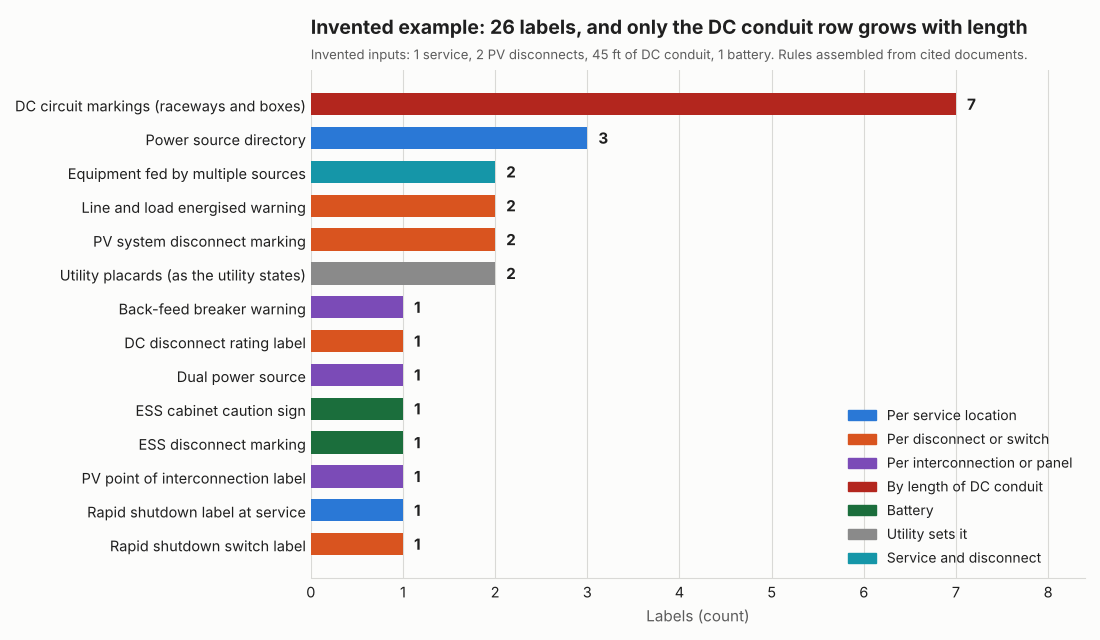
Figure 1. In the example, DC conduit markings are the largest row at 7 of 26 labels, and they alone grow with conduit length.
Part 1 covers the service, disconnects and warnings.
| Label | Count | Rule used |
|---|---|---|
| Rapid shutdown label at service | 1 | One per service equipment location. |
| Rapid shutdown switch label | 1 | One per switch. |
| PV system disconnect marking | 2 | One per PV system disconnect, AC or DC (SolarAPP+). |
| Line and load energised warning | 2 | Assumed on both disconnects. |
| DC disconnect rating label | 1 | One per DC disconnect. SolarAPP+ prints "PHOTOVOLTAIC DC DISCONNECT" there. |
| PV point of interconnection label | 1 | One per point of interconnection (SolarAPP+). |
| Equipment fed by multiple sources | 2 | SolarAPP+: at each service equipment location and each system disconnect. ASSUMED: the AC disconnect is the system disconnect. |
| Dual power source | 1 | One per busbar with more than one source. |
Part 2 covers breakers, conduit, directory, battery and utility labels (15 labels). Part 1 above has 11.
| Label | Count | Rule used |
|---|---|---|
| Back-feed breaker warning | 1 | 120% rule chosen, one per back-fed breaker. |
| Sum-of-breakers warning | 0 | Not used in this example. |
| DC circuit markings | 7 | 45 ft at spacing of no more than 10 ft gives 5 spans, so 6 marks with one at each end, plus 1 junction box (Milpitas spacing). |
| Power source directory | 3 | Service equipment plus 2 other source locations (Berkeley, Milpitas). |
| ESS disconnect marking | 1 | One per battery disconnect (Berkeley). |
| ESS cabinet caution sign | 1 | One per cabinet (Woodside). |
| Utility placards | 2 | Example rule: one at the meter, one at the remote disconnect, as in Oncor’s Class 2. |
| Total | 26 | Sum of both tables. |
The total is the sum of the rows in both tables. Take out the battery, which removes its disconnect, cabinet sign and directory entry, and the total is 23. With 90 ft of DC conduit it is 30. The sum-of-breakers method keeps the total at 26 labels. Only the wording changes. The marks-at-both-ends rule is our assumption.
Label and placard count calculator
The calculator repeats the table for your own site. It uses the same rules as the page code. It warns on impossible inputs.
How solar software handles labels and placards
Of the four tools below, three print placards in the plan set, and none of the pages read states a label count or a label schedule.
| Tool | Placards in output? | Label count or schedule? |
|---|---|---|
| Aurora Solar | Yes | Not stated |
| Solargraf | Yes | Not stated |
| SolarAPP+ | Partly | Not stated |
| SolarDesignTool | Yes | Not stated |
Not stated: the company page we cite does not say, which does not mean the tool lacks the feature. Partly: the tool supports label review but does not print labels.
- Aurora Solar: Instant Plan Sets help page, no date shown. Advanced settings include "Show all non-ANSI safety labels as red" and "Show site map placard, even if optional". Pitched-roof US homes up to 25 kW AC only.
- Solargraf: Self Service Permit Guidelines (23 April 2024) list "Placards (warnings, caution labels)" in the plan set. The permit settings article (19 March 2026) says users can add notes on the PV6 placard page after the automatically generated text.
- SolarAPP+: Example approval document (NEC 2017 PV, sheet dated 09/07/2021). Inspection checklist lines and label text from a fire bulletin. It is a review path, not a label printer.
- SolarDesignTool: Company permits page, no date. Package features include "PV safety labels and placards". One-click output needs supported equipment. No jurisdictions named.
The sources include no OpenSolar help page on labels. For ranked options, see the best solar permitting software and the best solar plan set services.
Common mistakes with labels and placards
FAQs
Does the permit plan set show the labels?
Usually. Aurora and Solargraf include placards in the plan set, as the table shows. Where SolarAPP+ is adopted, the approval document carries label checks instead of drawings. See the permit plan set and SolarAPP+ pages.
Do batteries need their own labels?
In the documents read, yes. Berkeley asks for an "ENERGY STORAGE SYSTEM DISCONNECT" marking. Woodside asks for cabinet and main panel signs. Palo Alto asks for a sign on the unit. The Milpitas handout lists none. See battery storage design.
Where does the rapid shutdown label go?
Put it within 3 ft of the service disconnect, with a roof diagram (SolarAPP+ example). A second label goes on or near the rapid shutdown switch. Rows 1 and 2 of the label schedule give the wording, and your AHJ’s edition governs.
Can I buy a generic solar label kit?
No single kit fits every job. DEMCO accepts no decals, and Palo Alto asks for its own plaque size. Wording, sizes and materials differ between the eight documents, so check the AHJ and utility before you print.
Who fits the placards on the utility’s equipment?
Oncor’s guideline says the contractor supplies the Class 3 placards. The contractor also supplies the tape. Oncor’s operations group mounts them on its own equipment. It approves the installation after a site visit. Your own utility’s rule may differ.
Related terms
- AHJ: the authority that adopts the code and approves the permit.
- Rapid shutdown: the safety function behind labels 1 and 2.
- Permit plan set: the drawings that locate the labels.
Next step: count the labels for one real job with the calculator, then see which of the best solar plan set services prints the placards sheet.
Sources
All sources opened October 2026. Oncor, Milpitas and Rhode Island were re-opened on 30 October 2026. Dates are as printed in each document.
| Source | Used for |
|---|---|
| SolarAPP+ example approval document (NEC 2017 PV, eligibility sheet 09/07/2021, the demo copy at this URL no longer loads as of November 2026, so treat the rows it supports as unconfirmed until a current copy is found) | Rows 1 to 5 and 7. Software row |
| City of Milpitas, Solar Photovoltaic (Residential) (as printed, 1/12/2026) | Rows 1 to 7. Materials. 10 ft spacing |
| City of Minnetonka, 2017 NEC labeling table (undated) | Rows 1 to 7. Colours and sizes |
| City of Berkeley, ESS code compliance checklist, Form 168 (revised 04/27/26) | Rows 6 and 8 |
| City of Palo Alto, ESS submittal guidelines (05/03/2019) | Rows 6 and 9. Plaque material |
| Woodside Fire Protection District, ESS design and installation standard (January 2024) | Rows 6, 8 and 9 |
| Oncor, Placard Guideline (revision 01/03/2012) | Row 10. Materials. FAQ |
| DEMCO, placards information for companies (undated) | Row 10. Materials |
| Rhode Island, PV system labeling, 2023 NEC (undated, made with Ridgeline Energy Analytics) | Section numbers note |
| Aurora: Instant Plan Sets. Solargraf: Self Service Permit Guidelines, permit settings. SolarDesignTool permits page. | Software table |
Last updated 30 October 2026. Next scheduled review: 30 January 2027.