Key takeaways
- On one 10 kW, 31,000 USD job, four example plans pay 1,550 to 4,250 USD gross, or 0.16 to 0.43 USD per watt.
- Those gaps come from the example rates, which are taken from different sources. They do not rank the plan types.
- With a 30/70 payout, 465 to 1,275 USD is paid before install. That is the amount at risk if the install cancels.
- The sources give different clawback rules: a 30-day example, a 90-day window and recovery in the next pay cycle.
- Job changes alter pay. One source says a revision, costed at 750 USD, may come out of a redline rep’s commission.
To run commission tracking in software instead of a spreadsheet, see the best solar commission tracking software.
Sales commission tracking at a glance
Tracking turns a written pay plan into a ledger. The ledger shows what each deal earned, paid and recovered.
| Item | Detail |
|---|---|
| Core calculation | Gross commission from the plan formula, minus adders, split by payout milestone, minus any clawback |
| Unit | USD per watt or per kW, percent of contract, or flat USD per deal |
| Where it matters | Rep pay accuracy, cash timing, and cancellation risk |
| Standard or rule | No single standard is cited. The written plan sets triggers and clawback terms |
| In software | Commission tools, solar CRMs and ERP suites. See best solar commission tracking software |
Why commission tracking matters for installers
Commission moves with every contract change, so tracking has to follow the job, not just the sale. A 30% payment at signing is cash at risk: 465 to 1,275 USD in our worked example if the install cancels.
Scanifly says a revision may come out of a redline rep’s commission. Redesigns and re-permitting may also delay pay.
In our example the same job pays 1,550 to 4,250 USD by plan, so one spreadsheet formula misstates pay.
How are solar sales commissions structured?
Sources quote a percent of contract, a rate per kW or a redline spread. Milestone timing, draws and clawbacks sit on top of the pay formula. Typical ranges differ by source, and even Rework’s two pages differ, so treat each figure as that source’s example.
This table shows the pay formulas.
| Structure | What the source shows | Source |
|---|---|---|
| Per watt with a redline | Priced at 3.00 USD per watt with a 2.50 USD redline, the rep earns 0.50 USD per watt. The redline is the minimum price that goes to the installer. | Scanifly, 2024 |
| Flat percentage of contract | 3% to 10%, with 5% to 8% most common | Everstage |
| Flat percentage of contract | Usually 2.5% to 5% of contract value | Rework, comp design guide |
| Flat percentage of contract | Common range of 8% to 15% of contract price | Rework, unit economics page |
| Flat percentage of contract | 5% of a 32,000 USD contract (1,600 USD) | Sequifi |
| Per kW | 200 USD per kW installed, paid at installation complete | Rework |
| Per kW | 200 USD per kW sold, in its example | Everstage |
| Tiered by volume | 4% on the first five deals in a month and 6% from the sixth | Everstage |
| Tiered by volume | A rate step of 0.5% above 500,000 USD sold | Sequifi |
| Base plus commission | 40,000 USD base plus 4% per sale | Everstage |
| Base plus commission | 50,000 USD base plus 350 to 500 USD per kW | Sales Cookie |
| Flat fee per deal | 1,200 USD per funded deal, paid within 10 business days of funding | Rework |
This table shows timing and recovery.
| Structure | What the source shows | Source |
|---|---|---|
| Milestone payout | 30% at signing and 70% at install or permission to operate | Everstage. Sequifi |
| Milestone payout | 50% upfront and 50% on completion | Sales Cookie |
| Milestone payout | Sign, fund and install listed as triggers | Rework |
| Recoverable draw | 1,000 to 1,500 USD per deal signed on install-triggered plans | Rework |
| Recoverable draw | A 2,000 USD monthly ramp draw | Sequifi |
| Clawback | Cancellation within 30 days as an example trigger | Everstage |
| Clawback | A 90-day window called common. 25% to 50% partial recovery if a sign-triggered deal cancels before install | Rework |
| Clawback | Recovery from the next pay cycle | Sequifi |
For how a redline is set and how it differs from a margin split, see redline and commission pricing. The cost per watt page covers the price input.
How does commission tracking work?
Each deal moves through a few events. Each event can create a payment or a recovery. The steps below combine what the sources describe.
- Record the deal: system kW, sold price, rep, any setter, and lead source.
- Define the pay trigger. Rework names sign, fund and install. Everstage notes that pay is often held until permission to operate.
- Work out gross commission with the plan formula, then apply adders or overrides.
- Release pay at each milestone, for example 30% at signing and 70% at install.
- Log every later change as a signed line. This covers a design revision, a cancellation or a clawback. Sequifi’s example shows a cancelled install as a negative 1,600 USD line, recovered in the next cycle.
- Review and approve each line before payment. Sequifi’s page says its ops team reviews every line first.
Worked example: one job, four plans, and a cancellation
The same 10 kW job pays a rep 1,550 to 4,250 USD, depending on the plan. A cancellation puts the share paid before install at risk.
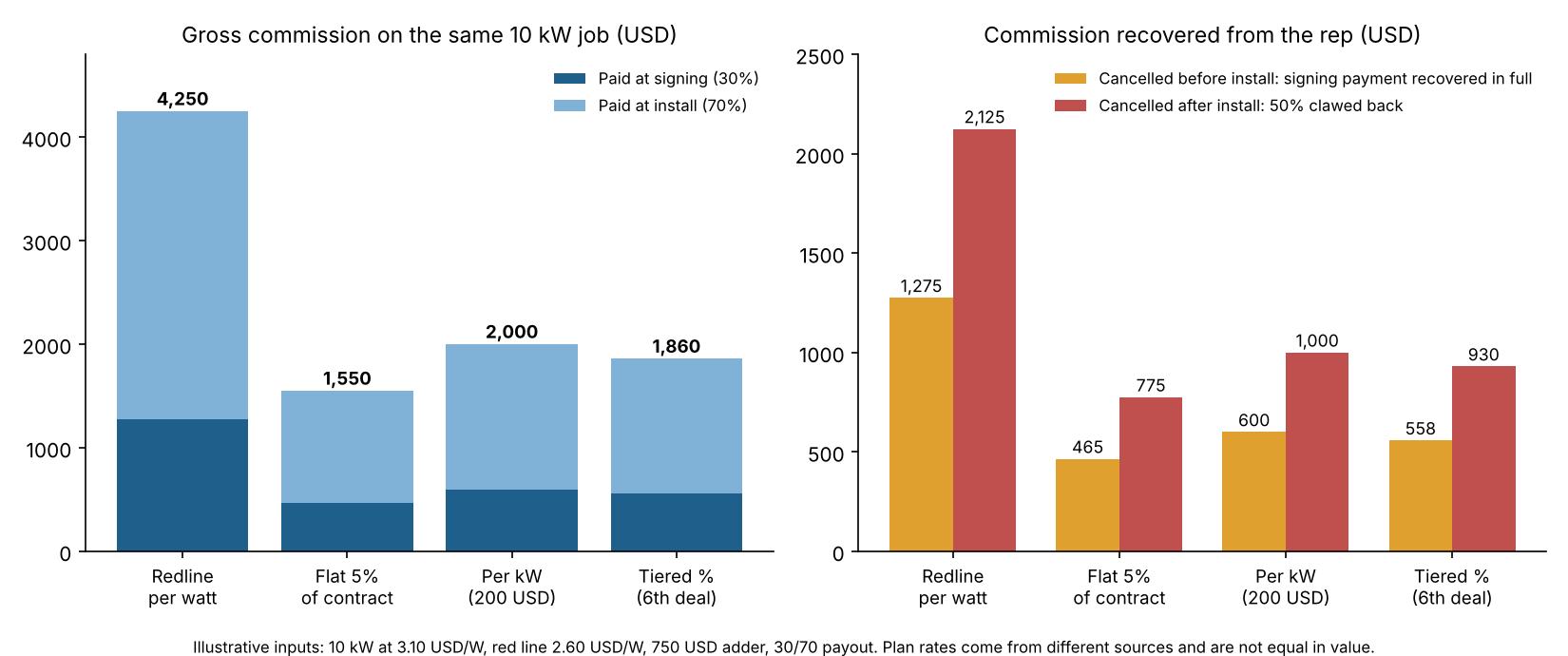
Figure 1. A 30% signing payment puts 465 to 1,275 USD at risk before install. A 50% clawback after install recovers 775 to 2,125 USD.
Inputs are illustrative. The rates come from different sources, so the plans are not equal in value.
| Input | Value |
|---|---|
| System and price | 10 kW at 3.10 USD per watt, contract 31,000 USD |
| Redline and adder | 2.60 USD per watt. One 750 USD revision charged to the rep (Scanifly) |
| Flat plan | 5% of contract (Sequifi example rate) |
| Per-kW plan | 200 USD per kW (Rework) |
| Tiered plan | 4% on deals 1 to 5 in the month, 6% from deal 6. This is the rep’s sixth deal (Everstage) |
| Payout and clawback | 30% at signing, 70% at install. Full recovery of the signing payment before install. 50% clawed back after install (assumed) |
Rework describes full recovery before funding and 25% to 50% before install, so set your own share. Scanifly says a rep may lose "some or all" if the contractor must fix a defect.
This table shows what each plan pays at each milestone.
| Plan | Gross (USD) | USD per watt | Paid at signing | Paid at install |
|---|---|---|---|---|
| Redline per watt | 4,250 | 0.43 | 1,275 | 2,975 |
| Flat 5% | 1,550 | 0.16 | 465 | 1,085 |
| Per kW | 2,000 | 0.20 | 600 | 1,400 |
| Tiered, deal 6 | 1,860 | 0.19 | 558 | 1,302 |
This table shows what is recovered if the sale cancels.
| Plan | Recovered, cancelled before install | Recovered, cancelled after install |
|---|---|---|
| Redline per watt | 1,275 | 2,125 |
| Flat 5% | 465 | 775 |
| Per kW | 600 | 1,000 |
| Tiered, deal 6 | 558 | 930 |
The redline row is 0.50 USD times 10,000 W, which is 5,000 USD, less the 750 USD adder. If the job were the rep’s third deal, the tiered plan would pay 1,240 USD. The before-install column assumes full recovery. The calculator lets you set a 25% to 50% share instead.
Solar sales commission calculator
Enter your own plan rates, including the share recovered before install. You will see gross pay, milestone payments and recovery for the four plan types. It is a planning aid. It does not replace your written plan.
How solar software handles commission tracking
For solar commission, a tool needs to support your plan type, take milestone triggers from your CRM, write clawbacks as negative lines and require approval before payment. The table rates only what each page says.
- Yes: the page states the feature.
- Partly: it states some parts but not all.
- Not stated: the page checked does not mention the feature. That does not mean the tool lacks it.
- No: the page says the tool does not do it.
| Software | Does it calculate solar-style commission plans? |
|---|---|
| Sequifi | Yes |
| SolarSuccess (Blu Banyan) | Partly |
| Solo | Partly |
| QuotaPath | Partly |
| CaptivateIQ | Not stated |
| Everstage | Not stated |
| Sales Cookie | Not stated |
| Enerflo | No |
How each tool does it, with notes:
- Sequifi. Its solar commission page states automatic setter and closer splits, milestone payouts, overrides and clawbacks, with approval of each line. Its examples are illustrative, and it names Solo and Enerflo as CRM feeds.
- SolarSuccess (Blu Banyan). Solar CRM page says it enables accurate commission calculations and shows redlines, adders and milestone variables beside the project. Clawbacks are not mentioned on the page checked.
- Solo. Help page answers yes to calculating rep commissions, via an adder in the proposal menu or a base price per watt. Milestones and clawbacks are not named.
- QuotaPath. Pricing page lists a plan builder, team plans, overrides, discrepancy resolution and approvals to payouts. Not solar-specific. Milestones, clawbacks and draws not mentioned on that page.
- CaptivateIQ. Incentives page names tiers, accelerators, bonuses, splits, overlays and draws. Clawbacks, milestones and solar are not mentioned on the page checked.
- Everstage. Rated on its solar guide only. We cite no product page, so this shows what we read, not what the tool does.
- Sales Cookie. Rated on a 2020 company blog that gives solar plan examples and never mentions clawbacks. We cite no product page.
- Enerflo. A help article dated 8 April 2026 states that Enerflo does not calculate commission.
Tools that handle solar-style plans are compared in the best solar commission tracking software list.
Common mistakes with commission tracking
FAQs
What is a redline in solar commission?
Scanifly describes it as the minimum price per watt that must go to the installer. The rep earns the sold price above it. For example, 3.00 USD sold against a 2.50 USD redline gives 0.50 USD per watt.
Is per-kW commission the same as per-watt?
The unit differs, but the maths is the same, because 1 kW is 1,000 W. A 200 USD per kW rate equals 0.20 USD per watt. Sources quote per-kW rates for flat pay. They quote per-watt prices for redline plans.
How long does a clawback window last?
Windows differ by source. Everstage gives cancellation within 30 days as an example trigger. Rework calls a 90-day window from sign common and reasonable. Scanifly ties post-install clawback to defects the contractor must fix, not to a time window.
When is solar commission usually paid?
Sources show several triggers: sign, funding, install and permission to operate. Everstage says pay is often held until permission to operate. Rework calls funding the most common trigger in well-run solar companies. Your own written plan sets the real trigger.
Related terms
- Redline and commission pricing: the minimum price per watt the installer keeps.
- Clawback: commission recovered when a sale cancels or fails a condition.
- Pricing and cost per watt: the sold price the commission formula starts from.
Next step: test your own plan on one past cancelled job in the calculator, then shortlist tools in the best solar commission tracking software list.
Sources
- Scanifly, How Operations Impact Solar Sales Commissions, Brad Knudsen, 8 October 2024 (checked October 2026).
- Everstage, Solar sales commission guide, 7 September 2026 (checked October 2026).
- Rework, Solar Commission and Comp Design, updated 2 July 2026 (checked 30 October 2026).
- Rework, solar unit economics and commissions, updated 2 July 2026 (checked 30 October 2026).
- Sales Cookie, Sales commission examples for solar sales, 7 August 2020 (checked October 2026).
- Sequifi, Solar commission software (checked October 2026).
- Blu Banyan, Solar CRM (checked October 2026).
- QuotaPath, Pricing (checked October 2026).
- CaptivateIQ, Incentives (checked October 2026).
Last updated 30 October 2026. Next scheduled review: 30 January 2027.