Key takeaways
- Rep pay under a redline is (sale price minus redline) times system watts, less any adders charged to the rep.
- On a 2.50 USD per watt redline, an 8 kW system sold at 3.00 USD pays the rep 0.50 USD per watt, or 4,000 USD.
- At 2.75 USD the same deal pays 2,000 USD, so every 0.25 USD per watt moves rep pay by 2,000 USD.
- Redline beats a 2,500 USD flat fee on that 8 kW system only above 2.81 USD per watt.
- Below the redline the spread is negative. Your plan decides whether that is a chargeback, a zero floor or a blocked deal.
To track redline commission in software, see the best solar commission tracking software.
Redline pricing at a glance
A redline turns the sale price into the rep’s pay. The company fixes its floor and the rep owns everything above it.
| Item | Detail |
|---|---|
| Formula | Rep pay = (sale price per watt minus redline per watt) × system watts, less adders charged to the rep |
| Unit | USD per watt. A system’s watts are its kW × 1,000. |
| Where it matters | Rep pay plans, dealer programmes, proposal pricing limits, margin control |
| Standard or rule | None. Each company or dealer agreement sets its own redline and its own below-redline rule. |
| In software | Mostly a plan the sales team or finance applies. Few company pages name redline (see the software table below) |
Why does redline pricing matter for solar sales teams?
It protects company margin on every deal while letting reps earn more by selling at higher prices. It also moves price risk onto the rep.
A sponsored article by Scanifly in Solar Power World describes a red line agreement. It is "the minimum price that must go to the Installer." The installer gets that fixed price whatever the rep sells for. The rep’s commission is what is left.
That makes the redline the number that sets deal quality. A redline that creeps up squeezes rep pay. NRG Clean Power, a California installer that runs a dealer programme, writes that a serious programme shows you the redline sheet. It adds that if the redline is a moving target, your income is too. Treat that as an interested party’s view.
How does redline pricing differ from flat and per-watt commission?
Redline pay follows the sale price. Flat, percentage and fixed per-watt plans pay for the deal or the size, so a price cut barely changes rep pay.
| Plan | Rep pay is based on | Reacts to price? | Who carries price risk |
|---|---|---|---|
| Redline spread | Sale price minus a minimum price, times watts | Yes, 1 USD per watt of price is 1 USD per watt of pay | Rep |
| Flat per deal | A fixed amount per signed contract | No | Company |
| Percent of sale | A share of the contract value | Weakly, at the percentage | Mostly company |
| Fixed per watt (per kW) | A set rate times system size | No | Company |
Printed ranges for the other plans come from companies or publishers, not surveys.
- Rework, unit economics page: 1,500 to 3,500 USD per deal as a common flat range, and 8% to 15% of contract price as a common closer share.
- Rework, comp design guide: "usually between 2.5 and 5 percent" of contract value for a percentage plan. Rework’s two pages differ.
- Everstage: 5% to 8% as the most common share, inside a 3% to 10% range. It also quotes 200 to 600 USD per kW. It credits that to an NPR Planet Money episode, which we did not open.
Do not confuse a fixed per-watt rate with the redline spread. The spread is also quoted per watt, but it changes with each sale price. A fixed rate does not.
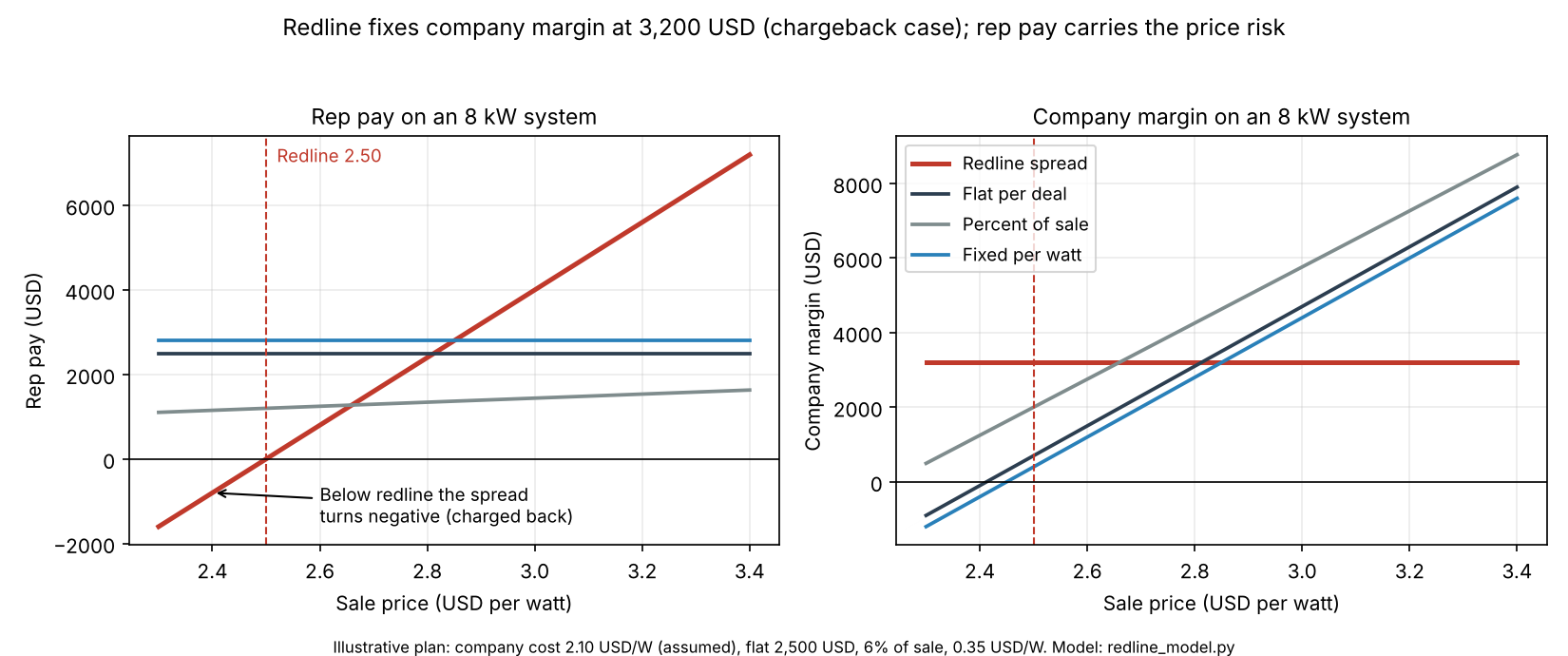
Figure 1. A redline holds company margin at 3,200 USD on an 8 kW system. Rep pay rises 8,000 USD for each 1 USD per watt of price. The other plans let company margin swing. The flat and per-watt plans go negative below about 2.41 and 2.45 USD per watt.
How do you calculate redline commission?
Multiply the spread above the redline by the system’s watts, then subtract any adders the plan charges to the rep.
- Convert system size to watts.
- Subtract the redline from the sale price per watt. This is the spread.
- Multiply the spread by the watts. This is gross rep pay.
- Subtract adders that your plan takes from the rep, such as a revision or a roof repair.
- For company margin, take the sale price, subtract rep pay, then subtract your own job cost.
Adders are costs or price changes beyond the base system. Scanifly says small items such as tree trimming, roof repairs or extra truck rolls "may be taken out of Rep commission". It puts the average revision at 750 USD. See adders.
Worked example: four plans on the same 8 kW sale
On a 2.50 USD per watt redline, rep pay on an 8 kW system runs from -800 USD to 6,000 USD. Price runs from 2.40 (below the redline) to 3.25.
Inputs are illustrative plan settings, not industry averages. The redline and the 3.00 USD example price are the figures in the Scanifly article. Company cost is our assumption: 2.10 USD per watt, so the redline leaves the company 0.40 USD per watt. The flat fee is 2,500 USD, the percentage is 6% and the fixed rate is 0.35 USD per watt. Each of these sits inside a range quoted above. The redline plan pays most at high prices and least at low ones. Rep pay comes first, in USD.
| Sale price (USD/W). Contract value | Redline spread | Flat 2,500 | 6% of sale | 0.35 USD/W |
|---|---|---|---|---|
| 2.40 (below redline). 19,200 | -800 | 2,500 | 1,152 | 2,800 |
| 2.50. 20,000 | 0 | 2,500 | 1,200 | 2,800 |
| 2.75. 22,000 | 2,000 | 2,500 | 1,320 | 2,800 |
| 3.00. 24,000 | 4,000 | 2,500 | 1,440 | 2,800 |
| 3.25. 26,000 | 6,000 | 2,500 | 1,560 | 2,800 |
Company margin on the same five sales comes next, in USD.
| Sale price (USD/W) | Redline spread | Flat 2,500 | 6% of sale | 0.35 USD/W |
|---|---|---|---|---|
| 2.40 | 3,200 | -100 | 1,248 | -400 |
| 2.50 | 3,200 | 700 | 2,000 | 400 |
| 2.75 | 3,200 | 2,700 | 3,880 | 2,400 |
| 3.00 | 3,200 | 4,700 | 5,760 | 4,400 |
| 3.25 | 3,200 | 6,700 | 7,640 | 6,400 |
The redline plan pays more than the flat fee only above 2.81 USD per watt. It beats the fixed rate above 2.85 and the 6% plan above 2.66. At 2.75 USD the redline rep earns 2,000 USD, below the flat and fixed plans but above the 6% plan. At 3.25 USD they earn 6,000 USD, more than any other plan.
System size changes the flat-fee comparison. At 2.90 USD per watt, the redline beats a 2,500 USD flat fee at 8, 12 and 20 kW but not at 6 kW.
| System size | Contract value at 2.90 USD/W (USD) | Redline rep pay (USD) | Flat 2,500 rep pay (USD) | Redline beats flat above (USD/W) |
|---|---|---|---|---|
| 6 kW | 17,400 | 2,400 | 2,500 | 2.92 |
| 8 kW | 23,200 | 3,200 | 2,500 | 2.81 |
| 12 kW | 34,800 | 4,800 | 2,500 | 2.71 |
| 20 kW | 58,000 | 8,000 | 2,500 | 2.63 |
Company margin under the redline equals rep pay at 2.90 USD per watt: 2,400, 3,200, 4,800 and 8,000 USD. Under the flat plan it is 2,300, 3,900, 7,100 and 13,500 USD.
Total value is the same under every plan: sale price minus company cost. The plan only decides how it splits. A 750 USD revision charged to the rep cuts 12 kW redline pay at 2.90 USD per watt from 4,800 to 4,050 USD. Company margin stays at 4,800 USD. Under the flat plan the company bears the cost, and its margin drops from 7,100 to 6,350 USD.
What happens when a rep sells below the redline?
The spread turns negative. The company still needs its minimum price, so the shortfall lands on the rep, on the company, or the deal is stopped.
Scanifly says that when the price falls from 3.00 to 2.75, "your commission drops", because the Installer gets the same fixed price. It does not say what happens below the redline. These are the options, and your agreement decides which applies.
- Charge back the shortfall: an 8 kW sale at 2.40 USD gives the rep -800 USD and the company 3,200 USD.
- Floor rep pay at zero: the rep gets 0 USD and the company margin falls to 2,400 USD, the 800 USD shortfall.
- Block or approve: the proposal needs sign-off before it goes out. This keeps the price from falling in the first place.
If pay has already gone out, recovering it is a clawback. See clawback.
Redline commission calculator
Enter size, sale price, redline and company cost to see rep pay and company margin under the redline plan and three alternatives.
It reproduces the tables above. It warns on empty, zero or out-of-range inputs, and on a price below the redline.
How solar software handles redline commission
Few company pages name redline. Enerflo says it does not calculate commission, and Solo and SolarSuccess are rated Partly. CaptivateIQ and Everstage do not mention redline on the pages read.
No: the company page says it does not. Partly: the page describes commission calculation or shows redlines but does not say it calculates redline pay. Not stated means redline was absent from the page read. It does not mean the tool cannot do it.
| Software | Does it calculate redline commission? |
|---|---|
| Enerflo | No |
| Solo | Partly |
| SolarSuccess (Blu Banyan) | Partly |
| CaptivateIQ | Not stated |
| Everstage | Not stated |
What each company page says is listed below, with the source checked October 2026 for each.
- Enerflo: A help article states "Enerflo does not calculate commission." Source: Enerflo help, Commission, dated 8 April 2026
- Solo: Help page answers yes and suggests an adder in the proposal side menu or a specific base price per watt. Redline is not named. Source: Solo help, "Can Solo calculate commissions for my reps".
- SolarSuccess (Blu Banyan): Blu Banyan solar CRM page says it gives accurate commission calculations and shows redlines, adders and milestone variables beside the project as sold. It does not say it calculates redline pay. Source: Blu Banyan solar CRM page.
- CaptivateIQ: Incentives page lists tiers, accelerators, bonuses, splits, overlays and draws. Solar and redline not mentioned on the page read. Source: CaptivateIQ Incentives page.
- Everstage: Solar commission guide describes flat, per-kW and tiered plans and names Everstage for tracking. Redline not mentioned on the page read. Source: Everstage solar sales commission page.
A general commission engine may model a spread if you set up the formula. A demo with your own redline sheet would show whether it does.
Common mistakes with redline pricing
FAQs
Is redline the same as a markup?
It is close. The redline is the base price, and the rep’s income is the spread between the sale price and that base. NRG Clean Power describes dealer income as that spread, but does not use the word markup. The sources read do not describe plans that split the spread with the company, so check your agreement.
How much do reps earn above redline?
NRG Clean Power, which sells dealer programmes, says dealers in 2026 typically earn 0.30 to 0.80 USD per watt above redline. It puts that at roughly 2,000 to 6,000 USD gross per deal. It describes this as "the honest range across programs we see", not a survey. The actual figure depends on the redline and the price the market bears.
Is redline pricing for employed reps or dealers?
Both. The sources cover reps selling for an installer (Scanifly) and dealers selling under an installer’s redline (NRG), but neither says which employment type applies. The maths is the same, but the tax and contract position may not be, so take advice.
Why would a company prefer redline to flat pay?
The company margin stays fixed per watt, so price cuts do not cost it money. In the example, a flat 2,500 USD fee leaves the company -100 USD at 2.40 USD per watt. The redline plan leaves it 3,200 USD if the rep is charged back for the shortfall. With a zero floor it leaves 2,400 USD.
Related terms
- Sales commission tracking: recording deals, payouts and disputes against a plan.
- Adders: extra costs or price items on top of the base system price.
- Clawback: recovering commission already paid when a deal fails or changes.
- Pricing / cost per watt: how system prices are quoted in USD per watt.
Next step: to apply a redline sheet to live deals, compare the best solar commission tracking software, or the best solar CRM if deals live there.
Sources
- Solar Power World, "How operations impact solar sales commissions" (sponsored content by Scanifly, 22 October 2024) (checked October 2026). Redline definition, 3.00 and 2.50 USD example, adders, 750 USD revision.
- NRG Clean Power, how to become a solar dealer in California (5 August 2026) (checked October 2026). Installer with a dealer programme. Redline as the spread. The per-watt range is the author’s own observation.
- Rework, solar unit economics and commissions (checked 30 October 2026). Flat per-deal range and 8% to 15% closer share.
- Rework, Solar Commission and Comp Design (checked 30 October 2026). Percentage range of 2.5 to 5 percent.
- Everstage, solar sales commission (checked 30 October 2026). Flat percentage, per-kW ranges, product wording.
- Enerflo help, Commission (8 April 2026, checked October 2026).
- Solo help, can Solo calculate commissions for my reps (checked October 2026).
- Blu Banyan, solar CRM page (checked October 2026).
- CaptivateIQ, Incentives (checked October 2026).
Last updated 30 October 2026. Next scheduled review: 30 January 2027.