Key takeaways
- One example 8.4 kW DC job gives 6 different per-watt figures, from 2.353 to 4.468 USD per watt. The price is the same, and only the basis changes.
- A base rate of 2.750 USD per watt DC (example) becomes 3.090 gross after adders and a discount.
- A 10 kWh battery takes it to 4.043. Example incentives then bring it to 3.306 net.
- The same 33,960 USD gross price is 4.043 per watt on 8,400 W DC. On a 7,600 W AC rating (example) it is 4.468. That is 10.5% higher.
- Published studies state their basis. The 2019 Berkeley Lab report uses DC watts and prices before incentives. The 2023 NREL benchmark uses DC watts and leaves out financing and owner tax credits.
- Of 5 tools checked, 4 document a base per-watt rate, and only Aurora documents a choice between 4 per-watt figures.
To set and show a base rate inside a proposal, see the best solar proposal software.
Price per watt at a glance
Price per watt is a price divided by watts. People often say cost per watt loosely for price. It is a ratio, so the same job has several values until you fix the basis.
| Item | Detail |
|---|---|
| Formula | Price per watt = price in USD ÷ system watts. Total price = rate × watts, plus adders. |
| Unit | USD per watt (PPW). Multiply by 1,000 for USD per kW. |
| Size basis | DC watts of module ratings in the three sources below. An AC inverter rating usually gives a higher rate when DC exceeds AC. See kilowatt and megawatt and DC/AC ratio. |
| Price basis | Gross (before incentives) or net (after). The label must say which. |
| Rule or standard | Set by whoever publishes the figure. Each study and tool states its own basis. |
| In software | A base rate per watt, then adders, discounts, incentives and storage. See the software table. |
This page is about the price you charge a buyer. Your own cost per watt is a margin figure: see job costing. For software subscription prices, see quote-only pricing.
Why does price per watt matter for installers?
It lets you compare quotes of different sizes, set a sales floor and sense-check an estimate. It misleads when the basis is different.
- Comparing quotes: a rate puts a 6 kW and a 12 kW job on one scale, before you consider fixed costs.
- Pay plans: a redline is a minimum rate per watt. See redline pricing.
- Estimates: a widget turns a size into a price with a rate. See instant estimates.
What counts toward price per watt, and in which watts?
Gross price per watt counts what the buyer is charged before incentives. Net subtracts incentives. Say whether the battery is in, and use DC watts unless you label otherwise.
| Line | Treatment |
|---|---|
| Base system | In gross and net |
| Adders and discounts | In gross and net |
| Battery | Your choice, so label it |
| Incentives | Out of gross, taken off in net |
| Loan fees | Not in a cash price |
| Sales tax, optional work | Check each source |
What the sources say about each line:
- Base system: Aurora’s help describes system price as a base rate multiplied by the STC system size in watts.
- Adders and discounts: see adders. Solargraf’s help lets each extra cost or discount be set before or after incentives.
- Battery: Aurora’s help lists a gross figure with storage and one without. OpenSolar’s help prices batteries by kWh inside its per-watt scheme. See battery storage design.
- Incentives: EnergySage’s help page and the 2019 Berkeley Lab report both give price before incentives. Company "gross" labels can differ, because Aurora’s help lists incentives among the inputs of its gross options. See incentives and rebates.
- Loan fees: Aurora’s gross figures add dealer or service fees tied to the loan, per its help page. See solar loan.
- Sales tax, optional work: the 2023 NREL benchmark lists sales tax in its modelled residential cost. It leaves out optional items such as extra electrical work, financing and extra roofing. Per the 2019 Berkeley Lab report (page 28), many states exempt PV from sales tax, which means a gap of up to 0.3 USD per watt across states.
DC is the usual basis. The Berkeley Lab report converts system size to DC nameplate under standard test conditions. The NREL benchmark states its unit in direct-current watts. Aurora multiplies its base rate by STC watts.
The 2019 Berkeley Lab report left third-party-owned systems out of its installed-price analysis. Their reported prices cannot be compared with host-owned prices. A lease or power purchase payment is not a purchase price. See solar lease and third-party ownership.
How do you calculate price per watt?
Add up the price lines you want in scope, then divide by watts. Repeat for each basis you will state.
- Fix the size. Modules × rating gives DC watts. For example, 20 × 420 W is 8,400 W.
- Price the base: base rate × DC watts.
- Add per-watt, fixed and percentage adders. Subtract discounts. This is gross, solar only.
- Add the battery if it is in scope.
- Subtract incentives to reach net.
- Divide each total by DC watts. Divide by inverter AC watts only if you label it AC.
Tools apply these steps in their own order. OpenSolar’s project pricing page lists six steps, from the pricing scheme to rounding and overrides. Quantities come from a bill of quantities or bill of materials. The rate is a ratio built on top.
Worked example: one 8.4 kW job, six per-watt figures
On example inputs, one job runs from 2.353 to 4.468 USD per watt. The system is 20 modules of 420 W (8,400 W DC) with a 7,600 W AC inverter. Nothing here is a market price.
Example inputs: base 2.75 USD per watt DC, roof adder 0.15 USD per watt, panel upgrade 2,100 USD, discount 500 USD. Battery: 10 kWh at 800 USD per kWh. Example incentives: 20% of the solar-only gross price, plus 1,000 USD.
| Line (all values example) | USD | USD per watt DC |
|---|---|---|
| Base price, 8,400 W | 23,100 | 2.750 |
| Roof adder | 1,260 | 0.150 |
| Panel upgrade | 2,100 | 0.250 |
| Discount | -500 | -0.060 |
| Gross, solar only | 25,960 | 3.090 |
| Battery, 10 kWh | 8,000 | 0.952 |
| Gross, with battery | 33,960 | 4.043 |
| Incentives (5,192 + 1,000) | -6,192 | -0.737 |
| Net, with battery | 27,768 | 3.306 |
Each per-watt figure is its USD value divided by 8,400, rounded to three places. A column may therefore miss its total in the last digit. The six figures a buyer or colleague could call "the price per watt" are below.
| Figure | Price (USD) | Divided by | USD per watt |
|---|---|---|---|
| Base rate | 23,100 | 8,400 W DC | 2.750 |
| Gross, solar only | 25,960 | 8,400 W DC | 3.090 |
| Gross, with battery | 33,960 | 8,400 W DC | 4.043 |
| Net, solar only | 19,768 | 8,400 W DC | 2.353 |
| Net, with battery | 27,768 | 8,400 W DC | 3.306 |
| Gross, with battery, AC basis | 33,960 | 7,600 W AC | 4.468 |
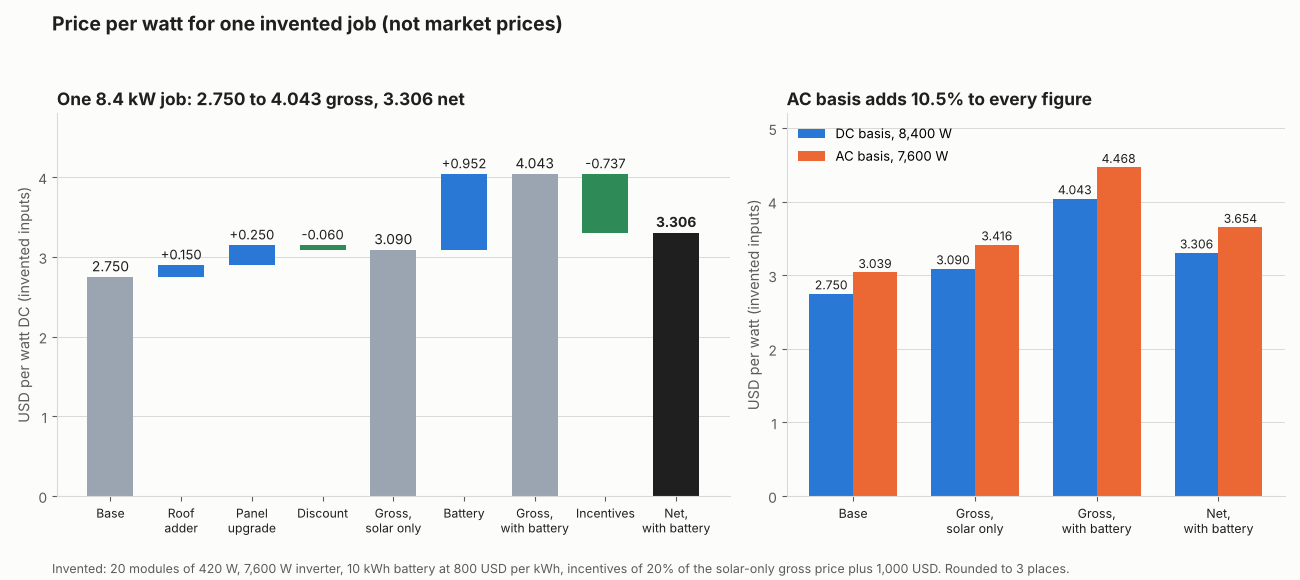
Figure 1. In this example job the battery adds 0.952 USD per watt and example incentives remove 0.737. An AC basis lifts every figure by 10.5%.
Per watt, per kWh or total price: which one?
Use the total for budget, the rate for comparing sizes, and a per-kWh figure for batteries. Each fails somewhere. Values below are from the example job.
| Measure | Example value | Best for | Misleads when |
|---|---|---|---|
| Total price | 33,960 USD gross | Budget and cash flow | Sizes differ |
| Price per watt DC | 3.090 USD solar only | Comparing sizes and bids | Fixed costs sit in the rate. The 2,100 USD panel upgrade is 0.350 USD per watt on 6 kW and 0.175 on 12 kW. |
| Battery price per kWh | 800 USD per kWh | Comparing battery options | Installation scope differs |
For lifetime cost per kWh, see LCOE, and for modelled output see energy yield simulation. For published cost and price benchmarks, see capex and opex.
Price per watt calculator
Enter size, a base rate, adders, a battery and incentives. It shows gross and net per watt on a DC and an AC basis. It reproduces the tables above. It also shows the price per first-year kWh, using a yield you enter.
If the calculator does not load, run the price per watt calculator on its own page.
How solar software handles price per watt
Aurora is the only tool whose help describes a choice between per-watt figures, and Solargraf documents per-watt discounts but no base rate. Ratings follow each company’s own help page, checked October 2026.
| Software | Per-watt pricing documented? |
|---|---|
| Aurora Solar | Yes |
| OpenSolar | Yes |
| Solo | Yes |
| Scanifly | Yes |
| Solargraf | Partly |
- Aurora Solar: A base rate per watt applies to every design, multiplied by STC system size. A setting shows a per-watt dropdown with 4 options: base, system with storage, gross without storage, gross with storage. The help text for the system and both gross options lists incentives among the inputs. Storage is priced per battery or as a flat amount. Page read: Aurora help, pricing account configuration, updated 6 May 2026
- OpenSolar: A Price Per Watt scheme multiplies kW by the per-watt rate and adds battery kWh times a per-kWh rate. Other schemes: markup percentage, price per watt by size, fixed price. Per-watt display setting: not stated. Page read: OpenSolar support, how project pricing works, updated 1 October 2026
- Solo: A default base rate per watt, with separate cash and financed rates, plus optional rules by state, system size or finance option. Battery and display handling: not stated. Page read: Solo help, MissionControl: Pricing, dated 6 August 2025
- Scanifly: The base price is a rate per watt for every design, or module tier pricing. Incentives are applied as discounts against system cost. Batteries are not mentioned. Page read: Scanifly help, Price a Proposal with Equipment and Adders, no date printed
- Solargraf: Discounts and extra costs can be calculated per watt on system size. Battery price is a flat amount per battery size. Base rate per watt: not stated on these pages. Page read: Solargraf help, discounts and extra costs, and setting up battery pricing, both published 10 December 2021, so may be dated
Not stated: the company page we cite does not say. Partly: the pages cover per-watt discounts but not a base rate. To compare tools that state a clear per-watt basis in proposals, see the best solar proposal software.
Common mistakes with price per watt
FAQs
Is price per watt before or after incentives?
Before incentives, in the sources cited. The 2019 Berkeley Lab report and EnergySage’s help page give price before incentives. Aurora’s help lists incentives among the inputs of its system and gross figures, so check what each option includes.
Is price per watt DC or AC?
DC in the sources cited here: Berkeley Lab, NREL and Aurora use DC or STC watts. An AC rating usually gives a higher number when DC exceeds AC (10.5% in the example job), so state the basis.
Why is price per watt higher on small systems?
Fixed costs are spread over fewer watts. Take the example job with the same base rate and adders. Gross solar-only price is 3.167 USD per watt on 6 kW and 3.033 on 12 kW. The panel upgrade alone is 0.350 against 0.175.
Are cost per watt and price per watt the same?
Not always, though people often use cost per watt loosely for price. Price is what the buyer pays. Cost is what the work costs you, and the gap is margin. The NREL benchmark separates modelled cost from reported prices. See job costing.
Related terms
- Adders: priced extras on top of the base rate.
- Solar incentives and rebates: the amounts that turn gross into net.
- Payback period: how price per watt feeds the time to recover a price.
- Balance of system: everything in a plant except the modules.
Next step: restate one recent quote as gross, DC and solar only, then see how tools show that rate in the best solar proposal software.
Sources
- EnergySage help: Price per watt, no date printed for the definition (checked October 2026).
- Berkeley Lab, Tracking the Sun, 2019 Edition. The lab lists it as November 2019 (checked October 2026). Full title: Pricing and Design Trends for Distributed PV in the United States. The sales-tax passage was read on page 28 of the Penn State copy of the PDF (checked 30 October 2026).
- NREL, U.S. Solar Photovoltaic System and Energy Storage Cost Benchmarks, With Minimum Sustainable Price Analysis: Q1 2023, NREL/TP-7A40-87303, September 2023 (checked October 2026). The lab is now the National Laboratory of the Rockies, renamed 1 December 2025. A Q1 2025 benchmark dataset exists under the lab’s new name, published 22 December 2025, so check it for a more current figure before quoting a specific rate.
- Aurora help: Pricing in New Aurora Account Configuration, updated 6 May 2026 (checked October 2026).
- OpenSolar support: How project pricing works, updated 1 October 2026 (checked October 2026).
- Solo help: MissionControl Pricing, dated 6 August 2025 (checked October 2026).
- Scanifly help: Price a Proposal with Equipment and Adders, no date printed (checked October 2026).
- Solargraf help: Discounts and extra costs and Setting up battery pricing, both published 10 December 2021 (checked October 2026).
Last updated 3 November 2026. Next scheduled review: 30 January 2027.