Key takeaways
- The sum is main breaker + solar source, compared with 1.2 x the busbar rating. A 200 A bus with a 200 A main leaves 40 A, as Show Me Boone County’s guide prints it.
- The wording differs by checklist. Rancho Cucamonga (CEC 2025) and Escondido use overcurrent device (OCPD) ratings. NREL’s 2017 NEC form and SolarAPP+ use 125% of the output current.
- All numbers below are invented. A 200 A bus with a 150 A main leaves 90 A of headroom. That is up to 72 A of inverter output on the 125% method.
- Four fixes: lower the main, raise the bus rating, shrink the solar source or connect supply-side. SolarAPP+ also names three other load-side methods.
- Plan sets should print the bus rating, main rating and solar breaker. They should also print the sum, its limit and the breaker position.
To print this check on a plan set, see the best solar SLD software.
Busbar 120% rule at a glance
The rule caps the total of a main breaker and a back-fed solar breaker on one busbar. It is one of several load-side methods.
| Item | Detail |
|---|---|
| Formula (125% wording) | Main breaker + 1.25 x inverter continuous output current <= 1.2 x busbar rating. |
| Formula (breaker wording) | Main breaker + back-fed breaker rating <= 1.2 x busbar rating. Riverside’s form (Rev 07/2021) prints it. Rancho Cucamonga (CEC 2025) and Escondido print the sum of the main and the "inverter OCPD" instead. |
| Placement | When the sum is above the bus rating, the solar breaker goes at the opposite end of the bus from the main. Wiles (IAEI, 16 July 2008) says this location "prevents overloading the busbar". He writes about the 2008 NEC commercial case. |
| Section as printed | Printed section numbers differ by source. The section-numbers table before the FAQs lists them. |
| Does not apply to | Supply-side connections made ahead of the main. |
Why does the busbar 120% rule matter?
It sets the largest solar breaker a panel can take. A design that fails it gets a plan-check correction. The fix can change the scope of the job.
Wiles (IAEI, 2008) says the 2005 NEC limits on back-fed breakers "were established in 1984" to protect buses from overload. Breaker size itself comes from the inverter, as the overcurrent protection page shows.
The choice to upgrade a panel, and what design tools flag, are on the main panel upgrade page. This page covers the arithmetic and the alternatives.
How do you calculate the busbar 120% rule?
Add the main breaker rating to 125% of the inverter output current. Compare the total with 120% of the busbar rating. If the total is within the limit, the rule is met.
- Read the busbar rating from the panel label. It can differ from the main breaker. SolarAPP+ lists correcting a mistyped busbar rating among the fixes for its 120% error.
- Read the main breaker rating.
- Add the continuous output current of all inverters. Murrieta’s 2020 NEC checklist asks for this sum.
- Multiply by 1.25. The NREL (2017 NEC) form words it as "the sum of 125 percent of the power source(s) output circuit current".
- Add the main breaker. Compare with 1.2 x the busbar rating. Headroom = 1.2 x bus - main.
- Place the solar breaker at the opposite end of the bus. Riverside’s form applies this when the devices feeding the panel add up to more than 100%.
In our reading, the two wordings differ only by the round-up to a breaker size. Take a 30 A output, a 200 A bus and a 200 A main (example). The 125% form gives 237.5 A. A 40 A breaker gives 240 A. Both pass. Rancho Cucamonga’s checklist (Revision D, 2 February 2026, CEC 2025) says "inverter OCPD", which is shorthand.
Centre-fed panels differ. Escondido’s checklist (January 2022) says the 120% rule check assumes a panel that is not centre-fed. NREL’s 2017 NEC form has a separate centre-fed condition.
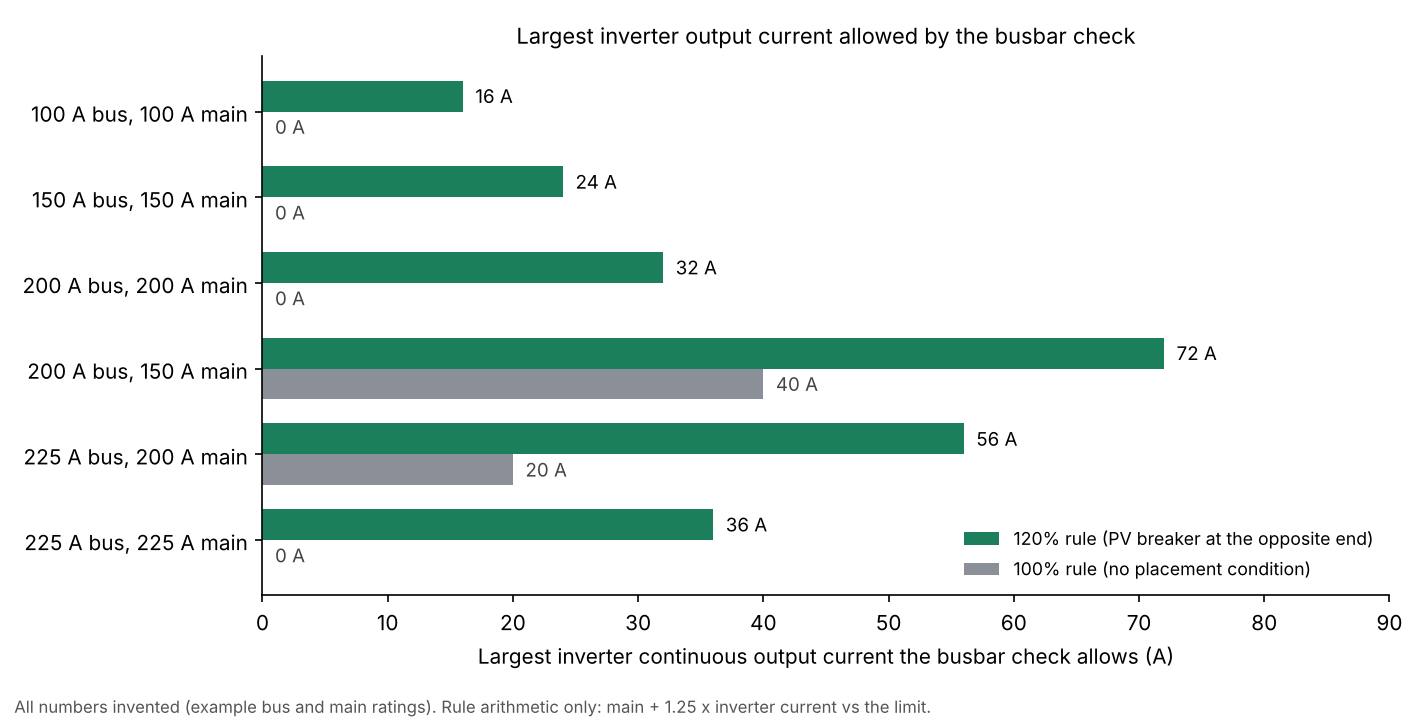
Figure 1. Under the 120% rule, a 200 A bus takes up to 72 A of inverter output with a 150 A main. With a 200 A main it takes 32 A.
Worked example: one panel, five cases
With a 200 A bus and a 200 A main, only 40 A of solar breaker fits. A 150 A main leaves 90 A. All numbers below are example.
| Case and panel | Inverter output | Main + 125% of output against 120% of bus | Meets 120%? | Meets 100%? |
|---|---|---|---|---|
| A (example): 200 A bus, 200 A main | 32 A | 200 + 40 = 240 A against 240 A | Yes | No |
| B (example): 200 A bus, 200 A main | 48 A | 200 + 60 = 260 A against 240 A | No, over by 20 A | No |
| C (example): 200 A bus, 150 A main | 48 A | 150 + 60 = 210 A against 240 A | Yes | No |
| D (example): 225 A bus, 200 A main | 48 A | 200 + 60 = 260 A against 270 A | Yes | No |
| E (example): 100 A bus, 100 A main | 48 A | 100 + 60 = 160 A against 120 A | No, over by 40 A | No |
Case A fits exactly, with no spare headroom. Case B is over by 20 A. Case C is case B with a 150 A main, which passes. Case D keeps the 200 A main and raises the bus to 225 A, which passes. Case E is a 100 A panel. Its main would have to fall to 60 A, so a supply-side connection is the likelier fix.
Cases A, C and D pass the 120% rule but fail the 100% rule. That is why placement matters: the allowance above 100% depends on it. Check the arithmetic with the calculator below.
Busbar 120% rule calculator
Defaults are example. The calculator uses the 125% wording. It shows the breaker reading if you enter a planned breaker.
What can you do when the rule fails?
You can lower the main, raise the bus rating, connect on the supply side or shrink the solar source. The numbers below use example case B. It has a 200 A bus, a 200 A main and a 48 A inverter output.
| Option | Effect on case B | What the pages say |
|---|---|---|
| Lower the main breaker (derate) | The main can be at most 180 A (1.2 x 200 - 60). The next standard size down is 175 A. | SolarAPP+ lists derating the main as a fix (8 April 2026). See the note below the table for Riverside’s conditions. |
| Raise the busbar rating | The bus must be at least 216.7 A (260 / 1.2). Case D uses 225 A. | See main panel upgrade for when and why. |
| Supply-side connection | The busbar sum is not used. | Murrieta’s checklist (August 2025, 2020 NEC) lists a meter socket adapter and a disconnect marked as service equipment, plus an OCPD within 10 ft. |
| Smaller solar source | The inverter output must be at most 32 A. | SolarAPP+ lists reducing the PV or ESS OCPD as a fix. |
| Another load-side method | Depends on the method. | SolarAPP+ (30 August 2025) names the 100% rule, the sum of breakers rule and a power control system. Case B fails the 100% rule too. |
- Riverside. Its form (Rev 07/2021) allows a lowered main only with load calculations and a placard: "No up-sizing is permitted." It does not allow supply-side taps at this time.
- Taps. Makers of combined meter and load centres often refuse them (Wiles, 2008).
How do plan sets show the calculation?
They print the inputs and the result where a reviewer can repeat the sum. The pages cited ask for the bus rating, main breaker, solar breaker and supporting calculations.
- Dublin, CA (file marked Rev 2026, 2025 CEC): the single line diagram shows "details of main breaker" and "PV breaker and rating of bussing".
- Riverside County (Rev 07/2021): supporting calculations and a note that the back-fed breaker goes at the opposite end. A lowered main also gets a placard.
- Murrieta (checklist dated August 2025, SolarAPP+ stamp 07-24-2023, 2020 NEC): busbar rating, main OCPD and a 125% line. The sample entry shows 25.19 A of inverter current and 31 A. It also asks about a derate or panel upgrade.
- Rancho Cucamonga (Revision D, 2 February 2026): calculations for the solar breaker size at permit issuance.
An SLD note could read (example numbers): "BUS 200 A. MAIN 150 A. PV 60 A, opposite end. 150 + 1.25 x 48 = 210 A, limit 240 A." Label wording is on the labels and placards page. See also the permit plan set page.
How solar software handles the busbar 120% rule
Two company pages mention the check: SolarAPP+ checks the rule, and Aurora Solar checks it in part. A useful tool works the sum from bus, main and inverter data and says which method it used.
| Software | Does it check the 120% rule? | Method (on-site / remote / modelled) |
|---|---|---|
| SolarAPP+ | Yes | Modelled from entered data |
| Aurora Solar (Instant Plan Sets) | Partly | Modelled from entered data |
Partly: the help page mentions the rule but not a full main-panel calculation. How and where each tool does it, with notes:
- SolarAPP+. Raises error R749 when the project’s numbers do not pass the 120% rule. Suggests reducing the PV or ESS OCPD, derating the main or correcting the busbar rating. Help article last updated 8 April 2026. Permit-side tool, for adopting AHJs.
- Aurora Solar. Hides the subpanel tie-in option if it "would violate the 120% rule". Says a traditional main panel tie-in will not be an option if a de-rate is needed. Help article, no date printed. A main-panel 120% calculation is not described.
For wider comparisons, read the best solar SLD software and best solar permitting software lists.
Common mistakes with the busbar 120% rule
Section numbers as printed
These are the section numbers as printed, by source. Your AHJ’s adopted edition decides which applies.
| Source | NEC edition as stated | Section as printed |
|---|---|---|
| Riverside form (printed as CEC) | Not stated | 705.12(D)(2) |
| IAEI (2013) | Not stated | 705.12(D)(2) |
| NREL form | 2017 NEC | 705.12(B)(2)(3)(b) |
| SolarAPP+ help pages (2025 and 2026) | Not stated | 705.12(B)(2) |
| Solar Builder article | 2020 NEC | 705.12(B)(3)(2) |
| GreenLancer (5 October 2026) | 2020 NEC. 2023 NEC | 705.12(B)(3)(2). 705.12(B)(2) |
Not stated means the source we cite does not print an edition. Where a row lists two editions, the sections follow in the same order. GreenLancer says the 120% method "was 705.12(B)(3)(2) in the 2020 NEC and is 705.12(B)(2) in the 2023 NEC". We did not read NFPA’s text, so confirm the section in your AHJ’s adopted edition.
FAQs
Does the 120% rule apply to a supply-side connection?
No. A supply-side connection is made ahead of the main, so the busbar sum is not used. It has its own rules, such as the ones on Murrieta’s 2020 NEC checklist. Some AHJs do not accept it.
What is the largest solar breaker on a 200 A panel?
On a 200 A busbar, it is 40 A with a 200 A main (Show Me Boone County’s guide). It is 90 A with a 150 A main (breaker method, computed here). On the 125% method the inverter output limits are 32 A and 72 A.
Does the rule apply to a sub-panel?
It can. SolarAPP+’s R749 article (8 April 2026) says the error "can be triggered by any busbar in your project, not just the main service panel". Aurora hides its sub-panel tie-in option if it would break the rule. SolarAPP+’s busbar-quantity article (27 April 2026) tells users to count any box with breakers for building loads as a busbar.
Do batteries count toward the sum?
Yes, if the battery system back-feeds the same busbar. SolarAPP+’s error article lists the ESS OCPD rating among the inputs. Your AHJ’s checklist decides how a battery inverter is added.
Related terms
- Main panel upgrade: when a bigger panel or another fix is chosen.
- Overcurrent protection (OCPD): how the solar breaker itself is sized.
- Labels and placards: the warning text at the solar breaker.
Next step: print the bus, main and solar breaker on the SLD, then run the sum in a tool that flags it. See the best solar permitting software, or the best solar SLD software for the drawing.
Sources
This page draws on AHJ checklists, SolarAPP+ help pages and trade articles, not the code text. Section numbers are as printed on each page, with the edition where the page gives one.
- SolarAPP+ help: Received an Error Message R749.0 "120% rule" (last updated 8 April 2026, checked October 2026).
- SolarAPP+ help: point of interconnection compliance method (last updated 30 August 2025, checked October 2026).
- SolarAPP+ help: busbar quantity (last updated 27 April 2026, checked October 2026).
- NREL SolarAPP+ example approval document, NEC 2017 PV (eligibility page dated 09/07/2021, checked October 2026).
- City of Murrieta, IB-133 SolarApp inspection checklist (August 2025, 2020 NEC, checked October 2026).
- City of Rancho Cucamonga, Standards for Residential PV, Revision D (2 February 2026, CEC 2025, checked October 2026).
- County of Riverside, Photovoltaic Permitting Guidelines, form 284-079 (Rev 07/2021, checked October 2026).
- City of Escondido, Information Guideline 24A (January 2022, checked October 2026).
- City of Dublin, Residential Photovoltaic System checklist (file marked Rev 2026, no date printed, checked October 2026).
- Boone County, Missouri, Guidelines for Residential Solar PV Permits (no date or code edition printed, checked October 2026).
- Wiles, Grid Interconnections, IAEI Magazine (July/August 2008, posted 16 July 2008, checked October 2026).
- GreenLancer, 120% rule for solar (5 October 2026, secondary source for the 2020 and 2023 NEC sections, checked 30 October 2026).
- Greef, PV Load-Side Feeder Taps, IAEI Magazine (September/October 2013, edition not named, checked October 2026).
- Mayfield, NEC 2020 Code Corner, Solar Builder (no date printed, checked October 2026).
- Aurora Solar help: Instant Plan Sets (no date printed, checked October 2026).
Last updated 30 October 2026. Next scheduled review: 30 January 2027.