Key takeaways
- Mersen and Eaton call for string fuses at 3 or more strings. A Utah checklist asks for them above two. Wiles says calculate.
- A string cannot overload itself, but parallel strings can push current into a faulted one.
- Invented example: a 10.4 A Isc module with a 20 A fuse limit needs no string fuse at 2 strings (13.0 A). It does at 3 (26.0 A).
- The fuse must sit inside a window. The floor is 1.56 x Isc / Kf. The ceiling is the lower of the module’s maximum series fuse and the conductor limit.
- Fuses and breakers must be DC-rated and listed for PV. AC breakers on the inverter output are a separate check.
To draw OCPD ratings on a single line diagram, see the best solar SLD software. Only Aurora’s SLD editor shows a fuse rating field in our table below.
Overcurrent protection at a glance
OCPD covers string fuses, combiner fuses, DC breakers and the AC breaker at the inverter output. Each one needs a current rating and a DC or AC voltage rating.
| Item | Detail |
|---|---|
| What it is | A fuse or circuit breaker. Wiles (IAEI, 2008) treats them as equivalent here. |
| Where it sits | At each string, at a combiner output, on a DC breaker, and at the AC output of the inverter. |
| Sizing inputs | Module Isc, the two 125% steps that Mersen and Eaton combine as 1.56, a temperature factor Kf, the module maximum series fuse rating, the conductor limit and the system voltage. |
| Standard or rule | The code edition your AHJ adopted (see NEC 690). Mersen’s note covers the 2017 NEC. The Utah checklist cites the 2020 NEC. |
| In software | Tools show breaker or fuse ratings on the diagram. Few document a sizing check. See the table below. |
Why does PV need overcurrent protection?
A module is a current-limited source, so one string cannot overload its own wiring. Other sources can: parallel strings, inverter failure and batteries.
EC&M (Mike Holt, 17 July 2024) says "OCPDs are required for PV system circuit conductors connected at one end to a current-limited supply". Under 690.9(A)(1), as printed, they are not required where "The PV system DC circuit conductors have an ampacity of at least the DC current per Sec. 690.8(B)." or where "the currents from all PV sources do not exceed the OCPD rating specified by the manufacturer". The article does not name an edition.
Wiles (IAEI Magazine, posted 16 May 2008) is older background and was written for the NEC of that era. It gives the three-string case. If one string faults, the other two can each deliver up to 1.25 x Isc into it. Eaton’s guide adds that unpredicted fault currents may arise from inverter failure or batteries connected to the strings.
This "backfeed" is current from other strings. A back-fed breaker on a main panel is a different issue. See the busbar 120% rule and labels and placards pages.
When is OCPD required for PV strings?
The answer turns on how many strings share a circuit and on two limits: the module’s maximum series fuse rating and the conductor. The documents below agree on three or more strings and differ on two. The newest is listed first, and the Wiles article is kept as history.
| Document and date | What it says about strings |
|---|---|
| Utah residential checklist hosted by Midway City (header "updated 8-8-2021", 2020 NEC) | "If more than two strings (DC source circuits) are to be combined together, please specify 15 amp or 20A DC fuses". |
| Mersen note TT-PVPN5, copyright 2018 (2017 NEC) | One string: no fuse if no external sources and cables are rated at 1.56 x Isc or more. Two strings: no fuse if fault currents stay within conductor ampacity or the module’s maximum series fuse rating. Three or more: "fusing required". |
| Eaton Bussmann PV application guide (publication BR132006EN, March 2015, on a third-party copy) | "PV systems that have three or more strings connected in parallel need to have each string protected." |
| Wiles, IAEI Magazine, posted 16 May 2008 (US, NEC of that era) | One or two strings: generally no OCPD in the DC wiring. Three or more: calculate. Compare 2 x 1.25 x Isc with the module’s marked fuse rating and the conductor. With Isc 5 A and a 15 A marking, the other strings deliver 12.5 A and "no fuses are required". With Isc 8 A, they could send 20 A, above the 15 A marking, so fuses are needed. |
The Utah checklist asks for fuses with "more than two" strings. Mersen’s two-string exception reads "or", while Wiles compares with both limits. This page flags a string if backfeed goes over either one.
The check follows Wiles. It is a minimum test, not a way around the 3-string rule. It runs in this order.
- Backfeed into one string = (N - 1) x 1.25 x Isc, where N is the strings in parallel.
- Limit = the lower of the module’s maximum series fuse rating and the conductor limit.
- If backfeed is above the limit, fuse each string. Eaton recommends fuses in both positive and negative cables.
- If backfeed is within the limit, no string fuse follows from this check. Check the combiner output and any battery or inverter source separately.
Under the Wiles-style check, the most strings with no string fuse is 1 + the whole number in limit / (1.25 x Isc).
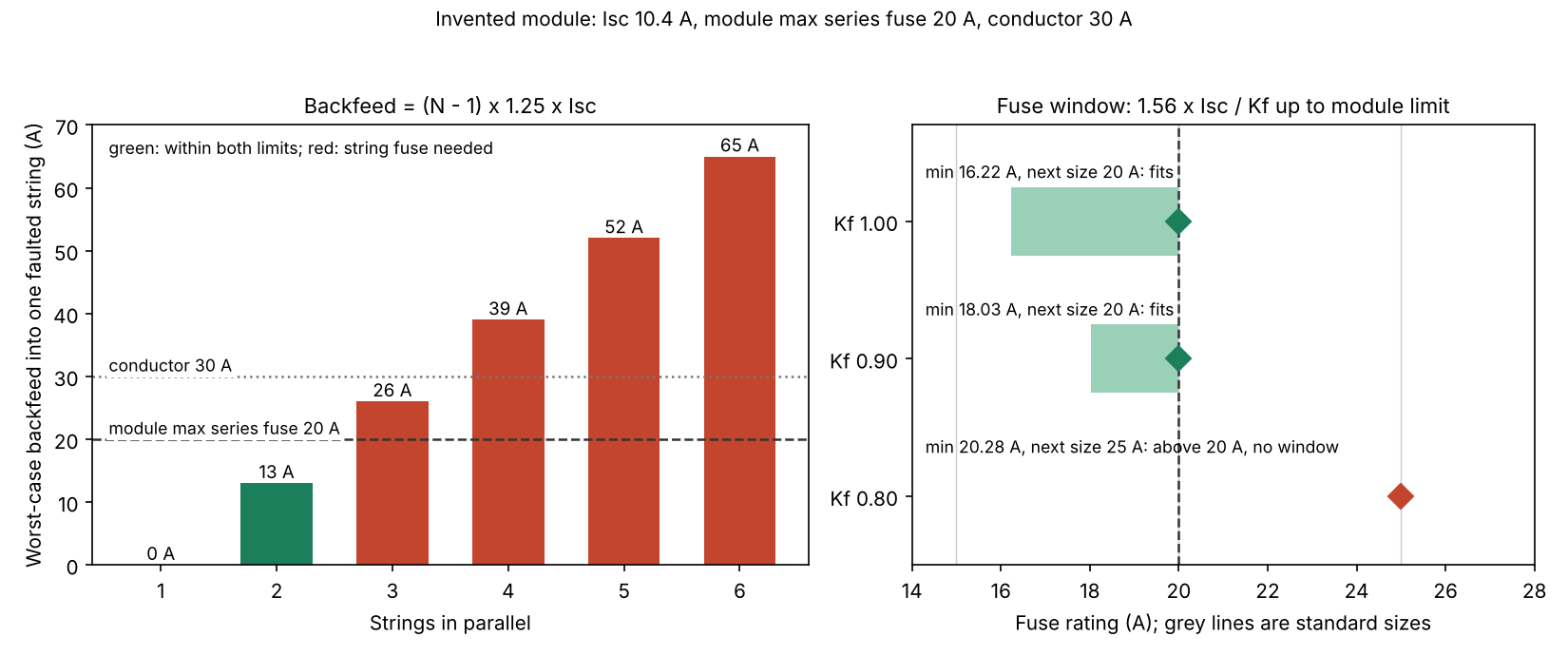
Figure 1. With example inputs, backfeed passes the 20 A limit at 3 strings, and a Kf of 0.80 leaves no standard fuse in the window.
How do you size a string fuse? A worked check
Find the minimum from Isc, round up to a standard size, then check the module and conductor limits. Mersen’s note and Eaton’s guide both work this way.
- Minimum rating = 1.56 x Isc / Kf. Mersen’s note cites two 125% rules (690.8(A)(1) and 690.9(B)(1)) and uses 1.56. The two factors multiply to 1.5625 (see Voc and Isc).
- Round up to the next standard size. EC&M says the next standard size up is permitted.
- Check the fuse is no larger than the module’s maximum series fuse rating and the conductor limit.
- Check the voltage. Eaton’s guide uses at least 1.2 x Voc x modules in series. The Utah checklist asks for devices designed for the maximum DC voltage.
Kf is a temperature factor. Mersen applies it for sustained ambients above 40 °C and reads 0.90 from its chart at 50 °C ambient. The cases below use example values. Cases A to F change one input at a time. Fits means the next standard size sits inside the window, not that the design is signed off.
| Case | Inputs | Backfeed | String fuse needed? | Minimum, next size, and window check |
|---|---|---|---|---|
| A (example) | Isc 10.4 A. 2 strings. Module limit 20 A. Conductor 30 A | 13.0 A | No, under 20 A | 16.22 A, 20 A. No string fuse from this check. |
| B (example) | As A, 3 strings | 26.0 A | Yes | 16.22 A, 20 A. Fits: 20 A is inside 16.22 to 20 A. |
| C (example) | As A, 4 strings | 39.0 A | Yes, above both limits | 16.22 A, 20 A. Fits, same size. |
| D (example) | As B, module limit 15 A | 26.0 A | Yes | 16.22 A, 20 A. No fit: the minimum is above the 15 A module limit. |
| E (example) | As B, Kf 0.90 | 26.0 A | Yes | 18.03 A, 20 A. Fits. |
| F (example) | As B, Kf 0.80 | 26.0 A | Yes | 20.28 A, 25 A. No fit: 25 A is above the 20 A module limit. |
Cases G and H recompute the two published examples. Not stated means the source or page we read does not give that figure or guidance.
| Case | Inputs | Backfeed | Minimum, next size, and result |
|---|---|---|---|
| G (Mersen example) | Isc 5.75 A. Kf 0.90 | Not stated | 9.97 A, 10 A. Mersen’s answer: 10 A. |
| H (Eaton example) | Isc 5.37 A. Voc 43.1 V. 18 in series. 4 strings. Module limit 15 A. Cable 11.5 A | 20.1 A, above the 11.5 A cable | 8.38 A, 10 A. Eaton picks 10 A, 1,000 V. Voltage minimum is 931 V. |
Case D is the conflict Wiles flags: some module markings fall below 1.56 x Isc. In A to F the voltage minimum is 972 V (1.2 x 45.0 V x 18, example).
The fuse must also be DC-rated. Penn State’s AE 868 lesson (undated) says OCPD must be listed and rated for DC. It says automotive fuses may not be used. Eaton’s October 2018 catalog prints 600, 1,000 and 1,500 V DC families, and 50 kA ratings for its PV 10 x 38 mm fuses.
String fuse calculator
Defaults are example.
Where does OCPD appear in the plan set?
On the single line diagram as ratings, and in the equipment schedule and labels. The Utah checklist asks for these items.
- The ratings of all breakers or fuses, DC and AC (checklist item 20).
- Fuse ratings for each string where strings are combined (item 27).
- The DC fuse ratings in the inverter specification, if any (item 49).
- A DC combiner listed to UL 1741. Over 30 A output needs a disconnect (items 65 and 66, see DC disconnect).
- A sign at any breaker back-fed by the PV system (item 79).
See also three-line diagram, permit plan set and combiner box.
How solar software handles overcurrent protection
Only Aurora’s SLD editor, for Europe, documents a fuse rating field. Solargraf and Aurora’s Instant Plan Sets cover breakers in part, and no page documents a sizing check for string fuses.
| Tool | Breaker or fuse on the diagram? | Sizes it? |
|---|---|---|
| Solargraf | Partly | Partly |
| Aurora Solar (Instant Plan Sets) | Partly | Not stated |
| Aurora Solar (SLD editor, Europe only) | Yes | Not stated |
Partly means the page covers breakers or wire sizes but not string fuses. What each page says, and its limits:
- Solargraf: permit settings help article, "Published on 19 Mar 2026": lets users exclude breaker sizes when generating single line diagrams. If a 35A breaker is unavailable, "Solargraf will automatically use the next available breaker size (e.g., 40A)", recalculating wire sizes. Fuses, string fuses and OCPD are not mentioned.
- Aurora Solar (Instant Plan Sets): help page (no date): "OCPD" appears as a column in the circuit table, with no explanation. A dropdown selects the breaker rating "from a list of compatible ratings" for the communication gateway. Fuses are not mentioned.
- Aurora Solar (SLD editor, Europe only): help article (no date). A disconnect can be fused ("providing overcurrent protection in addition to the disconnecting function") with a "Fuse rating" field in amperes. It gives no guidance on choosing the rating.
OpenSolar’s stringing article (updated 24 July 2025) and HelioScope’s (updated 9 July 2025) do not mention fuses or breakers in their text. For tools that draw OCPD on the single line diagram, see the best solar SLD software. For plan-set checks, see the best solar permitting software.
Common mistakes with overcurrent protection
FAQs
Do two parallel strings need string fuses?
Usually not, if backfeed stays within the module’s maximum series fuse rating and the conductor limit. Wiles says one or two strings generally need none. Mersen’s note paraphrases an exception for two strings, and the Utah checklist asks for fuses above two strings.
Can a breaker replace a fuse on a PV string?
Yes, in principle. Wiles treats fuses and breakers as equivalent for this purpose, and says arrays above about 150 V (cold-weather open-circuit voltage) may use fuses. The Utah checklist says breakers or fuses on DC circuits must be designed for the maximum DC voltage.
How is the AC breaker at the inverter sized?
At least 125% of the highest inverter current, says Penn State’s lesson. The Utah example sizes wires for 27.5 A with a 30 A breaker. The single line diagram page works a full case.
What does DC-rated mean for a fuse or breaker?
It is listed and rated for DC at the system voltage. Penn State says automotive fuses may not be used. The Utah checklist asks for devices designed for the maximum DC voltage.
Related terms
- Voc and Isc: the module values behind the 1.25 and 1.56 factors.
- Combiner box: where string fuses often sit.
- DC disconnect: the switch that sits beside the fuse.
- Grounding and earthing: joining exposed metal to earth.
Next step: to put fuse and breaker ratings on the single line diagram, see the best solar SLD software. For plan-set checks, see the best solar permitting software.
Sources
Dates are as printed in each document. All opened October 2026.
| Source | Used for |
|---|---|
| John Wiles, IAEI Magazine, "Questions from the AHJ: To Fuse or Not to Fuse?" (May/June 2008 issue, posted 16 May 2008) | Strings and backfeed, 1.25 x Isc, fuse or breaker |
| Mersen, Photovoltaic Protection Note 5, TT-PVPN5 (copyright 2018, 2017 NEC) | Exceptions, 1.56, Kf, standard sizes, example |
| Eaton Bussmann Series Photovoltaic Application Guide (BR132006EN, March 2015, third-party copy) and a second copy (no date) | Three strings, sizing criteria, example |
| Eaton Bussmann Full Line Catalog 1007, section 6, photovoltaic fuses (October 2018) | DC voltage and interrupting ratings by family |
| Mike Holt, EC&M, NEC Requirements for Solar, Part 2 (17 July 2024, edition not named) | Why OCPD is required, 125%, next standard size |
| Utah residential string-inverter PV plan review checklist, hosted by Midway City (header "updated 8-8-2021", file name 6-28-2021, 2020 NEC) | Strings, plan-set items, DC ratings |
| Penn State AE 868, Lesson 8, Protection Devices and Disconnects (undated) | DC rating, AC 125% |
| Company pages: Solargraf permit settings (19 March 2026), Aurora Instant Plan Sets (no date), Aurora SLD editor (no date), OpenSolar (24 July 2025), HelioScope (9 July 2025) | Software table |
Last updated 30 October 2026. Next scheduled review: 30 January 2027.