Key takeaways
- A failed busbar check is not an automatic upgrade. GreenLancer (5 October 2026): "A failed 120% rule calculation does not automatically mean the service needs to be replaced."
- Invented example: of 5 homes, 2 pass as designed, 1 needs a derated main (150 to 175 A) and 2 need another route.
- A battery can flip the result. Example home 2 fails the breaker-sum screen once a 25 A battery breaker joins 40 A of solar.
- Paperwork changes. Loveland, Colorado asks for a service change permit and a utility form. Symbium says the jurisdiction decides if an upgrade needs its own permit.
- Tools flag the failed check, not the cost. SolarAPP+ raises error R749, and Aurora hides a subpanel tie-in that would break the 120% rule.
To have the busbar check flagged in your plan set, see the best solar permitting software.
Main panel upgrade at a glance
Solar leads to an MPU when its breakers fail the busbar test and no lighter fix fits.
| Item | Detail |
|---|---|
| What it is | A replacement or substantial change to service or distribution equipment to add capacity (GreenLancer, 5 October 2026). |
| Why solar triggers it | Solar and battery breakers count against the busbar rating with the main breaker. The arithmetic is on busbar 120% rule. |
| Alternatives | Smaller solar or battery breaker, main derate, supply-side connection, listed power control system. |
| Standard or rule | The NEC edition your AHJ adopted. Section numbering differs by edition (see below). Not the code text. |
| In software | Plan-set and permit tools flag a failed busbar test. No help page in the table below prices an upgrade. |
Why does solar or storage trigger a main panel upgrade?
Every breaker that can feed current into the busbar counts against it. An old or full panel leaves little room. SolarAPP+ calls the 120% rule "a code requirement that limits how much backfed current a busbar can handle" (help page updated 8 April 2026).
Storage adds a source. In GreenLancer’s 200 A example (10 October 2026), an AC-coupled battery makes the static busbar calculation fail. See solar-plus-storage.
GreenLancer (5 October 2026) lists other triggers. They include no free breaker slot, old or damaged equipment, planned EV charging or heat pumps, and a load calculation that fails a derate. See EV chargers.
The scale is unclear. An Energy Star deck (27 September 2023) cites utility reports that name EV charging and solar as main drivers of service changes. A DOE poster (October 2024) says 62% of homes face panel constraints under business-as-usual electrification. Capacity or space management lets nearly half of those homes keep their panels. The poster is not about solar and gives no sample.
Which route: upgrade or an alternative?
Read the busbar and main ratings from the labels and run the busbar test. Then work down the table. An upgrade fits when no lighter route does, or when the equipment is unfit.
| Route | When the sources say it applies | Source |
|---|---|---|
| 1. Load-side connection passes | The busbar test passes with the main as it is. | GreenLancer, 5 October 2026. SolarAPP+, 17 July 2026 |
| 2. Smaller solar or battery breaker | The SolarAPP+ R749 fix list names reducing the solar or storage breaker size. | SolarAPP+, 8 April 2026 |
| 3. Main breaker derate | A lower main restores room: 200 A to 175 A on a 200 A busbar gives 65 A, against 40 A. | GreenLancer, 5 October 2026. SolarAPP+. Aurora help (undated) |
| 4. Supply-side connection | The source ties in ahead of the service disconnect. SolarAPP+ says this is "not subject to the 120% rule at all". | GreenLancer. Solar Builder (NEC 2020). Exception: Loveland, CO does not allow it (its contractor page). |
| 5. Listed power control system (PCS) | A controller limits current, so the busbar test uses a set limit. GreenLancer: it "does not increase the physical ampacity of the busbar". | GreenLancer, 10 October 2026. SolarAPP+ lists PCS as a method |
| 6. Main panel upgrade | Equipment is obsolete, damaged, undersized or unsuitable to modify, no breaker positions, no route above works, or heavy electrification is planned. | GreenLancer, 5 October 2026 |
What is still to check for each route:
- Load-side connection: Bus rating from the label. The common 120% method puts the solar breaker at the opposite end of the busbar. Other pathways exist.
- Smaller breaker: The breaker must still cover the equipment’s output current. See overcurrent protection.
- Main breaker derate: Load fits the lower main, the breaker is listed for the panel, labels change, AHJ and utility accept. Aurora: if a derate is needed, a traditional main panel tie-in is not an option.
- Supply-side connection: it is not unrestricted. Utility rules, conductors, listed connectors, nearby overcurrent protection, grounding, fault current and working space still apply. Loveland, CO says it does not allow line-side connections.
- Power control system: Listing papers, CT locations, setpoint on the plan set, uncontrolled sources counted in full. It adds no utility service capacity.
- Main panel upgrade: Cost, utility coordination, permitting and scheduling. The plan set and utility form change.
Section numbers differ by source and edition. SolarAPP+ prints 705.12(A) for a supply-side tap on one page and 705.12(B)(2) for the 120% rule on another. Solar Builder (NEC 2020) and GreenLancer print 705.11 for supply side. Use your AHJ’s edition.
Worked example: five example homes
Every rating and load below is example, in amps. The busbar test is GreenLancer’s form: main plus solar and battery breakers at most 1.2 times the busbar rating. GreenLancer calls it a "simplified screening calculation". The breaker sum is a screen. It can fail a design the 125% form passes, as busbar-120-rule shows. The load figure uses the illustrative form on an Energy Star deck slide, "Total load = (Metered Load) x 1.25 + New Load". The deck puts it under "Existing loads based on metering data (15 minute)". The slide shows no section number. This is an illustration, not a rule.
Each row tests one example home against the busbar and then against the load.
| Home | Bus / main / solar + battery breakers (A) | Busbar test, existing main | Largest main that passes / smallest main for the load (A) | Result |
|---|---|---|---|---|
| Home 1 (example) | 200 / 200 / 40 | Pass (40 ≤ 40) | 200 / 150 | Passes as designed. |
| Home 2 (example) | 200 / 200 / 40 + 25 | Fail (65 > 40) | 175 / 150 | A main of 150 to 175 A passes both. |
| Home 3 (example) | 200 / 200 / 40 + 25 (plus a 40 A new load) | Fail (65 > 40) | 175 / 190 | No main size passes both. |
| Home 4 (example) | 100 / 100 / 40 | Fail (40 > 20) | 80 / 87.5 | No main size passes both. |
| Home 5 (example) | 225 / 200 / 40 + 25 | Pass (65 ≤ 70) | 200 (bus allows 205) / 162.5 | Passes as designed. |
Home 5’s 225 A busbar would allow a main of up to 205 A. The table and Figure 1 stop at its existing 200 A main, which already passes. Metered loads from 15-minute data (example): 120, 120, 120, 70 and 130 A. Home 3 adds a 40 A load. Its load figure is 120 x 1.25 + 40 = 190 A. Home 4 is 70 x 1.25 = 87.5 A.
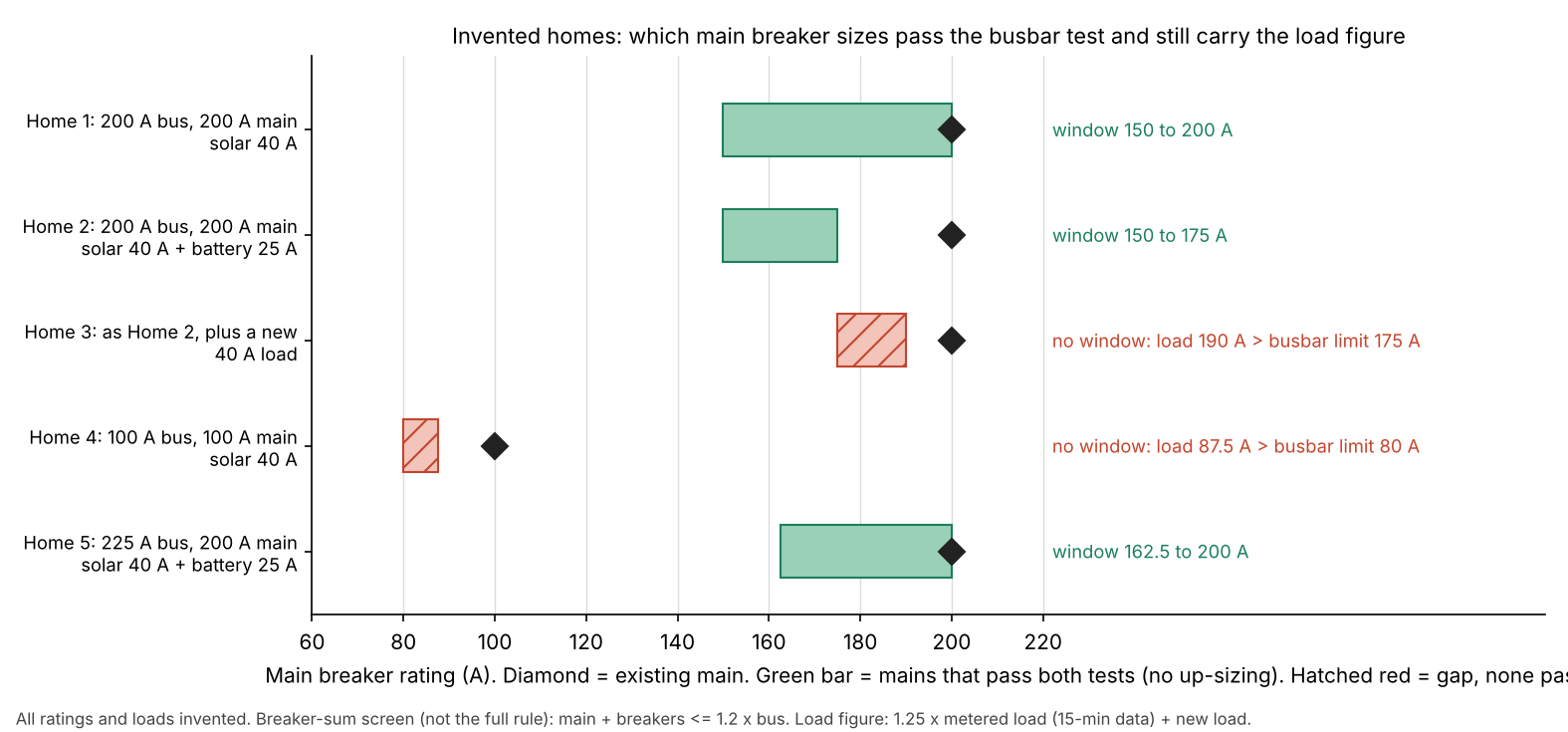
Figure 1. With example ratings and the breaker-sum screen, 2 of 5 homes pass as designed, 1 passes with a main of 150 to 175 A, and 2 have no main size that passes both tests.
Home 2: solar alone would pass, but the battery lifts the total to 65 A. Home 3: the busbar caps the main at 175 A, below the 190 A the load needs. Home 5 passes because its busbar is 225 A. Homes 3 and 4 move on to routes 4 to 6.
Main breaker window calculator
The defaults are Home 2 and are example. Swap in your labels and measured loads.
What do the permit and the utility need?
The AHJ and the utility decide. Some AHJs fold the upgrade into the solar permit. Others want a separate one. The utility may also need to approve service work.
- Separate permit or not: Symbium’s help page (undated) says the jurisdiction decides.
- Loveland, Colorado: its contractor page (undated, form 6/12/23, checklist 11-2021) has a "Service Change/Service Upgrade Building Permit" path. It asks for a signed ESW form with service change details from Loveland Electric. This is one city, not a national rule.
- Drawings: GreenLancer says the single line diagram should show the overcurrent device, the busbar and service ratings, the tie-in point and any PCS limit. The permit and utility forms must match. See permit plan set and interconnection application.
How does an upgrade change the quote and the timeline?
It adds a line item and at least one more approval. When you find the need decides how you bill it.
An MPU adds work, utility coordination, permitting steps and significant cost (GreenLancer), but no timeline is given. The Energy Star deck lists 3 to 6 month project delays and transformer lead times over a year. It does not tie them to solar. Better Earth’s help page (7 February 2025) says that for necessary upgrades "the costs can be included in your solar project quote".
Priced in the proposal, an upgrade is an adder. Found after signing, it needs a change order. Read the ratings at the site survey. This page gives no cost figures. See price per watt.
How solar software handles main panel upgrades
Only SolarAPP+ says outright that it flags a failed busbar test, and none of the four tools prices an upgrade. "Yes" means the help page says so. "Partly" means the page describes a related behaviour but no upgrade flag. "Not stated": the company page we cite does not say.
| Software | Flags a failed busbar test or an upgrade need? | Method | Notes |
|---|---|---|---|
| SolarAPP+ | Yes | Rules check on entered data | Help pages updated 8 April and 17 July 2026. Adopting AHJs only. |
| Aurora Solar (Instant Plan Sets) | Partly | Plan-set wizard | Help page, no date. Checked October 2026. |
| Solargraf | Not stated | Permit plan set | Published 19 March 2026 and 9 September 2024. |
| Symbium | Not stated | Permit platform | Help page, no date. Checked October 2026. |
What each page says:
- SolarAPP+: Error R749 appears when "the numbers in your project don’t pass the 120% rule". Fixes: smaller solar or storage breaker, main derate, corrected busbar rating, or another method (sum of breakers, PCS, supply-side tap). It does not mention upgrading the panel.
- Aurora Solar: The subpanel tie-in option is hidden if it would violate the 120% rule. A note says that if a de-rate is necessary, a traditional main panel tie-in is not an option. No upgrade flag or price is described.
- Solargraf: The permit settings article lets you exclude breaker sizes for a "Line-side connection (meter can - connectDER)" tie-in. Neither article mentions a busbar test or an upgrade.
- Symbium: When the user says the service panel is being upgraded, it shows if the jurisdiction needs a separate application. Its help page does not test the busbar.
To pick a permit or plan-set tool, see the best solar permitting software. For the drawing side, see the best solar SLD software.
Common mistakes with main panel upgrades
FAQs
Does adding a battery always mean a main panel upgrade?
No. A battery adds source current and can fail the busbar test, as in GreenLancer’s example. In example home 2, a 175 A main fixes it. Other routes exist if the load needs the larger main.
Is a supply-side tap a simple way to avoid an upgrade?
Only with limits. SolarAPP+ says it is not subject to the 120% rule. GreenLancer says utility rules, conductors, listed connectors and protection still apply. Loveland, CO does not allow line-side connections.
How much does a main panel upgrade cost?
This page found no sourced cost figure, so it gives none. The price depends on the equipment, utility coordination, permitting and scheduling. Better Earth’s help page says costs for necessary upgrades can be included in the solar quote.
Does a main panel upgrade need its own permit?
It varies by jurisdiction. Some AHJs fold the upgrade into the solar permit and others want a separate one. Symbium says the city or county decides, and Loveland, CO has a service change permit path. Your AHJ and utility have the final word.
Can an inverter or battery with current limiting replace an upgrade?
It can. GreenLancer says a listed PCS can be one device, such as a hybrid inverter with built-in current limiting. It must be listed and your AHJ must accept it.
Related terms
- Busbar 120% rule: the limit on backfed current that starts the decision table.
- Solar-plus-storage: a battery paired with solar.
- Single line diagram: the drawing that shows ratings.
Next step: read the busbar and main ratings from the labels at your next site visit. If the check fails and holds up a permit, compare the best solar permitting software.
Sources
All checked October 2026. Dates as printed.
- GreenLancer, main panel upgrade, 5 October 2026.
- GreenLancer, power control systems, 10 October 2026.
- SolarAPP+ help: error R749, 8 April 2026, and point of interconnection method, 17 July 2026.
- Solar Builder, Mayfield, NEC 2020 load and supply side, undated.
- Energy Star partner deck, alternatives to panel upgrades, 27 September 2023.
- DOE peer review poster, electrical panel constraints, 21 to 24 October 2024.
- City of Loveland, Colorado, rooftop solar for contractors, undated (form 6/12/23, checklist 11-2021).
- Symbium help, service panel upgrade permit, undated.
- Better Earth help, electrical upgrades, 7 February 2025.
- Company help: Aurora, Instant Plan Sets (undated) and Solargraf, permit settings (19 March 2026), Solargraf, plan set FAQs (9 September 2024).
Last updated 30 October 2026. Next scheduled review: 30 January 2027.