Key takeaways
- CUF = annual energy ÷ (rated capacity × hours). It needs a stated rating basis, AC or DC, and an hour count.
- Contract texts count hours differently. A Gujarat tender formula uses 8,760 and a SECI template uses 8,766, a 0.07% difference in the result.
- DC overloading lifts the AC-basis CUF. In a synthetic example with 16.8% at a ratio of 1.00, you need a ratio of about 1.26 for 21%.
- A band test compares a contract year’s CUF with the contracted CUF. A Gujarat PPA sets the band at +10% and -15% of it, so 26.70% gives 22.70% to 29.37%.
- A regulator’s minimum CUF is a tariff parameter, not a yield forecast.
Software rarely prints CUF by name. A contract-year figure usually needs an energy export. For tools that track plant output, see the best solar performance analytics software.
Capacity utilisation factor at a glance
CUF is a ratio between 0% and 100%. In India it appears in tariff rules, tenders and PPAs. So the contract text fixes how to compute it.
| Item | Detail |
|---|---|
| Formula | CUF (%) = annual energy (kWh) ÷ (rated capacity (kW) × hours) × 100. |
| Unit and range | A percentage between 0% and 100%. Regulators publish minimum or normative values. See the rules section. |
| Where it matters | Tariff setting, PPA generation tests, shortfall charges, lender models and O&M reports. |
| Standard or rule | No single standard. State regulators and CERC define it, and tenders refer to them. |
| In software | Simulation tools print capacity factor. Few name it CUF. See the software table. |
Why CUF matters for installers and developers in India
A contract can pay or charge you on CUF. So the basis and hour count affect real money.
Tenders and PPAs test the annual CUF against a declared value. Regulators set a minimum or normative CUF when they fix tariffs. Both push designers to add DC capacity behind the inverter. The AC:DC ratio then becomes a commercial question as well as a technical one. See DC/AC ratio, power purchase agreement and performance guarantee.
CUF, capacity factor and PLF: which name, which basis?
CUF and capacity factor are the same ratio under two names. The Indian documents cited here do not agree on the rating basis. So state it every time.
Table 1. How six documents set the basis.
| Document | What it says about CUF |
|---|---|
| SECI standard PPA template for solar power (undated) | Meaning as in CERC regulations. Based on Contracted Capacity and energy metered at the delivery point. Formula divides by capacity × 8,766. |
| GUVNL tender dated 7 February 2020, as quoted in the GERC order of 3 April 2024 | Annual energy metered at the delivery point. Formula divides by capacity × 8,760. The quoted text does not say AC or DC. |
| MERC tariff regulations, 30 December 2019 | CUF is the ratio of actual gross energy generated to the energy at rated capacity over the year. The definition does not say AC or DC. |
| CERC Statement of Reasons, 7 July 2020 | Uses "capacity utilization factor or plant load factor" together, as alternatives. |
| APTEL judgement, 23 April 2025 | A developer argued Haryana’s 21% CUF is an AC figure. The tribunal ordered a prudence check of AC:DC ratio and DC module cost. |
| PV Diagnostics post, 2 September 2020 | One blog says CUF divides by AC capacity and PLF by DC capacity. |
The blog’s split is not in the regulatory texts cited here. Treat CUF and PLF as synonyms unless the contract defines them apart.
How to calculate CUF for a contract year
Divide the metered energy by the contract capacity times the contract hours. Then compare the result with the contracted value and its band.
- Take the energy injected and metered at the delivery point for the period, in kWh.
- Take the rating the contract names, in kW. The SECI template says the Contracted Capacity.
- Take the hours the contract counts: 8,760, 8,766, or the actual hours of the period.
- CUF = energy ÷ (capacity × hours).
- Compare with the contracted CUF, its band and any floor.
The period matters too. The GUVNL PPA counts the annual CUF from 1 April to 31 March. The SECI template leaves out the contract year that ends on 31 March just after commissioning from shortfall compensation. For the DC and AC conversion and for kWh per kWp, see capacity factor and specific yield.
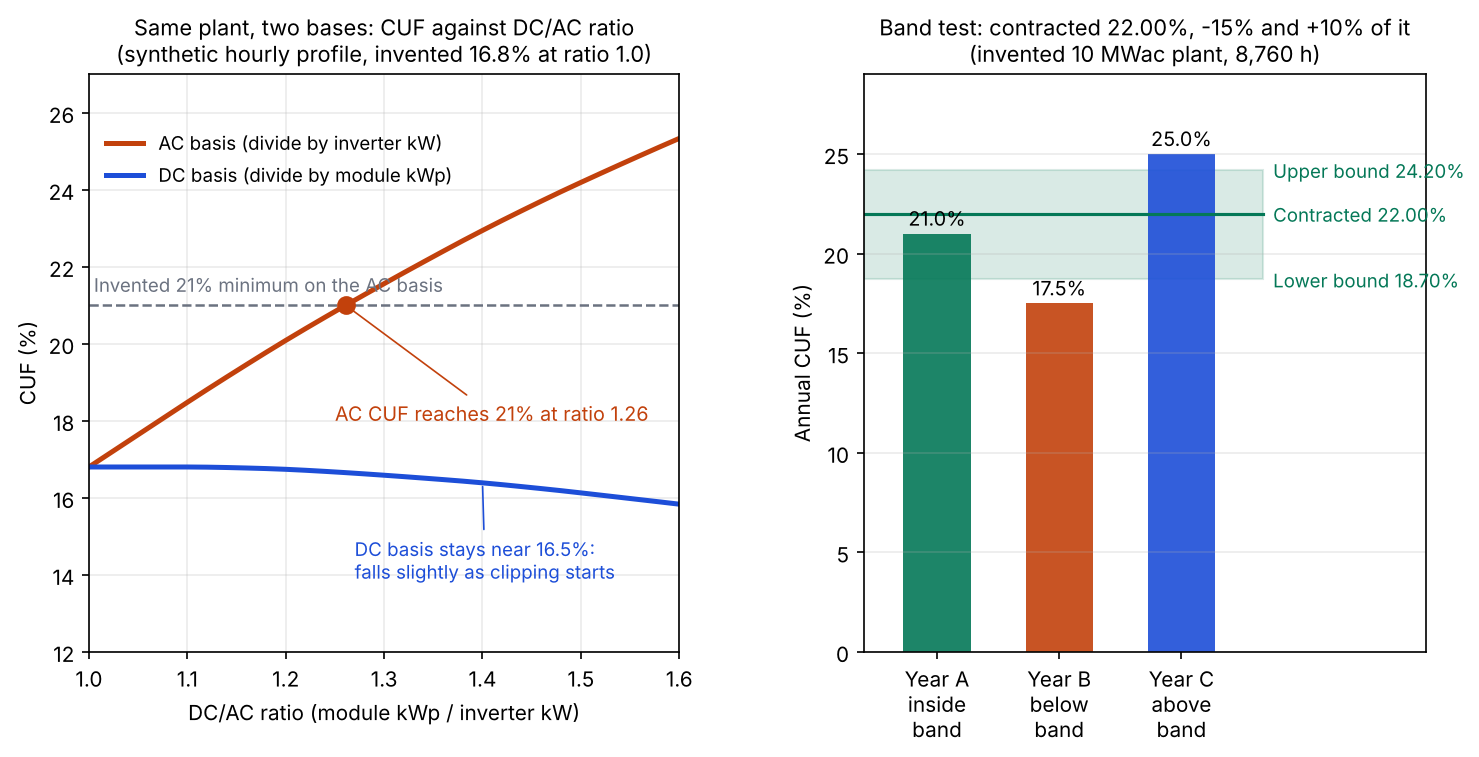
Figure 1. A higher DC/AC ratio lifts the AC-basis CUF while the DC basis stays near 16.5%. A contract band judges each year against the contracted CUF (synthetic profile, example plant).
Worked examples: reaching a CUF target, then a band test
Both examples use example numbers. The first uses a synthetic hourly profile, not a real site. It has a 12-hour daily curve, an example seasonal swing and an example sky mix. It ignores inverter efficiency.
Table 2. CUF against DC/AC ratio, scaled to 16.8% at a ratio of 1.00.
| DC/AC ratio | AC-basis CUF | DC-basis CUF | Energy clipped |
|---|---|---|---|
| 1.00 | 16.80% | 16.80% | 0.0% |
| 1.10 | 18.48% | 16.80% | 0.0% |
| 1.20 | 20.09% | 16.74% | 0.4% |
| 1.30 | 21.56% | 16.59% | 1.3% |
| 1.40 | 22.94% | 16.39% | 2.4% |
| 1.50 | 24.19% | 16.13% | 4.0% |
An example 21% minimum on the AC basis needs a ratio of about 1.26. Simple division gives 21 ÷ 16.8 = 1.25. Clipping adds a little. At 1:1 this example plant falls short of 21%. The numbers are ours, not the data in the 2025 APTEL case. See inverter clipping for real clipping ranges.
The band test below uses these inputs:
- Plant: 10 MWac.
- Contracted CUF: 22.00%.
- Band limits: -15% and +10% of it, as in the Gujarat PPA wording. The lower bound is 18.70% (22.00% less 15% of itself), which is above the 15% floor, so the floor does not bind. The upper bound is 24.20%.
- Shortfall rule: example. It charges 50% of an example tariff of 3.00 INR per kWh on energy below the band only, so year C has no charge.
Table 3. Three contract years of 8,760 hours against the band.
| Year | CUF | Energy (kWh) | Against the band | Shortfall charge (INR) |
|---|---|---|---|---|
| A | 21.0% | 18,396,000 | Inside | 0 |
| B | 17.5% | 15,330,000 | Below by 1,051,200 kWh | 1,576,800 |
| C | 25.0% | 21,900,000 | Above by 700,800 kWh | 0 |
Check the band wording. In the GERC order the GUVNL submission gives a minimum of 22.70% on a contracted 26.70%. That equals 26.70% × 0.85 = 22.695%, so the band is relative. The Commission’s paragraph prints 22.07%. The order does not make the two agree. If the band were 15 percentage points instead, the lower bound would be 7.00%, so the 15% floor would apply. That lowers the bound from 18.70% to 15%, a gap of 3,241,200 kWh on this plant.
Hours also matter. The same 19,272,000 kWh gives 22.000% on 8,760 hours, 21.985% on 8,766 and 21.940% on 8,784. One point of CUF on 10 MWac is 876,000 kWh a year.
CUF calculator
It computes the CUF for a contract year and tests it against a band. Enter the contract kW, energy and hours. You can also add the contracted CUF, floor, band, an example shortfall rule and module kWp.
How solar software handles CUF
SAM and PVWatts name the ratio "capacity factor", not CUF. The other three company pages do not name it either. So CUF reporting for a contract year usually means exporting energy and applying the contract formula yourself.
| Software | Reports CUF or capacity factor? | Company page |
|---|---|---|
| SAM | Yes, as capacity factor | SAM help, "Capacity Factor" (undated) |
| PVWatts | Yes, as capacity factor | PVWatts V8 API page (undated) |
| PVsyst | Not stated | PVsyst help, "Normalised performance index". Tutorial v7, chapter 1 |
| Prescinto | Not stated | pv-tech article by Prescinto staff, 8 August 2023 |
| Arka 360 | Not stated | Arka 360 blog page, 6 November 2025 |
Not stated: the company page we cite does not use the name CUF or capacity factor.
How and where each tool shows it:
- SAM: first-year output relative to nameplate every hour. For PV it gives a DC and an AC capacity factor. The page does not use the name CUF.
- PVWatts: the version 8 API returns capacity_factor, labelled "(AC-to-DC)". The name CUF is not used.
- PVsyst: the pages print specific production and normalised yields, not CUF or capacity factor.
- Prescinto: a company-written article lists plant KPIs: reference, expected and specific yield, performance ratio and temperature-corrected PR. It does not name CUF or PLF.
- Arka: the page says the design studio supports generation and financial analysis. It does not name CUF.
For tools that report plant output against a contract, see the best solar performance analytics software.
Common mistakes with CUF
CUF rules by regulator and contract
Regulators set minimum or normative CUF values, and each commission and tender sets its own. Check the current text for your state or tender.
- CERC, 2020 regulations: a CERC notification of 6 September 2023 says they applied "from 1st July 2020 to 31st March 2023". It extended them to 31 March 2024. A trade-press report says a later notice extended them to 30 June 2024. We did not open that notice. CERC then notified new regulations on 12 June 2024, with a control period starting 1 July 2024. Check which text applies to your project’s date. A CERC public notice dated 15 July 2024 proposes generic tariff for the 2024-25 control period. It lists small hydro, biomass, co-generation, biogas and municipal solid waste projects, not solar PV. Confirm which instrument sets the current normative CUF for solar before you rely on a figure. A CBIP summary table lists 21% for solar PV, 23% for solar thermal and 19% for floating solar, under the 2020 regulations. The CERC Statement of Reasons says full cost recovery is allowed at normative CUF.
- Maharashtra, MERC Regulation 66 (30 December 2019): a minimum normative CUF of 28% for utility-scale solar PV in the first year (MERC regulation text, checked 30 October 2026). This is far above the other state values. A project may revise it once within first year after commissioning. The first review period runs FY 2020-21 to FY 2024-25.
- Haryana, Regulation 48: the APTEL judgement of 23 April 2025 records a 21% minimum for solar PV, including floating. It records 23% for solar thermal. It also notes an earlier case: 17.3% at a 1:1 ratio and 19% at 1:1.11.
- Gujarat PPA (GUVNL): the GERC order quotes +10% and -15% of the contracted CUF for the first 10 years. It also requires the annual CUF to stay at or above 15%. After year 10 the lower band is -20%.
FAQs
Is CUF the same as capacity factor?
Yes. Both divide actual energy by the energy at rated capacity over the same hours. CUF is the term used in Indian regulations and tenders. Name the AC or DC basis either way.
Is CUF measured on AC or DC capacity?
The documents cited here do not agree. The SECI template says Contracted Capacity and energy metered at the delivery point. That is usually an AC metering point. The template does not say AC. The MERC definition and the quoted GUVNL text do not say. Read your contract and state the basis.
Should I use 8,760 or 8,766 hours?
Use the hours the contract names. A Gujarat tender formula quotes 8,760 and a SECI template formula quotes 8,766. The difference is 0.07% of the result. A leap-year contract year has 8,784 hours.
What is a good CUF for solar in India?
Regulators publish tariff minimums that differ by state. Haryana (APTEL judgement, 23 April 2025) and the CBIP summary of the CERC 2020 rules give 21% for solar PV. The MERC regulation gives 28% for the first year. These are tariff parameters, not forecasts, and no single figure fits every plant. The rules section lists them with their dates. Model your own site. See energy yield simulation.
What happens if the CUF falls below the contract band?
The contract sets the charge. The SECI template charges 50% of the PPA tariff on the shortfall energy. Force majeure is the exception. In Gujarat, GUVNL deducted INR 3,123,372 (printed as Rs. 31,23,372) for contract year 2021-22, and the developer asked for a refund.
Related terms
- Capacity factor: the same ratio, with the DC and AC conversion.
- DC/AC ratio: module kWp divided by inverter AC kW.
- Performance guarantee: a contract promise on output.
Next step: to test a year’s output against a contract band, start with the best solar performance analytics software. For yield estimates, see the best solar simulation software.
Sources
- GERC, Petition No. 2136 of 2022, Juniper Green Three v GUVNL, order dated 3 April 2024 (read October 2026).
- APTEL, Appeal No. 302 of 2024, Greenyana Solar v HERC, judgement dated 23 April 2025 (read October 2026).
- SECI, Standard PPA for solar power (template, no date printed, checked October 2026).
- CERC, public notice on the RE tariff order for FY 2024-25, 15 July 2024 (says the 2024 regulations were notified on 12 June 2024 and lists non-solar categories only, read November 2026).
- CBIP, summary of the CERC RE Tariff Regulations, 2020 (the summary gives 23.06.2020 for the regulations, checked October 2026).
- CERC, notification extending the RE Tariff Regulations 2020 to 31 March 2024, 6 September 2023 (checked 30 October 2026).
- CERC, Statement of Reasons, RE Tariff Regulations 2020, 7 July 2020 (read October 2026).
- MERC, RE Tariff Regulations, 2019, 30 December 2019 (read October 2026).
- PV Diagnostics, CUF vs PLF, 2 September 2020 (a blog, checked October 2026).
- SAM help, Capacity Factor and PVWatts V8 API documentation (both undated, checked October 2026).
- PVsyst help, Normalised performance index and PVsyst 7 tutorial, chapter 1 (undated, checked October 2026).
- PV Tech, Prescinto article, 8 August 2023, and Arka 360, best solar design software, 6 November 2025 (read October 2026).
- Example plant, profile, tariff and shortfall rule: computed with a fixed arithmetic model.
Last updated 30 October 2026. Next scheduled review: 30 January 2027.