Key takeaways
- The label is loose. Installers and service providers promise output, and manufacturers promise equipment. One consumer guide uses "performance guarantee" for the maker’s degradation promise.
- Three public forms differ. One tests weather-adjusted kWh each year. One settles every 60 months. One pays yearly credits.
- In one invented year the plant beat its 700,000 kWh guarantee by 12,000 kWh raw but missed it by 28,302 kWh once adjusted for a sunnier year. At an example 0.09 USD per kWh, that is 2,547.17 USD.
- Adjusting the output or adjusting the guarantee gives the same pass or fail, but a different payment: 2,547.17 USD or 2,700.00 USD.
- In an example five-year run, an annual test pays 1,147.58 USD, while a cumulative test pays nothing.
To track the inputs a guarantee uses, such as expected energy, PR and availability, see the best solar performance analytics software.
Performance guarantee at a glance
It ties a payment or a fix to measured plant results. The contract sets the numbers, not a standard.
| Item | Detail |
|---|---|
| What is promised | Energy in kWh at the meter, over one or more years. Some contracts use a performance ratio or availability instead. |
| Formula | Margin = weather-adjusted actual kWh minus guaranteed kWh. Payment = shortfall kWh times the contract rate. |
| Where it appears | Installer proposals, PPAs, contractor agreements and O&M contracts. VCOM: "O&M contracts commonly require a system availability or performance ratio (PR) guarantee." |
| Standard or rule | No single standard in the sources cited. See the EnergySage quote below the table. |
| Typical level and term | No public typical level cited. EnergySage’s one example: a one-year guarantee at 90 percent. Long ones run 10 to 30 years. |
| In software | Monitoring tools report the inputs: kWh, expected energy, PR, availability. The contract sets the method. |
EnergySage (updated 24 February 2023) says "there is currently no industry-leading standard for the guaranteed production of a solar panel product". It says the installer pays if output falls short.
Why does a performance guarantee matter to installers and owners?
You promise it at the sale. You may pay years later. It works only if both sides work out the same number.
You can also state a kWh promise per kW or as a share of nameplate. See specific yield and capacity factor.
How does a performance guarantee differ from a warranty or an availability guarantee?
An output guarantee tests what the plant made. An equipment warranty covers parts. An availability guarantee tests uptime. Contracts mix the labels, so the clause wording decides.
| Promise | Usually given by | What is tested | Source |
|---|---|---|---|
| Output (production) guarantee | Installer, EPC or service provider | Measured kWh against expected output. EnergySage says the fix may be cash, or maintenance and repairs. | EnergySage. Appendix A-10 and the New York form below |
| Availability guarantee | O&M provider | Share of sunlit time or expected energy the plant could produce, with exclusions. See availability. | VCOM help page |
| Equipment warranty | Manufacturer | Defects in physical parts such as panels and inverters. | EnergySage |
| Manufacturer degradation guarantee | Panel maker | Panel output against a decline curve. solar.com: the maker "will replace the panel that is degrading faster". See degradation rate. | solar.com. EnergySage |
The labels clash. solar.com (updated 26 July 2022) calls the maker’s degradation promise a "performance guarantee". It calls the installer’s output promise a "production guarantee". The New York model form is titled a Performance Guarantee Agreement. It calls itself the "Performance Warranty", yet it promises plant kWh.
How is a performance guarantee measured: kWh, P50 model or performance ratio?
The three forms quoted here all test metered kWh. They compare it with a weather-adjusted figure. A performance ratio test is the other route. A P50 value is a modelled median, not a measurement.
All three forms are undated templates or sample forms.
Appendix A-10, "Plant Performance Guarantee" (Utah PSC file, named 5-25-2018)
- Test and period: AC kWh from the revenue meter via SCADA must be "no less than" the weather-adjusted expected output. Annual periods, five in a row.
- Weather basis: The contractor models expected output in PVsyst version 5 or greater, run with actual site irradiance. Expected output is "based on actual irradiance".
- Shortfall and limits as printed: Damages per kWh short. No payment is due from the owner for excess. Force majeure cuts modelled output. Missing or bad data hours are removed.
New York OGS bid 23017, Appendix E, "Model Performance Guarantee Agreement"
- Test and period: Guaranteed kWh for Years 1-5, 6-10, 11-15 and 16-20, "under usual weather conditions". Cumulative kWh tested at the fifth anniversary of operation and every 60 months after.
- Weather basis: Actual kWh is "divided by the Insolation Adjustment Factor": X over Y, with X estimated and Y measured global horizontal insolation.
- Shortfall and limits as printed: Refund of the kWh gap times a price (utility price minus solar price per kWh), due within 30 days after the calendar year. Surplus carries forward. Eight exclusions, such as work by others and force majeure.
Omnidian Form PSAN-CA, Rev. 04-2020-01, a provider’s performance services form
- Test and period: "Guaranteed Annual Energy" per year, with later years from GE1 × (1 - DR)^(y - 1). Here GE1 is the year-1 figure and DR the degradation rate.
- Weather basis: Expected energy is the provider’s projection from weather feed and satellite irradiance. The form uses "weather-adjusted" but does not define it.
- Shortfall and limits as printed: Credits at a set rate per kWh, paid after each year. Debit only above 105% of guarantee. Shading or soiling losses of 5% or more are excluded. Liability is capped.
Sunlight data drive the result. Appendix A-10 takes irradiance from a site station. PVsyst says outside data are "typically satellite data with an accuracy of 10 to 20% for hourly values". See pyranometer.
PVsyst warns about PR-based warranties. It says: "When specifying a warranty based on PR value, it is very important to specify how this PR will be established on-site". It also advises a "degressive value" for ageing. The NREL 2013 report (NREL/TP-5200-57991, per its abstract) says plain PR can differ between winter and summer. It offers a weather-corrected PR. It also offers a test protocol as a start for contract wording. See performance ratio and energy performance index.
A guarantee level is a contract number. P50, P90 and P99 explains why a level set at P50 is missed about half the time.
How is a shortfall calculated, and what is a true-up?
A shortfall is the guaranteed kWh minus the weather-adjusted actual kWh, times the contract rate. It counts only if the gap is positive. A true-up settles the running balance at set dates.
- Set the guaranteed kWh for the period, from a table or a degradation formula.
- Take metered AC kWh for the same period.
- Find the weather factor X/Y. It is typical insolation over actual, same plane and period.
- Handle excluded events. Add back their lost kWh. Or cut the expected figure. Follow the contract.
- Margin = adjusted actual minus guaranteed. Only a negative margin is a shortfall.
- Multiply the shortfall by the rate. Apply any cap. Pay at the true-up date.
True-up timing differs. The New York form settles at each 60-month anniversary. It carries surplus into the next period (Section 1.B). Appendix A-10 tests each annual period. The provider form pays yearly credits. A net debit is not payable. It offsets later credits.
Example inputs: guarantee 700,000 kWh and typical insolation X 1,500 kWh/m2. Actual Y is 1,590 kWh/m2, 6.0% above X. The rate is 0.09 USD per kWh. One example 4,000 kWh outage is excluded by the contract. The table reads this one year five ways.
| Reading of one example year | Compared kWh | Margin (kWh) | Payment (USD) |
|---|---|---|---|
| Raw, no weather adjustment | 712,000 against 700,000 | +12,000 | 0.00 |
| Adjust the output: 712,000 × 1,500 ÷ 1,590 | 671,698 against 700,000 | -28,302 | 2,547.17 |
| Adjust the guarantee: 700,000 × 1,590 ÷ 1,500 | 712,000 against 742,000 | -30,000 | 2,700.00 |
| Adjust the output, 4,000 kWh excluded outage added back | 675,472 against 700,000 | -24,528 | 2,207.55 |
| New York wording as printed: 712,000 ÷ (1,500 ÷ 1,590) | 754,720 against 700,000 | +54,720 | 0.00 |
The raw figure hides a miss. The year was sunnier than typical. The plant should have beaten 700,000 kWh. Rows two and three always agree on pass or fail. X/Y scales both sides. The kWh gap differs by X/Y (0.9434 here). So the payment does too.
The fifth row follows the New York form as printed. Its text divides actual kWh by X/Y, where X and Y are sums of monthly insolation. When Y is above X, X/Y is below 1, so dividing raises the output of a sunny year. Appendix A-10 goes the other way, because its expected output rises with actual irradiance. Two forms can adjust in opposite directions, so read the equation in your own contract.
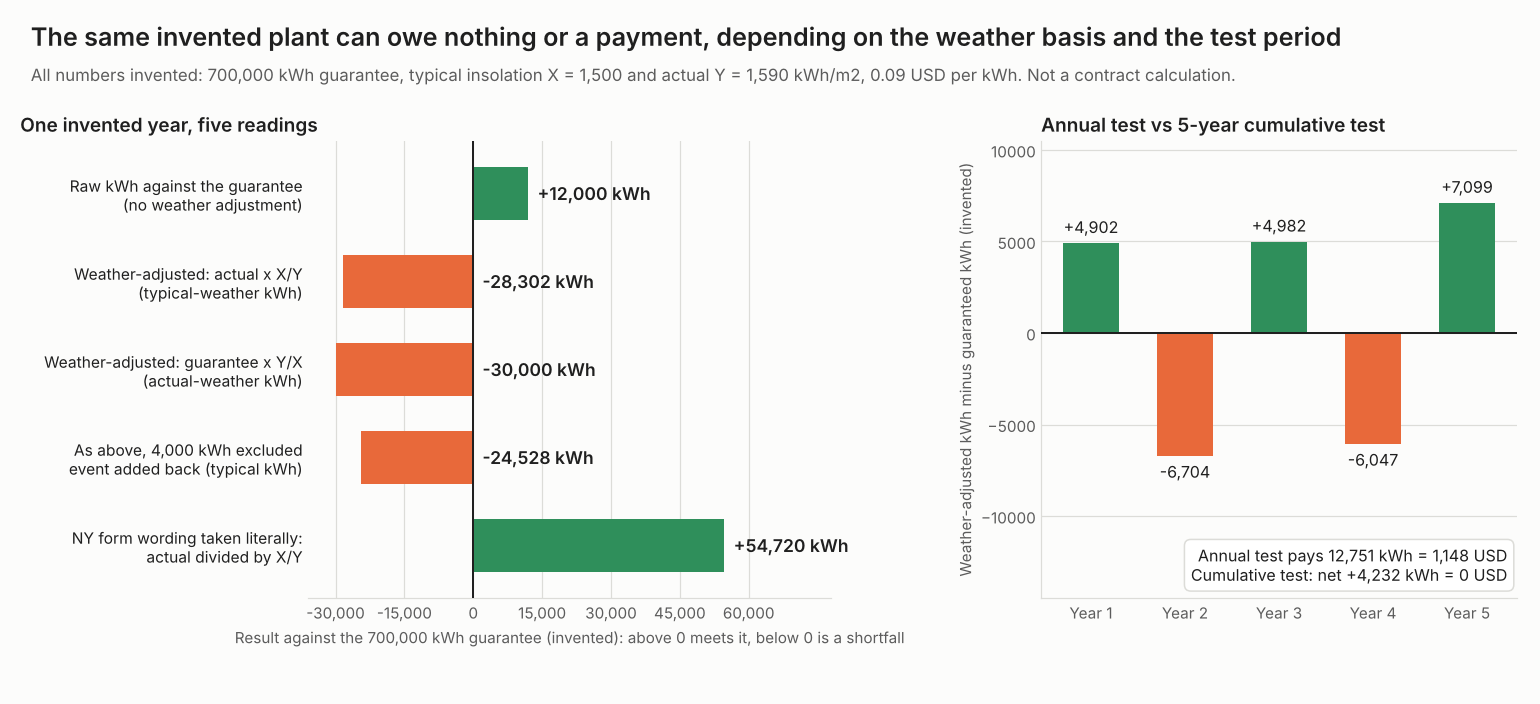
Figure 1. One example year reads as a 54,720 kWh surplus or a 30,000 kWh shortfall depending on the method, and a five-year annual test pays 1,147.58 USD where a cumulative test pays nothing.
Five example years follow. The guarantee starts at 700,000 kWh. It falls 0.5% a year. X is 1,500 kWh/m2 every year. The rate is 0.09 USD per kWh. Output is adjusted by X/Y.
| Year | Guaranteed kWh | Measured kWh (actual insolation Y) | Adjusted kWh | Margin (kWh) |
|---|---|---|---|---|
| 1 | 700,000 | 719,000 (1,530) | 704,902 | +4,902 |
| 2 | 696,500 | 676,000 (1,470) | 689,796 | -6,704 |
| 3 | 693,018 | 698,000 (1,500) | 698,000 | +4,982 |
| 4 | 689,552 | 663,000 (1,455) | 683,505 | -6,047 |
| 5 | 686,105 | 714,000 (1,545) | 693,204 | +7,099 |
An annual test pays for years 2 and 4: 6,704 plus 6,047 kWh, 12,751 kWh in all, or 1,147.58 USD. A cumulative test nets the margins to +4,232 kWh and pays 0.00 USD. It sums yearly margins. Adjusting over all five years at once gives +4,825 kWh.
Performance guarantee shortfall calculator
This tool reproduces both tables. The presets are example.
How solar software handles performance guarantees
Few of the help pages read mention guarantees. VCOM and PVsyst come closest, and no page describes a kWh shortfall payment.
| Software | Guarantee tracking documented? | Page and date |
|---|---|---|
| PVsyst | Partly | PVsyst help. No date printed. Checked October 2026 |
| meteocontrol VCOM | Partly | VCOM help, KPI editor. Last modified 22 July 2026. Checked October 2026 |
| GreenPowerMonitor (DNV) | Not stated | GreenPowerMonitor help. Undated. Checked October 2026 |
| AlsoEnergy PowerTrack | Not stated | AlsoEnergy page. Undated. Checked October 2026 |
| Solytic | Not stated | Solytic knowledge base. Undated. Checked October 2026 |
Not stated: the company page we cite does not say. Partly: the page covers a related method or KPI but has no built-in guarantee check. Notes on each page:
- PVsyst: The help page "PR as performance guarantee" describes ways to compare forecast PR with on-site PR, or to resimulate with measured inputs. It describes methods only. It has no built-in guarantee check.
- meteocontrol VCOM: A licence-based KPI editor calculates PR and availability, which "O&M contracts commonly require". Formulas are adjustable so provider and investor share one definition. Intervals tied to a ticket can be excluded. A kWh shortfall or payment is not described.
- GreenPowerMonitor (DNV): The availability page says a minimum is usually required for contractual obligations, and exceptions can be entered by hand. It has no guarantee wording.
- AlsoEnergy PowerTrack: The page lists "Multiple models for calculating expected energy (i.e., original, 8760, as built) and for benchmarking". It has no guarantee wording.
- Solytic: The availability page has no guarantee, contract or SLA wording.
To compare tools that track expected energy, PR and availability, see the best solar performance analytics software.
Common mistakes with performance guarantees
FAQs
Is a performance guarantee the same as a warranty?
No. An output guarantee is tested on kWh. An equipment warranty covers parts. Contracts mix the labels, so the title alone does not settle it.
What happens if the plant beats the guarantee?
Under the Utah form (Appendix A-10) the owner pays nothing for the excess. The New York form instead carries a surplus forward to offset later deficits, and the provider form debits only above 105% of guaranteed energy. The contract decides.
Can I copy these clauses into a contract?
No. They are public templates with blank values, and values and limits differ by contract. This page is not legal advice. Have a lawyer check any clause.
How is a performance guarantee shortfall calculated?
Shortfall kWh times the contract rate, after the weather adjustment the clause names. In the worked example, the same year pays 2,547.17 USD or 2,700.00 USD, depending on whether the output or the guarantee is adjusted for weather. A true-up then settles the running balance at the dates the contract sets.
Related terms
- Availability: the share of time or expected energy a plant could produce.
- Performance ratio: output against what the sunlight allowed.
- O&M: the service contract that often carries the guarantee.
- Power purchase agreement: the contract one form here is written for.
Next step: before you draft a clause, see which tools report expected energy and PR in the best solar performance analytics software. For live data, see the best solar monitoring software.
Sources
- Appendix A-10, Plant Performance Guarantee, Utah Public Service Commission file, no date printed (checked October 2026).
- New York OGS bid 23017, Appendix E, Model Performance Guarantee Agreement, no date printed (checked October 2026).
- Omnidian Performance Services Agreement, Form PSAN-CA, Rev. 04-2020-01 (checked October 2026).
- PVsyst help, PR as performance guarantee, no date printed (checked October 2026).
- NREL, Weather-Corrected Performance Ratio, NREL/TP-5200-57991, 2013, abstract page, and the OSTI record (checked October 2026).
- EnergySage, What is guaranteed production for solar?, updated 24 February 2023 (checked October 2026).
- solar.com, Production vs. Performance Guarantees, published 13 April 2017, updated 26 July 2022 (checked October 2026).
- meteocontrol help, KPI editor for PR and system availability, last modified 22 July 2026 (checked October 2026).
- GreenPowerMonitor help, Availability, undated. Solytic knowledge base, Availability, undated. AlsoEnergy PowerTrack page, undated (checked October 2026).
Last updated 30 October 2026. Next scheduled review: 30 January 2027.