Key takeaways
- The DISCOM acts at three points. It approves before the build. It fits the net meter. It inspects before the final certificate (MNRE document, 12 August 2024).
- The Ministry of Power release of 23 February 2024 exempts systems up to 10 kW from the feasibility study. Above 10 kW the study time fell from 20 to 15 days.
- States print their own clocks. The Mumbai BEST page adds up to 45 working days (3 + 15 + 7 + 10 + 10).
- Two news reports say Delhi’s 2026 guidelines, in force from 16 July 2026, allow 25 days above 10 kW and 10 days up to 10 kW.
- These clocks bind the DISCOM only. Add 18 example days for the build and one fix-up round. The BEST clocks then give 63 working days, about 89 calendar days.
Of the four tools we looked for, only Fuzen has pages that name DISCOM steps. Installers track these milestones in a CRM. Compare trackers in the best solar CRM in India.
DISCOM and net metering approval at a glance
A DISCOM is a state distribution company. Its approval has two parts: permission to build, then permission to run.
| Item | Detail |
|---|---|
| What it covers | Technical feasibility, approval, net meter, inspection, commissioning and a net metering or net billing agreement. |
| Unit and range | Days. The current clocks found run from 10 to 30 days, or 45 working days on one Mumbai page. They are limits for the DISCOM, not measured times. |
| Where it matters | The switch-on date and the commissioning certificate, which comes before the subsidy payment step in the MNRE document. |
| Standard or rule | The Electricity (Rights of Consumers) Rules, 2020 (G.S.R. 818(E), 31 December 2020), as amended, plus each state regulator’s rooftop regulations. |
| In software | CRM tools track the milestones. No tool page read says it files with a DISCOM. |
Why does DISCOM approval matter for installers?
It sets the switch-on date. The MNRE document of 12 August 2024 says to "await DISCOM approval". Then you build with a registered company.
Meter supply can slow the start-up. Mercom India reported on 15 January 2024 that MNRE told DISCOMs to stock enough smart or net meters "to avoid delays in commissioning". That report is second-hand, and the MNRE letter is not among the sources.
For other countries, see DNO, G98 and G99 for the UK. See interconnection application for US utilities.
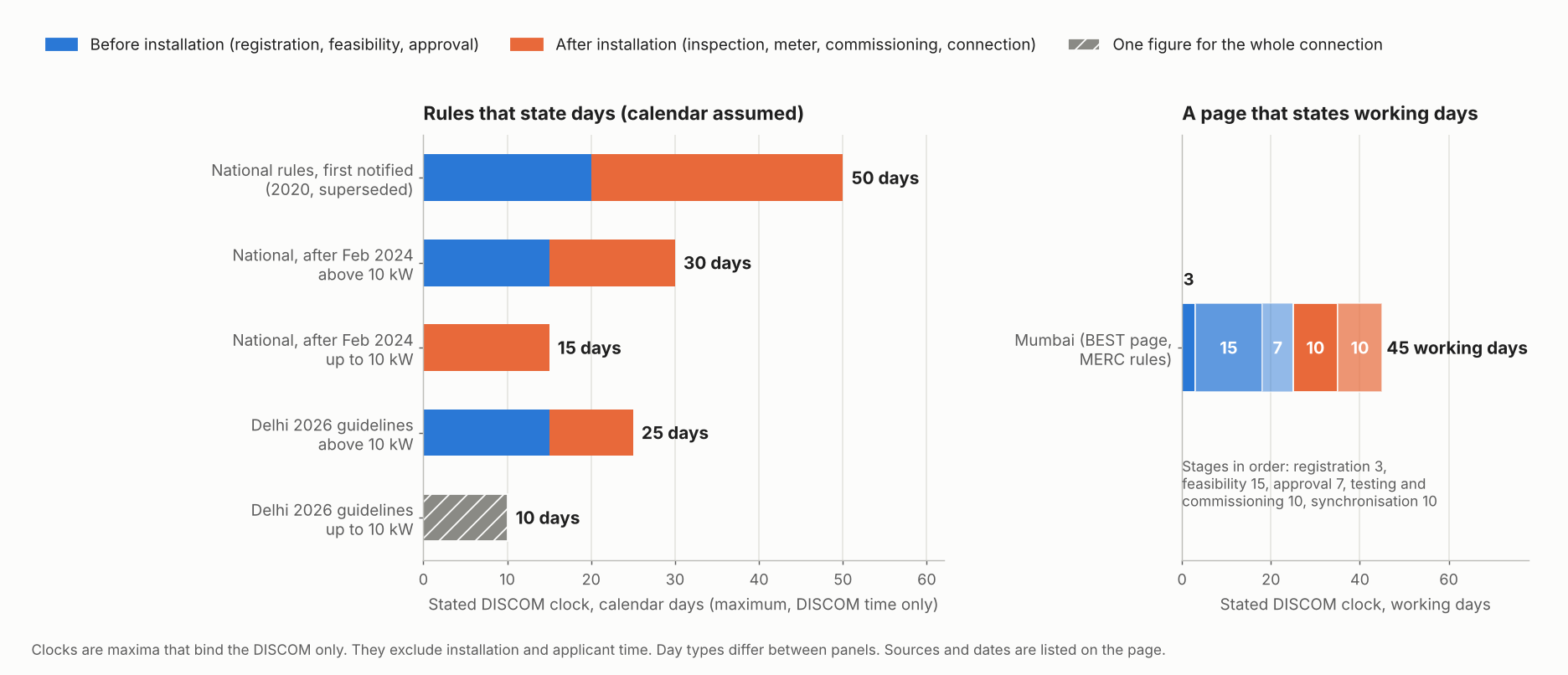
Figure 1. The current DISCOM clocks we found run from 10 to 30 days. The Mumbai page adds to 45 working days.
How does the approval work?
PM Surya Ghar: Muft Bijli Yojana is the MNRE rooftop scheme. It has a national application portal. The route runs in stages in our reading. The MNRE document dated 12 August 2024 puts the DISCOM at three points. These are approval, net meter and inspection.
- Register and apply on the national rooftop portal. The MNRE document lists registration and the online form as steps 2, 4 and 5.
- The DISCOM checks technical feasibility where the rules ask for it. The national amendment exempts systems up to 10 kW. Above 10 kW the study period is 15 days.
- Build with a registered company after approval. Step 6 of the MNRE document puts approval first.
- Send plant details. Ask for the net meter (step 7). The PM Surya Ghar draft guidelines say "The meter shall be installed by DISCOM after rooftop installation is complete". The BEST page says BEST fits the gear during commissioning.
- The DISCOM inspects. Then the portal issues the commissioning certificate (step 8). On the BEST page you sign the net metering or net billing agreement after the build. You sign it before grid connection.
- Subsidy follows. Step 9 of the MNRE document says "Receive subsidy within 30 days". The undated draft guidelines say 15 days for processing. Check the final text.
Which approval clocks apply?
Clocks vary by state and system size. The sources below print their own. State rules are covered here only for Maharashtra and Delhi.
| Source and date | Applies to | Day type and status |
|---|---|---|
| Rules 2020, Rule 11, G.S.R. 818(E), 31 Dec 2020 (Ministry of Power PDF) | Rooftop prosumers, national | Days, type not stated in the text read. As first notified. Amended since. |
| Ministry of Power release, 23 Feb 2024 | Rooftop, national | Days. Amended Rules text not cited. |
| MERC statement of reasons, 29 Aug 2024 (Maharashtra) | Maharashtra rooftop | Days. Final notified text not cited. |
| BEST web page, undated (Mumbai, Maharashtra) | BEST network | Working days. Cites the 2019 regulations and the 2023 amendment. It may predate the 2024 rule. |
| DERC 2026 guidelines (Delhi), in force from 16 July 2026 | Delhi | Days. Based on two news reports (SolarQuarter, Energetica India, 18 July 2026). The DERC text is not cited. |
- Consumers Rules: feasibility study "not exceeding twenty days". Agreement, meter and commissioning within thirty days of the installation certificate. Compensation "not less than five hundred rupees per day for each day of default".
- Ministry of Power release: no feasibility study up to 10 kW. Above 10 kW, 20 days cut to 15. Commissioning 30 days cut to 15. Licensee pays network strengthening up to 5 kW.
- MERC: feasibility study within 15 days, presumed feasible if no outcome is sent. Complete applications up to 10 kW are deemed accepted without a study.
- BEST: registration 3. Feasibility 15. Approval 7, valid 6 months. Testing and commissioning 10. Synchronisation 10.
- Delhi: Stage I feasibility 15 days, deemed granted if no reply. None up to 10 kW. Stage II 10 days. Deficiency fix 15 days, then 5 days for the DISCOM. Overall 25 days above 10 kW, 10 days up to 10 kW.
No dated data on actual approval times turned up, so no typical time is given.
Worked example: adding example installer days to the clocks
The DISCOM clocks are maxima. The total also holds your own days. So we add 10 days for the build to every row. We also add one fix-up round of 8 days. Both are example placeholders.
Smaller systems have the shortest totals, and the BEST page has the longest once working days are converted.
| Rule set and day type | DISCOM clocks added | Example installer and fix-up days | DISCOM re-check (Delhi states 5) | Total if every clock runs out |
|---|---|---|---|---|
| Mumbai BEST page (working days) | 45 | 18 | Not stated | 63 (about 89 calendar) |
| National 2020 text, superseded, comparison only (calendar days, assumed) | 50 | 18 | Not stated | 68 |
| National 2024, above 10 kW (calendar days) | 30 | 18 | Not stated | 48 |
| National 2024, up to 10 kW (calendar days) | 15 | 18 | Not stated | 33 |
| Delhi 2026, above 10 kW (calendar days) | 25 | 18 | 5 | 48 |
| Delhi 2026, up to 10 kW (calendar days) | 10 | 18 | 5 | 33 |
The BEST calendar figure is 63 x 7 / 5, rounded up. It assumes a five-day week and no holidays (our own conversion). "Not stated" means no source gives a re-check time, so the total adds none. Delhi’s 25 days is stage I plus stage II. The 5-day re-check comes on top of it, after a deficiency fix. The calculator below matches the table.
How solar software handles DISCOM approval
Only Fuzen’s pages name DISCOM steps and the subsidy stage, and only in part. We found no company pages on DISCOM milestones for Arka 360, Solar Ladder or OpenSolar (checked October 2026).
| Software | Tracks DISCOM approval steps? | Source and date |
|---|---|---|
| Fuzen | Partly | Fuzen solar CRM page, metadata updated 1 October 2026. Template page undated |
| Arka 360 | Not stated | No page found (October 2026) |
| Solar Ladder | Not stated | No page found (October 2026) |
| OpenSolar | Not stated | No page found (October 2026) |
Partly: the pages cover some DISCOM steps but not all. Not stated: the company pages we found do not say.
- Fuzen: "PM Surya Ghar tracker built in". Its milestone tracker runs "from material procurement to DISCOM inspection, net-meter and subsidy disbursement". It does not describe tracking a net-metering application.
- Fuzen tiers: a "per-state DISCOM rule engine" is listed for the Custom Solar App tier, not the Pro default.
The best solar CRM in India list covers milestone tracking. For the design side, see the best solar design software in India.
Common mistakes with DISCOM approval
FAQs
How long does net metering approval take in India?
The February 2024 national amendment caps commissioning at 15 days and the feasibility study at 15 days above 10 kW, and states print their own clocks. Limits for the DISCOM run from 10 days (Delhi, up to 10 kW) to 45 working days (Mumbai BEST page).
Is a feasibility study needed for a 5 kW rooftop system?
Not under the national amendment of February 2024, which exempts systems up to 10 kW. Maharashtra’s statement of reasons (29 August 2024) says complete applications up to 10 kW count as accepted. No study is needed. Check your own state’s current regulation.
Who fits the net meter?
The DISCOM does, on the sources cited. The BEST page says BEST fits the net metering gear at commissioning. The PM Surya Ghar draft guidelines say the DISCOM fits the meter after the build. Delhi’s stage II covers it too.
What if the DISCOM misses its deadline?
Some rules let the application move ahead by default. Maharashtra presumes feasibility if no outcome is sent. Delhi deems it granted. The 2020 Rules as first notified set compensation of at least 500 rupees a day for unjustified delay. Check the amended Rules before you rely on it.
Is this the same as PTO in the US?
The role is similar: permission before switch-on. In India the DISCOM approves before the build, fits the net meter and inspects before the final certificate. The steps differ from the US. See PTO for the US process.
Related terms
- Net metering: the billing rule that credits exports, with a US worked example.
- Interconnection application: the US form that asks a utility to approve a connection.
- PTO: the US permission to switch on.
- DNO, G98 and G99: the UK grid-connection rules.
- Gross metering: a two-meter setup where all output is sold.
- PM-KUSUM: India’s farm solar scheme.
Next step: write your state’s clocks into a checklist, then pick a tracker from the best solar CRM in India.
Sources
Every source below was checked in October 2026.
- Ministry of Power: Consumers Rules 2020, G.S.R. 818(E), 31 December 2020.
- PIB, Ministry of Power: amendment release, 23 February 2024.
- Renewable Watch, 26 February 2024, and Drishti IAS, 7 March 2024, as second sources.
- MNRE: PM Surya Ghar document, 12 August 2024.
- MNRE: PM Surya Ghar draft guidelines, undated draft.
- BEST Undertaking: connection procedure, undated.
- MERC: statement of reasons, 29 August 2024, and the draft amendment, May 2024.
- SolarQuarter: Delhi guidelines 2026, and Energetica India, 18 July 2026. They say the guidelines took effect on 16 July 2026.
- Mercom India: MNRE directions to DISCOMs, 15 January 2024.
- Fuzen solar CRM page, metadata updated 1 October 2026, and Fuzen template page, undated.
Last updated 30 October 2026. Next scheduled review: 30 January 2027.