Key takeaways
- Gross metering reads two totals: all output and all use. A two-way meter reads only import and export, so it cannot see solar used on site.
- In one example month the bill is 113.00 USD with gross metering, 107.00 with net billing and 53.00 with net metering.
- Gross beats net billing only above a break-even sell rate, which is 0.13 USD per kWh on the example inputs.
- A feed-in tariff is a sell rate, not a metering setup. Gross metering is one way to measure the output it pays on.
- NREL, Queensland’s regulator and India’s Rules each define the terms their own way, so read the tariff.
To quote a buy-all, sell-all job in a proposal tool, see the best solar proposal software, or the best solar proposal software in India.
Gross metering at a glance
Gross metering bills every kWh used at the retail rate and pays for every kWh generated at a sell rate. Self-use earns no extra credit.
| Item | Detail |
|---|---|
| Formula | Bill = total use × retail rate − total output × sell rate + fixed charge. |
| Meters | A generation (production) meter and a consumption meter (NREL, October 2017). Solargraf (10 December 2021) describes two separate meters. |
| Where it matters | Savings in proposals, meter and wiring scope, and the utility approval step. In India see DISCOM and net metering approval. |
| Standard or rule | No single standard. Regulators and utilities set it (see regions below). |
| In software | A tariff mode called "Buy All Sell All", "gross feed-in tariff" or a feed-in tariff. See the software table. |
Why does gross metering matter for installers?
It changes what the system is worth. The value comes from the sell rate on every kWh. It does not come from avoiding the retail rate on kWh used on site.
A proposal built for net metering gets a gross-metered job wrong. Model the two totals and the two rates. Escalate the retail and sell rates separately. See utility rate escalation. For reading bills, see utility bill analysis and bill offset.
How do gross metering, net metering and net billing differ?
They differ in what the meters read. They differ in what each kWh earns. NREL (renamed NLR in December 2025) lists the three below, in its October 2017 brief.
| Arrangement | Meters (NREL) | What the bill uses | Self-use |
|---|---|---|---|
| Gross (buy-all, sell-all) | A production meter in addition to the consumption meter. | All use at retail. All output at a standard sell rate. | Not applicable: customers "do not physically consume" their output. |
| Net metering | A single bidirectional meter, with an optional export validation meter, or a two-meter option. | Net kWh. A banked kWh is "implicitly worth the full retail rate". | Yes. |
| Net billing | A single smart meter or two separate meters. | Imports at retail. Exports credited at a sell rate. | Yes. |
Source: NREL, Compensation Mechanism Basics, October 2017 (NREL/BR-6A20-68469). Net billing valuation, netting intervals and credits are on the net billing page. Net metering credits are on the net metering page.
What does each meter read?
A two-way meter reads import and export. A gross setup reads total output on one meter and total use on another. The totals never net off.
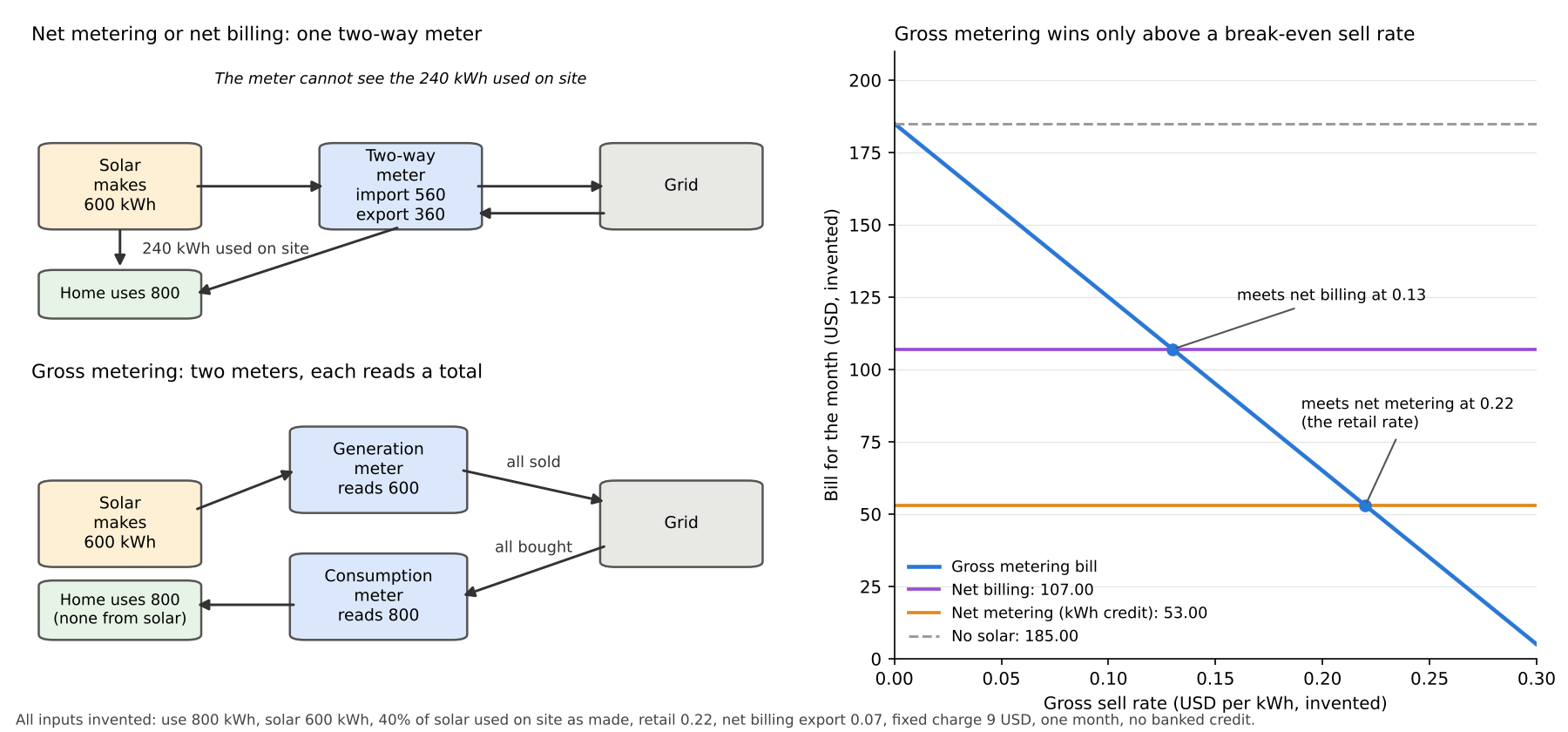
Figure 1. On the example inputs, the gross bill meets the net billing bill at a 0.13 USD per kWh sell rate and net metering at the 0.22 retail rate.
The meter at the grid connection sees flow, not output. Read behind the meter for what a utility meter misses. For monitoring clamps, see smart meter and CT clamp. Check which meter your tariff pays on.
Worked example: one example month, five bills
On example numbers, gross metering costs 113.00 USD. That is 6.00 USD more than net billing. It is 60.00 USD more than net metering. The sell rate sets the order.
| Input (example) | Value |
|---|---|
| Use and solar output | 800 kWh and 600 kWh in the month |
| Solar used on site as it is made | 40%, so 240 kWh. Net arrangements only. |
| Rates and fixed charge | Retail 0.22, net billing export 0.07, gross sell rate 0.12 USD per kWh. Fixed charge 9 USD. |
| Meter reads (kWh) | Two-way meter: import 560, export 360. Gross: generation 600, consumption 800. |
| Method | Calculation (USD) | Bill (USD) |
|---|---|---|
| No solar | 800 × 0.22 + 9 | 185.00 |
| Solar, no export credit | 560 × 0.22 + 9 | 132.20 |
| Net metering, kWh credit | (560 − 360) × 0.22 + 9 | 53.00 |
| Net billing | 560 × 0.22 − 360 × 0.07 + 9 | 107.00 |
| Gross metering | 800 × 0.22 − 600 × 0.12 + 9 | 113.00 |
The net billing page uses a different example month. Net metering wins here. It values the 360 exported kWh at retail. The month ends with a net import of 200 kWh. No credit is left.
To beat net billing, the gross sell rate must top this: on-site share × retail + (1 − share) × export rate. That is 0.4 × 0.22 + 0.6 × 0.07 = 0.13 USD per kWh. With the same inputs, 20% on-site use gives 0.10. 60% gives 0.16. 80% gives 0.19. Against net metering the break-even is the retail rate, 0.22. That holds while the month has a net import.
How does gross metering link to a feed-in tariff?
A feed-in tariff is the sell rate. Gross metering is the meter setup. It measures the output the rate pays on. NREL says a feed-in tariff "is not a metering & billing arrangement in itself".
- Great Britain: Ofgem says Feed-in Tariff payments rest on meter readings. Generators send these to their licensee. The Energy Saving Trust (updated 8 February 2024) describes a generation tariff. That is a rate for each kWh generated. It also lists a separate export tariff. The scheme closed to new applicants from 1 April 2019. The Smart Export Guarantee, launched 1 January 2020, pays from export meter readings.
- Software: OpenSolar ticks feed-in tariff applicability for Buy All Sell All. Solargraf calls it a gross feed-in tariff.
Where do rules name gross or net metering?
Wording differs. These two examples come from the regulator’s or ministry’s own text. They are not a survey.
- India (central Rules, 2021): the Electricity (Rights of Consumers) Amendment Rules, 2021 count all solar energy generated and all energy used apart. They use "appropriate metering arrangements". Commissions "may permit gross metering" for prosumers who want to sell all output.
- India (2020 Rules, since amended): Rule 11(4) asked for regulations "for net metering for loads up to ten kW" and "for gross metering for loads above ten kW". Renewable Watch reported this on 31 December 2020. The 2021 Amendment Rules raised the net metering limit to 500 kW. The text says loads "up to five hundred kW or upto the sanctioned load, whichever is lower". Renewable Watch reported that change on 30 June 2021. State commissions set the day-to-day rules. For India proposals, see solar proposal software in India.
- Queensland, Australia (historic, March 2013): the state competition regulator described a "net" arrangement, with meters recording imports and exports. It set this against a "gross" arrangement. There the meter records total use and total output apart. Its Table 2.2 lists Queensland as Net. This is not a statement of current rules.
For the United States, NREL’s 2017 brief names buy-all, sell-all as one compensation mechanism. It is not a survey of what each utility offers, so read your utility’s tariff.
How solar software handles gross metering
Aurora, OpenSolar, Solargraf and SAM state a mode that bills all use at retail and pays all output at a separate rate. The PVsyst and Energy Toolbase pages do not. A single sell price with a self-use input is not the same thing.
Not stated means the company page we cite does not say. Details for each tool follow the table.
| Software | Models gross metering (all output sold)? | Source |
|---|---|---|
| Aurora Solar | Yes | Aurora help, Edit Existing Utility Rates, no date shown |
| OpenSolar | Yes | OpenSolar support, no date shown |
| Solargraf | Yes | Solargraf help, published 10 December 2021 |
| SAM (NREL) | Yes, per 2021 slides | NREL SAM webinar slides, 29 September 2021 |
| PVsyst | Not stated | PVsyst help, self consumption, no version or date shown |
| Energy Toolbase | Not stated | ETB help, Metering Types, no date shown |
- Aurora Solar: A Feed-In Tariff option: "All energy produced is exported and credited at a specified rate." You still buy consumption from the grid. The page does not use the words gross metering.
- OpenSolar: Buy All Sell All: self-consumption not allowed, measures gross consumption and gross solar production over the billing cycle, sell rate for gross solar production, FiT applicability ticked. No netting interval listed.
- Solargraf: Gross feed-in tariff: the client "sells all electricity produced and purchases all electricity consumed" and uses two separate meters.
- SAM (NREL): Slides list "Buy all / Sell all" with accounting in dollars, hourly, and monthly compensation timing.
- PVsyst: Says some systems are connected through "a dedicated electricity meter for PV production". The page describes no buy-all, sell-all billing scheme.
- Energy Toolbase: The Metering Types page lists Net Metering and Net Billing only.
The table reflects the company pages as of October 2026. Solargraf’s page may be out of date.
Common mistakes with gross metering
FAQs
Is gross metering better than net metering?
Only if the gross sell rate is above the break-even. In the example month, gross metering needs 0.13 USD per kWh to match net billing. It needs 0.22 to match net metering. A real tariff may sit on either side.
Can you use your own solar power under gross metering?
Not under the setup NREL describes. It says these customers use none of their own output. OpenSolar’s help also marks self-consumption as not allowed for Buy All Sell All.
Is gross metering the same as a feed-in tariff?
No. Gross metering is how output and use are measured. A feed-in tariff is a sell rate. It can be paid on gross output. Ofgem’s Feed-in Tariff scheme paid on meter readings that generators sent in.
Does gross metering need two meters?
Usually, yes. NREL describes a production meter plus a consumption meter. Solargraf describes two separate meters for export and import. Check your utility’s wording.
Related terms
- Net metering: credits for exports, usually in kWh at the retail rate.
- Net billing (export tariff): exports valued at an export rate.
- Behind the meter: equipment on the customer’s side of the utility meter.
- Smart meter and CT clamp: devices that read grid flow and output.
Next step: compare the tariff’s sell rate with the break-even above, then test the job in a tool from the best solar proposal software list.
Sources
- NREL: Grid-Connected Distributed Generation: Compensation Mechanism Basics, October 2017. SAM webinar slides, 29 September 2021.
- India: Electricity (Rights of Consumers) Amendment Rules, 2021 (text as reproduced, no notification date on the page). Ministry of Power listing, 27 June 2021. Renewable Watch, 31 December 2020. Renewable Watch, 30 June 2021. Electricity (Rights of Consumers) Rules, 2020, PIB copy (notification day left blank in the copy, checked 30 October 2026).
- Queensland Competition Authority: Final Report, Estimating a Fair and Reasonable Solar Feed-in Tariff for Queensland, March 2013.
- Energy Saving Trust: Feed-in Tariff, last updated 8 February 2024.
- Ofgem: Feed-in Tariffs and Smart Export Guarantee (no page dates shown).
- Software: Aurora. OpenSolar. Solargraf. PVsyst. Energy Toolbase.
Last updated 30 October 2026. Next scheduled review: 30 January 2027.