Key takeaways
- The target is 34,800 MW with INR 34,422 crore of central support.
- A trade magazine reproduces a ministry memorandum letting projects with power purchase agreements (PPAs) signed by 31 December 2025 finish feeder plants by 31 March 2027.
- Pump support is a share of benchmark cost: 30% from the centre, or 50% in special regions. Support is generally capped at the 7.5 HP level.
- At 30 November 2025 the PIB shows 6.7% of sanctioned plant capacity, 72.0% of stand-alone pumps and 30.7% of grid-connected pumps installed.
- PM-KUSUM 2.0, with a planned 10 GW Agri-PV part, was still not formally notified by MNRE as of the most recent report found (October 2026), though trade press reports an internal Expenditure Finance Committee approval with no outlay disclosed. Check MNRE’s own site for a launch announcement before quoting it as live.
- MNRE extended the financial-closure deadline for Components A and C to 30 November 2026, and has said project completion will get no further extension past 31 March 2027 (MNRE notice, reported October 2026).
To price a farm plant bid in software, see the best solar proposal software in India. The software pages we read do not cover PM-KUSUM sums, so use the checker below.
PM-KUSUM at a glance: why it matters for installers
PM-KUSUM sets who pays for farm solar in India. Pump work runs through state agencies and tenders. Plant work runs through DISCOM power purchase agreements.
| Item | Detail |
|---|---|
| What it is | Ministry of New and Renewable Energy scheme, approved 19 February 2019 (PIB, 11 November 2021). Revised guidelines: 17 January 2024 (PIB, 10 December 2025). |
| Target and funds | 34,800 MW and INR 34,422 crore (Renewable Watch, 25 January 2024). The 2021 factsheet gave 30.8 GW. |
| Timeline | Sunset date 31 March 2026 (Lok Sabha reply, 27 November 2024), later moved again: MNRE’s own notice (reported October 2026) pushes financial closure for Components A and C to 30 November 2026, with project completion fixed at 31 March 2027 for projects with a PPA or notice-to-proceed by 31 December 2025, and no further extension promised past that date. |
| Who takes part | Farmers, groups, farmer producer organisations, water user associations and credit societies. Small and marginal farmers get priority (PIB, 10 December 2025). |
| Owned elsewhere | Home rooftop scheme: PM Surya Ghar. Module list: ALMM. |
| In software | No design or CRM page cited here names PM-KUSUM. One pump-sizing tool exists (see the software table). |
EQ Magazine (28 March 2026) reproduces the ministry memorandum for projects with PPAs or tariff notices signed or issued by 31 December 2025. It reports feeder-level plants (Components A and C) commissioning by 31 March 2027 and individual pump sets (Components B and C) by 30 September 2026. We could not open the memorandum PDF, so check it. That 30 September 2026 pump deadline has now passed. A later MNRE notice (reported October 2026) extends financial closure for Components A and C to 30 November 2026, with completion still fixed at 31 March 2027 and no further extension promised. The pages found do not confirm whether the individual pump-set date moved by the same notice, so check the current MNRE circular before quoting either date to a farmer.
Construction World (1 April 2026) cites supply chain delays. Drishti IAS (3 April 2026) and Energetica India (26 July 2026) repeat it.
The component decides the quote. A pump quote needs the benchmark, state share and farmer’s balance. A plant quote needs the DISCOM tariff, land and a substation within about 5 km.
What are the three components?
Component A is grid-connected plants of 500 kW to 2 MW on farm land. Component B is stand-alone solar pumps. Component C solarises grid-connected pumps, one at a time or by whole feeder. The table says what each covers, and the bullets below give the support and the installer angle.
| Component | What it covers |
|---|---|
| A | 10,000 MW of ground or stilt-mounted plants, 500 kW to 2 MW, within 5 km of a substation (Renewable Watch, 25 January 2024). |
| B | Stand-alone pumps, including diesel pump replacement. |
| C | Individual pump solarisation (IPS) and feeder-level solarisation (FLS). |
Support as printed, and what it means for installers:
- Component A: The DISCOM buys under a 25-year PPA (PIB, 2021). The centre pays the DISCOM 40 paise per kWh or INR 6.60 lakh per MW per year, whichever is lower. This runs for 5 years (Ministry of Information and Broadcasting booklet, data to 31 March 2023). A 2026 study says the plant owner gets no subsidy. Tariff, land and grid decide the case.
- Component B: Central assistance (CFA) is 30% of benchmark cost. It is 50% in the North-Eastern states, Sikkim, Himachal Pradesh, Uttarakhand, Jammu and Kashmir, Ladakh, Lakshadweep and the Andaman and Nicobar Islands. Under the booklet’s 30:30:40 pattern, the state adds at least 30% and the farmer pays the balance. CFA is generally capped at the 7.5 HP level.
- Component B for installers: Empanelled companies work with state agencies. Central tender rates cap state bids, and a company that fails to install can be removed for 5 years (SolarQuarter, 1 November 2022).
- Component C: FLS gets a fixed central assistance of INR 1.05 crore per MW, or INR 1.75 crore in special regions (PIB, July 2024, SolarQuarter, 11 December 2025). For IPS, the 2026 study says the farmer pays at least 10%. FLS plants are built for DISCOMs, and IPS has had little uptake (study, 8 April 2026).
Sources differ on which component carries the DISCOM incentive: the booklet puts it under Component A, and Down To Earth (30 December 2025) puts it under Component C. We follow the booklet and could not open the 2024 guidelines.
The booklet says CFA above 7.5 HP stays at the 7.5 HP level. Renewable Watch (25 January 2024) adds that special regions can get CFA up to 15 HP. That holds for no more than 10% of installations.
How far has each component got?
Component B is furthest on: the PIB shows 72.0% of sanctioned pumps installed at 30 November 2025. Component A is furthest behind, at 6.7% of sanctioned capacity (our sums).
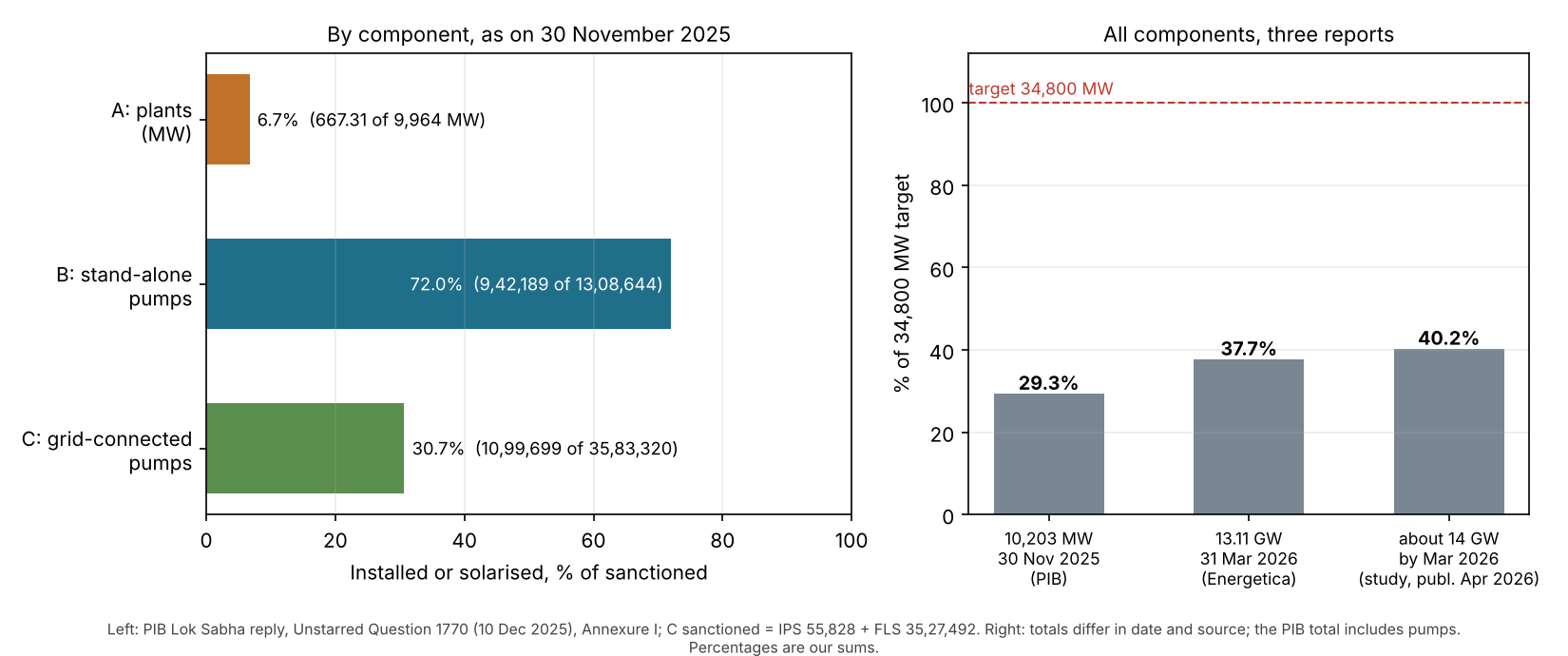
Figure 1. At 30 November 2025, stand-alone pumps were 72.0% installed and plants 6.7%, and later reports put total capacity at 37.7% to 40.2% of target.
Stand-alone pumps rose from 5,40,499 (5.4 lakh) on 31 October 2024 (Lok Sabha, 27 November 2024) to 9,42,189 (9.4 lakh) on 30 November 2025 (PIB). That is 4,01,690 more in 13 months, or about 30,900 a month (our sums). A lakh is one hundred thousand.
Component A is the hardest to pin down, because three sources give three figures.
| Component A, installed | Source and date |
|---|---|
| 667.31 MW of 9,964 MW sanctioned | PIB, Lok Sabha reply of 10 December 2025, data at 30 November 2025. |
| 8.4% of target met by March 2026, which is 840 MW of 10,000 MW (our sum) | CEEW, CSTEP and IISD study of 8 April 2026, via ThePrint, 14 April 2026. |
| 1,726.92 MW at 30 June 2026 | Energetica India, 26 July 2026, reporting a Lok Sabha reply. |
The figures have different dates and may use different bases. Quote one source with its date.
| Figure to quote | Value | Share | Source |
|---|---|---|---|
| Plants only (Component A) | 667.31 MW of 9,964 MW sanctioned | 6.7% of sanctioned | PIB, 30 November 2025 |
| All components | 10,203 MW | 29.3% of the 34,800 MW target | PIB, 30 November 2025 |
| All components, later | 13.11 GW | 37.7% of target | Energetica India, 31 March 2026 |
| All components, later | About 14 GW | 40.2% of target | ThePrint, 14 April 2026 (the share is our sum) |
The PIB release does not say how pump capacity is counted in its total. The 29.3%, 37.7% and 40.2% use the 34,800 MW target as base, and the 6.7% uses sanctioned capacity.
Targets also moved: the 2021 factsheet lists 20 lakh stand-alone pumps, and a Lok Sabha annexure of 27 November 2024 lists 14 lakh. PIB shows INR 7,106 crore released to 30 November 2025, which is 20.6% of INR 34,422 crore (our sum). It is money released, not spent.
What comes next is still unsettled as of November 2026. Down To Earth (30 December 2025) says PM-KUSUM 2.0 is proposed. On 11 March 2026 Energetica India quoted the Minister on a planned 10 GW Agri-PV part (see agrivoltaics). A later trade report (October 2026) says an internal Expenditure Finance Committee approval has come through, without a disclosed outlay, while other reports through mid-2026 say MNRE had not yet formally notified the scheme. None of the sources found confirm a Cabinet decision or a launch date. Check MNRE’s site before telling a customer PM-KUSUM 2.0 is live.
Worked example: pump support and plant incentive
The prices below are invented placeholders, not benchmarks, and show how the cap and rate change the support. The rates are as printed in the PIB factsheet and the booklet. We assume the benchmark equals the installed price.
| Pump | Installed price (INR) | Benchmark used (INR) | CFA (INR) and rate | CFA share of price |
|---|---|---|---|---|
| 5 HP, general state | 400,000 | 400,000 | 120,000 (30%) | 30.0% |
| 7.5 HP, general state | 550,000 | 550,000 | 165,000 (30%) | 30.0% |
| 10 HP, general state | 700,000 | 550,000 (7.5 HP cap) | 165,000 (30%) | 23.6% |
| 5 HP, special region | 400,000 | 400,000 | 200,000 (50%) | 50.0% |
For the 5 HP pump in a general state, the state share is at least INR 120,000. The farmer pays INR 160,000. The booklet says bank finance can cover up to 30% of cost (INR 120,000), leaving INR 40,000 of the farmer’s own money. In a special region the farmer pays at most INR 80,000 if the state adds 30% (our sums).
The 10 HP pump costs INR 150,000 more than the 7.5 HP pump, but the CFA does not move.
| Plant, example case | Energy (kWh a year) | 40 paise per kWh (INR) | Cap, INR 6.60 lakh per MW (INR) | Incentive (INR) |
|---|---|---|---|---|
| 1 MW at 15% utilisation | 1,314,000 | 525,600 | 660,000 | 525,600 (rate applies) |
| 1 MW at 22% utilisation | 1,927,200 | 770,880 | 660,000 | 660,000 (cap applies) |
The cap starts to bind above a utilisation factor of 18.84% at 8,760 hours. The sources do not say whether MW means AC or DC. See capacity utilisation factor. The incentive goes to the DISCOM, not the plant owner.
The checker below reproduces both tables. Its starting values are example.
How solar software handles PM-KUSUM
Of the four tools we read, only the IWMI tool sizes pumps, and none of the pages cited describes subsidy sums.
| Software | PM-KUSUM support documented? | What the page says | Page read |
|---|---|---|---|
| IWMI Solar Irrigation Pump Sizing Tool (not in our software list) | Partly | A beta Excel tool with four modules: crop water need, discharge, head loss and pump selection. Pump selection follows MNRE principles. No subsidy sums are described. | IWMI blog, 21 November 2022. |
| Fuzen | Not stated | The solar CRM page names only the PM Surya Ghar subsidy. | fuzen.io solar CRM page, metadata 1 October 2026. |
| Arka 360 | Not stated | An earlier site search for KUSUM showed no KUSUM or pump page. We could not reopen it on 30 October 2026. | arka360.com search page, read October 2026. |
| Solar Ladder | Not stated | A blog on PM Surya Ghar company registration has no KUSUM or pump text. | Solar Ladder blog, 20 May 2026. |
Not stated: the company page we cite does not say. Partly: the tool covers pump sizing but not subsidy. The three company pages read do not state PM-KUSUM support. For India-focused design and proposal tools, see the best solar design software in India and the best solar software in India.
Common mistakes with PM-KUSUM
FAQs
Is PM-KUSUM the same as PM Surya Ghar?
No. PM-KUSUM covers farm plants and pumps. PM Surya Ghar covers rooftop solar for homes and has its own company portal. Know which scheme a quote falls under before you price it.
Who receives the pump support?
Farmers get it, as a lower price on the pump. Central assistance (CFA) is a share of benchmark cost: 30%, or 50% in special regions. Under the booklet’s 30:30:40 pattern the state adds at least 30% and the farmer pays the rest. The booklet shows bank finance for up to 30% of cost.
Is PM-KUSUM still open?
Only for some projects. The first phase sunset on 31 March 2026. A memorandum reported by EQ Magazine lets projects with PPAs signed by 31 December 2025 run on (see At a glance). Confirm new sanctions with your state agency.
Must the modules be on the ALMM list?
Your tender decides. The 2021 PIB factsheet says the scheme will create demand of 20.8 GW for domestically produced cells and modules, but it sets no list. Our ALMM page shows which lists bind which projects.
Related terms
- PM Surya Ghar: India’s rooftop scheme for homes.
- ALMM: India’s list of approved module makers and models.
- Capacity utilisation factor: how Indian contracts state plant output.
- Agrivoltaics: crops and panels on the same land.
Next step: get your state agency’s pump benchmark or the DISCOM tariff, then build the quote in the best solar design software in India.
Sources
- PIB factsheet on PM-KUSUM, 11 November 2021 (checked October 2026).
- Ministry of Information and Broadcasting: PM-KUSUM, A New Green Revolution, no date printed, data to 31 March 2023 (checked October 2026).
- Lok Sabha Unstarred Question 346, 27 November 2024 (checked October 2026).
- PIB: PM-KUSUM progress, Lok Sabha Question 1770, 10 December 2025 (checked October 2026).
- Renewable Watch: amended guidelines, 25 January 2024 (checked October 2026).
- SolarQuarter: Component B tender clauses, 1 November 2022 (checked October 2026).
- SolarQuarter: PM-KUSUM progress, 11 December 2025 (checked October 2026).
- Down To Earth: PM-KUSUM 2.0, 30 December 2025 (checked October 2026).
- Construction World: deadline extension, 1 April 2026 (checked October 2026).
- EQ Magazine: Extension of timeline under PM KUSUM (reproduces the ministry memorandum), 28 March 2026 (checked 30 October 2026).
- PIB document on feeder-level solarisation support, July 2024 (checked 30 October 2026).
- Drishti IAS: deadline extension, 3 April 2026 (checked October 2026).
- ThePrint: study on PM-KUSUM, 14 April 2026 (checked October 2026).
- Energetica India: PM-KUSUM 2.0, 11 March 2026 (checked October 2026).
- Energetica India: PM-KUSUM installs 13.11 GW, 26 July 2026 (checked October 2026).
- Energetica India: MNRE extends PM-KUSUM financial closure deadline to 30 November, 1 October 2026 (checked 3 November 2026).
- IWMI: Solar Irrigation Pump Sizing Tool, 21 November 2022 (checked October 2026).
- Company pages: Fuzen solar CRM, Arka 360 site search and Solar Ladder blog (checked October 2026).
Last updated 3 November 2026. Next scheduled review: 3 February 2027.