Key takeaways
- PTO comes from the utility, not the building department. TEP says installers "must not operate the system until receiving a PTO". PG&E says never to turn on the system before its PTO letter.
- Before PTO, TEP lists a completion notice, a review of the final permit and photos, and meter set. PG&E lists engineering approval, an executed agreement and inspector confirmation.
- No single time applies. TEP prints a target for final review and meter set. It says its times assume no corrections or inspections.
- Money can wait on PTO. Connecticut Green Bank’s Smart-E schedule for solar PV holds the last third of the payment. It waits until a Certificate of Completion is signed and PTO arrives.
- In our invented example, an 8-week wait costs 468 USD for an 8 kW home. It costs 7,615 USD for a 250 kW roof. Replace every input with your own.
To track PTO as a milestone in software, see the best solar project management software.
PTO at a glance
PTO is the last gate before a system runs. The utility sends it by letter or email. It comes after the inspection and any meter work.
| Item | Detail |
|---|---|
| Who grants it | The utility. TEP: "we do not turn on your solar system". The installer turns it on after PTO. |
| Comes after | Utility approval to build, the AHJ’s final inspection, then the utility’s final review and meter set. |
| Time | No single figure. TEP prints up to 21 days for final review and meter set. For other utilities, see the interconnection application page. |
| Standard or rule | Utility tariff and state rules. No single national rule is cited. |
| In software | Project tools can track it as a milestone: see the best solar project management software and the best solar CRM. |
Why does PTO matter for installers?
PTO sets when the system starts to earn. It can also set when you get paid in full. A roof with panels is not a finished job. PTO has to arrive first.
Payment can wait on PTO. Connecticut Green Bank’s Smart-E schedule (page dated 3 January 2024) ties the final third of a solar PV payment to "Certificate of Completion signed and PTO". So you carry that held third until the letter arrives. Other lenders and contracts differ, so read yours.
The customer’s bill waits too. GreenLancer says a system without PTO cannot export, so it cannot join programmes such as net metering. Switching on early is a risk as well: TEP and PG&E both tell installers to keep the system off until PTO.
What happens between the build and PTO?
The AHJ inspects. The installer reports the job as done. The utility reviews it and sets any meter. Then it sends PTO. The two utilities below print different steps, so map the steps your own utility uses.
The table sets TEP and PG&E side by side, one step per row.
| Step | TEP (Arizona) | PG&E (California) |
|---|---|---|
| Before the build | "Construction of solar projects may only begin after approval from TEP." | Application, engineering review and an executed Interconnection Agreement. |
| Local sign-off | The local jurisdiction does the final inspection. A notice of installation completion follows. | Engineering approval, an executed agreement and a signed-off building permit come before final inspection. |
| Utility check | TEP reviews the final permit, photos and form. "Field inspections may be performed as necessary." | "Confirmation project is approved by PG&E inspectors." |
| Meter | TEP installs the billing and production meters. A missing kit part "may result in a meter set rejection". | Not stated |
| PTO | A "Permission to operate" email. Then "contact your installer to energize your system." | PG&E sends the contract and PTO at Interconnection Approval, "Within 5 business days of notification". The contractor can get a copy "once issued". |
Not stated: the page we read does not say. Sources: TEP’s residential interconnection page, process flowchart and expectations page (all undated). PG&E’s net energy metering page (2026 footer) and generation interconnection timeline (undated). TEP’s flowchart says it shows "the most likely flow with no corrections or inspections needed". See AHJ for the building side and commissioning for your own tests.
PTO is not the same as approval to build. Approval to build comes first. PTO comes last. PG&E’s page says you can add the customer’s email to its A&A form. That gives "faster notification" of when they can operate.
How long does PTO take?
It varies, and each utility prints its own figure. TEP lists up to 21 days for final review and meter set. It says its times assume no corrections or inspections.
The same TEP page gives a 7-day review of the completion notice and a meter set "within 1 to 3 weeks". Those two step times can together run past the 21 days in its "What to Expect" overview. Quote a range, because all of these are targets, not promises. For PG&E’s printed limits, and a chart of limits across utilities, see the interconnection application page.
GreenLancer says California homeowners "wait weeks or months" for some reviews, even with full paperwork. No dated national figure for PTO times is cited, so none is given.
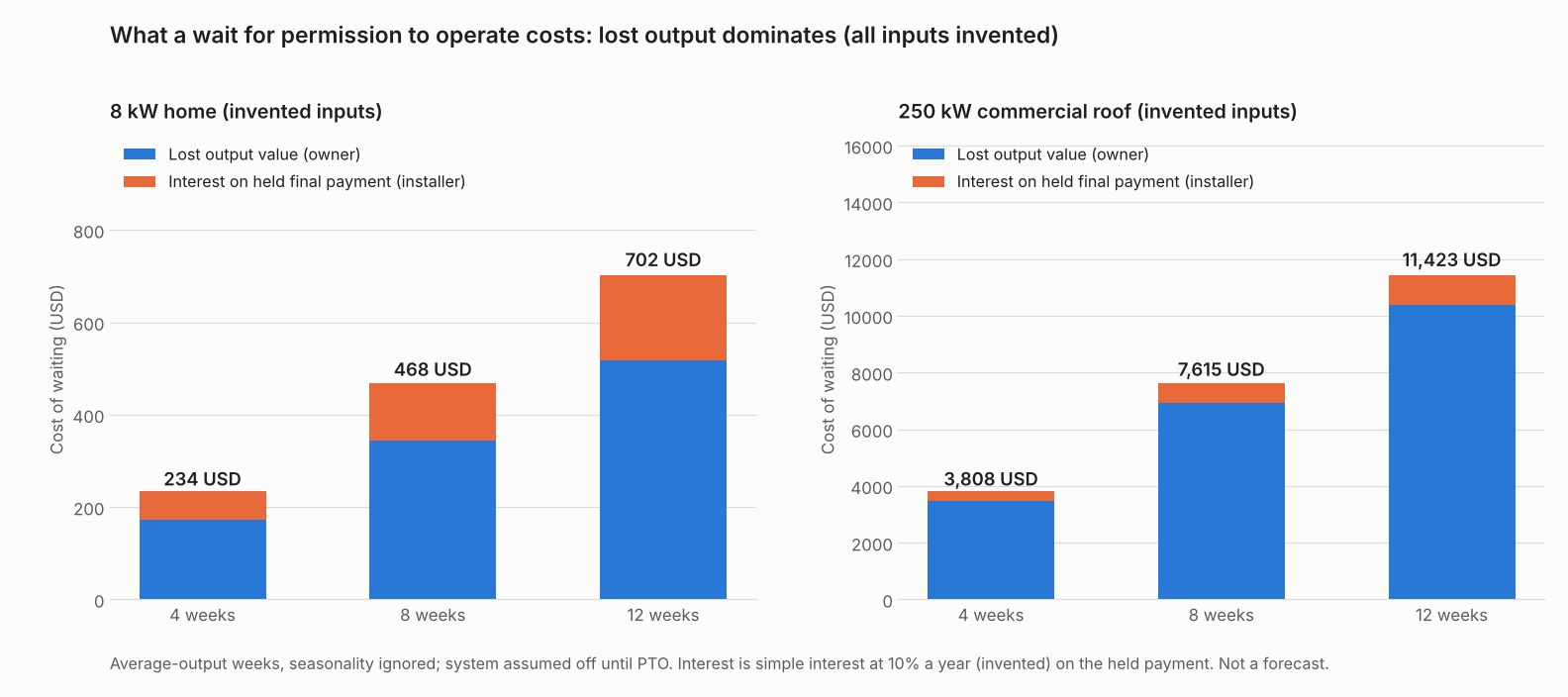
Figure 1. In our examples, lost output is 74% of the weekly cost of waiting for the 8 kW home. For the 250 kW roof it is 91%. Interest on the held payment is the rest.
What does a PTO delay cost?
A wait costs the owner lost output. It costs the installer interest on held-back money. Every input below is example. The totals show the method. They do not show the market.
- Lost output per week = kW × annual yield ÷ 52 × value of each kWh.
- Held payment = contract price × share tied to PTO.
- Interest per week = held payment × annual rate ÷ 52 (simple interest).
- Total = (lost output + interest per week) × weeks of delay.
The table applies those four steps to an 8 kW home and a 250 kW roof.
| Input (example) | 8 kW home | 250 kW commercial roof |
|---|---|---|
| Yield, kWh per kW per year | 1,400 | 1,500 |
| Value of each kWh | 0.20 USD | 0.12 USD |
| Contract price | 3.00 USD per W (24,000 USD) | 1.80 USD per W (450,000 USD) |
| Share paid at PTO | 33.33% (7,999 USD) | 10% (45,000 USD) |
| Cost of capital | 10% a year | 10% a year |
| Lost output per week | 43.08 USD | 865.38 USD |
| Interest per week | 15.38 USD | 86.54 USD |
| Total after 4 / 8 / 12 weeks | 234 / 468 / 702 USD | 3,808 / 7,615 / 11,423 USD |
The 33.33% echoes the Connecticut schedule above. The 10% share and the other inputs are our guesses, not data. The system is off until PTO, at average output, and we ignore seasons. Staff time, calls and export credit are left out. The owner bears the lost output. You bear the interest.
The weekly cost is small for a home, but it repeats on every open job. Ten homes waiting on PTO hold back about 80,000 USD of final payments, on these inputs. See cash flow analysis and payback period for the wider money picture.
PTO delay cost calculator
Enter the system size, annual yield, the value of a kWh, the contract price, the share tied to PTO, your cost of capital and the weeks waiting. The calculator returns the held final payment and the cost of financing it for that wait, on your own numbers rather than the worked example above.
How solar software handles PTO
Of the five company pages we read in October 2026, only SmartService documents PTO as its own status with reminder alerts, not just "install complete". Sunbase and Enerflo mention PTO but name no PTO feature or milestone. Coperniq and Solar Permit Solutions do not state PTO. The utility grants PTO, not the software.
| Software | Tracks PTO? |
|---|---|
| SmartService | Yes |
| Sunbase | Partly |
| Enerflo | Partly |
| Coperniq | Not stated |
| Solar Permit Solutions | Not stated |
- SmartService: "Permit submission, AHJ inspection, utility interconnection, and PTO each get their own status with reminder alerts." Source: Company product page, undated (2026 footer)
- Sunbase: Company blog says it "Manages all project tasks from solar design to PTO". Its table rates Inspection/PTO "Strong: Alerts across stages of the project lifecycle". No dedicated PTO feature is named. Source: Sunbase blog, 27 April 2026
- Enerflo: Describes coverage "from lead to PTO (Permission to Operate)" and milestones in Install Tracker. Does not say PTO is a milestone. Source: Enerflo FAQ, undated (2026 footer)
- Coperniq: Products page lists "Milestone Tracking: Monitor key project phases". PTO not named on the page read. Source: Coperniq products page, undated
- Solar Permit Solutions: A service. Pricing page lists a utility interconnection add-on. PTO not mentioned. Source: Pricing page, undated (2026 footer)
Not stated: the company page we cite does not say. Partly: the page mentions PTO but names no PTO feature. SmartService has no profile on our site yet. Its "Yes" rests on the company’s own page, which is marketing copy. To compare tools that track milestones, see the best solar project management software and the best solar CRM.
Common mistakes with PTO
FAQs
What does PTO mean in solar?
PTO means permission to operate. It is the utility’s go-ahead to switch the system on. The building department’s inspection is a separate step.
Can I turn on my panels before PTO?
Not under the two utilities cited. TEP says installers "must not operate" before PTO. PG&E says "Never turn on" before its letter. Check your own utility’s rule before any test run.
Is PTO the same as the final inspection?
No. The AHJ’s final inspection comes first. In TEP’s flow, the utility then reviews the final permit and photos. It sets the meter before it sends PTO.
How long does PTO take?
No national figure applies. TEP prints up to 21 days for final review and meter set. Its step-by-step list gives a 7-day review and a meter set within 1 to 3 weeks, so the real wait can run longer. Check your utility for its own times.
Why is my PTO delayed?
Common causes are a missing meter kit part, extra engineering work or a utility backlog. PG&E says extra engineering work can add time. GreenLancer names backlogs. The utility can tell you whether it is waiting on you or on its own queue.
Related terms
- Interconnection application: the form and drawings that ask the utility for approval to build.
- AHJ: the local authority that issues the permit and the final inspection.
- Net metering: the billing credit that starts after PTO.
Next step: write your utility’s printed PTO target on each open job, then compare the best solar project management software for tools with a PTO status.
Sources
- TEP residential page, undated (checked October 2026).
- TEP flowchart and TEP expectations, both undated (checked 30 October 2026).
- PG&E net metering page, 2026 footer only, and PG&E timeline, undated (checked October 2026).
- Connecticut Green Bank Smart-E schedule, dated 3 January 2024 (checked October 2026).
- GreenLancer solar PTO post, published 1 December 2025 (checked October 2026).
- SmartService, undated (checked October 2026).
- Sunbase blog, 27 April 2026 (checked October 2026).
- Enerflo FAQ, Coperniq products and Solar Permit Solutions pricing, all undated (checked October 2026).
Last updated 30 October 2026. Next scheduled review: 30 January 2027.