Key takeaways
- Datasheets differ. Of 12 checklist fields, Sungrow’s SH10RT prints 12, Fronius’s 10.0 Plus 11 and SolarEdge’s SE10000H (EU) 7.
- Battery power is current times voltage. Sungrow’s 30 A meets its 10.6 kW cap at 353 V. Below that voltage the current limit binds.
- Fronius’s distributor copy prints Full Backup switching as under 45 sec.. Sungrow prints under 20 ms. Confirm the unit on the maker’s current sheet.
- Example: 12 modules of 450 W read 545.1 V cold, inside both PV limits. Sungrow gives 0 failures and 3 flags. Fronius gives 1 failure and 2 flags.
- Of 4 tools checked, Aurora and SMA Sunny Design say they handle hybrid inverters. No page says a tool checks the inverter’s PV, battery or backup limits.
To size hybrid and battery systems in software, see the best solar battery storage design software.
Hybrid inverter at a glance
A hybrid inverter puts PV, battery and backup limits on one sheet. Each set can stop a design on its own.
| Item | Detail |
|---|---|
| What it is | An inverter that joins PV and battery on its DC side. Aurora’s help says a DC-coupled battery "connects to a hybrid inverter on the DC side". |
| Four limits | PV window (voltage, current, power). Battery range. Battery power. Backup rating, including switching time. |
| Example limits | Sungrow SH10RT: 1,000 V PV, 150 to 600 V battery, 10,000 W backup. Fronius 10.0 Plus: 600 V, 150 to 455 V, 10,000 VA. |
| Standard or rule | The sheet sets the limits. Fronius’s short-circuit footnote cites IEC 60364-7-712, NEC 2020 and AS/NZS 5033:2021. The NEC 690 page covers code limits. |
| In software | Aurora and SMA Sunny Design name hybrid inverters. The company pages do not document limit checks. |
Why does a hybrid inverter matter for installers?
One box carries four sets of limits, and a missed limit can fail the design.
AC vs DC coupling covers efficiency and clipping. Solar-plus-storage covers modes. Grid-connected system covers anti-islanding.
How does a hybrid inverter differ from a string inverter plus a battery inverter?
A hybrid inverter carries the battery on its own DC side. So one sheet should hold every limit. Aurora’s help says an AC-coupled battery connects "via a storage-only inverter". That adds a second sheet.
| Design question | Hybrid inverter | String inverter plus AC-coupled battery inverter |
|---|---|---|
| Sheets to read | One. The Sungrow sheet prints PV, battery, AC and backup limits together. | Two: the PV inverter and the storage-only inverter. |
| Where PV and battery meet | On the DC side of one inverter (Aurora). | On the AC side (Aurora). |
You check PV inputs as on a string inverter. See also microinverter. Off-grid banks use a stand-alone charge controller. For off-grid designs, see the best off-grid solar design software.
What does a hybrid inverter datasheet print?
The three sheets print different subsets. Fields 1 to 4 are the PV window. "Not stated" means the sheet text gives no value.
| Field | Sungrow SH10RT (three-phase) | Fronius Primo GEN24 10.0 Plus (single-phase) | SolarEdge Home Hub SE10000H (EU) |
|---|---|---|---|
| 1. Maximum PV voltage | 1,000 V | DC input range 65 to 600 V | 480 V |
| 2. MPP range | 200 to 950 V. Full-load range in manual | Usable 65 to 480 V. 260 to 480 V at rated power | Not stated |
| 3. PV inputs and current | 2 MPPT. 37.5 A (12.5 A and 25 A). Isc 48 A (16 A and 32 A) | 2 MPPT. 22 A each. Isc 41.25 A and 36 A | 25.5 A maximum input current |
| 4. Maximum PV power | 15,000 Wp recommended | 15,000 Wp | 20,000 W |
Fields 5 to 12 cover the battery, the AC output and backup.
| Field | Sungrow SH10RT (three-phase) | Fronius Primo GEN24 10.0 Plus (single-phase) | SolarEdge Home Hub SE10000H (EU) |
|---|---|---|---|
| 5. Battery voltage range | 150 to 600 V | 150 to 455 V | Not stated. The sheet lists 380 V nominal DC input for PV and battery together |
| 6. Battery current | 30 A (conditional, see the Sungrow notes below) | 22 A | Not stated |
| 7. Battery power | 10,600 W charge and discharge | 10,360 W maximum DC input and output. 10,000 W AC-coupled charging | 5,000 W per battery. Discharge limited to rated AC power |
| 8. Compatible batteries | "Li-ion battery" (type only) | BYD Battery-Box Premium HVS and HVM, LG FLEX. Country and exclusions apply | SolarEdge Home Battery 400V. Up to 3 |
| 9. Rated AC power | 10,000 W | 10,000 VA | 10,000 VA |
| 10. Backup rated power | 10,000 W and VA | Full Backup 10,000 VA. PV Point 3,000 VA | 10,000 W |
| 11. Backup peak | 12,000 W / 12,000 VA for 5 min (conditional, see the Sungrow notes below) | Not stated | Not stated |
| 12. Transfer time | Under 20 ms | PV Point under 35 sec.. Full Backup under 45 sec. (Krannich copy, Jan 2024) | Not stated |
Sheets: Sungrow German version 22.1 (2024). Fronius EN_UK V01 Jan 2024. SolarEdge DS-000198-EU, 22 August 2023. The last two are distributor copies.
- Units: Fronius prints switching time in "sec.". Sungrow prints "ms". Both are printed upper bounds, not measurements. Fronius’s Australian page prints PV Point at 20 s and no Full Backup time, so confirm on the current sheet.
- Battery power: it is a current limit times voltage. At 150 V, Sungrow’s 30 A passes 4.5 kW. At 455 V, Fronius’s 22 A is 10.0 kW. That is under its printed 10.36 kW.
- Sungrow notes: the battery current is printed "depending on the connected battery". The backup peak note reads "Can be reached only if PV and battery power is sufficient."
- Footnotes: Fronius says AC power derates at a battery voltage of 419.7 V and higher. It also says Full Backup needs "additional external components for grid switchover". SolarEdge says backup needs extra hardware and firmware.
- PV oversizing: printed PV power is 1.5 times AC power for Sungrow and Fronius (15,000 Wp over 10,000). It is 2.0 for SolarEdge (20,000 W over 10,000 VA). These ratios are our own division of printed values. See DC/AC ratio and inverter clipping.
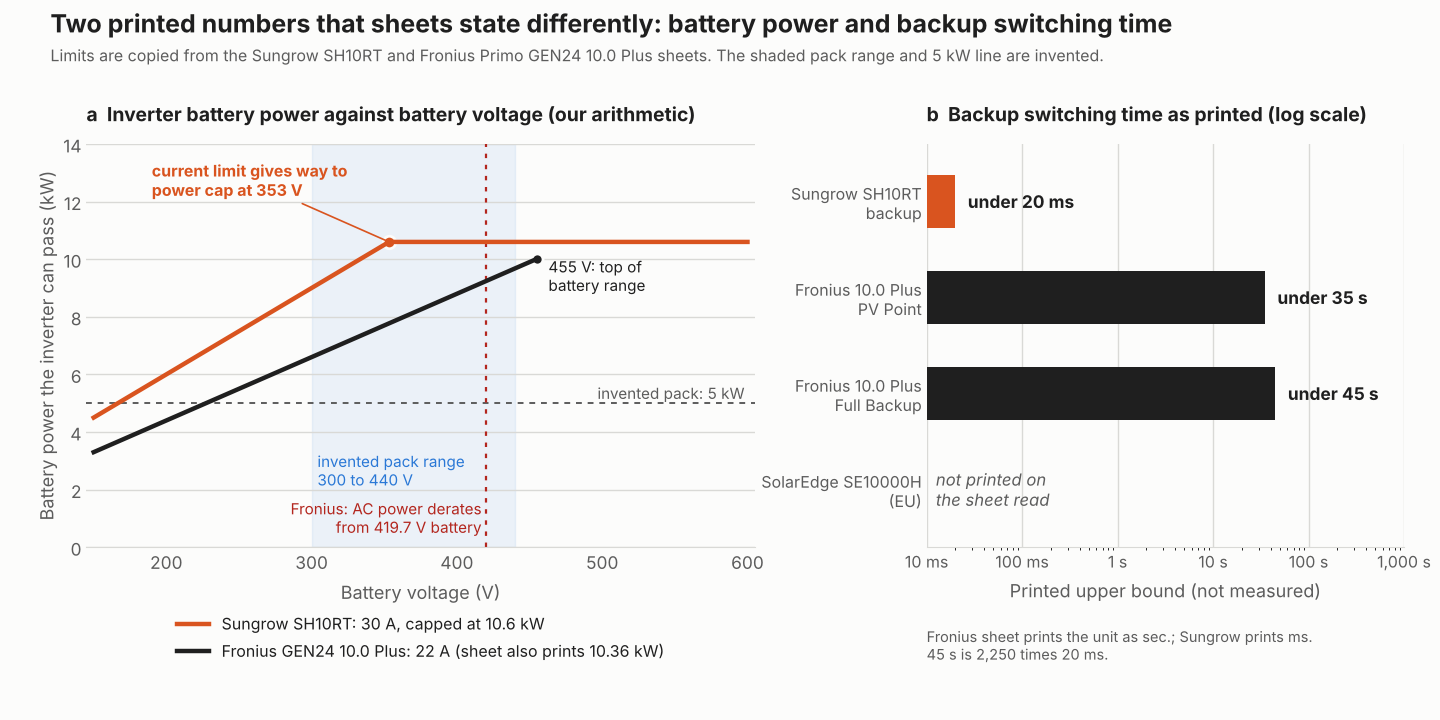
Figure 1. Printed limits cap battery power by current below 353 V on the Sungrow sheet, and printed backup switching times run from under 20 ms to under 45 sec.
Worked example: one array and one pack on two sheets
An example array and pack are checked against two real sheets, using the printed limits above. SolarEdge is left out because its sheet prints no MPP range, battery range or transfer time.
| Input | Value (example unless stated) |
|---|---|
| Module | 450 W. Voc 41.5 V, Vmp 34.5 V, Isc 13.9 A, Imp 13.05 A. Voc -0.27 %/°C. Vmp -0.34 %/°C (assumed) |
| Site and array | Cell -10 °C cold and 70 °C hot. 24 modules. 12 per string. One string on the checked input |
| Pack | 300 to 440 V. 5,000 W charge and discharge |
| Critical load | 6,000 W running. 11,000 VA peak |
PV side:
| PV check | Sungrow SH10RT, MPPT 1 | Fronius 10.0 Plus, MPPT 2 |
|---|---|---|
| Cold Voc against maximum PV voltage | 545.1 V against 1,000 V: within | 545.1 V against 600 V: within |
| Cold Vmp against MPP upper limit | 463.3 V against 950 V: within | 463.3 V against 480 V: within |
| Hot Vmp against MPP lower limit | 350.7 V against 200 V: within | 350.7 V against 260 V: within |
| Input Isc | 13.9 A against 16 A (plain Isc): within | 17.4 A (13.9 A x 1.25) against 36 A: within |
| Input Imp | 13.05 A against 12.5 A: flag | 13.05 A against 22 A: within |
| Array power | 10,800 W against 15,000 W: within | 10,800 W against 15,000 W: within |
Battery and backup side:
| Battery and backup check | Sungrow SH10RT | Fronius 10.0 Plus |
|---|---|---|
| Pack against battery range | 300 to 440 V inside 150 to 600 V: within | 300 to 440 V inside 150 to 455 V: within |
| Pack top against AC derating | Not stated | 440 V against 419.7 V: flag |
| Battery power at 300 V | 9,000 W against 5,000 W: within | 6,600 W against 5,000 W: within |
| Running load against backup rating | 6,000 W against 10,000 W: within | 6,000 W against 10,000 VA: within |
| Peak load against backup rating | 11,000 VA against 10,000 W: flag, inside 12,000 W / 12,000 VA for 5 min | 11,000 VA against 10,000 VA: fails, no peak figure printed |
| Running load on battery alone | 6,000 W against 5,000 W pack: flag | 6,000 W against 5,000 W pack: flag |
| Result (all checks) | 0 failures, 3 flags | 1 failure, 2 flags |
Sungrow’s sheet gives no multiplier, so plain Isc is compared. At 1.25 the value would be 17.4 A, over 16 A. Sungrow would then show 1 failure. Fronius’s cold Vmp is the closest call. Twelve modules is the longest string that stays under 480 V. Thirteen would read 501.9 V.
To test the margins, we ran 81 assumption combinations. Voc coefficient: -0.25, -0.27 or -0.30 %/°C. Vmp coefficient: -0.30, -0.34 or -0.40. Cold cell: -20, -10 or 0 °C. Hot cell: 60, 70 or 80 °C. Cold Voc never passed 600 V. Cold Vmp passed 480 V in 9 combinations. Hot Vmp never fell under 260 V.
The 6,000 W flag means the pack alone cannot carry the load. See backup power and critical loads.
Hybrid inverter datasheet check calculator
Enter a module, a pack, a load and the inverter’s printed limits in the hybrid inverter check calculator. It opens on the Sungrow case. Other free tools are in the best free solar calculators for installers.
What limits adding a battery to an existing system?
The battery must match the inverter’s list and voltage range. The solar must also reach its DC side. AC vs DC coupling covers the trade-offs.
- Battery lists: SolarEdge’s sheet names one battery, the Home Battery 400V. You can add up to 3 per inverter. Fronius lists BYD and LG models "depending on the country-specific certification and availability". Its footnote excludes five named models. Sungrow’s sheet gives only a type and range.
- Solar connection: Aurora’s help says a switch from a hybrid inverter to a storage-only inverter "removes any direct solar connections". It adds that a wrong pairing may block a DC-coupled setup.
- Backup add-ons: Fronius Full Backup is for the GEN24 Plus only. It needs external switchover parts. SolarEdge’s cover says backup "Requires additional hardware and firmware version upgrade". It lists a Backup Interface (purchased separately).
How solar software handles hybrid inverters
Aurora and SMA Sunny Design say they handle hybrid inverters, but no page documents limit checks. "Yes" means the company’s page says the tool handles hybrid inverters. Partly means the page covers them only in part.
| Software | Handles hybrid inverters? | Method |
|---|---|---|
| Aurora Solar | Yes | Modelled |
| SMA Sunny Design | Yes | Modelled |
| PVsyst | Partly | Modelled, hourly |
| Sol-Ark sizing tool | Partly | Indicative |
- Aurora Solar: "Storage system types and outputs" says Design Mode supports "battery-integrated hybrid inverters" and that, in performance simulations, they "behave like inverters". Notes: No date shown. No PV, battery or backup limit checks are mentioned.
- SMA Sunny Design: Release notes: 5.30 says hybrid inverters "can now be simulated with battery system". Release 5.70 makes several Sunny Boy Smart Energy hybrid inverters available in one design. Notes: Product page has no date. Notes run to 6.10. Limit checks not mentioned.
- PVsyst: The grid-storage help page lists "hybrid inverters" as equipment but says charging and discharging use "generic converters". Notes: Page undated (it names version 8.0.17). No hybrid model described.
- Sol-Ark sizing tool: The page says the tool recommends a hybrid inverter size, battery bank size and panel count from loads and sun hours. Notes: Page last modified 17 February 2026 (as printed). PV window and backup checks not mentioned.
To compare tools that size hybrid and battery systems, see the best solar battery storage design software.
Common mistakes with hybrid inverters
FAQs
Is a hybrid inverter the same as a battery inverter?
No. Aurora’s help treats a storage-only inverter as an AC-side unit. It treats a hybrid inverter as a DC-side unit. The sheets above print PV and battery limits together.
Does a hybrid inverter give backup power in a blackout?
Not by default on these sheets. A blackout needs a backup output, and some sheets need extra parts. Sungrow’s sheet prints a backup rating and a switching time. Fronius needs external switchover parts for Full Backup. SolarEdge lists a separately purchased Backup Interface and says backup needs extra hardware and firmware. See backup power and critical loads.
What size hybrid inverter do I need?
Size the PV side by the DC/AC ratio, the battery side by current times voltage, and the backup side by peak load in VA. Printed PV power is 1.5 times AC power for Sungrow and Fronius and 2.0 for SolarEdge. See DC/AC ratio.
Do I still need a string check on a hybrid inverter?
Yes. In our example 12 modules read 545.1 V cold Voc, inside Fronius’s 600 V limit. Thirteen would put cold Vmp at 501.9 V. That is over its 480 V MPP ceiling. See string sizing.
Related terms
- Solar-plus-storage: PV and battery behind one grid connection, with its modes.
- AC coupling vs DC coupling: where a battery joins solar.
- Battery storage design: sizing battery kWh and kW for a goal.
Next step: run your own array and pack through the datasheet checks above, then compare sizing tools in the best solar battery storage design software list.
Sources
All checked October 2026.
- Sungrow SH5.0RT, SH6.0RT, SH8.0RT, SH10RT: German datasheet, version 22.1 (2024), and English datasheet, version 17 (2022).
- Fronius: Primo GEN24 and GEN24 Plus datasheet, EN_UK V01 Jan 2024 (Krannich Solar copy) and Symo GEN24 4.0 Plus product page (PV Point wording only).
- SolarEdge Home Hub single-phase inverter datasheet (EU), DS-000198-EU, 22 August 2023 (SEGEN reseller copy).
- Fronius own page: Primo GEN24 10.0 Plus technical data (Australia) (checked 30 October 2026): "Max. switchover time PV-Point" 20 s, no Full Backup time.
- Aurora help: storage system types and outputs. SMA Sunny Design. PVsyst help: grid systems with storage. Sol-Ark: battery storage and hybrid inverter sizing tool.
Last updated 30 October 2026. Next scheduled review: 30 January 2027.