Key takeaways
- The inverter turns DC into AC and watches the grid. NREL (renamed NLR in December 2025) says solar systems "have long been required to disconnect from the electric grid" when an island forms.
- With no backup hardware, a grid-tied system stops in an outage, even in full sun. On our invented day (5 kWp, 18 kWh of use), a 3-hour midday outage loses 9.64 kWh, which is 43% of the day’s solar.
- The same example day exports 16.14 kWh and imports 11.64 kWh. Only 28.3% of the solar is used on site.
- A 5 kWh battery (example) lifts that to 51.7%, counting battery charge before losses, and cuts imports to 6.89 kWh. A 1.5 kW export cap (example) raises it to 37.0%, only because less solar is produced.
To file and track the utility forms in software, see the best solar interconnection software.
Grid-connected system at a glance
A grid tie is a design choice and a legal status. The array shares a connection with the grid. The utility has to approve it.
| Item | Detail |
|---|---|
| What it is | PV that runs in parallel with the utility grid through an inverter. Solar serves the site first. The grid covers any shortfall and takes any surplus. |
| Variants | With or without a battery (a hybrid inverter also connects one). Backup in an outage takes extra hardware and design. See backup power and solar plus storage. |
| Rules | No single rule. IEEE 1547 covers how distributed energy resources connect (see IEEE 1547). UL says it uses UL 1741 to test and certify inverters (see UL 1741). The utility’s tariff and agreement cover the rest. |
| Approval | The utility approves before the build and grants PTO before switch-on. Great Britain and India use other routes (see the steps below). |
| In software | Simulators and proposal tools split solar into on-site use and export hour by hour. Some model export caps. |
What does the inverter do on a grid connection?
It converts the array’s DC into AC. It keeps working alongside the grid. It also stops feeding in when the grid is not normal. This page gives the short version. The inverter page covers datasheet limits, and anti-islanding has more detail.
- Convert: DOE says an inverter converts the DC a solar panel makes into AC (page modified 31 March 2025).
- Watch the grid: DOE says small inverters are generally expected to ride through small dips or spikes in voltage or frequency. Longer or larger ones can make them disconnect. They then shut down.
- Detect islands: NREL says solar and similar resources "have long been required to disconnect from the electric grid" when an island forms (July 2016, updated January 2025). It adds that PV inverters typically spot islands on their own.
An island is a part of the grid that local generation keeps live while it is cut off from the rest. NREL’s August 2016 slides quote IEEE 1547-2003, section 4.4.1. The system "shall detect the island and cease to energize the Area EPS" "within two seconds of the formation of an island".
That is the 2003 edition. A Massachusetts requirements document quotes the 2018 edition (Clause 8.1.1). The DER "shall detect the island, cease to energize the Area EPS, and trip within 2 s of the formation of an island". NREL summarises the 2018 edition in 11 clauses. It says Clause 8 covers islanding, "including black-start capability" (December 2025). UL’s 2016 advanced-inverter programme used UL 1741 Supplement A to test and certify inverters for grid support (release of 8 September 2016). The release does not describe anti-islanding tests.
Why does a grid-connected system stop in an outage?
With no battery and no backup hardware, the inverter stops feeding in when the grid goes down.
The solar-electric.com learning centre (no author or date shown) says anti-islanding "simply means that the inverter stops grid-feed-in". That happens when the grid has abnormal frequency or voltage, or a complete outage. The page says the purpose is to protect line workers. They may be repairing the grid. NREL’s 2016 slides say unintentional islands can put utility workers at risk.
A battery changes the answer only if the design adds backup. The same page says you can add a battery system for backup. It says that system can "fool the grid-tied system into thinking the grid is still functional" as it disconnects from the grid. Tesla’s Powerwall 3 manual (copyright 2024) describes whole-home and partial backup. The installer picks which loads get backup. The page does not say what solar does in an outage.
So backup is a separate promise. It has its own load list and sizing. See backup power and critical loads and AC and DC coupling. The battery storage design page covers a battery that only shifts solar into the evening.
What are the steps to connect to the grid?
TEP is an Arizona utility. It requires approval before you build and permission to operate before you switch on. It prints these installer steps on its residential page (undated, a banner names a 2025 deadline). Check the current page and your own utility.
- Submit the application and documents in TEP’s PowerClerk portal on the customer’s behalf. The customer signs the interconnection agreement.
- Build only after approval. Get permits, book inspections and secure clearances. See AHJ and permit plan set.
- Send a Notice of Completion with as-built photos.
- TEP installs any billing meter and a production meter. Then it issues PTO.
- Switch on only after PTO. TEP says: "Installers must not operate the system until receiving a PTO from TEP."
Other utilities differ on forms, fees and timing. The interconnection application page covers size tracks. The PTO page covers timing. Great Britain uses G98 and G99. India uses DISCOM approval. Large projects join the interconnection queue. The best solar interconnection software guide lists tools that file these forms.
Worked example: one example day, hour by hour
A grid-tied home uses solar first. Next it uses the battery, if it has one. Then it uses the grid. Surplus goes to the battery. After that it goes to the grid, up to any export cap. The panels do not make the rest.
All inputs are example. A 5 kWp array makes 22.50 kWh on a clear day (4.5 kWh per kWp). The home uses 18 kWh with an evening peak. The battery holds 5 kWh usable at 3 kW. It starts empty, with 95% efficiency each way. The cap is 1.5 kW. The outage runs 11:00 to 14:00, with no backup hardware. Solar and battery stop. The load goes unserved.
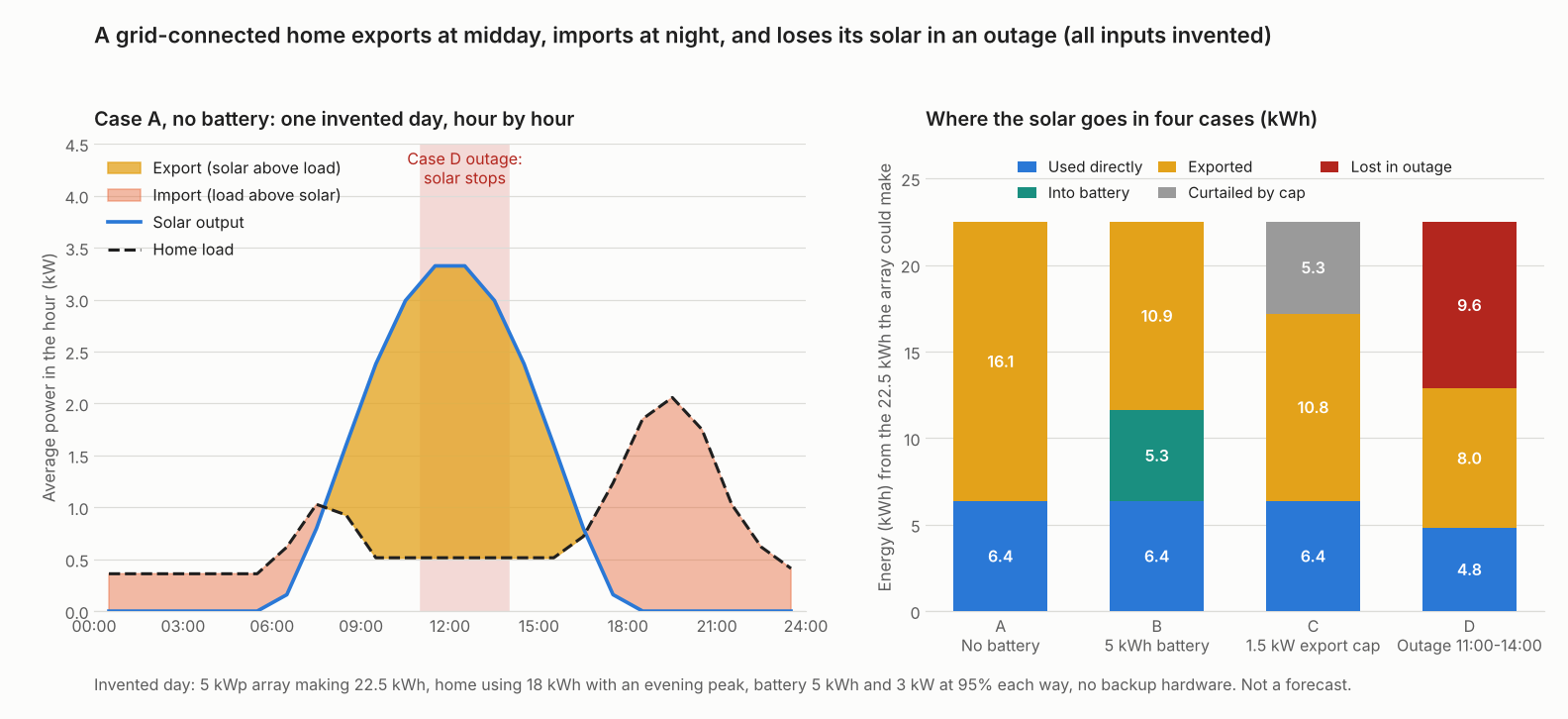
Figure 1. On an example sunny day a home with no battery exports 16.14 kWh around midday and imports 11.64 kWh at night, and a 3-hour midday outage wastes 43% of the solar.
The first table sets the four example cases side by side for use and export.
| kWh unless stated (example inputs) | A. No battery | B. Battery | C. Export cap | D. Outage |
|---|---|---|---|---|
| Solar produced | 22.50 | 22.50 | 17.20 | 12.86 |
| Used directly | 6.36 | 6.36 | 6.36 | 4.82 |
| Into battery (before losses) | 0.00 | 5.26 | 0.00 | 0.00 |
| Battery to home (after losses) | 0.00 | 4.75 | 0.00 | 0.00 |
| Exported | 16.14 | 10.88 | 10.84 | 8.04 |
The second table covers losses, imports and the two ratios for the same cases.
| kWh unless stated (example inputs) | A. No battery | B. Battery | C. Export cap | D. Outage |
|---|---|---|---|---|
| Curtailed by the cap | 0.00 | 0.00 | 5.30 | 0.00 |
| Lost in the outage | 0.00 | 0.00 | 0.00 | 9.64 |
| Imported | 11.64 | 6.89 | 11.64 | 11.64 |
| Home load not served | 0.00 | 0.00 | 0.00 | 1.54 |
| Self-consumption (% of solar produced) | 28.3% | 51.7% | 37.0% | 37.5% |
| Self-sufficiency (% of load served) | 35.3% | 61.7% | 35.3% | 29.3% |
In case A the home exports in 9 hours and imports in 15. Peak export is 2.81 kW in the 11:00 and 12:00 hours. The battery in case B is full by the end of the 11:00 hour. It is empty after the 19:00 hour, before the evening peak ends. See self-consumption for the two ratios. Here self-consumption divides by solar produced. See net metering for what exports earn.
Self-consumption counts energy into the battery before losses, so case B would read a little lower if you counted only what the home uses. The cap raises the ratio in case C, from 28.3% to 37.0%. It adds no use. It only shrinks the denominator, because 5.30 kWh is never made. Quote kWh as well as the ratio. In case D the ratios count only the solar and load of the hours the grid was up.
Grid-connected day calculator
Enter your own values. The presets load the four cases above.
How solar software handles grid-connected systems
Only PVsyst documents a use and export split in full, and only PVsyst, SAM and Aurora document an export limit. Outage behaviour is the least documented: only PVsyst mentions backup, and only as an application. We checked the pages in October 2026.
| Software | Use and export split each time step | Export limit or curtailment | Outage or backup |
|---|---|---|---|
| PVsyst | Yes | Yes | Partly |
| SAM | Not stated | Yes | Not stated |
| Aurora Solar | Partly | Yes | Not stated |
| OpenSolar | Partly | Not stated | Not stated |
Not stated means the page read does not mention it. Partly means the page covers only part of it, such as backup named only as an application. What each page says:
- PVsyst: it lists energy used on site, injected to the grid and drawn from it, "at each simulation time step". It needs a user’s needs profile. The ratio is defined on its self-consumption page. The "Grid power limitation" page says the limit can be in kW or kVA. It adds: "The only way to limit power is to not produce it." Storage help names backup power as an application and lists a "Weak grid recovery" strategy. See battery storage design. (Pages read: PVsyst help, undated, documentation build only.)
- SAM: it has a grid interconnection limit in kWac. Power above it is treated as curtailed. (Pages read: SAM help, "Grid Limits", undated.)
- Aurora Solar: surplus solar goes to the battery first, and only the remainder is curtailed. No split of on-site use and export is described. It has a "Grid export limit" setting in Design Mode, blank for no limit. Outage behaviour is not on this page. See backup power for its backup-duration help. (Pages read: Aurora help, "Using Grid Export Limits", undated.)
- OpenSolar: it simulates battery activity hour by hour. Its self-consumption scheme charges from excess solar after the load, and the rest is exported. The page does not mention backup. (Pages read: OpenSolar support, battery modelling, updated 7 May 2026.)
To compare tools that model use, export and limits hour by hour, see the best solar simulation software. The best solar battery storage design software list covers battery tools.
Common mistakes with grid-connected systems
FAQs
What is the difference between grid-connected and off-grid?
A grid-connected system shares a connection with the utility. It can import and export. An off-grid system has no utility connection. It must meet the load by itself. See off-grid system design.
Do grid-tied solar panels work in a power outage?
Not without backup hardware. The inverter stops feeding in when the grid goes down. A battery system built for backup can keep chosen circuits on. Without it, this example’s 11:00 to 14:00 outage cost 9.64 kWh of solar.
Do I need utility approval for a grid-tied system?
Usually yes. A home builders’ toolkit (NAHB) describes an approval application, then a Permission to Operate before switch-on. For example, TEP, an Arizona utility, says construction may begin only after approval. Installers must not operate the system until PTO.
Is a grid-connected system the same as net metering?
No. Grid connection is the physical and approval status. Net metering is a billing rule for exports. The same connection can sit under a net-billing or export tariff. See net metering.
Can the grid operator limit how much I export?
Yes. PVsyst’s help says many large systems face an injection power limit. The grid manager sets it. Aurora’s help calls export limits utility-defined caps on instant export. It says to use them where rules require them (the UK and parts of Europe).
Related terms
- Inverter: the device that converts DC to AC and limits what the array can feed in.
- Self-consumption: the share of solar used on site.
- Interconnection application: the form that asks the utility to approve the connection.
- PTO: the utility’s permission to switch on.
Next step: compare the tools that submit and track utility applications in the best solar interconnection software.
Sources
All pages were checked in October 2026. Page dates are as the pages print them.
- US Department of Energy, inverters and grid services basics (published 7 November 2019, modified 31 March 2025).
- NREL news item on anti-islanding tests (26 July 2016, updated 9 January 2025). The original page is gone and we found no working replacement URL, so check the claim against a current NLR or IEEE source before relying on it.
- NREL webinar slides on unintentional islands, 24 August 2016 (NREL/PR-5D00-67185).
- NREL guide to the clauses of IEEE 1547-2018 (updated 6 December 2025). A summary, not the standard text.
- UL news release on advanced inverter testing, 8 September 2016.
- solar-electric.com learning centre on grid-tie shutdown in outages (no author or date).
- Tesla Powerwall 3 owner’s manual, System Design (copyright 2024).
- TEP residential interconnection page (undated).
- NAHB, Solar Interconnection Process (checked 30 October 2026).
- Massachusetts, Inverter Source Requirements Document, quoting IEEE 1547-2018 Clause 8.1.1 (checked 30 October 2026).
- US Department of Energy, renaming of NREL as the National Laboratory of the Rockies (1 December 2025, checked 30 October 2026).
- PVsyst help (undated): grid power limitation, self consumption and inverter and array sizing.
- SAM help, Grid Limits (undated).
- Aurora help, Using Grid Export Limits (undated).
- OpenSolar support, battery modelling (last updated 7 May 2026).
Last updated 30 October 2026. Next scheduled review: 30 January 2027.