Key takeaways
- Under IEEE 1547-2018, as NLR (formerly NREL)’s April 2022 primer reports it, an inverter trips within 2 seconds by default and returns to service after 5 minutes by default.
- An island lasts only if its load nearly matches the inverter’s output. Voltage and frequency trips alone are not considered sufficient.
- Sandia (2002) prints one example. Voltage trips at 88% and 110% leave loads of 91% to 114% of output undetected. The check on this page matches it.
- A backup system opens its grid switch first. A grid-tied inverter with no such hardware just stops.
- The Enphase IQ8MC sheet says it "Meets UL 1741 only when installed with IQ System Controller 2 and 3". Check the controller named on the listing.
Anti-islanding is inverter firmware, so design tools do not cover it. To confirm the UL 1741 listing and utility checks before you file, see the best solar interconnection software.
Anti-islanding at a glance
It is a function inside the inverter. It spots that the grid has gone. Then it stops the feed-in. The grid-connected system page covers the connection steps.
| Item | Detail |
|---|---|
| What it does | Detects an unintentional island and stops the inverter energising it. NREL says PV inverters usually do this on their own, with one or more methods. |
| Time limit | IEEE 1547-2018, as NREL’s primer reports it: 2 seconds by default, or 2 to 5 seconds by mutual agreement. Return to service is 5 minutes by default. Other editions, utilities and countries can differ. |
| Standards named | IEEE 1547-2018 Clause 8.1 and IEEE 1547.1-2020 tests, as the primer describes them. UL 1741 and Supplement B. IEC62116 appears on one sheet. |
| Where it shows | Datasheets, the interconnection form’s equipment section and utility equipment checks. |
| In software | Not stated on the design-tool help pages used. It is inverter firmware. |
Why must an inverter stop energising an island?
A live island that nobody expects is a danger. NREL’s 2016 slides define an island. It is part of the grid powered only by local generation. They list the hazards.
- Workers. Utility staff may assume a downed line is dead.
- Equipment. Rejoining out of phase can put large torques on motors.
- Protection. An island’s fault current may be too small for protection to clear a fault.
The grid can also reclose onto an island. The primer’s summary of Clause 8.1.3 calls for means to prevent damage then. An island is unintentional when unplanned. One cause is a utility that opens a line section for repair.
An island is most likely to persist when its load matches the inverter’s output. The primer says an island lasts only if output nearly matches the load. That means real and reactive power. Then grid current is close to zero.
How do inverters detect an island?
Inverters detect islands with passive methods, which watch voltage and frequency at the connection point. They also use active methods, which disturb the grid and read the response, and remote signals from the utility. The primer quotes an informative note in IEEE 1547-2018: relying only on voltage and frequency trips is not considered sufficient. The table groups the methods named on the pages used.
| Class | Idea | Named on the pages used |
|---|---|---|
| Passive | Monitor electrical quantities at the connection point. | Over and under voltage, over and under frequency, rate of change of frequency, voltage phase jump, harmonics (NREL slides 12 to 15, Sandia 4.1.1 to 4.1.3). |
| Active | Deliberately make small changes there and study the response (the primer). | Impedance measurement, slip-mode frequency shift, frequency bias, Sandia frequency shift, Sandia voltage shift, frequency jump (NREL slides 12 and 16, Sandia 4.2.1 to 4.2.7). |
| Remote | Use a device or signal on the utility side. | Direct transfer trip, power line carrier, impedance insertion (NREL slides 17 and 18). |
Passive methods have a gap. NREL’s slide 14 says a non-detect zone sits between trip points. Sandia (2002, page 15) defines the NDZ as the range of local loads. A detection method can be made to fail for those loads.
Worked check: where a voltage window goes blind
A voltage window misses an island whose load is close to the inverter’s output. Sandia prints one example. Trips at 88% and 110% give an NDZ for loads from 114% down to 91%. This window is Sandia’s 2002 example. It is not an IEEE 1547-2018 setting. Check your utility’s trip settings.
Sandia says this part of the NDZ comes from Ohm’s law. Sandia’s equations are not reproduced here. The steps below are a reconstruction that matches Sandia’s printed example. Assume a resistive island load. Assume the inverter holds its current. Assume real power only.
- Load ratio x is island load at nominal voltage divided by inverter output.
- Island voltage is 1 / x of nominal. A heavier load pulls voltage down.
- No trip while 1 / x sits between the under-voltage and over-voltage limits.
- The blind band runs from 1 / over-voltage limit to 1 / under-voltage limit.
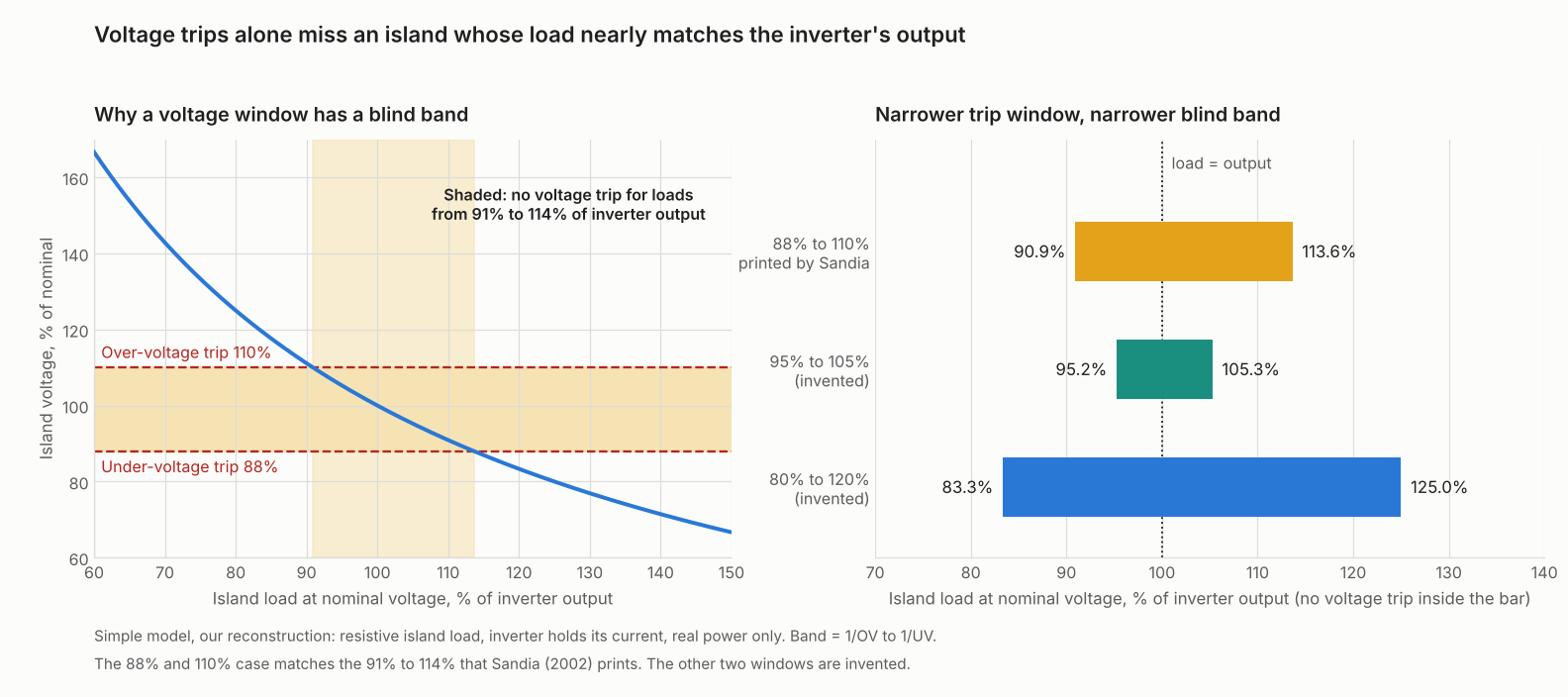
Figure 1. Trips at 88% and 110% leave island loads from 90.9% to 113.6% of inverter output undetected. A 95% to 105% window (invented) narrows it to 95.2% to 105.3%.
| Trip window (under / over) | Lowest load, no trip | Highest load, no trip | Width (points) |
|---|---|---|---|
| 88% / 110% (Sandia’s printed example) | 90.9% | 113.6% | 22.7 |
| 95% / 105% (example) | 95.2% | 105.3% | 10.0 |
| 80% / 120% (example) | 83.3% | 125.0% | 41.7 |
Sandia rounds the first row to 91% and 114%. Loads are percentages of inverter output. The model ignores frequency and reactive power. Real inverters add active methods.
Two example site checks follow. They use an 88% / 110% window and a 5 kW inverter output.
| Example island load | Load, % of output | Island voltage, % of nominal | Voltage trip alone operates? |
|---|---|---|---|
| 4.6 kW | 92.0% | 108.7% | No, inside the band |
| 3.0 kW | 60.0% | 166.7% | Yes, over-voltage |
In this simple model the first island runs on unless another method catches it. That is why standards ask for more than a voltage window.
Voltage-trip blind band calculator
Enter a trip window to see its blind band. Add a load and an inverter output to test a site. Only the Sandia preset is not example.
How do backup systems fit with anti-islanding?
A backup system leaves the grid first. Then it powers chosen loads as a deliberate island. A grid-tied inverter with no backup hardware stops instead.
- Intentional islands. NREL’s 2016 slides separate planned islands from unplanned ones. Microgrids are planned islands. In 2018 the IEEE 1547 working-group secretary, Vartanian, said "1547 does not permit unintentional islands".
- Disconnect, then island. Victron’s Hub-2 manual says in an outage "the inverter/charger will disconnect from the grid". When the battery is full, it raises its output frequency to limit the PV inverter. The manual is dated 8-4-2013 and covers one layout.
- External device. Victron’s Quattro ESS sheet says the unit is certified for ESS "in conjunction with Ziehl’s UFR1001E anti-islanding device".
- Listing depends on the controller. Enphase’s IQ8MC sheet says "Meets UL 1741 only when installed with IQ System Controller 2 and 3". Its grid-down line has the same asterisk.
For sizing and modes, see backup power and critical loads, solar plus storage and hybrid inverter.
Where does anti-islanding show on datasheets and forms?
Sometimes as a protection line. Sometimes only in a standards list. Read the sheet for your country, because US and EU sheets differ.
| Document | What it prints |
|---|---|
| SolarEdge Home Wave, US (DS-000153-NAM, 23 February 2023) | "Utility Monitoring, Islanding Protection, Country Configurable Thresholds": Yes. Grid standards "IEEE1547-2018, Rule 21, Rule 14 (HI)". Safety lists UL1741, SA and SB. |
| SolarEdge Home Wave, EU (DS-000094-EU, 26 July 2022) | Same line plus Configurable Power Factor. Standards include IEC61727, IEC62116, G98, G99 and VDE-AR-N-4105. |
| SMA Sunny Tripower TL-US (version 1.3, undated) | "The islanding detection function is activated by default." No islanding-specific times. |
- Enphase IQ8MC (2023-10-18) and IQ8H-208 (printed code DS-0077-03, 2022-12-27, the reseller file name carries 2022-07-29): no "anti-islanding" wording found. They list "IEEE 1547:2018 (UL 1741-SB)" and "CA Rule 21 (UL 1741-SA)".
- 10 kW inverter template, cooperative.com toolkit (undated): asks if the equipment is UL1741 listed and for the cut-sheet showing it. Certified equipment "shall not require further type-test review". Commissioning and acceptance testing still apply.
The SolarEdge US sheet prints "Islanding Protection" as a feature line. The Enphase sheets print no such words. A datasheet range is not a trip setting. The IQ8MC range is 211 V to 264 V. That is 87.9% to 110.0% of 240 V. The sheet calls it the grid voltage range. Do not enter it as a trip window.
The interconnection application page lists what PNM, PG&E and APS ask for. That includes UL 1741 status. The hosting capacity map page lists utility PV checks. These include anti-islanding or backfeed protection.
How solar software handles anti-islanding
Design tools size and simulate, but they do not cover this function. The help pages for PVsyst (inverter and array sizing) do not mention anti-islanding. Nor do those for Aurora Solar (Using Grid Export Limits) or SAM (Grid Limits). All three are undated. They were read in October 2026 and say nothing on the topic. The function sits in inverter firmware, so use the datasheet and the utility’s equipment check.
To compare tools that handle utility filings, see our ranked list of the best solar interconnection software. For backup and storage designs, see the best battery energy storage software.
Common mistakes with anti-islanding
FAQs
Why do solar panels shut off in a power outage?
Because a grid-tied system without backup hardware is built to stop feeding the grid once the inverter sees the grid has gone. To keep loads running, see backup power and critical loads. NREL’s 2016 slides list the hazards of a live island. One is risk to utility workers. See grid-connected system.
How fast must an inverter stop after the grid fails?
NREL’s primer reports 2 seconds by default under IEEE 1547-2018, and 2 to 5 seconds by agreement. NREL’s 2016 slides quote two seconds for the 2003 edition. The standard text is not quoted here. Your utility’s rule decides.
What is a non-detection zone?
It is the range of island loads where a detection method can be made to fail (Sandia, 2002). For an 88% and 110% voltage window, Sandia prints 91% to 114% of output.
Are intentional islands allowed?
Yes, when planned. NREL’s slides separate intentional islands, such as microgrids, from unintentional ones. A 2018 working-group slide says IEEE 1547 does not permit unintentional islands.
Is anti-islanding the same as rapid shutdown?
No. The SolarEdge US sheet lists them on separate lines. It cites NEC 690.12 for rapid shutdown, as printed. It also lists "Automatic Rapid Shutdown upon AC Grid Disconnect". See rapid shutdown for what that rule needs.
Related terms
- Grid-connected system: an array that runs in parallel with the grid.
- IEEE 1547: the interconnection standard. Its Clause 8.1 covers unintentional islanding.
- UL 1741 and UL 9540: the UL standards that test and list inverters and storage.
- Backup power and critical loads: the loads kept on during an outage.
Next step: match the inverter listing to the utility’s equipment check in the best solar interconnection software, or see battery energy storage software for backup.
Sources
All pages were checked in October 2026. Dates are as the pages print them.
- NREL primer on unintentional islanding in IEEE 1547-2018, TP-5D00-77782, April 2022.
- NREL slides on preventing unintentional islands, PR-5D00-67185, 24 August 2016.
- Sandia report on islanding detection methods, SAND2002-3591, November 2002 (library copy).
- Vartanian slides on IEEE 1547-2018, 31 October 2018.
- Datasheets from resellers. SolarEdge Home Wave US, SolarEdge Home Wave EU, Enphase IQ8MC and Enphase IQ8H-208.
- SMA technical information, undated. Sunny Tripower TL-US v1.3 and Sunny Boy Storage v1.0 (reseller copy).
- Victron, undated, reseller copies. Hub-2 manual, Revision 02, 8-4-2013 and ESS application, Quattro 48V.
- 10 kW inverter process template, cooperative.com DG toolkit (undated, issuer is a placeholder).
- Undated help pages. PVsyst, Aurora and SAM.
Last updated 30 October 2026. Next scheduled review: 30 January 2027.