Key takeaways
- FERC staff slides (3 February 2021) say a DER is "any resource located on the distribution system, any subsystem thereof or behind a customer meter".
- Each source has its own purpose. PJM’s 2019 article covers only generators and storage. The NLR (formerly NREL) slide on IEEE 1547-2018 says storage counts if it can export power.
- "Typically 1 kW to 10,000 kW" is how FERC’s 2020 fact sheet describes DER technologies. It is not a cap on what counts.
- In our invented 36-site fleet, adding the PV kWp, battery, charger and load ratings gives 459.2 kW. The sites can export 190.0 kW and cut 168.2 kW of load.
- No one example site type reaches 100 kW of export alone. The five types together reach 190.0 kW.
To size batteries or solar as DERs, see the best solar battery storage design software. To run a fleet of them, see the best VPP software for solar installers.
DER at a glance
A DER is defined by where it connects and what it can do, not by its size or fuel. Each source words this a little differently.
| Item | Detail |
|---|---|
| Core idea | A resource on the distribution system or behind a customer meter. |
| Size terms | No single limit. See the definitions table. |
| In software | Design tools model devices and a connection point. Monitoring tools track device state. See the DERMS page for functions. |
How do FERC, PJM, IEEE and EIA define a DER?
Each body words DER for its own job. A device can fit one definition. It can miss another.
| Source and date | Wording | Size term |
|---|---|---|
| FERC Order 2222 fact sheet, last updated 28 September 2020 | DERs "are small-scale power generation or storage technologies (typically from 1 kW to 10,000 kW)". | Each tariff "must set a size requirement for resource aggregations that do not exceed 100 kW". |
| FERC staff slides to the DOE Electricity Advisory Committee, 3 February 2021 | Order 2222 defines a DER as "any resource located on the distribution system, any subsystem thereof or behind a customer meter" (slide 5). | "Minimum size requirement for DER aggregations can be no more than 100 kW." "Rule does not adopt a maximum size for a DER aggregation." (slides 8 and 9). |
| PJM Inside Lines, 1 July 2019 | "any generator or electric energy-storage resource connected to lower-voltage, local distribution lines". | None printed. |
| IEEE Std 1547-2018 (Interconnection and Interoperability of Distributed Energy Resources), via NREL slides, 30 and 31 July 2019 | Slide 7: "all DERs connected to typical primary or secondary distribution voltage levels". | Any size at distribution voltages. |
| EIA Today in Energy, 2 December 2015 | Small-scale solar PV is "also called behind-the-meter, customer-sited, or distributed generation capacity". | "less than 1 megawatt (MW)". |
The table gives each wording and size term. The notes below say whether loads count under each wording.
- FERC fact sheet: DERs "can be located on an electric utility’s distribution system, a subsystem of the utility’s distribution system or behind a customer meter". The sheet lists electric storage, intermittent generation, distributed generation, demand response, energy efficiency, thermal storage, and EVs and their charging equipment. The sheet never uses the word loads. Demand response and EV charging equipment are the nearest items on its list. The 1 kW to 10,000 kW range describes the technologies, not a limit on what counts.
- FERC staff slides: the slide does not say whether loads count.
- PJM: the wording cited covers generators and storage and does not name loads.
- IEEE and NREL: the wording cited does not name loads. Another slide says DER "includes energy storage technologies capable of exporting active power to the electric power system". A charger that cannot export looks outside it. The slides add that synchronous generators of 10 MVA or more follow other design standards.
- EIA: solar only, so the question does not arise.
The EIA article is from 2015, so its definition may have changed. The IEEE wording comes from NREL slides, not the standard text.
What counts as a DER? Device classes
Solar, batteries and small generators count under all the wordings above. FERC also lists demand response, EVs and charging equipment. Before you list a device, ask which definition applies. The utility or market rule sets it.
| Class | Can it send power out? | PJM 2019 and IEEE 1547 wording |
|---|---|---|
| Rooftop or commercial solar | Yes | In both. The NREL slides show PV on inverters. |
| Battery storage | Yes | In both (IEEE: if it can export). |
| Small generator (CHP, diesel, gas) | Yes | In both. IEEE’s slides name synchronous, induction and inverter-based machines. |
| EV charger | Only with vehicle-to-grid | Outside PJM’s 2019 article wording. Inside IEEE’s only if it exports. |
| Controllable load (HVAC, water heater) | No | Outside both wordings cited. |
PJM’s wording is from a 2019 article. Later PJM filings may differ. See BESS for large batteries and EV charger integration for charging control.
Why do utilities and software treat DERs as one class?
They share a connection level. They share a data need. All of them change what the grid sees. NLR’s (formerly NREL) page, last updated 29 October 2026, points to "the proliferation of distributed energy resources (DERs)". It names mainly solar PV and battery storage.
The rules follow the same grouping. FERC says that grid operators "must revise their tariffs to establish DERs as a category of market participant". IEEE 1547 applies to DERs at distribution voltages. For communication protocols, see the DERMS page.
Design software follows too. Xendee says DERs "must be sized and optimized as one system". A design must also pass the connection process. For that, see interconnection application, DNO, G98 and G99 (Great Britain) and DISCOM approval (India).
Visibility. Utilities cannot always see behind the meter. EIA’s 2015 article says small-scale PV output "must be estimated". PJM’s 2019 article lists observability of non-wholesale DER as a concern. See fleet monitoring and net metering.
Worked example: add up a mixed fleet three ways
Adding the nameplate ratings overstates what a fleet can deliver, because the grid sees the connection, not the devices. Our 36 sites in five types are example placeholders.
| Type (example) | Sites | PV kWp / inverter AC kW | Battery kW / charger kW / load kW | Export limit kW |
|---|---|---|---|---|
| 1 PV only | 12 | 6 / 5 | 0 / 0 / 0 | none |
| 2 PV, DC-coupled battery, charger | 8 | 8 / 6 | 5 / 7.4 / 0 | 5 |
| 3 PV, AC-coupled battery, water heater | 5 | 6 / 5 | 5 / 0 / 3 | none |
| 4 EV charger only | 10 | 0 / 0 | 0 / 7.4 / 0 | none |
| 5 Commercial rooftop with HVAC | 1 | 60 / 50 | 0 / 0 / 20 | 40 |
These rules are assumptions. Export-capable is the inverter AC rating. An AC-coupled battery has its own inverter, so add its kW. Leave the inverter field for PV only. A DC-coupled battery shares the inverter, so add nothing. An export limit then caps it. Flexible load is charger plus controllable load. The assumption is that it is running and fully curtailable. See AC and DC coupling and DC to AC ratio.
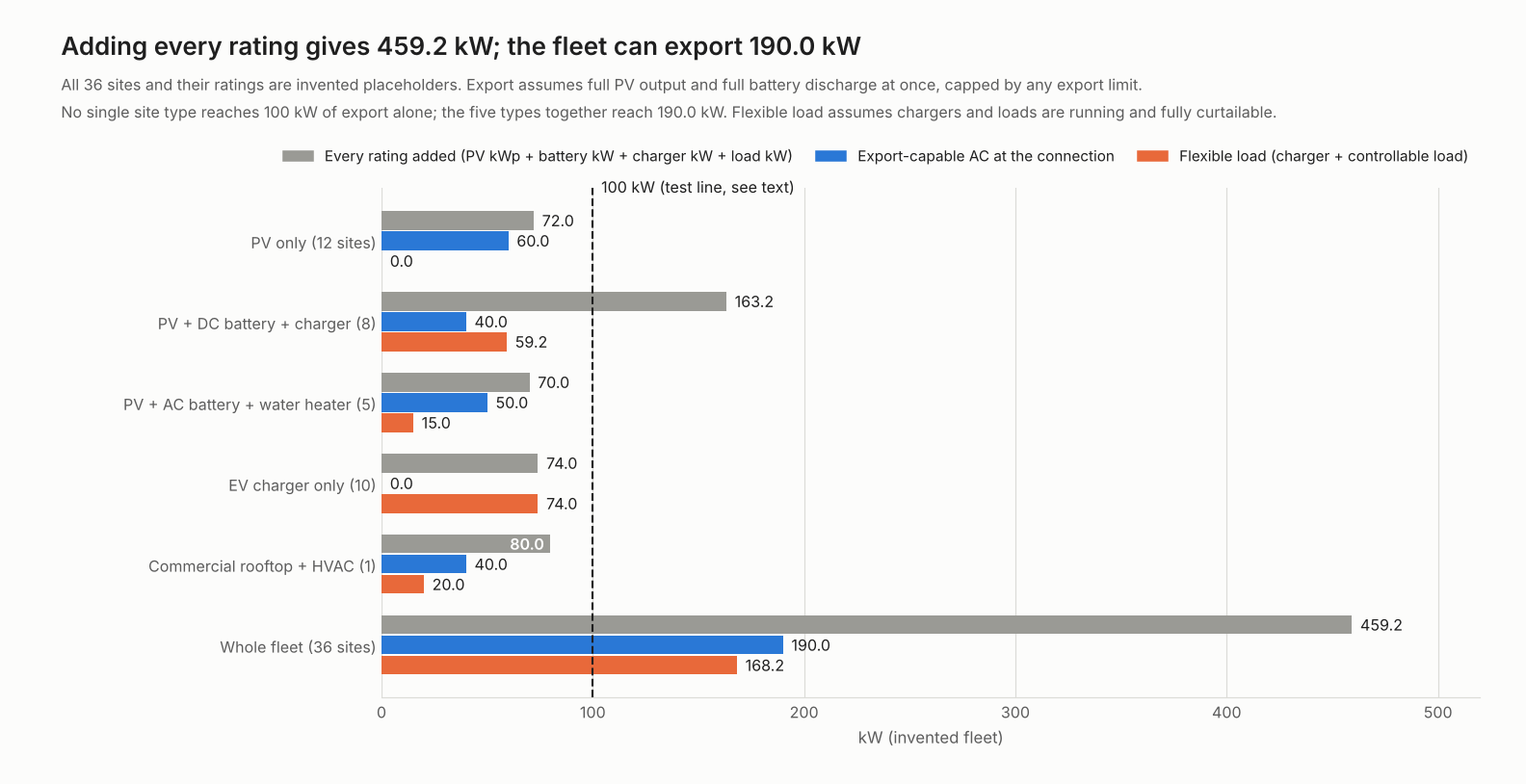
Figure 1. In an example fleet, adding the nameplate ratings gives 459.2 kW, but only 190.0 kW can be exported.
| Type (fleet totals, kW) | Ratings added (PV kWp, battery, charger, load) | Export-capable | Flexible load |
|---|---|---|---|
| 1 PV only | 72.0 | 60.0 | 0.0 |
| 2 PV, DC battery, charger | 163.2 | 40.0 | 59.2 |
| 3 PV, AC battery, water heater | 70.0 | 50.0 | 15.0 |
| 4 EV charger only | 74.0 | 0.0 | 74.0 |
| 5 Commercial rooftop | 80.0 | 40.0 | 20.0 |
| Fleet | 459.2 | 190.0 | 168.2 |
The sum of ratings is 2.42 times the export capability. It mixes panel kWp, battery kW and loads. Loads cannot push power out. Only the whole fleet exports 100 kW or more. No single type does. With every load running, the fleet could shift at most 358.2 kW at the meters (190.0 export plus 168.2 load).
The 100 kW line is a test value. It is the most FERC lets a tariff set as an aggregation minimum. A tariff may set less. It also defines how size is measured. We use export-capable kW only to show the effect.
DER fleet tally calculator
Change any value. "Load page example" restores the example fleet above.
How solar software handles DERs
Of the five tools we checked in October 2026, Xendee and HOMER Pro describe design models that hold several DER classes. Victron and Enphase cover several classes in control apps. Ratings use only the page named.
| Software | More than one DER class in one model? | Page and date |
|---|---|---|
| Xendee DESIGN | Yes | xendee.com/design. Page metadata modified 2 October 2026. |
| HOMER Pro | Yes | HOMER Pro product page, undated (checked November 2026). |
| Aurora Solar | Partly | Aurora help, entering energy consumption, updated 15 April 2026. |
| Victron VRM | Yes | VRM portal manual, sections 5.5 and 6.3, no date printed (copyright 2026). |
| Enphase App | Yes | Enphase EV charging page, 8 October 2025. |
Partly: the page covers more than one class only in part.
What each page says:
- Xendee DESIGN: "supports 25+ technologies such as electric vehicles, CHP generators, batteries, PV systems, geothermal plants, and wind turbines". "Solar, storage, generators, EV charging, and other distributed energy resources must be sized and optimized as one system".
- HOMER Pro: Models "solar PV, wind, batteries, diesel generators, and even simple grid connections" and "deferrable loads such as pumping or HVAC". EV loads are not on the page.
- Aurora Solar: An "Electric Vehicle" appliance adjusts the load profile from miles per day. The page mentions "solar, or solar + storage" once and describes no charger control.
- Victron VRM: It is a monitoring and control portal. Section 6.3 lists alarm monitoring for inverters, batteries, solar chargers and generator start/stop. Section 5.5 is "EV Charging Station controls in VRM". The monitoring list does not name EV charging.
- Enphase App: A control app, not a design tool. EV charger behaviour depends on whether it is paired alone, with solar and a Consumption CT, or with solar, CT and batteries. Battery use for charging depends on the profile.
Our ranking of the best solar battery storage design software covers storage-led design tools. The best VPP software for solar installers list covers fleet control.
Common mistakes with DERs
FAQs
Is rooftop solar a DER?
Yes, under every wording above. FERC lists generation. PJM counts any generator on distribution lines. The NREL slides on IEEE 1547-2018 show PV on inverters as in scope.
Is an EV charger a DER?
Yes under FERC’s wording, only if it can export under the IEEE wording, and no under PJM’s wording. FERC’s list includes EVs and their charging equipment. PJM’s wording covers only generators and storage. The IEEE wording on the NREL slide needs the device to export power.
What is the difference between DER and DERMS?
A DER is the device or resource, such as a battery or solar array. A DERMS is software that monitors and controls many DERs. The DERMS page covers functions and protocols.
What is the 100 kW in FERC Order 2222?
The FERC fact sheet says each tariff "must set a size requirement for resource aggregations that do not exceed 100 kW". That caps the minimum a tariff may set. The staff slides say the rule sets no maximum. That applies to aggregation size. See virtual power plants for how fleets get grouped.
Related terms
- DERMS: software that monitors and controls many DERs.
- Microgrid design: a set of DERs and loads that can island.
- Kilowatt and megawatt: the units behind every size term above.
Next step: name the definition your utility or market uses before you list a device, then compare fleet tools in the best VPP software for solar installers. To size the devices themselves, see the best solar battery storage design software.
Sources
- FERC, Order No. 2222: A New Day for Distributed Energy Resources, fact sheet, last updated 28 September 2020.
- FERC staff slides, Order No. 2222, to the DOE Electricity Advisory Committee, 3 February 2021. The order was issued 17 September 2020.
- PJM Inside Lines, What Are Distributed Energy Resources? A Beginner’s Guide, 1 July 2019.
- NLR (formerly NREL), Highlights of IEEE Standard 1547-2018, PJM workshop slides, 30 and 31 July 2019. Quoted from the slides, not the standard text.
- IEEE SCC21, IEEE 1547 page, IEEE Std 1547-2018 with 2020 amendment. Sections dated to January 2024.
- EIA, Today in Energy, 2 December 2015.
- NLR (formerly NREL), Distribution System Planning, Analysis, and Grid Integration, last updated 29 October 2026 (checked November 2026).
- Xendee DESIGN, page metadata modified 2 October 2026.
- HOMER Pro, undated (checked November 2026, URL updated after the old product page stopped resolving).
- Aurora help, entering energy consumption, updated 15 April 2026.
- Victron VRM portal manual, no date printed.
- Enphase, manage EV charging, 8 October 2025.
All sources checked October 2026.
Last updated 3 November 2026. Next scheduled review: 3 February 2027.