Key takeaways
- The US Department of Energy (DOE, September 2015) calls a building zero energy when yearly delivered energy is no more than exported on-site renewable energy.
- New Buildings Institute (NBI, June 2019) says net zero energy and net zero carbon "are not the same". A zero energy building cuts CO2 but may not reach zero.
- The IPCC (2022) calls carbon neutrality and net zero CO2 "overlapping concepts". They are equal only at global scale.
- Example building B exports 78 MWh and imports 48 MWh, so it passes a site-basis energy test. It still leaves 1.8 t CO2e if exports earn half the import factor.
- No software page read tests net zero status. Three of five tools report a CO2 figure.
No tool we read tests net zero status, but some report a CO2 figure. To compare those, see the best solar simulation software list.
Net zero at a glance: why it matters for installers
Net zero is a set of claims, not one standard. A buyer may mean energy, carbon or an offset claim. One array can pass one test and fail another.
| Item | Detail |
|---|---|
| Meaning | A balance of inflows against outflows for one boundary and one period, often 12 months. |
| Energy test | Delivered energy is no more than exported on-site renewable energy. DOE uses a source energy basis. Our example uses a simpler site basis. |
| Carbon test | Emissions, less credited exports and any removals, are zero or below. |
| Standard or rule | No single standard. The source sets the boundary, see the next section. |
| In software | Tools report a CO2 saving or emissions limit. None of the pages read tests net zero status. |
Why does net zero matter for installers?
Solar cuts delivered energy and can earn export credit. It does not cover site fuel, embodied carbon or a supply chain. A proposal that says "net zero" with no definition can fail the buyer’s own test, so the buyer’s test should be agreed first. For the energy units used here, see kilowatt-hour and megawatt-hour.
How do net zero energy, net zero carbon and carbon neutral differ?
They balance different things. Each source below sets its own boundary and says what you may buy in.
| Term | What is balanced | Off-site purchases or offsets | Source |
|---|---|---|---|
| Zero energy (also net zero energy or zero net energy) building | Annual delivered energy against exported on-site renewable energy, source basis. | Only on-site renewables count. A variant adds acquired renewable energy certificates (RECs). | DOE, September 2015 (US) |
| Zero carbon building | Building that is "highly energy-efficient and produces onsite, or procures, carbon-free" renewable energy to offset yearly operational carbon (Canada Green Building Council wording, per NBI). | Procured carbon-free energy is allowed in that wording. | NBI, 12 June 2019 |
| Carbon neutral | CO2 emissions balanced by CO2 removals (IPCC wording). | Off-site renewable purchases can count. The Zondits expert says a carbon neutral claim "could have a contract for renewable energy purchased elsewhere". | IPCC, 2022. Zondits (undated) |
| Net zero (organisation) | Scope 1, 2 and 3 emissions cut to zero or a residual level, then the residual permanently neutralised. | Carbon credits do not count as reductions. | SBTi V1.3.1, April 2026 |
Terms vary by place. NBI says net zero energy and net zero carbon differ. It adds that zero carbon, net zero carbon and carbon neutral are "generally used interchangeably". Write the boundary, the period and the test on the proposal.
What does a net zero building count?
It counts what its source says. DOE’s test is about energy only. UK carbon rules add building work and are changing.
DOE (US, 2015). The test is "on a source energy basis, the actual annual delivered energy" being "less than or equal to the on-site renewable exported energy". Source energy uses national average factors from ASHRAE Standard 105.
Renewable fuels brought to the site count as delivered energy. DOE says net zero energy and zero net energy mean the same as zero energy. It sets no carbon test.
NBI (US, 2019). A net zero energy building cuts carbon a lot, but "not necessarily" to "zero emissions".
UK. UKGBC published its net zero carbon buildings framework on 30 April 2019. It covered construction and operation. UKGBC’s page now says the Whole Life Carbon Framework, published in 2026, replaces it.
RIBA calls the UK Net Zero Carbon Buildings Standard a voluntary document. It covers new and existing buildings. Its term is "Net Zero Carbon Aligned Building". RIBA says the standard helps align buildings with UK carbon and energy budgets, so the label is not a zero balance for one building.
A Designing Buildings summary (March 2026) says version 1 covers upfront carbon. It also covers energy in use, avoiding fossil fuels, renewables and refrigerants. Offsets may "complement but not replace" the core rules.
How do organisations use net zero and carbon neutral?
A company sets a target for its whole footprint, not one building. Net zero means deep cuts first, then neutralising what is left. Carbon neutral has its own standard.
- SBTi (global). Its Corporate Net-Zero Standard V1.3.1 (April 2026) asks for "reducing scope 1, 2, and 3 emissions to zero or a residual level". It also asks for "permanently neutralizing any residual emissions". Credits "must not be counted as emission reductions". SBTi’s page says Version 2.0 is out. Validation under it starts in Q1 2027. All new submissions must follow it from 1 February 2028.
- ISO 14068-1:2023. The ISO catalogue titles it "Transition to net zero, Part 1: Carbon neutrality". It says the standard gives "principles, requirements, and guidance" for "achieving and demonstrating carbon neutrality". The text is paywalled.
- IPCC (2022). Net zero CO2 is CO2 emissions "balanced by anthropogenic CO2 removals over a specified period". The IPCC calls carbon neutrality and net zero CO2 overlapping. At global scale it calls them equivalent. Below global scale, net zero covers what is "under direct control". Carbon neutrality "generally includes" more, "beyond the direct control".
- GHG Protocol Scope 2 Guidance (2015). A reporter "shall report scope 2 emissions in two ways", location-based and market-based, and label each. The market-based way uses contracts such as RECs. To see who may claim the solar power, see renewable energy certificates.
Worked example: three buildings, two tests
Three example buildings get two tests. The energy test compares delivered and exported energy. The carbon test finds net CO2e from running the building. It credits exports at two factors.
| Case (example) | Electricity use (MWh) | Gas use (MWh) | Solar (MWh) | Solar used on site |
|---|---|---|---|---|
| A: electric, small array | 100 | 0 | 80 | 50% |
| B: electric, large array | 100 | 0 | 130 | 40% |
| C: gas-heated, mid array | 70 | 40 | 100 | 40% |
Over one year, on-site solar use is solar times the used share. Electricity use is the cap. Import is use minus that. Export is solar minus that. Delivered energy is import plus gas. No battery is modelled. Net CO2e is import x 0.20 plus gas x 0.18 minus export x credit factor, in kg per kWh. The factors are placeholders, not data. The energy test uses site energy, a simpler version of DOE’s source-basis test.
| Case | Delivered / exported (MWh) | Energy test (site basis) | Net t CO2e, credit 0.20 | Net t CO2e, credit 0.10 |
|---|---|---|---|---|
| A | 60 / 40 | Fail | +4.0 | +8.0 |
| B | 48 / 78 | Pass | -6.0 | +1.8 |
| C | 70 / 60 | Fail | +1.2 | +7.2 |
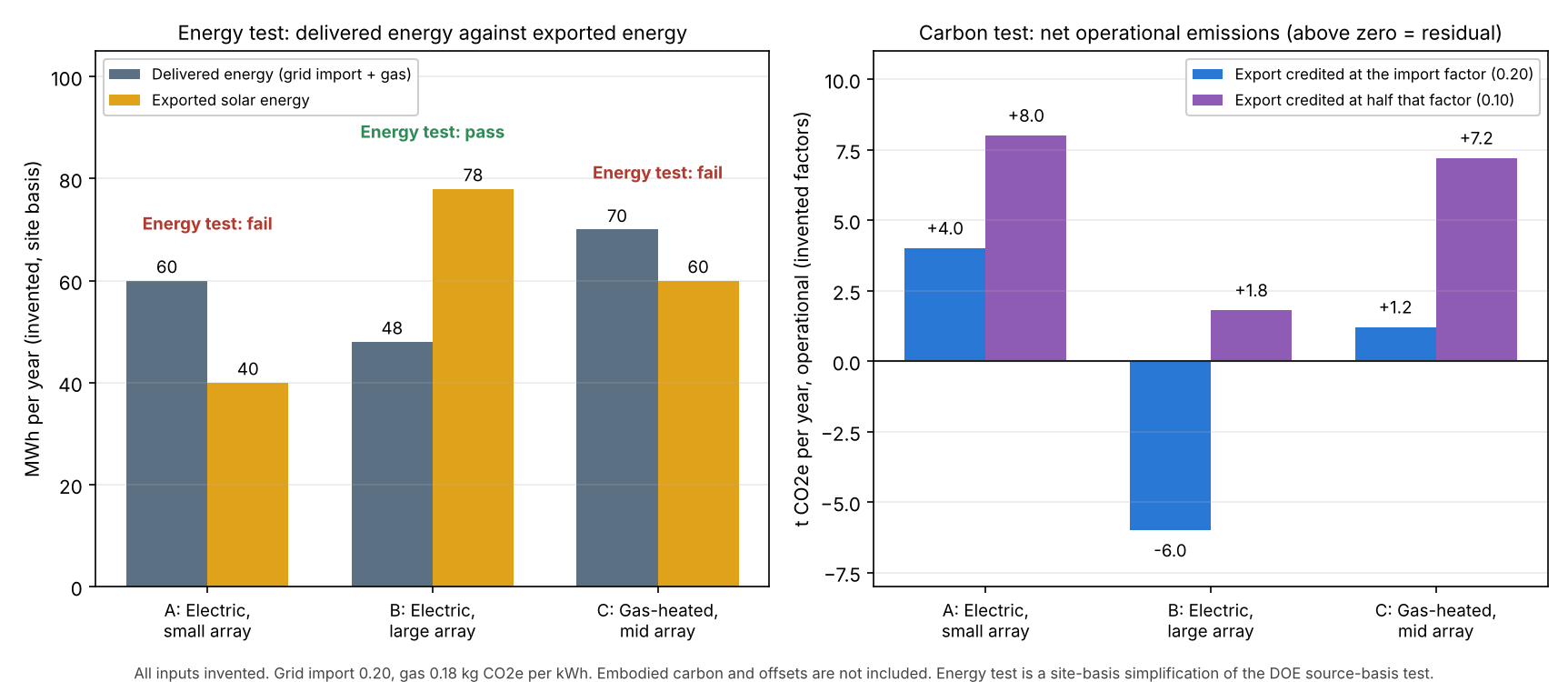
Figure 1. On example inputs, building B passes the simplified site-basis energy test with 78 MWh exported against 48 MWh delivered, yet leaves 1.8 t CO2e if exports are credited at half the import factor.
Building B passes the energy test. The carbon test depends on how exports are credited. A carbon-neutral claim could close the 1.8 t gap with removals. Standards treat that step in different ways. Building C burns gas on site. So a similar array falls short on both tests. None of these numbers include embodied carbon.
Check your own building
Enter yearly use, solar and your own dated factors. The calculator starts with example building B.
How solar software handles net zero
None of the pages read describes a net zero status test. They only report emissions or a CO2 saving. "Yes" means the company page says the tool reports a CO2 figure. The pages were read in October 2026.
| Software | Reports emissions or CO2 saving? | Page read |
|---|---|---|
| PVsyst | Yes | PVsyst help, undated. Its IEA country values are 2010 emissions. |
| HOMER Pro | Yes | HOMER Pro help, header 3.16, undated. |
| OpenSolar | Yes | OpenSolar support, undated. |
| Aurora Solar | Partly | Aurora help, undated. |
| Xendee | Partly | xendee.com/design, structured-data date 2026-10-02. |
- PVsyst: Carbon Balance Tool takes grid emissions (gCO2/kWh), system emissions (tCO2), yield, degradation and lifetime. It returns total and yearly CO2 saving.
- HOMER Pro: tracks six pollutants including carbon dioxide. You can set a penalty or an annual cap.
- OpenSolar: proposal section "Environmental Benefits" shows CO2 saved annually, trees planted and car miles avoided.
- Aurora Solar: Sales Mode variables include barrels of oil saved, trees planted and vehicles per year. The page lists no tonnes of CO2 variable.
- Xendee: product page says goals can include carbon reduction and site data can include marginal emissions. No help page read.
For ranked tools that model a system before you quote, see the best solar simulation software list.
Common mistakes with net zero
FAQs
Is net zero the same as carbon neutral?
No, though they overlap. The IPCC says the two are equal at global scale. For one building or company, the source decides. SBTi’s net zero standard does not count credits as cuts. Carbon neutral is about balancing CO2 with removals.
Does solar make a building net zero?
Not by itself. DOE’s test compares delivered energy with exported on-site renewable energy. Array size, use and fuels all matter. Fuel brought to the site counts as delivered energy.
Can a net zero building use certificates or offsets?
Sometimes, depending on the definition. DOE’s zero energy building counts only on-site renewables. Its REC variant adds bought certificates. The UK standard summary says offsets may add to the core rules, not replace them.
Which emission factor should I use?
Use a dated factor from a named source and state it on the proposal. The GHG Protocol Scope 2 Guidance (2015) asks reporters to show location-based and market-based results and label each. This page gives no factor of its own.
Related terms
- Solar plus storage: solar with a battery, which can raise on-site use.
- Behind-the-meter: equipment on the customer side of the utility meter.
- Self-consumption: the share of solar used on site.
Next step: write the test, boundary and period on your next proposal, then compare CO2 reporting in the best solar simulation software list.
Sources
All sources were checked in October 2026.
- DOE, A Common Definition for Zero Energy Buildings (DOE/EE-1247), September 2015.
- NBI, Decarbonizing Buildings: A Changing Lexicon, 12 June 2019.
- UKGBC, Net Zero Carbon Buildings: A Framework Definition, published 30 April 2019, now superseded (page rechecked 30 October 2026).
- Designing Buildings, UK Net Zero Carbon Buildings Standard version 1, March 2026.
- UK Net Zero Carbon Buildings Standard site.
- RIBA, UK Net Zero Carbon Buildings Standard explained, checked 30 October 2026.
- IPCC AR6 Working Group III, Annex I: Glossary, 2022.
- SBTi Corporate Net-Zero Standard V1.3.1, April 2026, and the SBTi net zero page (Version 2.0 dates rechecked 30 October 2026).
- ISO 14068-1:2023 catalogue page, edition 1, November 2023.
- GHG Protocol, Scope 2 Guidance, 2015.
- Zondits, Ask the Expert: net zero and carbon-neutral, undated. Author not confirmed (checked 30 October 2026).
- PVsyst help, Carbon Balance Tool.
- HOMER Pro help, emissions.
- OpenSolar support, Navigating the proposal.
- Aurora help, Sales Mode Variables.
- Xendee design page.
Last updated 30 October 2026. Next scheduled review: 30 January 2027.