Key takeaways
- 1 MWh is 1,000 kWh. SI prefixes step by 1,000, and 1 kWh is exactly 3.6 MJ (NIST SP 811), so 1 MWh is 3.6 GJ.
- kWh/kWp and MWh/MWp are the same number. An example 5,000 kWp plant at 1,450 kWh/kWp makes 7,250 MWh a year, which is 7.25 GWh.
- Adding mixed prefixes gives wrong totals. An example three-site portfolio sums to 8,469.75 if labelled MWh, against a true 7,320.9 MWh, which is 15.7% too high.
- EIA defines nameplate duration as energy capacity divided by power capacity. An example 40 MWh battery is 4 h at 10 MW.
- EPA says one REC is issued when 1 MWh of renewable electricity is generated and delivered to the grid.
For plant-scale yield in MWh, see the best utility-scale solar design software. For measured MWh, see the best solar performance analytics software.
Kilowatt-hour and megawatt-hour at a glance
A megawatt-hour is a kilowatt-hour moved up one step of the unit ladder. Each step is 1,000 times the last.
| Item | Detail |
|---|---|
| Formula | Energy = power × hours. 1 MWh = 1,000 kWh = 1,000,000 Wh = 3.6 GJ. |
| Ladder | Wh, kWh, MWh, GWh, TWh. NIST SP 811 lists kilo as 10³, mega as 10⁶, giga as 10⁹ and tera as 10¹². |
| Where it matters | Yield reports, plant and portfolio totals, battery duration and prices stated per MWh. |
| Standard or rule | NIST SP 811 marks 3.6 × 10⁶ J per kW·h as exact. EIA defines battery duration as energy over power. |
| In software | Tools print kWh, MWh or GWh, set by each tool. See the software table or the best solar simulation software. |
Why the scale of the unit matters for installers
One project can show as kWh on a bill, MWh in a yield report and GWh in a portfolio summary. A slip of one step is a 1,000 times error.
Power ratings have the same problem. Wp, kW and kWp are power. See wattage, kW and kWp and peak watt. Dividing a yearly kWh by 8,760 hours gives an average power, covered on capacity factor.
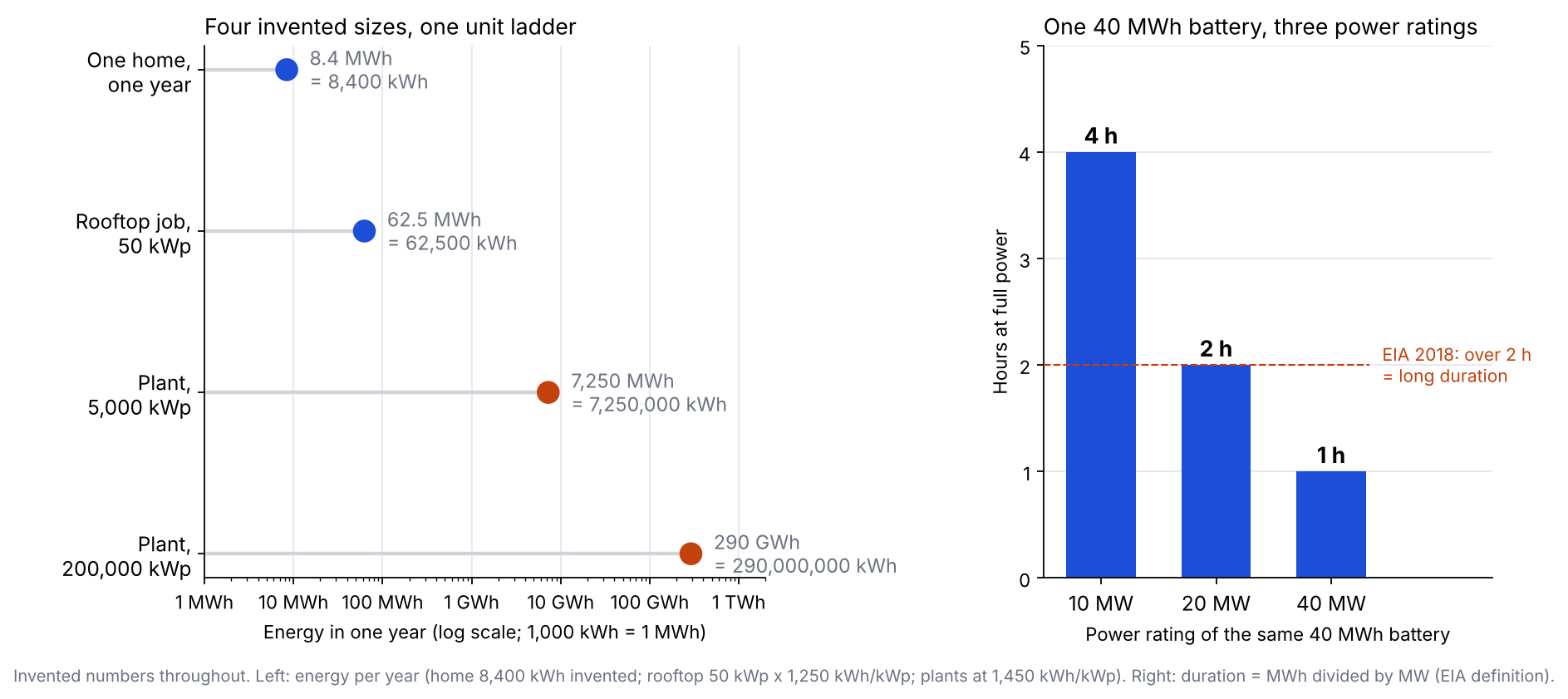
Figure 1. Four example sizes span 8.4 MWh to 290 GWh on one ladder. The same 40 MWh battery lasts 4 h, 2 h or 1 h, depending only on its MW rating.
How do you convert kWh, MWh and GWh?
Divide by 1,000 to move up one prefix. Multiply by 1,000 to move down. Always keep the unit label beside the number.
- Write the unit on every energy number: Wh, kWh, MWh or GWh.
- Move one step up the ladder by dividing by 1,000. 7,250,000 kWh is 7,250 MWh, and that is 7.25 GWh.
- For yield, note that kWh/kWp and MWh/MWp are equal, because the factor of 1,000 cancels. 1,450 kWh/kWp × 5,000 kWp is 7,250,000 kWh. 1,450 MWh/MWp × 5 MWp is 7,250 MWh. See specific yield.
- For average power, divide MWh by hours. 7,250 MWh ÷ 8,760 h is 0.828 MW.
- For a battery, divide the MWh rating by the MW rating to get hours. See C-rate for the rate view.
- For other units, 1 MWh is 3.6 GJ (NIST SP 811). EIA gives 3,412 Btu per kWh.
Two energy figures can only be compared as they stand when three things match:
- Period: each covers the same day, month or year.
- AC or DC: both are AC energy or both are DC energy.
- Prefix: both are written in the same prefix.
Worked example: one plant, one portfolio, one battery
All inputs here are example. Table 1 relabels one plant’s energy. Table 2 shows a mixed-unit sum. Table 3 gives battery hours at three power ratings.
Table 1. The example 5,000 kWp plant at an example 1,450 kWh/kWp, one year
| Label | Calculation | Value |
|---|---|---|
| kWh | 5,000 kWp × 1,450 kWh/kWp | 7,250,000 kWh |
| MWh | 7,250,000 ÷ 1,000 | 7,250 MWh |
| GWh | 7,250 ÷ 1,000 | 7.25 GWh |
| GJ | 7,250 MWh × 3.6 | 26,100 GJ |
| Average power | 7,250 MWh ÷ 8,760 h | 0.828 MW |
| Per MWp | 7,250 MWh ÷ 5 MWp | 1,450 MWh/MWp |
Table 2. Three example sites, each written in its own unit
| Site | As written | In MWh |
|---|---|---|
| Home | 8,400 kWh | 8.4 MWh |
| Rooftop job, 50 kWp at 1,250 kWh/kWp | 62.5 MWh | 62.5 MWh |
| Plant | 7.25 GWh | 7,250 MWh |
| Total | 8,400 + 62.5 + 7.25 = 8,469.75 (wrong) | 7,320.9 MWh |
If you add the "as written" column and call it MWh, you get 8,469.75, which is 15.7% too high. Convert first, then add.
Table 3. One example 40 MWh battery at three example power ratings
Usable and delivered energy are on the kWh page.
| Power rating (MW) | Energy rating (MWh) | Duration (h) |
|---|---|---|
| 10 | 40 | 4 |
| 20 | 40 | 2 |
| 40 | 40 | 1 |
The energy stays 40 MWh while the duration falls as power rises. EIA’s 2018 article calls systems over 2 hours long duration. By that 2018 scheme the 4 h row is long duration and the 2 h row is not. The US DOE Long Duration Storage Shot page (14 July 2021) describes long-duration systems as storing energy for more than 10 hours at a time. Sources use different definitions, so name the one you follow.
kWh and MWh calculator
Part 1 moves one energy value across the ladder. Part 2 turns size and yield into MWh. Part 3 gives battery duration in hours. Part 2 warns outside 600 to 2,200 kWh/kWp, a rough check range of ours, not a published norm.
Not showing? Open the calculator on its own page.
How solar software handles kWh and MWh
Three of the four tools name a unit for energy results. The prefixes differ: SolarFarmer uses MWh and kWh, HelioScope uses GWh, SAM uses kWh and PVsyst uses kWh/kWp and kWh/m². The bullets under the table carry the page wording.
| Software | Names a unit for energy results? | Prefix printed | Page read |
|---|---|---|---|
| DNV SolarFarmer | Yes | MWh and kWh | SolarFarmer manual v1.2, Web API reference, EnergyYieldResults (undated), October 2026 |
| HelioScope | Yes | GWh and kWh/kWp | HelioScope help, Metrics Bar (no date shown on the page), October 2026 |
| SAM | Yes | kWh | SAM help, Energy Yield (undated), October 2026 |
| PVsyst | Partly | kWh/kWp and kWh/m² | PVsyst help, simulation variables, grid system (no date shown), October 2026 |
- DNV SolarFarmer: NetEnergy is net energy injected into the grid, in MWh. ModulePower, Pac and Pdc are in kWh, and EnergyYield is in kWh/kWp.
- HelioScope: The Metrics Bar lists Grid Power as the total energy generated in the simulation, in GWh, and Specific Yield in kWh/kWp.
- SAM: Energy yield is annual AC kWh over DC nameplate kW, for year one. The page does not mention MWh or changing units.
- PVsyst: The Grid system variables page prints units in the yield formulas. Variables such as E_Grid and EArray carry no printed unit there.
Yes means the page names a unit, not that the tool offers a unit setting. Partly means only some outputs carry a unit on the page read. Here a named unit is enough for Yes. The kWh page covers the AC and DC boundary. For design tools that print energy results, read the best solar design software list.
Common mistakes with kWh and MWh
FAQs
How many kWh are in a MWh?
There are 1,000 kWh in 1 MWh, and 1,000 MWh in 1 GWh. In joules, 1 MWh is 3.6 GJ, because NIST SP 811 gives 3.6 MJ per kWh as an exact factor.
What is the difference between MW and MWh?
MW is power, the rate. MWh is energy, the amount. Energy capacity divided by power capacity is the duration. In this example’s battery, 40 MWh at 10 MW is 4 h.
How many MWh does a 1 MW solar plant make in a year?
Multiply the plant’s MWp rating by the site’s MWh/MWp from a simulation. No fixed figure applies to every site. An example 1,450 MWh/MWp gives 1,450 MWh for 1 MWp. See energy yield simulation.
Is one REC always one MWh?
Usually, yes. An archived EPA page (last updated 26 December 2024) says RECs are issued when 1 MWh of renewable power is generated and delivered to the grid. Programmes set their own eligibility rules, so check the tracking system you sell into.
Do tools switch between kWh, MWh and GWh on their own?
Not on the pages read. None of the four help pages describes automatic switching or a unit setting. They name units per output, such as MWh for SolarFarmer’s net energy and GWh for HelioScope’s Grid Power. Read each report’s label.
Related terms
- Kilowatt-hour (kWh): kW against kWh, usable battery kWh and a kWh calculator.
- Kilowatt and megawatt: power units and DC against AC size.
- Specific yield: annual kWh per kWp of modules.
- Battery capacity: stored energy in kWh and Ah.
Next step: write the unit beside every energy figure, then check which prefix your yield reports print in the best solar simulation software.
Sources
- NIST Guide to the SI (SP 811), Appendix B.8 (page last modified 18 August 2025). Its kW·h to joule factor is in boldface, which the page defines as exact. Checked 30 October 2026.
- NIST Guide to the SI (SP 811), Chapter 4, SI prefixes (updated 18 August 2025, checked October 2026).
- EIA, Energy units and calculators explained (no article date, 1 kilowatthour is 3,412 Btu, checked 30 October 2026).
- EIA, Today in Energy, 1 June 2018, "Costs of different battery storage technologies depend on technical characteristics" (checked 30 October 2026).
- EPA, Renewable Energy Certificates (RECs) (archived snapshot of 19 January 2025, page last updated 26 December 2024, checked 30 October 2026).
- DNV SolarFarmer manual v1.2, EnergyYieldResults (undated) and HelioScope help, Metrics Bar (no date shown on the page). Checked October 2026.
- SAM help, Energy Yield (undated) and PVsyst help, grid system variables (no date shown). Checked October 2026.
- US DOE, Long Duration Storage Shot announcement (page dated 14 July 2021, checked 30 October 2026).
- Example numbers: computed with a fixed model.
Last updated 30 October 2026. Next scheduled review: 30 January 2027.