Key takeaways
- EPA says one REC conveys one megawatt-hour of electricity generated from renewable sources (EPA, 21 September 2026). One MWh is 1,000 kWh.
- Only one party can claim a given MWh. A system owner who sells the certificates can say the system generates solar power. The owner cannot say it uses that power.
- A tracking system issues one certificate per MWh, and it sits in one account at a time. Put the owner in the contract. EPA’s status report lists 9 US systems.
- In an example, an 8 kWdc system makes 10.4 certificates in year 1 and 150.7 over 15 years. At an example 40 USD each, that is 6,026 USD in total.
- The same stream has a present value of 3,923 USD at an example 6% discount rate. Deducting the full 6,026 USD at signing overstates its worth by 2,103 USD.
To find tools with an SREC incentive line in a quote, see the best solar proposal software list.
Renewable energy certificates at a glance: why they matter for installers
A certificate splits the green claim from the power. The kWh earns bill savings. The MWh certificate carries the claim, which can be kept, sold or assigned.
| Item | Detail |
|---|---|
| Unit | 1 REC = 1 MWh = 1,000 kWh of renewable generation. Aurora’s help says 1 SREC = 1,000 kWh of solar production. |
| Formula | Certificates = kWh generated ÷ 1,000. Which meter reading counts is set by the programme. |
| Who issues it | A tracking system issues the REC to the generator and gives it a unique ID. |
| Where it matters | Proposal income, ownership clauses in lease and PPA contracts, and what a customer may say in marketing. |
| Standard or rule | Ownership and programmes are set by states and contracts. EPA points readers to DSIRE for state SREC programmes. |
| In software | An incentive line with a per-kWh or per-certificate income. See best solar proposal software. |
Timing matters. Certificate income comes in over years and depends on a programme or a buyer. It is not a bill saving. See solar incentives and rebates for how tools treat per-kWh income.
How do a REC, an SREC and an STC differ?
A REC is the general certificate. An SREC is the solar kind. An STC is the Australian small-scale certificate, counted by a different method.
| Term | What it is | Where |
|---|---|---|
| REC | One certificate per MWh of renewable electricity generated, issued in a tracking system. | US tracking systems |
| SREC | A REC from solar. Many states create SREC markets by requiring suppliers to buy them, as part of the renewable portfolio standard. This is called a solar carve-out. | States with a carve-out |
| STC | Small-scale technology certificate. The count comes from system size, zone and deeming period. See STCs. | Australia |
Who owns the certificate, and what happens to the solar claim?
The owner is whoever the state rule or the contract says. EPA states that the ultimate owner of an SREC owns the "solar-ness" of the power.
The table shows five common cases, using EPA and Center for Resource Solutions text.
| Case | Holds the certificates | May say it uses the solar power? |
|---|---|---|
| Owner keeps them | Owner | Yes, if it holds the RECs exclusively. EPA says using the power needs the RECs. |
| Owner sells them | Buyer | No. The seller may still say it generates solar. Center for Resource Solutions: "If you sell the REC, you lose the right to say you are using renewable electricity" (1 December 2021). |
| Host on a PPA gives them up | System owner | No. EPA says hosts can cut costs by forgoing contractual ownership of SRECs. |
| Host holds none but buys replacement RECs | Another party | Only a claim that matches the replacement RECs, not the on-site system. |
| Net-metered or incentive-funded system | Set by state rule or agreement | The rule or contract decides. Ask your programme administrator. |
Net metering and certificates are separate records. Net metering credits kWh on the bill. See net metering. A certificate counts MWh generated. For net-metered systems, ownership is set by your programme, so ask its administrator.
Leases and PPAs add a second owner. See third-party ownership, solar lease and power purchase agreement. Ask whether the contract names certificates.
An owner can lose the claim by selling, by a contract clause, or by a double claim. EPA says double counting "occurs when two different parties claim the same environmental benefits". It advises that contracts state who owns the RECs.
Which tracking systems issue certificates?
Tracking systems are electronic databases. They register each MWh, issue certificates to generators and move them between account holders. EPA’s status report lists 9 in the US.
| Single-state system | Coverage | Generation tracked |
|---|---|---|
| ERCOT | Texas | Renewable |
| MIRECS | Michigan | Renewable |
| NC-RETS | North Carolina | Renewable |
| NYGATS | New York | All sources |
The other five cover more than one state.
| Multistate system | Coverage | Generation tracked |
|---|---|---|
| M-RETS | Multistate or national | Renewable |
| NAR | Multistate or national | Renewable |
| NEPOOL-GIS | Northeast | All sources |
| PJM-GATS | PJM region | All sources |
| WREGIS | West | Renewable |
M-RETS and NAR accept generators anywhere in North America. The others need generators inside their footprint. The report says financial settlements take place outside the systems. PJM-GATS also holds SREC price information.
The table is from EPA’s status report, which listed 9 US systems at that date. The report prints no publication date (its URL path shows 2025-01). Generator totals were collected 31 July 2024, and ERCOT and MIRECS totals are from 2023. Ask your programme which system covers your site.
EPA says a system ensures only one REC is issued for each MWh reported. A certificate can sit in only one account at a time.
Worked example: how many certificates does a system make?
Each MWh generated is one certificate. Multiply by a value per certificate to get income. All inputs are example, not market or programme data. Yield is 1,300 AC kWh per kWdc a year (see specific yield). Output falls 0.5% a year (see degradation rate). Certificates sell for 15 years at 40 USD each. The discount rate is 6%, with payment at each year end.
Certificates in year t = kWdc × 1,300 × (1 − 0.005)t−1 ÷ 1,000. Part certificates are not rounded. The 15-year term is our assumption, not a programme rule.
| System (example) | Year 1 certificates | 15-year certificates | 15-year value (USD) | Present value at 6% (USD) |
|---|---|---|---|---|
| A: 8 kWdc home | 10.4 | 150.7 | 6,026 | 3,923 |
| B: 50 kWdc commercial | 65.0 | 941.6 | 37,664 | 24,518 |
| C: 250 kWdc commercial | 325.0 | 4,708.0 | 188,321 | 122,592 |
For all three, the present value is 65.1% of the 15-year total, so waiting costs 34.9%. The value per certificate then moves the result in a straight line. The next table shows this for system A.
| System A case (example) | 15-year value (USD) | Present value at 6% (USD) |
|---|---|---|
| 10 USD per certificate | 1,507 | 981 |
| 40 USD per certificate | 6,026 | 3,923 |
| 80 USD per certificate | 12,053 | 7,846 |
| 40 USD, falling to 20 USD after year 5 | 4,043 | 2,829 |
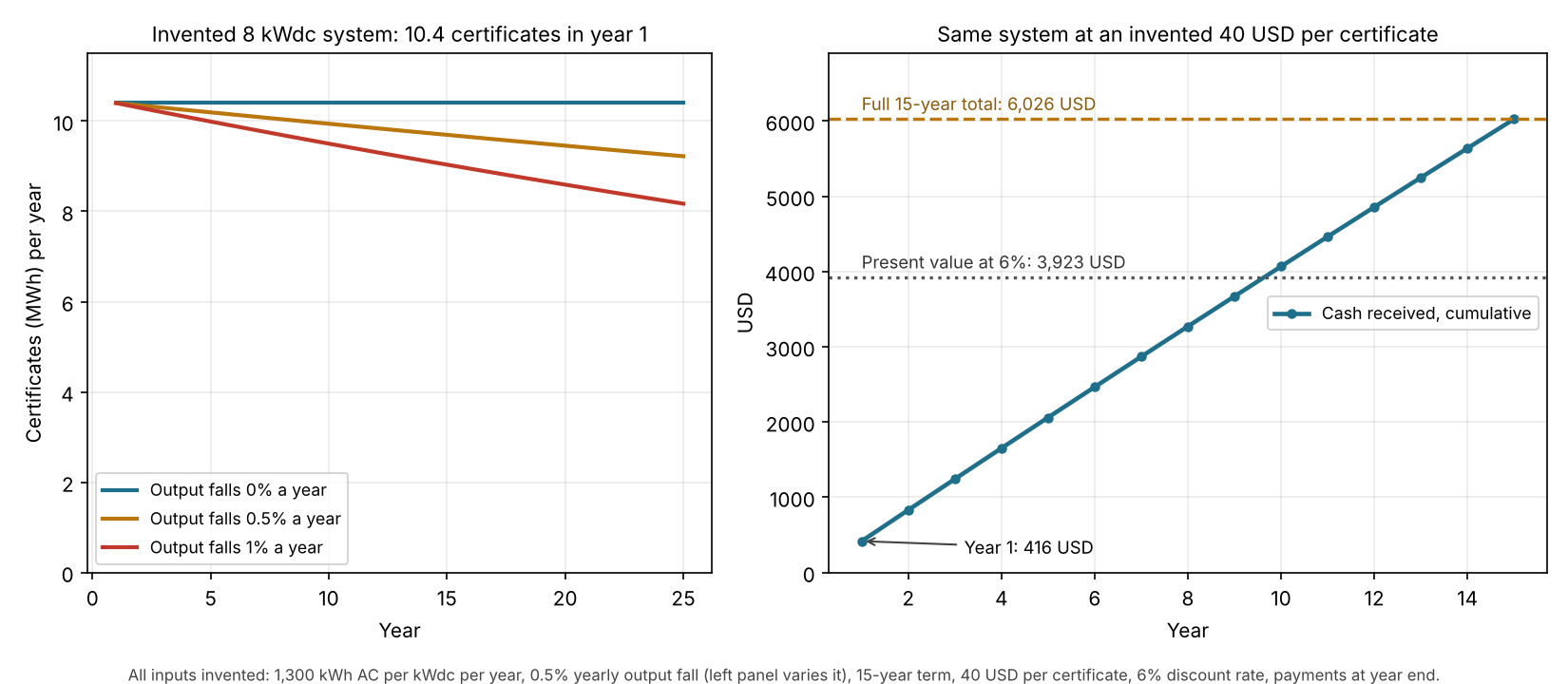
Figure 1. On example inputs, the full 15-year total of 6,026 USD is 2,103 USD above its present value of 3,923 USD at 6%.
Degradation costs 3.4% of the 15-year certificates against a flat output. The bigger risk is price and term, which our inputs do not predict. The last row lowers the present value by 27.9%. Treat the value as an estimate. See NPV for discounting.
Check your own certificate count and value
Enter your system size, yield, term, value and discount rate. The calculator opens with the example system A.
Open the certificate count and value calculator full screen if the embedded one does not load.
How solar software handles RECs and SRECs
Of three company pages checked in October 2026, two name an SREC setup and one has only per-kWh income inputs. A "Yes" means the page names an SREC setup. "Partly" means the page has per-kWh income inputs but does not name SRECs. Not stated means the page is silent. None of the three pages says the tool registers or sells certificates. Aurora’s page describes state tracking and sale to aggregators, but as market background, not as a feature.
| Software | Sets up SREC income? | Registers or sells certificates in the software? | Source and date |
|---|---|---|---|
| Aurora Solar | Yes | Not stated | Aurora help, SRECs (no date shown on re-check) |
| Solargraf | Yes | Not stated | Solargraf help, How to: Add an SREC (published 10 December 2021) |
| OpenSolar | Partly | Not stated | OpenSolar support, How to set up Incentives (printed 4 September 2026) |
What each company page says:
- Aurora Solar. States 1 SREC = 1,000 kWh. Reps add an SREC with Add Incentive in Sales Mode. Models incremental or lump-sum programmes. By default it subtracts the total expected SREC value from system cost. An "Incentive income" line on the post-solar card is optional. The page says a state system tracks generation and issues SRECs, and that SRECs can be sold to aggregators.
- Solargraf. An SREC incentive has a name, zones, a DSIRE program ID, a rate in USD per AC kWh and a duration in years. Rates can be fixed or varied by year. How it shows in a proposal is not described.
- OpenSolar. The page does not mention SRECs. A Performance-Based incentive takes a value for each year and a number of years. The page also lists a large-scale generation certificate (LGC, Australia) incentive and an expected certificate spot price field in an NSW battery incentive.
Companies may state more elsewhere. Tools that show incentive income in a quote are compared in the best solar proposal software list.
How should a proposal show certificate income?
Show it as an estimate, apart from bill savings, with its owner and its timing. Use these checks.
- Name the programme or the buyer, and say which meter reading counts.
- State who owns the certificates in the contract, and what the customer may then say about solar use.
- Show the years in which the income arrives, not only the total.
- Flag that the value can change. Use your own dated quote, not a default.
Common mistakes with RECs
Where do the rules differ?
- US states. Programmes and ownership rules differ. EPA names DSIRE or your state energy agency for current state policy. The NREL SREC report it links was published in 2011, and EPA warns that some of it may be out of date.
- Australia. STCs follow a different method. The Australian REC Registry is not a US tracking system. See STCs and the list of solar software for Australia.
FAQs
Do I own the RECs from my solar panels?
You own them only if your state rule or contract says so. EPA says the owner of the certificate owns the solar claim. A customer who signed a PPA may have given up the SRECs to the system owner.
Is a REC the same as a net metering credit?
No. A net metering credit is a bill credit for exported kWh. A REC is a separate record of 1 MWh generated. A programme may treat the two differently, so check its rules.
Can I sell my RECs and still say my home runs on solar?
No. EPA says that without the RECs you cannot publicly claim to use the renewable electricity. You may still say the system generates solar power.
Does a tracking system pay the owner?
No. EPA’s status report says financial settlements take place outside the systems. The systems record issue, transfer and retirement. PJM-GATS also holds SREC price information.
Related terms
- Solar incentives and rebates: rate types and timing for incentives in a quote.
- Net metering: bill credits for exported kWh.
- Third-party ownership: a company other than the host owns the system.
- Kilowatt and megawatt: the units behind a certificate count.
- Renewable portfolio standard: a state rule that sets a renewable share for utilities.
Next step: see how the best solar proposal software shows incentive income apart from bill savings.
Sources
- EPA Green Power Partnership: Energy Attribute Certificates. Last updated 21 September 2026. Checked October 2026.
- EPA Green Power Partnership: Energy Attribute Tracking Systems. Last updated 21 September 2026. Checked October 2026.
- EPA Green Power Partnership: Solar Power Use Claims. Last updated 21 September 2026. Checked October 2026.
- EPA Green Power Partnership: Double Counting. Last updated 10 July 2026. Checked October 2026.
- EPA Green Power Markets: page on state solar carve-outs. Last updated 10 July 2026. Checked October 2026.
- EPA: Status and Trends Report on U.S. Energy Attribute Tracking Systems (publication 430S25002). Generator totals collected 31 July 2024. Checked October 2026.
- Center for Resource Solutions: Guidelines for Renewable Energy Claims. Updated 1 December 2021. Checked October 2026.
- Berkeley Lab: Who Owns Renewable Energy Certificates? Holt, Wiser and Bolinger, April 2006. Abstract page only. Checked October 2026.
- Aurora Solar help: Solar Renewable Energy Credits (SRECs). No update date shown. Checked October 2026.
- Solargraf help: How to: Add an SREC. Published 10 December 2021. Checked October 2026.
- OpenSolar support: How to set up Incentives. Page shows 4 September 2026. Checked October 2026.
Last updated 30 October 2026. Next scheduled review: 30 January 2027.