Key takeaways
- NREL, now NLR (US, August 2021) puts a BTM battery on "the customer’s side of the utility’s service meter". Utilities see only "the difference between customer demand and storage operation".
- Meter reading = load + battery charge - battery discharge - solar. A positive number is import.
- In an invented hour, three sites with different load, solar and battery flows all read export 30 kW.
- In an example day with a battery, meter import is 576 kWh against 1,540 kWh of load, and the meter reads zero for 4 hours.
To size a battery behind the meter in software, see the best solar battery storage design software. For tariff savings at commercial sites, see the best solar software for C&I installers.
Behind-the-meter at a glance
BTM is a location, not a technology. Anything wired to the customer side of the meter is behind it. So one meter hides several flows.
| Item | Detail |
|---|---|
| Boundary | The utility’s service meter. NREL (August 2021) puts BTM storage on the customer’s side of it. |
| Formula | Meter reading = load + battery charge - battery discharge - solar. Positive is import. Negative is export (our arithmetic, AC side). |
| Unit | kW for power and kWh for energy. |
| Where it matters | Bills, export pay, demand charges, scheme eligibility and utility visibility. |
| Standard or rule | No single definition. EIA (US, 2 December 2015) defines small-scale solar as under 1 MW and says it is "also called behind-the-meter". FERC’s 2020 fact sheet lets a DER sit "behind a customer meter". See DER. |
| In software | Design tools take a load profile. They report import and export. Of the six help pages below, only SAM’s uses the term. |
Why does behind-the-meter matter for installers?
The meter decides what the customer pays. It also sets what the utility knows. A design that ignores it can promise savings that the tariff does not pay.
It also shapes approval and data. Interconnection rules can ask for metering and telemetry (NREL). See grid-connected systems and solar-plus-storage.
Behind-the-meter vs front-of-the-meter: where is the line?
The line is the utility meter. Behind it, equipment serves the customer’s site. In front of it, equipment connects on the utility side. It serves the grid or the market.
| Behind the meter | In front of the meter | |
|---|---|---|
| Side of the meter | Customer side. | Utility side. |
| Who it serves | NREL: "installed and operated to meet customer needs". | NREL: utility-scale storage is sited and dispatched for power system needs. |
| Revenue basis in SAM | Buys and sells electricity at retail rates. | Sells at negotiated PPA or market prices. |
SAM’s help (SAM 2023.12.17, revised 3/4/2024) draws the same line. It does so for projects. A 2020 DOE webinar slide calls the other side "on the utility side of the meter". NREL’s Karlynn Cory wrote it (26 August 2020). GOV.WALES (updated 28 July 2026) says a BTM system is "usually located at the site of the electricity consumer". It aims to displace grid power. That power passes through the utility meter. Read curtailment for plants in front of it.
What does the utility meter see?
It sees net flow only. Solar output, battery flows and most of the load net off before the reading. So one number can come from many cases.
- Net, not gross. The National Academies (2023, Table 2-1) describe a usage meter. It measures kWh delivered to the customer. A bi-directional meter measures energy delivered. It also measures energy sent back.
- Gross output needs separate measurement. PVsyst’s help says such systems "are directly connected to the grid through a dedicated electricity meter for PV production". Inverter and CT monitoring is another route. Solargraf’s help (10 December 2021) says a gross feed-in tariff needs two separate meters.
- Utilities estimate. EIA (US, 2015) says small-scale solar output "must be estimated". NREL says operators have "limited visibility" into BTM storage.
- Markets net it too. PJM’s Manual 14D Appendix A (Revision 48, 25 February 2019) uses "a net load (gross load minus operating BtMG, not to be less than zero)".
To work out use from solar, import and export, see smart meter and CT clamp. For the ratios, see self-consumption.
Worked example: gross generation against one meter
All numbers are example. Power in kW over one hour equals kWh. The battery is on the AC side. The hourly tables ignore losses. In the hour cases the battery is as big as each case needs. The day case uses a 50 kW, 100 kWh battery that never exports.
Table 1: one hour, five cases
| Hour case (example) | Site load, kW | Solar, gross, kW | Battery, kW | Meter reads, kW |
|---|---|---|---|---|
| A: Solar only, no battery | 80 | 120 | None | Export 40 |
| B: Battery charges 40 kW | 80 | 120 | Charge 40 | 0 |
| C: Battery charges 60 kW | 80 | 120 | Charge 60 | Import 20 |
| D: Evening, battery discharges 50 kW | 80 | 0 | Discharge 50 | Import 30 |
| E: Evening, battery discharges 100 kW | 80 | 0 | Discharge 100 | Export 20 |
Across these cases the load and solar do not change when the battery does. Only the meter reading moves. In case C the meter shows import 20 kW even though solar makes 120 kW. In case D it shows import 30 kW against an 80 kW load. In case E it shows export in the evening, with the battery as the source.
Table 2: three sites, one reading
| Three sites (example) | Site load, kW | Solar, gross, kW | Battery, kW | Meter reads, kW |
|---|---|---|---|---|
| X: Light load, no battery | 90 | 120 | None | Export 30 |
| Y: Light load, battery charges | 50 | 120 | Charge 40 | Export 30 |
| Z: Evening, battery exports | 100 | 20 | Discharge 110 | Export 30 |
The meter cannot tell these sites apart. A reader who treats export as solar would call site Z a producer. But its solar is only 20 kW.
Table 3: one day, with and without a battery
| One example day, kWh | No battery | With battery |
|---|---|---|
| Gross solar generation | 1,149 | 1,149 |
| Site load | 1,540 | 1,540 |
| Meter import | 671 | 576 |
| Meter export | 280 | 175 |
| Import as a share of load | 43.6% | 37.4% |
| Export as a share of gross solar | 24.4% | 15.2% |
| Hours the meter reads zero | 0 | 4 |
| Peak hourly import, kW | 65.0 | 55.0 |
The battery cuts both import and export, and the meter reads zero for some hours. Reading import as load would understate use by 964 kWh.
Assumptions: a 150 kW solar peak on a half-sine day from 06:00 to 18:00, and the load shape is example. The battery is 50 kW and 100 kWh. It runs at 95% efficiency each way, charges only from solar surplus and starts empty.
The battery took in about 105 kWh and gave out about 95 kWh. That shifted the day’s net by 10.3 kWh before rounding, which is its losses. The table rows are rounded to whole kWh.
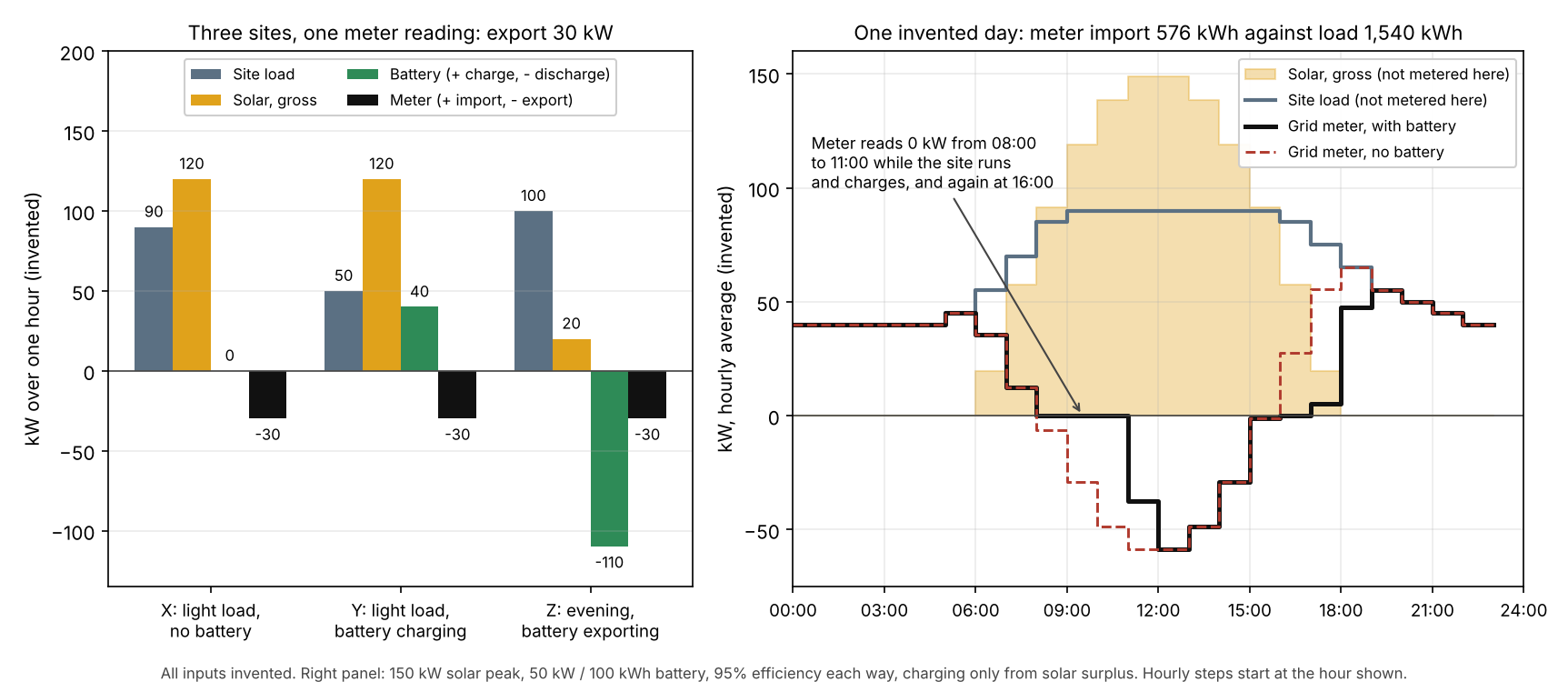
Figure 1. In example data, three sites with different solar, load and battery flows give the same 30 kW export, and on one day the meter shows 576 of 1,540 kWh of load.
Check your own hour and day
Part one reads one hour and loads case A. Use the presets for the others. Part two loads the example day. It runs with and without a battery.
What does behind-the-meter change for metering, export and incentives?
The label itself changes nothing. The meter setup, the tariff and each scheme’s rules do. Your regulator or utility sets the local terms. The examples below come from US sources and one Welsh guide.
- Export pay. NREL says net energy metering gives bill credits. These are for exports above on-site use. Under net billing, exports earn a predetermined sell rate. GOV.WALES (2026) says pay for exports "is often low". See net metering and net billing and export tariffs.
- Incentives. NREL says incentives can set conditions on how a BTM battery runs. Examples are loans, grants or tax credits, and the programme text sets the terms. Demand response shows schemes with their own metering rules.
- Demand charges. NREL says BTM batteries save money mainly by cutting demand charges. NREL’s 2015 study used 98 commercial facilities. It warns that cloud-driven solar may leave the peak untouched. Demand charges then stay the same. See peak shaving.
- Homes and businesses. GOV.WALES (2026) says BTM suits domestic and commercial buildings. The physics is the same. The tariff differs, and it may include a demand charge.
How solar software handles behind-the-meter
Of the six tools we read, only SAM is documented as modelling a site load behind one meter in full, and only its page uses the term itself. "Yes" means the company’s help page says so, as read in October 2026.
| Software | Models site load behind one meter? | Page read |
|---|---|---|
| SAM | Yes | SAM help home (SAM 2023.12.17, revised 3/4/2024). Grid page, undated. |
| PVsyst | Partly | PVsyst help, self-consumption, undated. |
| Aurora Solar | Partly | Aurora help, entering energy consumption, 15 April 2026. |
| OpenSolar | Partly | OpenSolar support, battery modelling, 7 May 2026. |
| Solargraf | Partly | Solargraf help, grid connection types, 10 December 2021. |
| HOMER Pro | Partly | HOMER Pro 3.16 manual, undated. |
Partly: the page covers site load or self-consumption but not the whole meter picture. What each page says:
- SAM. Projects can be behind the meter, on the customer side, at retail rates. Or they can be front of meter at PPA or market prices. Commercial and residential models use building load and retail rates. The grid can meet load and receive output.
- PVsyst. Needs a user’s needs profile. Splits energy used on site from energy injected to the grid. Notes a net-metering install may use "one only counter", but only when injection and purchase prices are equal. The term behind-the-meter does not appear.
- Aurora Solar. Accepts 15, 30 or 60 minute interval load data. Says the load profile sets when the home imports or exports. No mention of the meter or BTM.
- OpenSolar. A battery "Load Offsettable" share of usage. Excess solar above the battery’s maximum charge rate is exported. No mention of metering or BTM.
- Solargraf. Describes net metering with "one meter" and gross feed-in tariffs with "two separate meters". Does not use the term load or BTM.
- HOMER Pro. Reports energy purchased, sold and net purchased from the grid. Net metering can net monthly or annually. No mention of BTM.
For wider comparisons, see the best solar software for C&I installers and the best solar simulation software.
Common mistakes with behind-the-meter
FAQs
Is behind-the-meter the same as net metering?
No. BTM describes where equipment sits. Net metering is a billing rule for exports. A BTM system can earn pay under net billing instead. An export tariff works too.
Can a behind-the-meter system export to the grid?
Yes. GOV.WALES (2026) says surplus energy can be exported and sold back. NREL describes bill credits or a sell rate for exports. Pay and limits depend on the tariff.
How do you measure solar output behind the meter?
Use a dedicated generation meter, or inverter and CT monitoring. The grid meter cannot split it out, because it shows only net flow. See smart meter and CT clamp.
Is behind-the-meter solar a DER?
Usually, yes. FERC’s 2020 fact sheet says a DER can be "behind a customer meter". EIA uses BTM for small-scale solar under 1 MW. See DER.
Related terms
- DER: small generators and batteries on the local grid.
- Solar-plus-storage: PV paired with a battery behind one connection.
- Net billing and export tariffs: how exports are paid.
- Distributed generation: generation at or near the customer, on the local grid.
- Net zero: balancing what a site uses against what it exports or removes.
Next step: to test export and import for a real site, load its hourly profile into a tool that models tariff and battery. See the best solar software for C&I installers.
Sources
- NREL/TP-7A40-79393, battery storage FAQ, August 2021.
- NREL/TP-5400-63162, storage for demand charge reduction, January 2015.
- EIA Today in Energy, small-scale solar, 2 December 2015.
- FERC Order No. 2222 fact sheet, last updated 28 September 2020.
- Cory, DOE tribal energy webinar slides, 26 August 2020.
- National Academies, net metering report, Chapter 2, 2023.
- PJM Manual 14D, Appendix A, Revision 48, effective 25 February 2019.
- GOV.WALES, behind-the-meter guidance, first published 29 June 2026, last updated 28 July 2026.
- SAM help home, SAM 2023.12.17 Revision 1, last revised 3/4/2024, and SAM help, Grid, undated.
- PVsyst help, Self-consumption, undated.
- Aurora help, energy consumption, updated 15 April 2026.
- OpenSolar support, battery modelling, updated 7 May 2026.
- Solargraf help, grid connection types, published 10 December 2021.
- HOMER Pro 3.16 manual, Net metering and Grid outputs, undated.
Last updated 30 October 2026. Next scheduled review: 30 January 2027.