Key takeaways
- Only a company registered on the national portal can install under the scheme. The subsidy goes to the buyer’s bank account.
- Company ratings have 3 tiers by installs: above 50, above 250 and above 1,500. Site checks cover 5% of sites for Tier II and 2% for Tier I.
- Reported bank guarantees: INR 250,000 per state, or INR 2.5 million for all India.
- Sources differ on subsidy timing. The MNRE page says 30 days and later reports say 15 days.
- Sources date the scheme’s end to FY 2026-27 or March 2027.
To put the subsidy slab into a customer quote, see the best solar proposal software in India.
PM Surya Ghar at a glance: why it matters for installers
For you, the scheme sets who may sell, the rating buyers see and the checks on your sites.
| Item | Detail |
|---|---|
| What it is | A central scheme launched 13 February 2024. Outlay INR 75,021 crore. Target 1 crore households (pmindia.gov.in, 29 February 2024). |
| Subsidy as printed | 60% of system cost for 2 kW and 40% of the extra cost from 2 to 3 kW, capped at 3 kW. |
| Subsidy amounts | At benchmark prices: about INR 30,000 for 1 kW, INR 60,000 for 2 kW and INR 78,000 for 3 kW or more (same page). |
| Period | The rating framework says it runs till FY 2026-27. Business Standard (5 August 2026) says it expires in March 2027. Construction World (8 September 2026) reports a possible 3 to 4 month extension under consideration while a successor scheme is worked out, not yet confirmed. |
| Who installs | Companies registered on the national portal. The portal shows company ratings to buyers. |
| Owned elsewhere | DISCOM clocks: DISCOM and net metering approval. Billing credit: net metering. Other schemes: solar incentives and rebates. |
| In software | Quotation subsidy fields and status trackers. No tool page cited here says it files a company registration. |
How does the portal flow work for an installer?
The buyer drives nine steps. The installer comes in at step 6. An MNRE page of 12 August 2024 prints them.
| Step | What the page says | Installer touchpoint (our reading) |
|---|---|---|
| 1 to 5 | Visit the website, give personal details, log in with consumer number and mobile number, then fill in the online application. | Not stated. |
| 6 | "Await DISCOM approval and then install the plant with a registered vendor." | Install only after approval, and only as a registered company. |
| 7 | Submit the plant details and apply for the net meter once installation is over. | Plant details come from your as-built record. |
| 8 | After net meter installation and DISCOM inspection, get the commissioning certificate from the portal. | The certificate gates the subsidy step. |
| 9 | "Submit bank details and a cancelled cheque. Receive subsidy within 30 days." | The buyer receives the subsidy. |
Later trade reports give a shorter clock, and no official source for it was found. Business Today (29 May 2026) says transfers are "generally processed within 15 days of a valid request". SolarQuarter (8 July 2025) says "CFA will be processed within 15 days of DISCOM approval". These are processing times, not payment dates, so check the portal. The DISCOM approval page covers the 15 days in the undated MNRE draft guidelines. It also covers the February 2024 Ministry of Power cut in the commissioning period from 30 to 15 days.
Renewable Watch (23 October 2024) says a company covers design, supply, installation, commissioning and 5 years of maintenance. SolarQuarter (8 July 2025) reports mandatory 5-year maintenance, with penalties for poor service.
How do companies register?
A company registers for one state with the DISCOM or a state agency. For several states or all India, it registers with REC Limited. Each route needs a bank guarantee. The terms below are as reported, not from the MNRE order.
| Scope | Registers with | Bank guarantee (reported) | Where you may install |
|---|---|---|---|
| State | DISCOM or state agency | INR 250,000. A state may collect one guarantee for the whole state | The state registered for |
| Multi-state | REC Limited | INR 250,000 per state or union territory | Any district in the registered states |
| National | REC Limited | INR 2.5 million | Any district |
Renewable Watch (10 May 2024) says registration lasts five years. It renews for five more if the guarantee is extended. Energetica (5 June 2024) says the guarantee stays valid at least five years. A company who adds states must raise it. A Solar Ladder blog (20 May 2026) gives the same split and amounts.
The latest official company count cited is 6,552, from an MNRE page of 12 August 2024 with data as of 23 July 2024. That figure is well out of date. Government answers and reports since then show steady growth: KNN India (11 February 2026) reports 24,511 companies registered as of 4 February 2026, a government milestone report (August 2026) gives 34,219 registered and 29,469 active, and Republic World (15 October 2026) reports over 37,000. Check the portal for the current count.
At INR 250,000 a state, 10 states cost INR 2.5 million, the national amount. Past 10 states, national is cheaper on guarantee alone.
How does the company rating work?
The table below shows how the rating tiers set the share of sites checked. Companies with at least 50 eligible home installs get a rating in three tiers. It shows on the national portal. The Framework for Company Rating Programme shows no issue date. SolarQuarter (24 July 2024) reported the programme’s launch. Clause 1(a) cites the approval of 29 February 2024 and an order dated 16 March 2024.
| Tier | Eligible installs (cumulative) | Rating components | Sites physically assessed |
|---|---|---|---|
| III | More than 50 and up to 250 | Consumer feedback | Not stated |
| II | More than 250 and up to 1,500 | Feedback, quality assessment, techno-financial assessment | 5% of total sites |
| I | More than 1,500 | The same three | 2% of total sites |
Tier edges give odd results. If total sites equal eligible installs, a company with 1,500 installs has 75 sites assessed and one with 1,501 has about 30 (our sum). The count includes installs under the earlier Phase II rooftop programme. Feedback comes 2 to 6 months after installation. Techno-financial data is self-declared. Companies pay rating fees to the national agency. No amount is printed.
One clause says "at least 50" and the Tier III row says "More than 50". So exactly 50 installs is unclear. Top Tier I companies (90th percentile) are "encouraged to become Champion Vendors". Rating complaints are to be settled within 7 days.
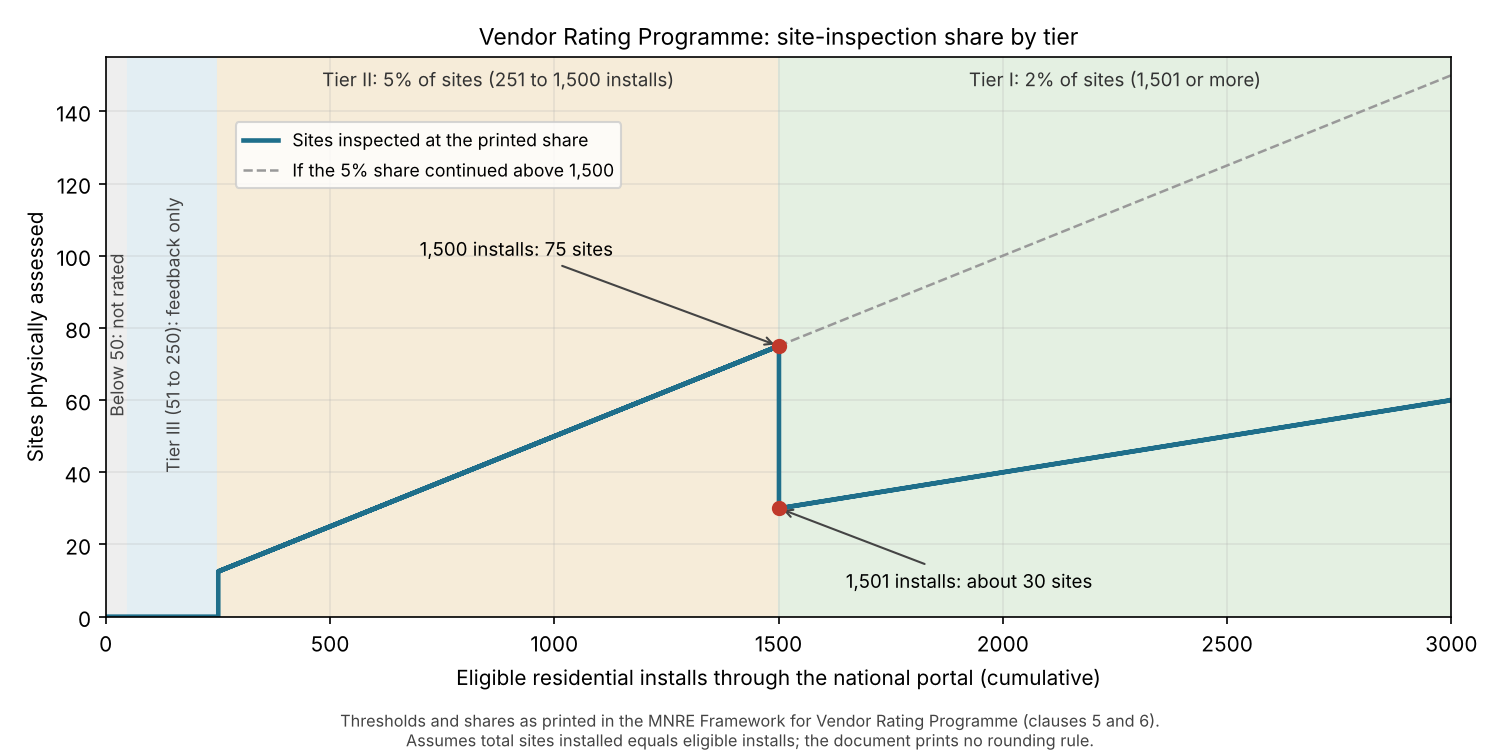
Figure 1. At the printed shares, a company with 1,500 installs has 75 sites assessed and one with 1,501 has about 30, assuming total sites equal eligible installs.
Worked example: tier, inspection load and guarantee
Six invented installers show the tiers. Install counts are placeholders, and shares are as printed. The first table covers tier and inspection load, and the second covers the guarantee.
| Installer | Eligible installs (example) | Tier | Sites assessed | Installs to next tier |
|---|---|---|---|---|
| A | 40 | Below Tier III | None | 11 to reach Tier III |
| B | 180 | III | Not stated | 71 |
| C | 900 | II | 45 | 601 |
| D | 1,500 | II | 75 | 1 |
| E | 1,501 | I | About 30 | None |
| F | 3,000 | I | 60 | None |
The framework prints no rounding rule, so counts are plain shares. Installer E has more installs than D but fewer sites checked.
| States or union territories | Multi-state guarantee (INR) | National guarantee (INR) |
|---|---|---|
| 1 | 250,000 | 2,500,000 |
| 3 | 750,000 | 2,500,000 |
| 5 | 1,250,000 | 2,500,000 |
| 10 | 2,500,000 | 2,500,000 |
| 12 | 3,000,000 | 2,500,000 |
The amounts are as reported. We worked out the multi-state row by multiplying. The checker below reproduces both tables.
How solar software handles PM Surya Ghar
OpenSolar and Fuzen quote the subsidy, only Fuzen documents a tracker, and no tool page says it files a company registration or reports a rating.
| Software | Subsidy in quotation | Subsidy or portal-stage tracking | Company registration or rating | Page read |
|---|---|---|---|---|
| OpenSolar | Yes. A size-based incentive with INR 30,000 and INR 18,000 value tiers and an INR 78,000 cap. | Not stated | Not stated | Help article "How to Set Up the PM Surya Ghar: Muft Bijli Yojana Incentive in OpenSolar", no date shown. |
| Fuzen | Yes. "PM Surya Ghar subsidy auto-fill". The 2024 central slabs are hard-coded. | Partly. The tracker follows "registration → documents submitted → approved → disbursed". It is not said to read the portal. | Not stated | Fuzen solar CRM page, metadata 1 October 2026. |
| Arka 360 | Not stated. No subsidy field on the article. | Not stated | Not stated | Arka360 article, 18 September 2026. |
| Solar Ladder | Not stated | Not stated | Not a tool feature. The blog explains that registration happens on the government portal. | Solar Ladder blog, 20 May 2026. |
Not stated: the company page we cite does not say. Partly: the page describes the feature but not how far it goes.
For subsidy-ready quotes, see the best solar proposal software in India. To track portal stages, see the best solar CRM in India. For layouts, see the best solar design software in India.
Common mistakes with PM Surya Ghar
FAQs
How much is the PM Surya Ghar subsidy?
At benchmark prices it is about INR 30,000 for 1 kW, INR 60,000 for 2 kW and INR 78,000 for 3 kW or more, which is the cap.
Does the subsidy pay the installer?
No. The nine steps send the subsidy to the buyer’s bank account. SolarQuarter (1 September 2026) says home subsidy covers only the capex model, where the buyer pays first. So quote the buyer’s net price.
Is the subsidy higher in some states?
Yes, in special category regions. SolarQuarter (1 September 2026) reports INR 33,000 per kW for the first 2 kW. It reports INR 19,800 for the third kW in special category regions. It lists the North-Eastern states, Uttarakhand, Himachal Pradesh, Jammu and Kashmir, Ladakh, Andaman and Nicobar, and Lakshadweep.
How does an installer register?
A one-state company registers with the DISCOM or a state agency, and a multi-state or national company registers with REC Limited. Each route needs a bank guarantee: INR 250,000 per state, or INR 2.5 million for all India (as reported).
Related terms
- DISCOM and net metering approval: the distribution company’s sign-off and its stated clocks.
- Net metering: the billing rule that credits exported power.
- Solar incentives and rebates: how tools model incentives.
- Rooftop solar: the system type the scheme covers.
- Gross metering: a two-meter setup where all output is sold.
- PM-KUSUM: India’s farm solar scheme.
Next step: enter your own install count in the checker above, then pick a quote tool from the best solar proposal software in India.
Sources
- PMIndia: Cabinet approval page, 29 February 2024.
- MNRE: PM Surya Ghar explainer, 12 August 2024.
- Framework for Company Rating Programme, no issue date (uploaded 2024/07).
- SolarQuarter: company rating launch, 24 July 2024.
- Renewable Watch: company registration, 10 May 2024.
- Renewable Watch: company EoI, 23 October 2024.
- Energetica India: multi-state registration, 5 June 2024.
- Solar Ladder blog: company registration, 20 May 2026.
- SolarQuarter: CFA process, 8 July 2025.
- SolarQuarter: subsidy guidelines, 1 September 2026.
- Business Today: how it works, 29 May 2026.
- Business Standard: next phase, 5 August 2026.
- MSEDCL PDF of the MNRE order, 10 June 2022.
- OpenSolar help article, no date shown.
- Fuzen solar CRM page, metadata 1 October 2026.
- Arka360 article, 18 September 2026.
- KNN India: vendor and installation count, 11 February 2026.
- Republic World: vendor network, 15 October 2026.
- Construction World: possible extension, 8 September 2026.
- Energetica India: Phase II CFA claim deadline, 1 September 2026.
All sources checked October and November 2026.
Last updated 3 November 2026. Next scheduled review: 30 January 2027.