Key takeaways
- ALMM has two main lists: List-I for modules and List-II for cells. List-II applied from 1 June 2026, with dated exemptions.
- A listing names a maker, a factory and a model. It holds only while the BIS registration is valid.
- List-I changes often. Revision L came out on 3 August 2026. A later update followed in September 2026.
- Your project type decides which list applies. As reported on 5 August 2026, net metering and open access projects commissioned by 31 December 2026 are exempt from List-II cells.
- ALMM is not the domestic content requirement (DCR). They are separate rules. A project can face both.
None of the five companies we read documents an ALMM check. The practical next steps are the PM Surya Ghar and DISCOM and net metering approval pages. For design tools, see the best solar design software in India.
ALMM at a glance: why it matters for installers
ALMM decides which module models you may use in a covered project. A module may be off the list on the day that counts. That can cost you the approval or the incentive.
| Item | Detail |
|---|---|
| What it lists | Modules (List-I) and cells (List-II). List-I(a) holds modules without List-II cells, for exempt projects (Energetica India, 10 December 2024). |
| Rule behind it | The ALMM Order of 2 January 2019. BIS certification is a prerequisite for listing (AZB, 31 October 2025). |
| Proposed List-III | A draft of 12 September 2025 covers wafers, with compliance from 1 June 2028 (AZB). |
| Validity | Two years originally (CEEW, May 2022, JSA, July 2025), four after reforms (AZB, 31 October 2025). Revision XLIX approvals run four years (SolarQuarter, 7 July 2026). |
| Where it matters | Government and government-assisted projects, competitive bids, net metering and open access (Khaitan and Co, 5 June 2026). See PM Surya Ghar for the rooftop scheme. |
| In software | None of the five company pages documents an ALMM check. |
Breaking the rules can cost more than a rejected module. AZB (31 October 2025) lists loss of ALMM-linked subsidies and clawback of paid-out money. It says a maker can be blacklisted from government tenders. For DCR violations it names forfeited bank guarantees and blacklisting of the developer for 10 years. Keep the list printout with the bill of materials. Then you can show what you checked.
What does the ALMM list actually print?
It prints one row per model. The Revision XXV copy (list "as on 24.05.2024") has the columns below. Later revisions may lay out the table differently.
| Column heading | What to do with it |
|---|---|
| Name of the Manufacturer | Match it to the maker on the datasheet and invoice. |
| Location of Manufacturing Facility | Match the factory. AZB says listing is per factory and per model. |
| Enlisted Capacity (MWs / Year) | Read it as the capacity enlisted for that maker. |
| Type of Module Applied. Applied Model. Enlisted Models | Match your exact model against Enlisted Models. |
| Module Efficiency (%). No. of Cells in Module. System Voltage (in Volt) | Compare with the datasheet. |
| Validity, From and To | The To column reads "subject to valid BIS Registration; else deemed to be delisted". |
| BIS Registration No. | Paragraph 7 of the memorandum says you can check BIS registration details on the BIS website. |
A model enters List-I only if it meets BIS standards. It must also reach a minimum module efficiency (memorandum of 10 May 2023, revised 22 March 2024). SolarQuarter prints tiered limits by use. It lists three in March 2024 and four categories in its Revision L report of 4 August 2026. The two reports list silicon and CdTe in a different order, so find the figure for your cell technology on the memorandum.
Energetica India (10 December 2024) says thin-film modules and modules from integrated units on List-I are deemed to meet the cell rule.
The 10 May 2023 memorandum held the module order "in abeyance for one financial year, i.e. FY 2023-24". A clarification of 29 March 2024 said List-I "would come back into effect from April 1, 2024" (JSA, July 2025). For module parts, see solar panel (module).
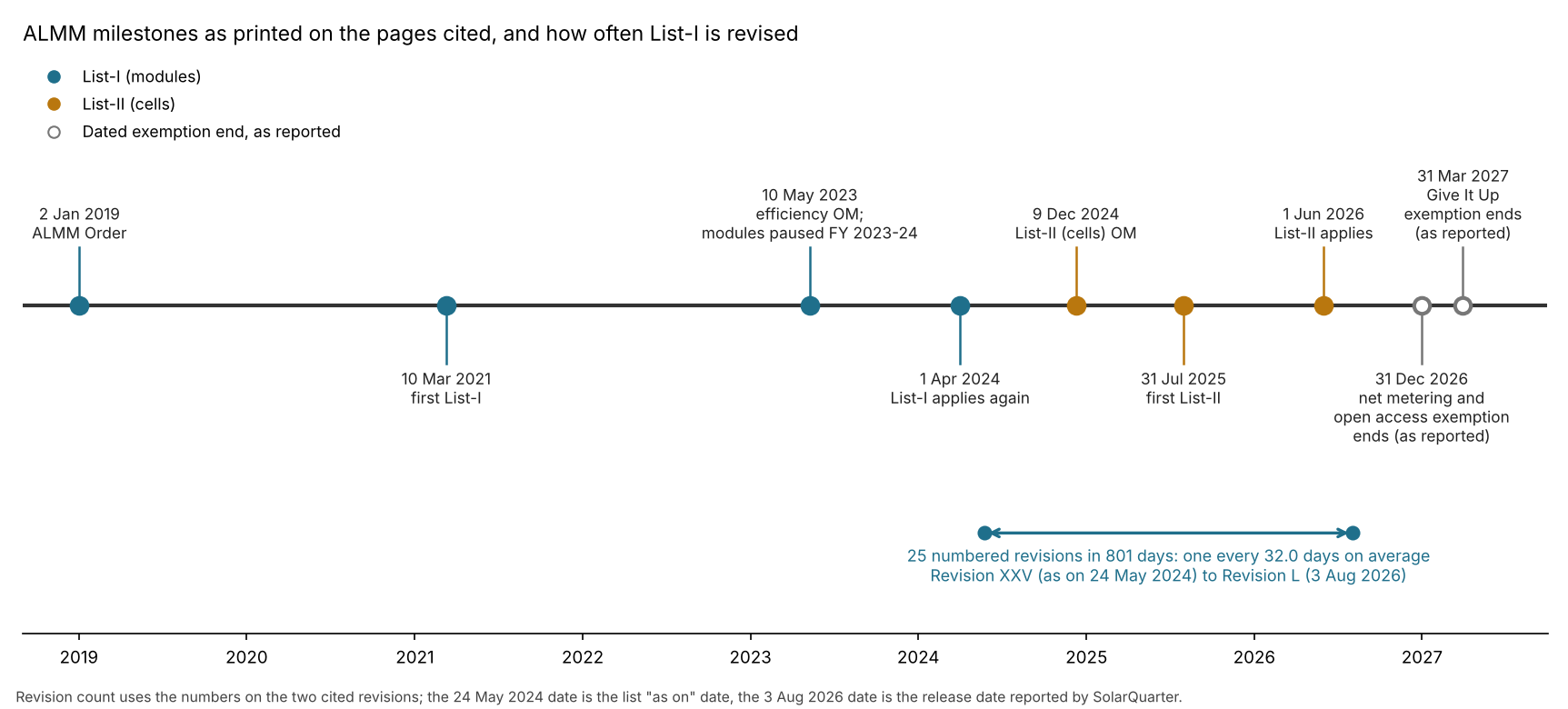
Figure 1. List-I was revised 25 times in 801 days between Revision XXV and L. A saved copy goes out of date within weeks.
Which projects must use ALMM modules and cells?
The rule that applies follows the project type. For cells, bid or commissioning dates matter too. Find your project type in the first column, then read the cell and module columns. "Not stated" means the source we cite does not say. Private behind-the-meter captive plants fall outside both rules, and DCR scheme projects get no relaxation. The table follows Energetica India (5 August 2026). That report is about an MNRE memorandum with no issue date. Power Line (7 August 2026) agrees on the net metering row. Angel One (11 June 2026) agrees on the Give It Up row.
| Project type | List-II cells | List-I modules |
|---|---|---|
| Competitive bidding | Exempt if the last bid date was on or before 31 August 2025 and the bid was live on 28 July 2025. | Not stated |
| Net metering and open access | Exempt if commissioned by 31 December 2026. | Continues where applicable. |
| PM Surya Ghar "Give It Up" (households that forgo the subsidy) | Exempt until 31 March 2027, if applied for only through the national portal. | Continues to apply. |
| Behind-the-meter captive, private buyers | Does not apply. | Does not apply. |
| Behind-the-meter captive, government entities and public sector | Exempt if commissioned by 31 December 2026. | Required. |
| Rooftop on government buildings, competitively bid | Exempt if the bid deadline was on or before 9 December 2024 or from 28 July to 31 August 2025. | Not stated |
| Rooftop on government buildings, not competitively bid | Exempt if commissioned by 31 December 2026. After that date List-II cells are required. | Not stated |
| Projects under a DCR scheme | No relaxation. | Domestic modules remain mandatory under the scheme. |
Notes on the two bid rows:
- Competitive bids: tenders from 9 December 2024 to 28 July 2025 that required List-II cells keep that term.
- Government rooftops, competitively bid: for deadlines from 9 December 2024 to 28 July 2025, follow the tender terms. After 31 August 2025, List-II applies.
The August 2026 reports are newer than Khaitan’s June note and replace it on dates. Energetica India (10 December 2024) printed 1 June 2026 as the line. That was for net metering and open access projects. Power Line (7 August 2026) prints 31 December 2026. Khaitan and Co (5 June 2026) says MNRE has said there will be no blanket extension of the 1 June 2026 date. It adds that some projects may ask an expert committee for their own extension.
The Give It Up exemption ends on 31 March 2027. For how the scheme’s portal works, see PM Surya Ghar. For grid sign-off, see DISCOM and net metering approval.
How does an installer check a module against ALMM?
Match the maker, factory and exact model on the latest list. Then read the validity dates and BIS number.
- Fix the project type and the date that counts. The pages named in Sources do not say which date a listing must cover. It could be the bid, supply or commissioning date. Ask the tender owner or DISCOM.
- Get the latest list revision from MNRE. Note its number and date on your file.
- Match the maker and the factory to the datasheet and invoice.
- Match the exact model in the Enlisted Models column. Then compare efficiency, cell count and system voltage.
- Read the Validity To date and the BIS number. Look up the BIS number on the BIS website.
- If List-II applies, ask the maker to prove the cells come from a List-II maker. The pages named in Sources do not say what document shows it. File the answer with the list printout.
The table runs this check on one invented list row. The row reads Alpha Solar, Plant A, model AS-540-TB, valid 1 February 2026 to 31 January 2030, BIS number present. The check date is 15 October 2026 unless stated.
| Case | Datasheet or invoice says | Result against the row |
|---|---|---|
| 1 | Alpha Solar, Plant A, AS-540-TB | Match. The date is inside the validity window. Passes List-I. |
| 2 | Alpha Solar, Plant B, AS-540-TB | Factory differs from the row. Hold and ask the maker. |
| 3 | Alpha Solar, Plant A, AS-545-TB | Model is not on the row. Not listed. |
| 4 | Alpha Solar, Plant A, AS-540-TB, check date 15 February 2030 | After 31 January 2030. Not valid unless renewed. |
| 5 | Alpha Solar, AS-540-TB, but the row sits on List-I(a) and the project needs List-II cells | Fails unless the project is exempt from the cell rule. |
Case 5 follows Energetica India (10 December 2024). It says List-I(a) is only for projects exempt from the cell rule.
How solar software handles ALMM
None of the five company pages mentions ALMM, so ask each company how new list revisions reach your module library. A module record should hold its maker, factory, model and validity, tied to a named list revision and date.
Five company pages were read in October 2026. They were the OpenSolar PM Surya Ghar help article, the Fuzen CRM page and a search of the Arka 360 site. The others were the Solar Ladder blog of 20 May 2026 and the Sunbase blog of 4 February 2026. None mentions ALMM. That means the pages are silent. It does not mean the tools lack a check.
To compare tools for Indian installers, see our ranked lists of the best solar design software in India and the best solar proposal software in India.
Common mistakes with ALMM
FAQs
Is ALMM mandatory for rooftop solar in India?
Sometimes. It covers government and government-assisted projects, schemes, net metering and open access projects (Khaitan and Co, 5 June 2026). Private behind-the-meter captive plants are outside it, as Energetica India said on 5 August 2026.
What is the difference between List-I and List-II?
List-I covers module makers and models. List-II covers solar cell makers and models. From 1 June 2026, List-I keeps only modules made with List-II cells. Exempt cases are the exception (Energetica India, 10 December 2024).
How long does a listing last?
Two years under the original rules (CEEW, May 2022, JSA, July 2025). AZB (31 October 2025) says reforms raised it to four. As SolarQuarter reported on 7 July 2026, Revision XLIX approvals mostly run from 6 July 2026 to 5 July 2030, which is four years. All depend on valid BIS registration.
Is ALMM the same as DCR?
No. DCR duties stay under each scheme’s guidelines. Energetica India (5 August 2026) says the ALMM clarifications do not relax them. For the rooftop scheme, see PM Surya Ghar.
Does ALMM list inverters?
Not on the pages named in Sources. They cover List-I for modules, List-II for cells and a draft List-III for wafers. AZB says wind turbine equipment has its own list, renamed from RLMM to ALMM (Wind) on 31 July 2025.
Related terms
- PM Surya Ghar: India’s central rooftop scheme for homes.
- Solar panel (module): the unit that ALMM lists.
- DISCOM and net metering approval: the grid sign-off for rooftop systems.
- Net metering: the billing rule that credits exported power.
Next step: ask each company how list revisions reach your module library. Start with the best solar design software in India or the best solar software in India.
Sources
- MNRE office memorandum and List-I, Revision XXV (ACMA-hosted copy), list as on 24 May 2024.
- SolarQuarter: Revision XLIX of List-I, 7 July 2026.
- SolarQuarter: Revision L of List-I, 4 August 2026.
- Energetica India: September 2026 List-I update, 18 September 2026 (names no revision number, checked 30 October 2026).
- SolarQuarter: module efficiency thresholds, 22 March 2024.
- Energetica India: List-II applicability by project type, 5 August 2026.
- Power Line: List-II clarification, 7 August 2026.
- Energetica India: List-II to be effective from 1 June 2026, 10 December 2024.
- Khaitan and Co on Mondaq: operationalisation of List-II, 5 June 2026.
- Angel One: Give It Up consumers and non-DCR modules, 11 June 2026.
- AZB and Partners: ALMM and RLMM compliance, 31 October 2025 (checked 30 October 2026).
- JSA Prism, Energy, July 2025.
- CEEW: What is ALMM, 5 May 2022.
- OpenSolar help article, no date shown.
- Fuzen solar CRM page, metadata 1 October 2026.
- Arka360 site search for ALMM, October 2026.
- Solar Ladder blog, 20 May 2026.
- Sunbase blog, 4 February 2026.
All sources checked October 2026.
Last updated 30 October 2026. Next scheduled review: 30 January 2027.