Key takeaways
- DIN SPEC 91434:2021-05 has two categories: Category I is raised, with at least 2.10 m clearance, and Category II is low-mounted, with farming between rows.
- DIN SPEC 91434 caps lost farmland at 10% of project area for Category I and 15% for Category II. Both need at least 66% of the reference yield.
- Fraunhofer ISE’s guideline (third edition, February 2024) gives overhead heights of above 2 m for farming and about 2.5 m for horticulture. It calls these only a trend.
- In this example’s geometry, pitch sets average direct light and height does not. A 3.4 m row passes 61% at 9.5 m pitch and 46% at 6.8 m (48°N).
- In NLR slides for one 0.144 ha plot, lifting panels to 3 m added 3.3% energy. Doubling row spacing cut DC capacity to 48%. Tracking added 13.8%.
For the plant layout itself, not the light check, see the best utility-scale solar design software for ground-mount layouts.
Agrivoltaics at a glance
Agrivoltaics adds farm produce as a second output. Three levers set the trade-off. They are clearance height, row pitch and tilt.
| Item | Detail |
|---|---|
| What it is | The US Department of Energy defines it as "agricultural production underneath or adjacent to solar panels". |
| Design levers | Clearance of the lowest edge, row pitch, tilt and orientation, and the spacing of supports. |
| Standard or rule | DIN SPEC 91434:2021-05 (Germany). A paper published in 2025 says it is not legally binding by itself. It gains weight only when legislation refers to it. |
| In software | Of the four tools we checked, only bifacial_radiance documents ground-level light (see the software section). |
Why does agrivoltaics change a ground-mount design?
A plain ground mount is tuned for energy per hectare. An agrivoltaic design must also leave light, water and machine access for crops or animals.
NLR (formerly NREL) says partial shade reduces the direct sunlight reaching crops. A DOE and NLR design guide of November 2024 says designs tend to favour energy or farm output. They rarely favour both. Raising panels adds wind load (structural loads, racking design).
For the plant itself, see solar farm and ground-mount design. For spacing, see row spacing and pitch and ground coverage ratio. This page covers what changes when a farmer shares the land.
Which agrivoltaic layouts are there?
Four layouts appear in the sources. They are raised, low-mounted with farming between rows, vertical bifacial and tracked. Each moves the trade-off differently.
| Layout | What the sources say |
|---|---|
| Raised (DIN Category I) | Clearance of at least 2.10 m as printed in the DIN SPEC copy. Fraunhofer gives higher figures only as a trend (see the height table). |
| Low-mounted, farm between rows (DIN Category II) | DIN treats ground under modules with clearance below 2.10 m as non-usable farmland. The first edition (2020) of Fraunhofer’s guideline says grassland systems use conventional mounts, sometimes with small changes. It says row spacing is typically wider than on conventional ground mounts. |
| Vertical bifacial | The first edition (2020) calls vertical systems a new approach that largely permits cultivation, with benefits expected mainly in windy areas. It says low mounting is cheaper but leaves fewer light-management options. See bifacial modelling. |
| Tracked | The first edition (2020) considered tracking uneconomical for German sites. It says large two-axis tables can create an umbra beneath them. The DOE and NLR guide says single-axis trackers generally make more annual electricity than fixed tilt. See single-axis trackers. |
Statements marked first edition come from the October 2020 guideline. We did not find them repeated in the third edition (February 2024).
How high should the panels be?
Set the lowest edge by what must pass underneath. Sources give different minimums, because they answer different questions.
| Source | Clearance rule |
|---|---|
| DIN SPEC 91434, Category I | At least 2.10 m. Section 5.2.2 separately says clearance must follow occupational safety law. |
| Fraunhofer guideline, third edition (February 2024), p. 10 | Overhead systems above 2 m for farming and about 2.5 m for horticulture. The guideline says the heights should only be seen as a trend. |
| Fraunhofer guideline, third edition, p. 28 | Massachusetts requires a bottom edge of at least 2.4 m for fixed rows and at least 3 m with module tracking. |
DIN SPEC 91434 also caps lost farmland. Section 5.2.3 of the copy we read allows at most 10% of project area for Category I and 15% for Category II. Section 5.2.10 requires crop yield of at least 66% of the reference yield. Sections 6.4.2 and 6.4.3 word the limits as "less than".
Machinery, crop height and local rules decide the final value. Do not use these sources as a design basis. Higher panels also carry more wind loading, so involve your structural engineer first.
How do pitch and height set the shade?
Pitch sets the average light on the ground. Height changes only where the shadow falls. That evens out the light across the strip between rows.
Take endless rows facing south. The sun is at cross-row angle α. A row of slant length L at tilt β casts a shadow of width L cos β + L sin β ÷ tan α. The shaded share is that width divided by pitch. It is capped at 1. Height is not in the formula. It slides the shadow along the ground.
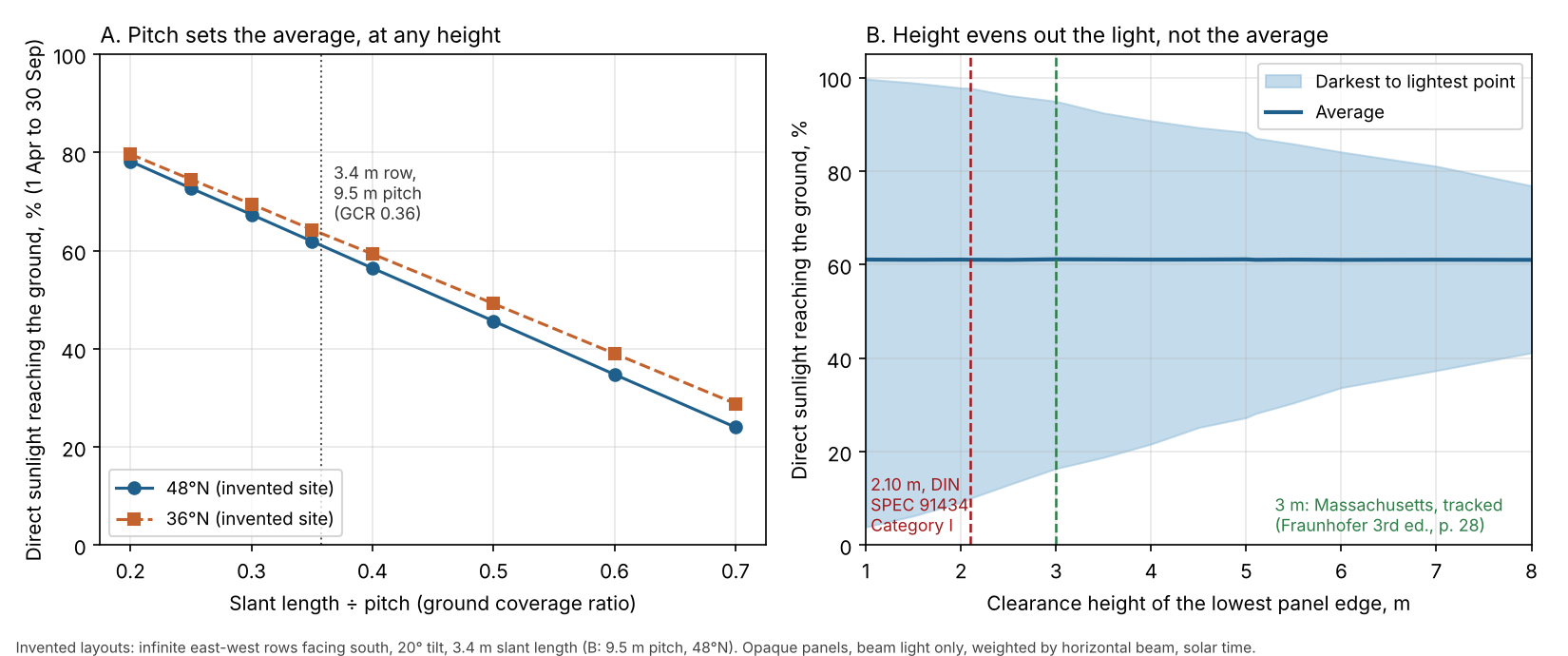
Figure 1. For example rows, direct ground light falls as pitch tightens at any height. Higher clearance narrows the gap between the darkest and lightest points.
Higher panels sweep their shadow over more ground as the sun moves. So each point is shaded for less of its time. In a separate sky-view measure, the darkest point at 9.5 m pitch sees 43% of an isotropic sky at 2.1 m clearance and 60% at 5.0 m. The direct-light figures in the next table are a different measure.
Fraunhofer’s third edition (p. 33) says a radiation reduction of around a third can be considered acceptable for arable farming in Germany. It applies to arable farming in Germany and is not our measure. Our 9.5 m case loses 39% of direct light. Tilt and orientation also change crop light (tilt angle, azimuth).
Worked example: three pitches and two heights
This example uses an example 3.4 m slant row at 20° tilt and 48°N, facing due south. The row width and spacing echo the Heggelbach plant in Fraunhofer’s third edition. Rows sit 9.5 m apart and are 3.4 m wide (p. 15). Tilt and orientation are example. Light is for 1 April to 30 September.
| Pitch | GCR (slant / pitch) | Capacity per hectare, 6.8 m = 100% | Average direct light | Darkest to lightest point at 2.1 m / at 5.0 m |
|---|---|---|---|---|
| 6.8 m | 0.50 | 100% | 46% | 10% to 87% / 25% to 68% |
| 9.5 m | 0.36 | 72% | 61% | 10% to 98% / 27% to 88% |
| 12.0 m | 0.28 | 57% | 69% | 10% to 99% / 29% to 95% |
Moving from 6.8 m to 9.5 m pitch lifts average direct light from 46% to 61%. It costs 28% of the capacity per hectare. Raising the lowest edge from 2.1 m to 5.0 m leaves the average unchanged. It lifts the darkest of 40 ground points from 10% to 27% at 9.5 m. At 36°N the 9.5 m average is 64%.
What do published numbers show for energy?
NLR slides compare seven designs on the same 0.144 ha. Lifting panels adds a little energy. Wider rows cut capacity almost in step with energy.
| Design (NLR slides 33 to 39) | Front height / row spacing | DC capacity | Annual energy | kWh per kWdc (ours) |
|---|---|---|---|---|
| Standard height and spacing | 0.5 m / 3.65 m | 100 kW | 170,761 kWh | 1,708 |
| Raised, standard spacing | 3 m / 3.65 m | 100 kW | 176,458 kWh | 1,765 |
| Standard height, wider rows | 0.5 m / 7.3 m | 48 kW | 82,581 kWh | 1,720 |
| Raised, wider rows | 3 m / 7.3 m | 48 kW | 86,290 kWh | 1,798 |
| Raised, inter-panel spacing | 3 m / 3.65 m | 48 kW | 86,487 kWh | 1,802 |
| Vertical bifacial | 0.5 m / 8.5 m | 64 kW | 84,034 kWh | 1,313 |
| Tracking, standard spacing | 0.3 m (max tilt) / 3.65 m | 100 kW | 194,251 kWh | 1,943 |
Only slide 32 states a tilt. It is 22.3°, south-facing, for the baseline. Slides 33 to 39 show no tilt value, location, weather file or tool. Treat them as one illustration, not a benchmark.
Lifting the panels added 3.3% at 100 kW. Doubling the spacing left 48% of the capacity and 48.4% of the energy. So the cost is capacity per hectare, not efficiency. The vertical design kept 64% of the capacity and 49% of the energy. Tracking added 13.8% at 100 kW. Slide 40 adds that wider row spacing lowers panel temperature.
Check your own layout
Enter latitude, tilt, row length, pitch and clearance. It opens with the example 9.5 m case.
Prefer a full-page view? Open the agrivoltaics calculator on its own page.
How solar software handles agrivoltaics
Of four tools, only bifacial_radiance documents ground-level light for agrivoltaics. The table shows what each page says (October 2026).
| Software | Ground-level light for agrivoltaics? | Method |
|---|---|---|
| bifacial_radiance | Yes | Radiance-based simulation |
| PVcase Ground Mount | Not stated | Not stated |
| RatedPower | Not stated | Not stated |
| PVsyst | Not stated | Not stated |
Not stated means the pages listed for that tool below do not say.
- bifacial_radiance: Tutorial 11 computes irradiance on the ground as well as on the modules. Tutorial 12 loops over module clearance heights (hub heights of 4.3, 3.5, 2.5 and 1.5 m in its code) for tomato and kale growing windows. Docs, tutorials 11 and 12. Undated. Version 0.5.4, copyright 2024 NREL.
- PVcase Ground Mount: No agrivoltaic feature is named on the pages read. PVcase blog of 10 March 2026 has an image captioned "Agri-PV design with PVcase Ground Mount". The Agrivoltaics 101 and e-book pages name no feature.
- RatedPower: The page names a webinar, not a feature. Webinar page says the session covers "solar layout and planning considerations for Agri-PV projects" (30 September 2025).
- PVsyst: No company page is cited. One unattributed forum reply mentions a bifacial run and the "global on ground" variable. PVsyst forum thread "Radiation losses at ground level". Author and date not shown on the page.
For plant layout and terrain, see utility-scale layout optimisation and shading analysis.
Common mistakes with agrivoltaics
FAQs
What is agrivoltaics?
Agrivoltaics is farming or grazing on the same land as solar panels, under them or between the rows. The US Department of Energy defines it as "agricultural production underneath or adjacent to solar panels". Design trades off panel height, row spacing and shade against energy.
Does agrivoltaics reduce solar energy output?
It can, through wider rows. In the NLR slides, doubling row spacing on the same plot cut DC capacity. It fell to 48% of the baseline. Energy per kWdc stayed close, at 1,720 against 1,708 kWh. Lifting panels did not cut energy in the slides.
How high do agrivoltaic panels need to be?
There is no single figure. DIN SPEC 91434 Category I uses at least 2.10 m. Fraunhofer gives above 2 m for farming and about 2.5 m for horticulture, and calls this only a trend. Machinery, crop height and wind load decide the final value.
How much shade do crops get under solar panels?
Fraunhofer treats a radiation reduction of about a third as acceptable for arable farming in Germany. This example’s 9.5 m pitch case loses 39% of direct light. Shade depends on pitch, tilt, orientation and the crop. NLR says local demonstration sites show how a crop responds at a given site.
What is the DIN SPEC for agrivoltaics?
It is Germany’s specification for agrivoltaic systems. It sets a raised category and a low-mounted category, each with clearance and lost-farmland limits (10% and 15% of project area). A paper on legislation says it is not legally binding by itself and gains weight only when legislation refers to it.
Can animals graze under solar panels?
Yes. Grazing is part of the usual definition of agrivoltaics. Fraunhofer’s first edition says grassland systems use conventional mounts, sometimes with small changes, and row spacing is typically wider than on conventional ground mounts.
Related terms
- Solar farm: a ground-mounted PV plant built to export power to the grid.
- Ground coverage ratio: module area divided by the ground area allotted to it.
- Row spacing and pitch: how far one row of modules sits from the next.
- Floating solar: PV on floats over a reservoir or lake.
- PM-KUSUM: India’s farm solar scheme.
Next step: enter your own pitch and clearance in the calculator above, then compare layout tools in the best utility-scale solar design software. Of the four tools checked, only bifacial_radiance documents the ground-light check.
Sources
- US Department of Energy, What is Agrivoltaics? (checked October 2026).
- NLR (formerly NREL), agrivoltaics page, last updated 7 December 2025 (checked October 2026).
- Fraunhofer ISE, Agrivoltaics: A Guideline for Germany, third edition, February 2024 (checked October 2026).
- Fraunhofer ISE, same guideline, first edition, October 2020, copy hosted by Penn State (checked October 2026).
- DIN SPEC 91434:2021-05, copy hosted by LAVES Niedersachsen, German text (checked October 2026).
- Trommsdorff, Vollprecht and Sterzenbach, Legislation on Agrivoltaics in Germany, AgriVoltaics Conference Proceedings 3 (2024), published 26 May 2025 (checked October 2026).
- NREL, Session 3: Agrivoltaics Pathways, SAREP Agrivoltaics Knowledge Series, 6 August 2024 (checked October 2026).
- DOE and NREL, Agrivoltaic Designs and Configurations, DOE/GO-102024-6470, November 2024 (checked October 2026).
- Company pages: bifacial_radiance tutorial 11, tutorial 12, PVcase blog, RatedPower webinar page, PVsyst forum thread (checked October 2026).
Last updated 30 October 2026. Next scheduled review: 30 January 2027.