Key takeaways
- In this example’s 10.2 kW example, 2.60 USD per watt plus seven adders gives 4.356 USD per watt all-in. The adders add 17,914 USD.
- One adder, a battery at 9,500 USD (example), is 53% of that adder total. Without it the all-in price is 3.425 USD per watt.
- Price an inverter swap at its full 0.30 USD per watt (example) when the base already pays 0.18, and you charge 1,836 USD twice.
- A 2% percentage adder (example) is 530 USD on base alone and 878 USD on base plus other adders, so state the basis.
- An adder is not a redline. A redline is the company’s minimum price. An adder is a priced item inside the sale price.
To price adders inside a quote, see the best solar proposal software list.
Adders at a glance
The base price covers a standard job. Adders cover what makes a job different from it.
| Item | Detail |
|---|---|
| Formula | All-in price = base price per watt × system watts + the sum of the adders. All-in price per watt = all-in price ÷ system watts. |
| Unit | USD, or USD per watt. Rate types seen in company help pages: fixed, per watt, per unit or panel, and percentage. |
| Typical triggers | Roof type or slope, ground mount, trenching, a main panel upgrade, batteries, EV chargers. Company pages list roof, system size, equipment and financing as conditions. |
| Standard or rule | None. Each company sets its own adders. Tools differ on the basis of percentage adders and may differ on the order of calculation. |
| In software | Proposal tools hold an adder list, applied by hand or by rule. See the software table. |
Why do adders matter for installers?
They decide whether a job that costs more than the base assumes is also priced higher. If you miss an adder, you give away margin.
Scanifly’s blog describes adders as "in some cases, changes or additions to make the project possible" (published 8 October 2024). It says smaller costs, such as tree trimming and small roof repairs, may come out of rep commission. See redline pricing and sales commission tracking for pay plans.
One finance programme limits them. A Palmetto help page said adders "(roofing, electrical, steep roof, trenching, etc.)" cannot go on the initial Enerflo proposal for LightReach deals. That article no longer resolves when checked in November 2026, so confirm the current rule with Palmetto before relying on it. See third-party ownership. For the base rate itself, see cost per watt.
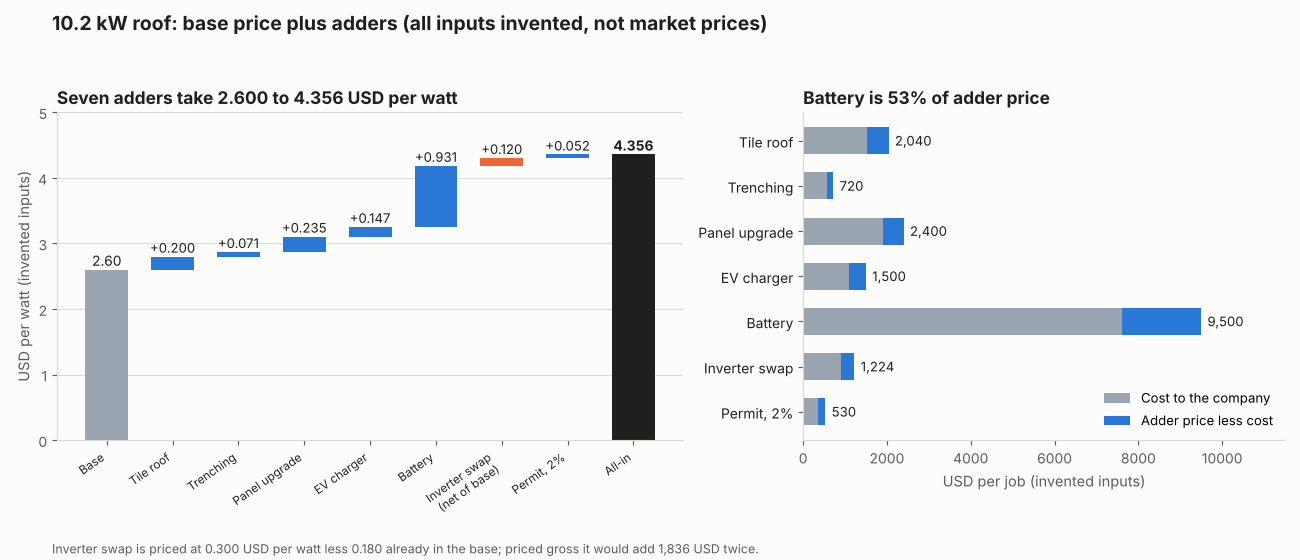
Figure 1. In our example, seven adders lift 2.600 USD per watt to 4.356, and the battery alone adds 0.931. Netting the inverter swap against the base removes 0.180 USD per watt of double charge.
How is an adder different from a redline?
A redline is the minimum price the installer must receive. An adder is a priced extra inside the sale price. They meet in pay plans, where adders can be charged to the rep.
Company pages use the word adder in three ways.
- Price adder: raises the price the buyer sees. OpenSolar: adders "can influence the system price, system cost, or both".
- Cost adder: raises your cost, not the quoted price. This is on the same OpenSolar page.
- Rep-charged adder: reduces rep pay under a plan. Only Scanifly’s blog describes this: costs "may be taken out of Rep commission".
| Item | Redline | Adder |
|---|---|---|
| What it is | A minimum price per watt | A priced extra on top of the base |
| Who sets it | The company, in the pay plan | The company, in its price list |
| Unit | USD per watt | USD, USD per watt, per unit or percent |
| Effect on the buyer’s price | None directly | Raises it, if it is a price adder |
How do you build a price per watt with adders?
Start with the base price times watts. Add each adder by its rate type, then divide the total by watts. OpenSolar’s project pricing page (updated 1 October 2026) has its own order of calculation, so confirm the current order there before you copy the steps below.
- Multiply the base price per watt by system watts. Aurora’s help calls this a base price per watt times system size in watts.
- Add per-watt adders: rate × watts.
- Add per-unit adders (rate × quantity) and fixed adders.
- Add percentage adders. Choose the basis and write it down.
- Remove any part of an adder that the base price already pays for.
- Divide the total by watts for the all-in price per watt.
Aurora’s help names three percentage bases: PV cost only, storage cost only, and the full system cost (page updated 13 October 2026). OpenSolar’s page gives no worked example. Scanifly’s page notes that whether a percentage adder applies to the base alone or the base plus equipment is still to be confirmed. Read your tool’s own page.
Worked example: a 10.2 kW roof with seven adders
On our example inputs, adders add 17,914 USD. The all-in price is 44,434 USD, or 4.356 USD per watt.
The array is 24 modules of 425 W, as on the bill of materials page. We assume the base price pays for every part on that BOM.
| Adder (all values example) | Gross price (USD) | Already in base (USD) | Net price (USD) | Cost (USD) |
|---|---|---|---|---|
| Base price, 10,200 W at 2.60 USD per watt | 26,520 | 26,520 | ||
| Tile roof (per watt, 0.20) | 2,040 | 0 | 2,040 | 1,530 |
| Trenching, extra run (per unit, 18 USD × 40 ft) | 720 | 0 | 720 | 560 |
| Main panel upgrade (fixed) | 2,400 | 0 | 2,400 | 1,900 |
| EV charger (fixed) | 1,500 | 0 | 1,500 | 1,100 |
| Battery (fixed) | 9,500 | 0 | 9,500 | 7,600 |
| Microinverters for a string inverter (per watt, 0.30) | 3,060 | 1,836 | 1,224 | 900 |
| Permit and admin (2% of base price) | 530 | 0 | 530 | 350 |
| Total | 46,270 | 1,836 | 44,434 | 13,940 |
The adder price is 17,914 USD against a cost of 13,940, so adder margin is 3,974 USD, or 22.2% of adder price. The base price has its own cost, which this example leaves out.
Two choices move the answer. If the permit adder is 2% of base plus the other adders, it is 878 USD. The all-in price is then 44,782 USD (4.390 USD per watt). If the inverter swap is priced gross, the total is 46,270 USD (4.536 USD per watt). That is 1,836 USD, or 4.1%, above the correct total.
These figures feed the capex in a project model. See financial modelling and cash flow analysis for what a price does next.
How do you stop adders double-counting the BOM?
For each adder, ask whether it adds a new line, changes a line the base already pays for, or adds only labour or a fee. Charge only the difference.
- New line: the item is not in the base BOM, so the full price is right. The battery and EV charger lines are examples.
- Changed line: the base already pays for the part. Charge new price less base-included price. The inverter swap is the example: 3,060 less 1,836 is 1,224 USD.
- Labour or fee only: no new material, so check no BOM line carries the same work. Extra trenching is a run beyond the base’s conduit allowance (assumed), not a repeat of it.
Also look for a name that appears twice, or two adders for one change. A roof adder and a steep-pitch adder might both price the same safety cost. The calculator flags repeated names and takes off the overlap you enter. It cannot see whether two different names mean one cost.
Solar adders price build-up calculator
Enter size, base price and up to seven adders. It shows the price build-up, the overlap removed, all-in price per watt and adder margin.
If the calculator does not appear, open the solar adders calculator on its own page.
How solar software handles adders
OpenSolar, Aurora and Solo document rules that apply adders automatically. Scanifly prices adders per proposal, and Enerflo’s collection page lists titles only. The table is as read in October 2026. OpenSolar’s and Aurora’s own help pages blocked automated access when we tried to recheck them in November 2026, so those two rows are as last confirmed, not reverified this pass.
| Software | Documents adders? | Source and date |
|---|---|---|
| OpenSolar | Yes | OpenSolar support, adders page (dated 31 July 2025 on the page) and project pricing page (updated 1 October 2026) |
| Aurora Solar | Yes | Aurora help, Adders and Discounts and Automatic Adders & Discounts (both updated 13 October 2026). Base price: account configuration page (6 May 2026) |
| Solo | Yes | Solo help, MissionControl: Adders (page dated 30 June 2026, checked November 2026) |
| Scanifly | Yes | Scanifly help, Price a Proposal with Equipment and Adders (no date printed) |
| SubcontractorHub | Yes | Help centre moved off helpscoutdocs.com in 2026. Adders are now documented across several Intercom-hosted articles, for example How To Add Adders (no date printed, checked November 2026) |
| Enerflo | Partly | Enerflo help collection (no date printed) |
Partly: the page lists titles only. The notes below summarise each company page.
- OpenSolar: Adders affect price, cost or both. Priced fixed, per watt or per panel. Can apply automatically by location, system size, components, sector, roof type and roof slope. Negative values act as discounts.
- Aurora Solar: Adders and discounts are line items that modify the final price. Rates: flat, per watt or percentage with three bases. Applied by the rep, to all designs or by conditions such as roof pitch and roof surface.
- Solo: Adder types: checkbox, input, select, automatic. Price types: per watt, per unit, per panel, fixed amount. The page lists no separate cost field.
- Scanifly: "Each adder is a flat amount, dollars per watt, or a percentage, and adds to the system cost." Chosen per proposal.
- SubcontractorHub: The article that listed per panel, per watt, percentage and flat rate pricing is no longer live, after the company restructured its help centre in 2026. Its current adders articles describe a "Unit Price" field and automatic adder rules by roof type, office and connected sales organisation, but do not spell out the rate types or a default-adder setting in the text we could read. Check the current help centre before relying on this.
- Enerflo: The help centre has an "Adders" collection described as "Adder setup and configuration". The collection page lists article titles only, such as System vs. Value Adder and how to list adders.
For more proposal tools that handle adders, see the best solar proposal software list.
Common mistakes with adders
FAQs
What are common examples of adders in solar?
Roof type or pitch, ground mount, trenching, electrical work and storage. Palmetto’s page names roofing, electrical, steep roof and trenching. OpenSolar and Aurora list roof type, pitch and system size as automatic conditions.
Are adders included in price per watt?
Not in the base rate. Adders sit on top, so the all-in price per watt is higher. In our example the base is 2.60 USD per watt and the all-in price is 4.356. Some tools show the all-in figure beside the base.
Can adders be applied automatically?
Yes, in tools that document it. OpenSolar and Aurora apply adders by rule, and Solo lists an automatic adder type. A rule that fires by mistake is a double-count risk, so test it on a sample job.
Who pays for an adder, the buyer or the rep?
The buyer pays a price adder, and the company bears a cost adder. Scanifly says some costs may come out of rep commission, so check your plan. See clawback for recovery of pay.
Related terms
- Redline pricing: the minimum price per watt that sets rep pay.
- Bill of materials: the parts list that the base price pays for.
- Main panel upgrade: a common fixed adder.
- Cost per watt: the base rate that adders sit on top of.
- Third-party ownership: a finance route that can restrict adders.
- Capex and opex: where the all-in price lands in a project model.
Next step: to apply adders by rule in a quote, compare the best solar proposal software.
Sources
- OpenSolar: How to create adders in your organization, dated 31 July 2025 on the page (checked October 2026).
- OpenSolar: How project pricing works, updated 1 October 2026 (checked October 2026).
- Aurora help: Adders and Discounts and Automatic Adders & Discounts, both updated 13 October 2026 (checked October 2026).
- Aurora help: pricing account configuration, updated 6 May 2026 (checked October 2026).
- Solo help: MissionControl Adders, dated 30 June 2026 (checked November 2026). The separate "adder pricing types" page we cited before no longer resolves.
- Scanifly help: Price a Proposal with Equipment and Adders, undated (checked October 2026).
- Scanifly blog on how operations affect sales commissions, published 8 October 2024, last modified 19 March 2025 (checked October 2026).
- SubcontractorHub: How To Add Adders, undated. The company moved its help centre off helpscoutdocs.com during 2026, so our earlier EasyQuote Auto Adders link no longer resolves (checked November 2026).
- Enerflo help: Adders collection, undated (checked November 2026, still resolves).
- Palmetto help: pricing adders when using Enerflo, LightReach and Palmetto Energy, no date printed. This article no longer resolves (checked November 2026). Treat the claim above as unconfirmed until you find a current version on Palmetto’s site.
Last updated 3 November 2026. Next scheduled review: 30 January 2027.