Key takeaways
- Logo and colours show up on 4 of the 6 company pages read. Aurora and Coperniq mention branding with no detail. An own domain shows up on 2 and an own app-store app on 1.
- "White label" is not one feature. Solargraf aims its white-label edition at manufacturers, lenders and distributors, not only installers.
- Fees, minimum term and who owns the domain and app listing vary by company. Solytic names a licence fee, a one-year minimum and monitoring fees "reduced by 50%", with no price.
- White label means one product that many companies rebrand. Private label means a product made for one brand.
- Send yourself a test proposal before you sign. Check the link, the email sender and the footer.
To compare branded quotes in software, see the best solar proposal software, or the best solar customer portal software for branded logins.
What does white-labelling look like at a glance?
White-labelling puts your name where the company’s name would go. How far it goes depends on the company. It also depends on your plan.
| Item | Detail |
|---|---|
| What can be branded | Proposals, customer portals, apps, reports, monitoring pages, whole platforms. |
| Layers seen on the pages read | Logo and colours, own domain, own email sender, own app-store app, dealer or partner control. |
| Who offers it | The software company, often as a paid add-on, plan or contract. No standard defines it. |
| Where it matters | Customer trust, reseller and dealer programmes, and how locked in you are to one company. |
| Proposals only | See white-label (branded) proposals. |
Why does white-labelling matter for installers and resellers?
It decides whose name the customer recalls. It also decides who relies on whom. A branded product can make you look like the maker. It can also tie your customers to a company you do not control.
The cost shows on Solargraf’s white-label page. Dealers are "locking them into only providing the options that you offer to their customers".
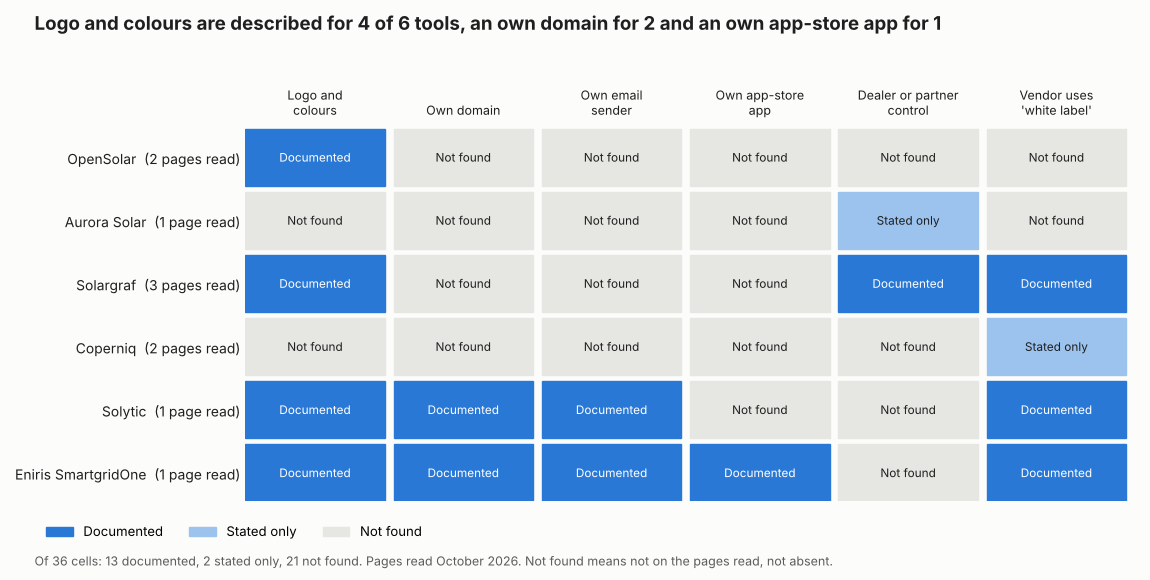
Figure 1. Logo and colours are described for 4 of 6 tools, an own domain for 2 and an own app-store app for 1. An empty cell means the pages read do not say, not that the feature is absent.
What are the levels of white-labelling?
This page groups it into 4 levels, from light to deep. It is our own grouping, not a standard. Each level asks more of the company and may sit in a dearer plan.
| Level | What changes | Who needs it | Seen on the pages read |
|---|---|---|---|
| 1. Branded | Your logo and colours on the company’s screens and documents. | Any installer. | OpenSolar, Solargraf, Solytic and Eniris describe it. Aurora and Coperniq mention branding without detail. |
| 2. Own address | Links open on your domain. Notices come from your email sender. | Firms that want customers never to see the company’s web address. | Solytic and Eniris describe a domain and an email sender. |
| 3. Full white label | The product is presented as yours, including an app in your own app-store listing. | O&M firms, installers with many customers, energy providers. | Eniris describes a branded app published under your name. Solytic does not mention an app. |
| 4. Reseller or enterprise | You run an account for others: dealers, sub-accounts, a shared product library. | Manufacturers, lenders, distributors, large dealer groups. | Solargraf’s white-label edition. Aurora lists dealer "Partner Management" with no detail. |
Level 1 changes the look. Levels 2 and 3 change what the customer can trace. Level 4 changes who runs the account. Solar Power World (14 March 2024, trade press, not company documentation) says Sunvoy’s white-label option means "allowing any solar installer to have its own branded app".
Our branded-proposals page uses 3 levels. Its Branded level is level 1 here. Its White label level, where the company’s name is hidden or replaced, covers levels 2 and 3. Its Co-branded level, a partner logo beside yours, has no exact match here.
How does white label differ from private label, OEM and reselling?
White label is one product that many companies rebrand. Racklify is a general trade guide. It was updated 8 October 2026. It says: "White label refers to products or services created by one company that other companies rebrand and sell as their own."
- Private label: "A private label arrangement involves a supplier producing goods exclusively for a specific retailer or brand."
- OEM: "OEMs manufacture components or complete products that other companies incorporate into their own products".
- Reselling: in this page, selling a company’s software to your own dealers or customers. It may or may not carry your brand.
These are general trade definitions, not solar rules. Software companies also use "white label" loosely. In the software table below, Coperniq lists a white-label portal but gives no settings.
How solar software handles white-labelling
Four of the 6 pages read document own-brand settings, and 3 describe a white-label option. The table uses the pages named, read in October 2026. Four tools are design, sales or project software and two are for monitoring or energy management. The first 3 ratings match our branded-proposals page.
| Software | Own-brand settings documented? | White label documented? | Pages read |
|---|---|---|---|
| OpenSolar | Yes | Not stated | Support article, 15 April 2026. Enterprise page, 29 April 2026. |
| Aurora Solar | Partly | Not stated | Pricing page, metadata modified 29 October 2026. |
| Solargraf | Yes | Yes | Help article, 10 December 2021. Edition pages, undated. |
| Coperniq | Partly | Partly | Home page, checked November 2026 (the October 2026 page has since moved). |
| Solytic | Yes | Yes | White-label monitoring page, metadata modified 21 October 2026. |
| Eniris SmartgridOne | Yes | Yes | White-labelling article, no date printed (copyright 2026). |
What each page says:
- OpenSolar: Branding settings: see the proposals page. The enterprise page covers tools for suppliers and lenders and does not mention white label.
- Aurora Solar: Branding: see the proposals page. "Partner Management" is "Manage permissions for dealers and other teams". White label is not mentioned.
- Solargraf: Branding settings: see the proposals page. The white-label edition lets an enterprise choose which brands dealers can offer on proposals. It can also make its product library public and appear as a financing option.
- Coperniq: The page read in October 2026 listed a "White-label portal for milestone updates, service tickets, and referrals". That page no longer exists. Coperniq’s current home page, read in November 2026, instead lists a "White-labeled Client Portal" as one line under its dispatch features, with no settings described. The separate products page cited earlier has also gone, so check the live site before relying on either wording.
- Solytic: A monitoring portal on "a domain that reflects your company". It also has a custom email address for notifications, logo, favicon, primary and secondary colours, and a login background image. It has a monthly licence fee, no setup fee and a one-year minimum. Regular monitoring fees are "reduced by 50% with the White Label" for installations of 200 kWp or less. No branded app or reports are mentioned.
- Eniris SmartgridOne: The page addresses "an installer, distributor, or energy provider". Your logo and colours go on the app, which you publish under your own name in the Google Play or Apple App Store. The web portal can sit on your own domain. Account emails can come from your own mail server. Pricing is by calculator.
Not stated: the company page we cite does not say. Partly: the page covers only part of the question. The notes show what the pages say. They are not tests. Companies may share more in help centres behind a login. Pages with no dates may have changed. For a wider comparison of tools, see the best solar proposal software guide.
What should you ask a company before you white-label?
These 6 contract questions belong in writing. A test proposal then shows the link, sender and footer. The proposals page lists tests for branding.
| Question | Why it matters |
|---|---|
| 1. What do I pay, and what does the fee change with? | Solytic names a monthly licence fee and a lower monitoring fee for installations of 200 kWp or less. Ask for the fee in writing. |
| 2. What is the minimum term and the exit notice? | Solytic states a one-year minimum. It says the contract "can be terminated 3 months before the contract expires". |
| 3. Who holds the domain, the email sender set-up and the app-store account? | Eniris says you publish the app under your own name. Ask who owns the listing if you leave. |
| 4. Who supports my customers or dealers? | Solargraf says the enterprise can train its own support team. It can also give dealers company support and training videos. |
| 5. What happens to branded data and assets on exit? | No page read says. Ask for export formats and a deletion date. |
| 6. Can the company change or withdraw the branded service, and how are my customers told? | No page read says. Ask for the notice period. |
Common mistakes with white-labelling
FAQs
What is the difference between white label and private label?
White label is one product that many companies rebrand. Private label is made for one brand. Salesforce’s white-label guide (page modified 12 January 2026) adds that private labelling costs more because of the exclusivity.
Is white-labelling the same as reselling?
No. Reselling is about who sells the product. White-labelling is about whose name it carries. Solargraf’s white-label edition touches both. It gives dealers sub-accounts and lets an enterprise choose which brands show on proposals.
Can I white-label monitoring for my customers?
Yes, with some companies. Two of the 6 pages read describe it. Solytic offers a portal on your domain. It carries your logo and colours. Eniris offers an app and portal under your brand. See fleet monitoring for the installer-side view.
Does white label include an API?
Not necessarily, because branding changes what the customer sees and an API moves data between systems. Solargraf’s white-label page does not mention an API. Eniris’s page only links an "Eniris API" under Compatibility and does not say whether branded accounts get it. Ask about each separately. See API.
Related terms
- White-label (branded) proposals: your brand on the quote the buyer receives.
- Customer portal: a login where buyers follow their project.
- Fleet monitoring: watching many sites from one view.
Next step: Shortlist companies that carry your brand on quotes in the best solar proposal software, or on logins in the best solar customer portal software.
Sources
- OpenSolar: Add your Logo and Business Details and OpenSolar enterprise page. Checked October 2026
- Aurora Solar pricing. Checked October 2026
- Solargraf help centre: tailor your account, white-label page and white-label edition post. Checked October 2026
- Coperniq home page. Checked November 2026 (the October 2026 home and products pages cited then have since been retired).
- Solytic: white-label PV monitoring. Checked October 2026
- Eniris: white-labelling SmartgridOne. Checked October 2026
- Racklify: white label vs private label vs OEM. Published 31 October 2025, updated 8 October 2026 and checked October 2026
- Salesforce: what is a white label product, page modified 12 January 2026 and checked October 2026
- Solar Power World: Sunvoy white-label option, 14 March 2024 and checked October 2026
Last updated 30 October 2026. Next scheduled review: 30 January 2027.