Key takeaways
- Panel and module name the same unit. The US Department of Energy (DOE) writes "modules or panels". The Aurora and PVsyst help pages and the California list say "module".
- A module has seven parts. They are front glass, encapsulant, cells, a rear layer, a frame, a junction box and bypass diodes.
- The REC Alpha Pure-R US print lists 80 half-cut cells and 4 bypass diodes. It is 1730 x 1118 x 30 mm and 21.5 kg.
- Array kWp is modules times Pmax at STC. For an example 9.0 kWp target and a 420 W module, 22 modules give 9.24 kWp (+2.7%).
- With example 400 W and 440 W classes of the same size, the same target needs 23 and 21 modules. Module mass falls from 483 kg to 441 kg.
To find a tool with a module library and custom module upload, see the best solar design software.
Solar panel (module) at a glance
A module is the unit you order, place on a roof and list on a permit form. Its datasheet gives the numbers a design tool stores.
| Item | Detail |
|---|---|
| Formula | Array kWp = modules × module Pmax at STC ÷ 1,000. See standard test conditions and kW and kWp. |
| Parts | Seven: glass, encapsulant, cells, rear layer, frame, junction box, bypass diodes. |
| Where it matters | Library records, layout, string checks, structural loads, proposals, permit forms and the bill of materials. |
| Standard or rule | IEC 61215:2021, IEC 61730:2023 and UL 61730, as listed on the REC sheet. |
| In software | Tools keep one record per module model. See the software table. |
Why a solar module matters for installers
A wrong power class or weight changes the bill of materials, permit sheet and roof load.
- Cost: the class you pick sets the module count and the built kWp, as the worked example shows.
- Approval: the Santa Clara checklist wants the model number to match the plans. It also asks for STC watts and Voc.
- Risk: module weight goes into the roof-load check. See bill of materials.
Why do people say both module and panel?
They mean the same assembled unit. DOE says cells are connected in chains to form "larger units known as modules or panels". The TU Delft course text uses both words with no difference.
Tools and forms mix the two words. One Santa Clara roof check reads "the plane of the modules (panels)". Aurora’s Sales Mode variables read "Module Count", "Module Manufacturer" and "Module Name". OpenSolar’s proposal page says "panels, inverters, batteries" for its System Hardware section. In a permit set, "panel" can also mean an electrical panel, so write "module" for the PV unit. See main panel upgrade.
What is inside a solar module?
It has seven parts: a glass front, encapsulant, cells, a rear layer, a frame, a junction box and bypass diodes. DOE says the stack is laminated in an oven "to make the module waterproof". Then it gets a frame and a junction box.
The table pairs a source quote with the REC datasheet value for each part.
| Part | What the sources say |
|---|---|
| Front cover | TU Delft: "The most commonly used cover is tempered low iron-content glass." REC sheet: "0.13 in solar glass with anti-reflective surface treatment". |
| Encapsulant | TU Delft: "The most commonly used polymer material is ethyl vinyl acetate, or EVA in short." DOE: a "sheet of polymer encapsulant" under the cells. |
| Cells | TU Delft: "A PV module consists of a number of interconnected solar cells." |
| Rear layer | DOE: a "tough polymer backsheet or another piece of glass". REC sheet: "Highly resistant polymer (Black)". |
| Frame | TU Delft: "The final structural component of the module is the edging or framing of the module." REC sheet: "Anodized aluminum (Black)". |
| Junction box | TU Delft: "This plastic box, located at the rear of the module, is designed for outside operation and to withstand heat cycles." REC sheet: "IP68 rated, in accordance with IEC 62790:2020". |
| Bypass diodes | TU Delft: "Usually the junction box also contains some bypass-diodes." The REC sheet prints "4 bypass diodes". For failures, see bypass diode failure. |
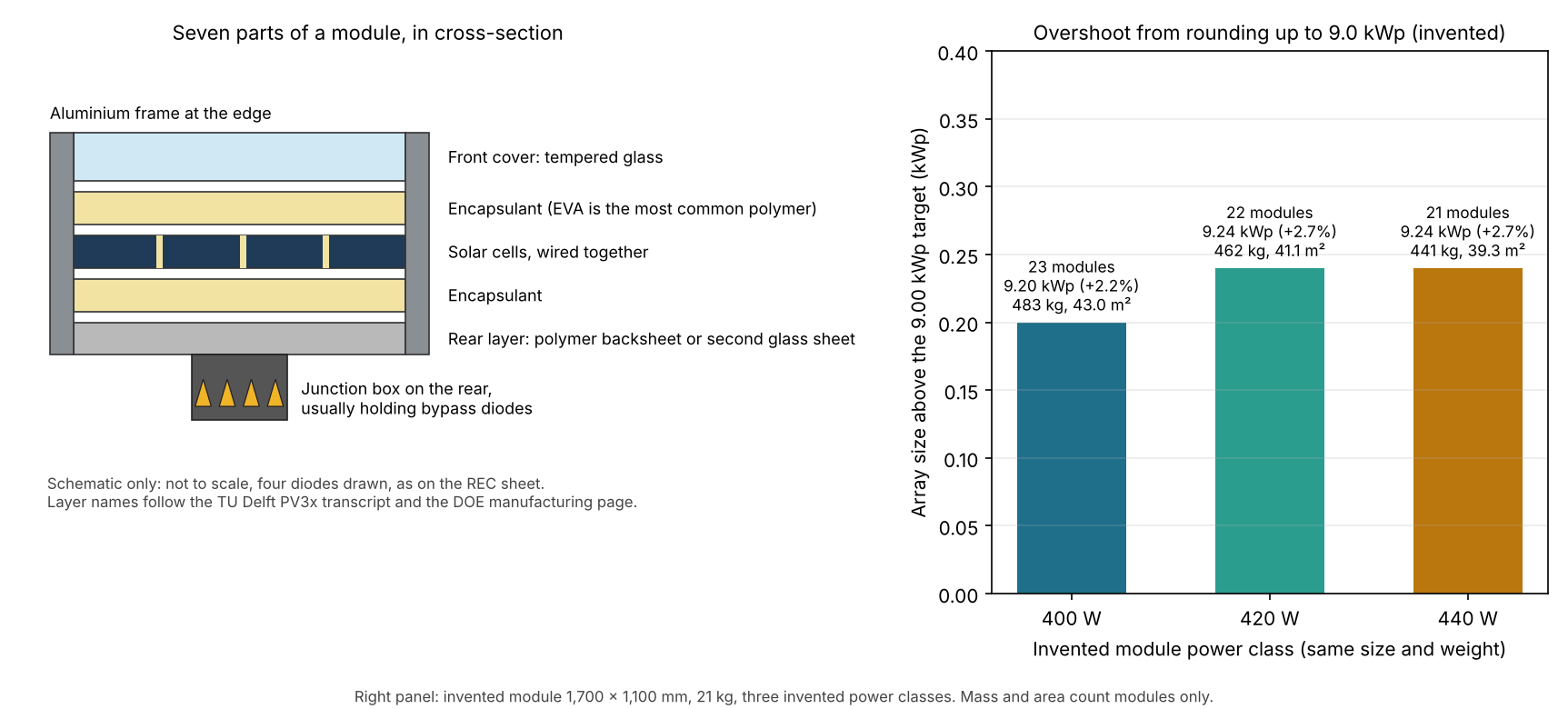
Figure 1. A module is seven parts in one laminate. For an example 9.0 kWp target, rounding up overshoots by 0.20 to 0.24 kWp in all three example classes.
Cell type is a record field too. DOE’s cell and module design page names crystalline silicon, cadmium telluride and III-V cells. It lists perovskites and organic PV as emerging technologies. TU Delft’s text describes mono- or polycrystalline silicon cells. DOE says one cell makes about 1 or 2 watts, so cells are joined into modules. The REC sheet prints "80 half-cut bifacial REC heterojunction cells". PVsyst’s module form has a Technology field that "acts on the model". For rear-side ratings, see PERC and half-cut cells and bifacial module.
What does a design tool need from a module record?
It needs the maker and model, STC power and size. It also needs weight, cell and diode counts, electrical values and listings. The table matches each one to a printed example.
| Record field | REC Alpha Pure-R, US print (footer "UL EN 6.2025") | What it feeds |
|---|---|---|
| Maker, model, print code | "REC ALPHA PURE-R". "REF: PM-DS-12-06-REV-/D UL EN 6.2025" | Library match and permit cut sheet. See equipment datasheets. |
| Pmax class and sort | 400, 410, 420 and 430 W. "Watt Class Sorting - (W) 0/+10" | Array kWp. |
| Size | 1730 x 1118 x 30 mm (1.93 m²) | Layout fit and area. See solar panel layout. |
| Weight | 21.5 kg (47.4 lb) | Roof load. See structural loads. |
| Cells | 80 half-cut bifacial heterojunction cells | Cell count. PVsyst asks for the number of cells in series, so confirm that figure with the maker. |
| Bypass diodes | 4 | PVsyst: "Useful for the electrical shading calculations in the Module Layout part." |
| Electrical values | Voc, Isc, Vmp, Imp and three coefficients | String limits. See Voc and Isc, Vmp and Imp and temperature coefficient. |
| Limits and listings | System voltage 1000 V. Max series fuse 25 A. UL 61730 | Fuse and voltage checks, permit review. |
Worked example: module count and array kWp
A target size becomes a whole number of modules, so the built size is not the target. Every module value here is example.
Example module: 1,700 × 1,100 mm (1.87 m²), 21 kg, sorting 0 to +10 W. Example target: 9.0 kWp. The table below rounds up. Mass and area count modules only, not rails, gaps or other hardware.
| Example class | Modules (exact count) | Array kWp (against target) | Area / mass | Max with +10 W |
|---|---|---|---|---|
| 400 W | 23 (22.50) | 9.20 (+2.2%) | 43.01 m² / 483 kg | 9.43 kWp |
| 420 W | 22 (21.43) | 9.24 (+2.7%) | 41.14 m² / 462 kg | 9.46 kWp |
| 440 W | 21 (20.45) | 9.24 (+2.7%) | 39.27 m² / 441 kg | 9.45 kWp |
The 440 W class gives the same 9.24 kWp as the 420 W class. It uses one module fewer. That is 21 kg and 1.87 m² less. At 420 W, rounding to the nearest module gives 21 modules and 8.82 kWp. That is 2.0% under target. The "Max" column assumes every module reads the full +10 W. It is an upper bound.
Module count and kWp calculator
Enter a target or a module count and the module record values. The starting values match the worked-example table (example).
Where do modules appear in proposals and permits?
A proposal shows the module count, maker, model and array size. A permit form asks for the count, model, STC watts, Voc and Isc, and the spec sheet.
- Proposals: Aurora’s Sales Mode variable list has Module Count, Module Manufacturer, Module Name and Design System Size. OpenSolar’s proposal page says the System Hardware section "displays the components (e.g., panels, inverters, batteries) used in the selected system". See best solar design and proposal software.
- Permits: the City of Santa Clara checklist (central string inverter form, revised 07-2023) lists "Number of PV modules and model number match plans and specification sheets". It asks for "Module DC output power under standard test conditions (STC)" and "Module Voc (from module nameplate)". It says "MANUFACTURER’S SPECIFICATION SHEETS MUST BE PROVIDED" for modules and other equipment. Other AHJs ask for different lines. See permit plan set and best solar permitting software.
How solar software handles module libraries
The table has four design tools and one regulator’s list. All four tools document a module library, and only HelioScope lets you upload a PAN file yourself. Aurora and OpenSolar send a missing module through a request form or their support team. The ratings cover the library, not checks of values against the sheet.
| Software | Documents a module library? | Page checked |
|---|---|---|
| Aurora Solar | Yes | Enabling Solar Components. No date shown, October 2026 |
| OpenSolar | Yes | How to add your hardware components, dated 15 April 2026 |
| HelioScope | Yes | Upload new modules, updated 24 August 2026 |
| PVsyst | Yes | PV modules main interface and basic data. No date shown, October 2026 |
| California Energy Commission PV module list | Yes (a list, not a design tool) | Solar Equipment Lists. No page date, October 2026 |
- Aurora Solar
- Route for a missing module: Component request form. A self-service custom module is not described on this page.
- What the page says: "Admins use model type row toggles to enable component models." If a model is missing, "please submit a component request form".
- OpenSolar
- Route for a missing module: "Create Your Own Component". The support team adds it.
- What the page says: Search by "Manufacturer Component Code". "Our team will add the item into the database on your behalf."
- HelioScope
- Route for a missing module: Upload a PAN file yourself, or email the spec sheet.
- What the page says: "Users can manually upload Modules via PAN Files." Spec sheets take "a few business days".
- PVsyst
- Route for a missing module: Fill the module form. The file name must end .PAN and be unique.
- What the page says: Tabs for basic data, size and technology, and commercial data. Number of bypass diodes is a field.
- California Energy Commission PV module list
- Route for a missing module: The page links a PV Module Listing Request Form.
- What the page says: The list "contains information such as PTC value, reported nameplate ratings, and temperature coefficients". The page says manufacturers’ self-reported information "is not confirmed".
The equipment datasheets page rates whether a tool documents a datasheet step. The best solar design software list covers more design tools. For the file format, see the PAN and OND files page.
Common mistakes with solar modules
FAQs
What is the difference between a solar panel and a solar module?
There is none. They are the same unit, an assembled set of cells. DOE writes "modules or panels". Write module on permit sets, because panel can also mean an electrical panel.
Why does one datasheet list several power classes?
The maker sorts one design into several power classes. The REC sheet prints 400, 410, 420 and 430 W under one dimensions line. Make one library record per class, each with its own Pmax. Match the class on the permit sheet.
Which module value sets array kWp?
The Pmax at STC of the class you order sets it. Multiply it by the module count and divide by 1,000. The calculator does this.
How big and heavy is a solar panel?
The REC Alpha Pure-R US print is 1730 x 1118 x 30 mm and 21.5 kg. Use the sheet for the exact module you install.
How many watts is a solar panel?
A datasheet lists watts by power class, and one design can come in several. The REC Alpha Pure-R sheet lists 400, 410, 420 and 430 W. Use the class you actually order.
Related terms
- String inverter: turns DC from modules wired in series strings into AC.
- Microinverter: turns DC into AC at one module, or two.
- Solar cell: the single device that modules join in chains.
- Anti-reflection coating: a thin layer that lets more light into the cell.
- IEC 61215 and IEC 61730: the module qualification and safety standards.
- Peak watt (Wp): module rated power at standard test conditions.
Next step: pick a design tool with your module or a PAN file upload, then lay it out with the best solar panel layout software.
Sources
- DOE, Solar Photovoltaic Technology Basics (page prints October 22, 2020, metadata modified 2 September 2026, checked October 2026).
- DOE, Photovoltaic Cell and Module Design (metadata published 12 February 2021, modified 10 December 2025, checked October 2026).
- DOE, Solar Photovoltaic Manufacturing Basics (metadata published 17 May 2021, modified 7 April 2025, checked October 2026).
- TU Delft DelftX PV3x, Structure and Materials of PV Modules, transcript (file name says 2017, no date printed, checked October 2026).
- REC Alpha Pure-R datasheet, US print, footer "REF: PM-DS-12-06-REV-/D UL EN 6.2025" (checked October 2026).
- City of Santa Clara, central string inverter checklist, footer "Revised 07-2023" (checked October 2026). One California city’s form.
- Aurora help (checked October 2026). Enabling Solar Components and Sales Mode Variables.
- OpenSolar support (checked October 2026). add your hardware components and Navigating the proposal.
- HelioScope help, upload new modules (updated 24 August 2026, checked October 2026).
- PVsyst help (no date shown, checked October 2026): main interface and basic data.
- California Energy Commission, Solar Equipment Lists (no page date, checked October 2026).
Last updated 30 October 2026. Next scheduled review: 30 January 2027.