Key takeaways
- SolarAPP+ says cut or spec sheets are required for all equipment used. One California standard plan, revised 07-2023, asks for them on five types of equipment.
- Silfab’s SIL-430 QD sheet appears in prints dated 17 August 2023, 5 September 2023 and 17 December 2024. Voc rose from 37.76 V to 38.91 V, which is 3.0% higher.
- An invented entry copied from the August 2023 print passes the Vmp x Imp check (430.2 W against 430 W). It still differs from the December 2024 print on 7 of 8 fields.
- With an illustrative 600 V limit, that entry allows 14 modules where the current sheet allows 13. This happens only for illustrative design lows from -23.2 to -17.3 °C.
- At a 65 °C cell, the August 2023 Pmax coefficient (-0.36 %/°C) gives 12.0 W (3.2%) less than the December 2024 one (-0.29 %/°C).
For design tools that take a datasheet into their library, see the best solar design software. For the permit side, see the best solar permitting software.
Equipment datasheets at a glance
A datasheet is the maker’s own word on what a product is rated for. Design tools copy its numbers into libraries. Permit packages attach it. Three prints of one module show Voc as 37.76 V or 38.91 V.
| Item | Detail |
|---|---|
| What it holds | Rated values at standard test conditions, temperature coefficients, voltage and current limits, power tolerance and listings. Example: Silfab SIL-430 QD, print SIL-430-QD-20241217. |
| Revision | The footer carries a model and date code. All three Silfab prints say: "Data and information is subject to modifications without notice." |
| Where it matters | Library entries (string length and yield), plan set cut sheets, AHJ and utility review, and listing checks. |
| Standard or rule | No single standard fixes the layout. The AHJ and the adopted code set the rules on listings and required sheets. The City of Santa Clara plan says PV equipment "shall be listed for the PV application" and cites CEC 690.4(B). |
| In software | Each tool keeps a library entry per model. How each tool builds an entry from the sheet varies (see the software table). |
Why do datasheets matter for installers?
Every equipment number in a design comes from a sheet. A wrong value can fail a string check. It can also draw a permit comment or skew a yield estimate.
Reviewers compare sheets with drawings. The City of Santa Clara standard plan for one- and two-family dwellings (footer revised 07-2023) says you must provide maker specification sheets. Those cover inverters, modules, combiner or junction boxes, racking and rapid shutdown equipment. The plan also asks that module counts and model numbers match the plans and sheets. The permit plan set page shows where they sit in the package.
Which datasheet values do design tools and permit packages need?
Design tools need the electrical values at standard test conditions. They also need the temperature coefficients and the limits. Permit packages need the exact model, the ratings and the listings.
| Equipment | Design tools read | Reviewers check |
|---|---|---|
| Module | Pmax, Voc, Isc, Vmp, Imp at STC. Voc, Pmax and Isc coefficients. Power tolerance | Model, maximum system voltage, series fuse rating, listings |
| Inverter | Maximum PV power, maximum input voltage, MPP range, start voltage, input and short-circuit current per input, rated AC power | Model, maximum input voltage against string voltage, listing for rapid shutdown |
The table covers modules and inverters. Printed examples by equipment type, including batteries and optimisers:
- Module: Silfab SIL-430 QD, print 20241217: 430 W, 38.91 V, 13.87 A, 33.25 V, 12.93 A. Maximum system voltage 1,000 V DC. Series fuse 25 A. Power tolerance 0 to +10 W.
- Inverter: SMA SB6.0-1AV-41 (SMA manual page, no date printed). Printed values: 9,000 Wp, 600 V, 210 to 500 V, start 125 V, 15 A per input, 6,000 W AC.
- Battery: the CEC battery list gives manufacturer, model number and description. Ratings come from the maker’s sheet. See battery storage design.
- Optimiser: the maker’s sheet sets string length limits. See power optimiser for the SolarEdge sheet it cites.
The SMA page prints no DC/AC ratio. Dividing 9,000 Wp by 6,000 W gives 1.5, our own sum (see DC/AC ratio). String sizing shows how to use these limits.
A listing printed on a sheet is only a claim. Silfab’s two 2023 prints carry the footnote "Certification and CEC listing in progress." The December 2024 print says "CEC Listed". The California Energy Commission’s equipment lists page says the PV module list holds "information such as PTC value, reported nameplate ratings, and temperature coefficients". It says the lists are updated three times a month and that "manufacturers’ self-reported information is not confirmed". SolarAPP+ says "a system that uses equipment not listed by the CEC cannot be approved through SolarAPP+" (help article last updated 10 October 2025).
How do you check a datasheet against a library entry?
Compare every field with the current print. Do not compare with another library entry. An internal check cannot find a stale print.
- Download the current sheet from the maker. Note the footer revision code and record it in the project file.
- Match the exact model and column. One print can cover several watt classes, as the Silfab 2023 prints and SMA’s SB5.0 and SB6.0 page do.
- Compare Pmax, Vmp, Imp, Voc and Isc. Flag a difference above 0.1%. That is our allowance for the last printed digit.
- Compare the coefficients using the same sign and unit. -0.24 %/°C is -0.0934 V/K for a 38.91 V module. Flag any difference above 0.005 %/°C.
- Check Vmp x Imp against Pmax, allowing 0.5% (our allowance). This only finds typos.
- Compare the limits and listings. These are maximum system voltage, fuse rating and the inverter’s input window. Add the listings your AHJ asks for.
Worked example: one module, three printed revisions
An example entry from the oldest Silfab print differs from the newest on 7 of 8 fields, yet it passes the internal check.
At the time of this check, the maker’s newest print was SIL-430-QD-20241217. A later print, SIL-430-QD-20260804, appeared on Silfab’s own site by November 2026 and carries the same STC values and coefficients, confirmed directly from the maker. The older prints are SIL-420/430-QD-20230817 and -20230905. The entry holds the 17 August 2023 values and is example. The design lows and the 600 V limit are illustrative, not site data. The September 2023 print kept the August STC values but changed the three coefficients. The December 2024 print changed Vmp, Imp, Voc and Isc. The sheets do not say why the values changed.
| Field | Sheet 20241217 | Entry (example) | Difference | Flag |
|---|---|---|---|---|
| Pmax (W) | 430 | 430 | 0.00% | OK |
| Vmp (V) | 33.25 | 33.07 | -0.54% | Flag |
| Imp (A) | 12.93 | 13.01 | +0.62% | Flag |
| Voc (V) | 38.91 | 37.76 | -2.96% | Flag |
| Isc (A) | 13.87 | 13.81 | -0.43% | Flag |
| Voc coefficient (%/°C) | -0.24 | -0.28 | -0.04 | Flag |
| Pmax coefficient (%/°C) | -0.29 | -0.36 | -0.07 | Flag |
| Isc coefficient (%/°C) | +0.04 | +0.064 | +0.024 | Flag |
The entry agrees with itself: 33.07 x 13.01 = 430.2 W, 0.06% above 430 W. A typo such as Imp 12.39 against Vmp 33.25 gives 412.0 W, 4.2% low, and the internal check would catch it. The stale entry slips past that check.
Now look at the string limit. Take an illustrative -20 °C design low and an illustrative 600 V limit. The "Real cold voltage" column uses the current sheet’s values.
| Source of the entry | Voc per module at -20 °C | Most modules at 600 V | Real cold voltage | Result |
|---|---|---|---|---|
| Sheet 20241217 | 43.11 V | 13 | 560.5 V | Within limit |
| Entry from the 20230817 print | 42.52 V | 14 | 603.6 V | 3.6 V over |
| Entry from the 20230905 print | 41.84 V | 14 | 603.6 V | 3.6 V over |
| STC Voc used uncorrected | 38.91 V | 15 | 646.7 V | 46.7 V over |
The 20230905 row uses that print’s own coefficients: -0.24, -0.29 and +0.04 %/°C, the same as the December print. The old entry’s Voc is 3.0% low. Its steeper coefficient wins back part of the gap in the cold. Its cold Voc is 1.7% low at -10 °C, 1.4% at -20 °C and 1.1% at -30 °C. So the count differs only between -23.2 and -17.3 °C. From 0 to -50 °C, outside that band, both entries give the same count at 600 V.
Power moves too. At a 65 °C cell the August coefficient gives 368.1 W against 380.1 W, which is 12.0 W (3.2%) lower. A yield model that uses it understates hot-hour output. See energy yield simulation. Voc and Isc covers the Voc maths.
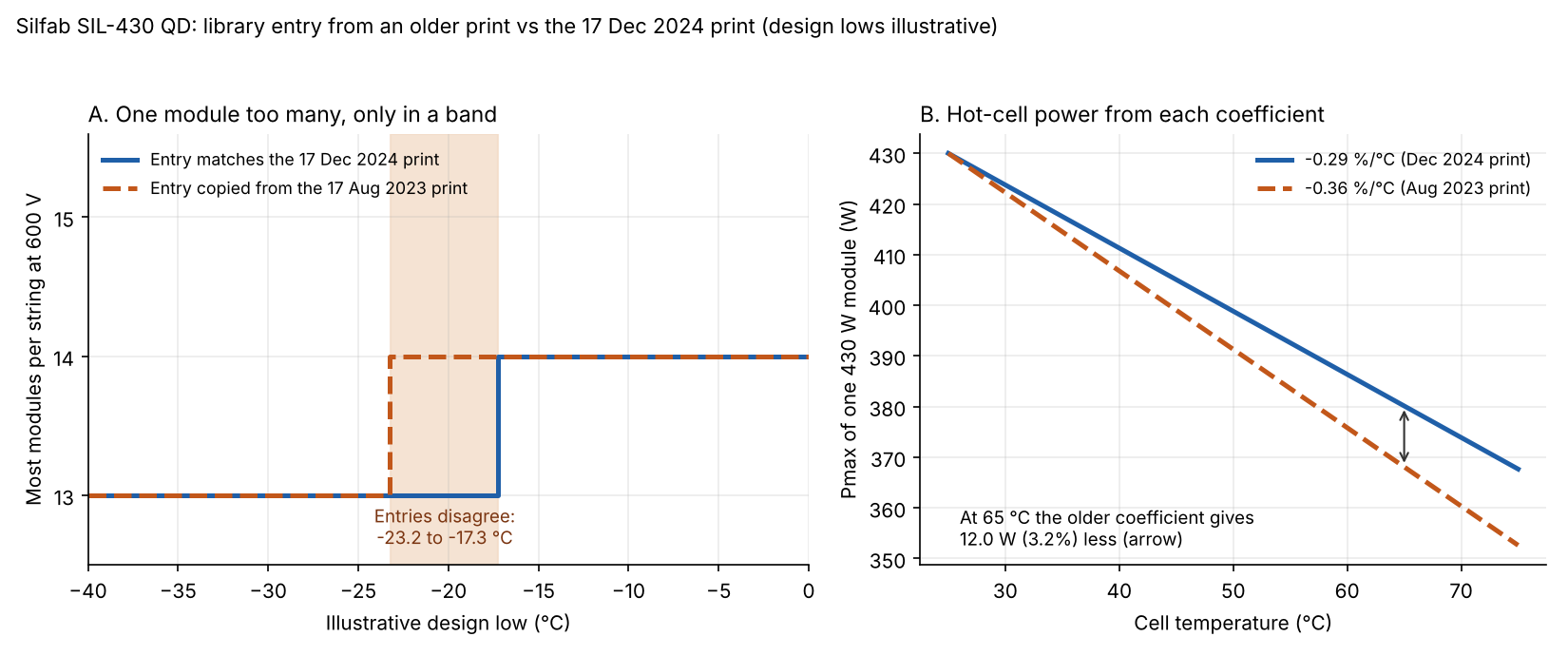
Figure 1. At an illustrative 600 V limit, an entry from the August 2023 print allows one module too many only for design lows from -23.2 to -17.3 °C, and reads 3.2% low at a 65 °C cell.
Datasheet entry checker
Enter the sheet values on the left and your library entry on the right. It flags each field. It also compares string limits. The defaults match the tables here.
How solar software handles datasheet data
HelioScope and SolarAPP+ document a datasheet step. OpenSolar and Solargis partly do, and Aurora Solar’s page names none. Where library values come from, and how a missing model gets added, differs by tool.
| Software | Documents a datasheet step? | Page read |
|---|---|---|
| HelioScope | Yes | Upload New Modules and Inverters, no date shown, read October 2026 |
| OpenSolar | Partly | How to add your hardware components, no date shown |
| Aurora Solar | Not stated | Aurora help article on component availability, no date shown |
| Solargis PV components catalog | Partly | Knowledge-base page, updated 21 October 2026 |
| SolarAPP+ | Yes | Help articles updated 14 May 2024 and 10 October 2025 |
Not stated means the page we read does not say. Partly means the page describes a related step, not the whole check.
- HelioScope: staff enter the values from a spec sheet you email. You can upload PAN files for modules and OND files for inverters. "we manually translate the spec sheet to a format for our HelioScope database". It takes "a few business days".
- OpenSolar: search by manufacturer component code, or create your own component. The team adds it for you. "we strongly recommend sending your component details (spec sheets, warranties, etc.) to our Support Team". No verification step described.
- Aurora Solar: admins enable models. For missing equipment, you fill in a component request form. The page names no datasheet step.
- Solargis PV components catalog: bulk import of module datasheet values. "After submission, the system checks whether each value is within its allowed range". It checks ranges, not your sheet.
- SolarAPP+: needs cut or spec sheets for all equipment. Pulls CEC List data every Sunday. It cannot approve equipment that is not on the CEC list.
For design tools with component libraries and datasheet upload, see the best solar design software list. For the permit side, see the best solar permitting software list.
Common mistakes with datasheets
FAQs
What is the difference between a datasheet, a spec sheet and a cut sheet?
A datasheet, spec sheet and cut sheet are the same manufacturer document, and permit checklists use all three names. SolarAPP+ writes "cut/spec sheets". The Santa Clara plan writes cut sheets on its checklist and specification sheets in its notes.
Which datasheet values set string length?
Voc and its temperature coefficient set the cold limit. Vmp sets the MPPT window. In the example above, a 3.0% Voc error moved the count by one module. That happened over a 5.9 °C band at 600 V (illustrative). See temperature coefficient.
Do permit packages need datasheets for every item?
Usually yes, though rules vary by AHJ. SolarAPP+ says cut or spec sheets are required for all equipment used (help article updated 14 May 2024). The Santa Clara plan names five equipment types. Other AHJs differ, so check your own checklist.
Is the CEC list the same as the datasheet?
No. The CEC page says the module list holds items such as PTC value, nameplate ratings and temperature coefficients. It also says self-reported data is not confirmed. This is a California list. SolarAPP+ says it cannot approve unlisted equipment.
Can I trust a PAN file or a tool library instead of the sheet?
Treat it as a copy and run the same check. Two Anza Renewables authors wrote in Solar Builder (second-quarter 2023 issue) that "PAN files are too often taken at face value". See PAN and OND files.
Related terms
- PAN and OND files: the PVsyst module and inverter files that carry datasheet values into a simulation.
- Voc and Isc: the open-circuit voltage and short-circuit current printed on every module sheet.
- Temperature coefficient: how much a module value changes per degree.
- Permit plan set: the package that attaches the sheets.
- IEC 61215 and IEC 61730: the module qualification and safety standards.
Next step: before the next permit package, load the current sheet into your design tool. To pick a tool, compare design software by library and datasheet upload. To outsource the package, see solar plan set services.
Sources
- Silfab SIL-420/430 QD datasheet, print SIL-420/430-QD-20230817, copy hosted by a retailer (checked October 2026).
- Silfab SIL-420/430 QD, print SIL-420/430-QD-20230905, copy on EnergySage’s file host, and SIL-430 QD, print SIL-430-QD-20241217, copy on the same host (checked October 2026).
- Silfab’s own SIL-430 QD product page and current datasheet, print SIL-430-QD-20260804, reached directly from the maker (checked November 2026). Values match the December 2024 print used in the worked example.
- SMA, Sunny Boy 5.0 / 6.0 technical data, no date printed (checked October 2026).
- City of Santa Clara, expedited solar PV permitting, central string inverter system, footer "Revised 07-2023" (checked October 2026).
- SolarAPP+ help: cut and spec sheets (updated 14 May 2024) and the CEC list (last updated 10 October 2025).
- California Energy Commission, Solar Equipment Lists (checked October 2026).
- Company help pages: HelioScope, OpenSolar, Aurora Solar and Solargis (checked October 2026).
- Solar Builder, how to evaluate solar module PAN files (second-quarter 2023 issue per the article, no day printed, checked 30 October 2026).
Last updated 30 October 2026. Next scheduled review: 30 January 2027.