Key takeaways
- ServiceM8 sells both. Its free plan allows 1 user and 30 new quotes and work orders a month, plus bonus credits for card payments. Its 14-day trial is separate.
- Trials end in different ways. PVsyst falls back to Demo mode after 30 days and HubSpot returns to its previous plan after 14. Bigin moves you to Free after 15 and OpenSolar API Access turns paid after 30.
- Free does not always mean no end date. Archelios PRO Free lists "Licence validity: 1 year". OpenSolar says its core platform "will always be free".
- On example inputs, an 8-job test needs a 16-day trial. A 14-day and a 15-day trial fall short, and a 30-day trial fits.
- On example inputs, 18 jobs a month growing 8% a month passes a 30-job allowance in month 7, before bonus credits.
To find solar tools with a free plan or trial, see the best free solar software.
Free plan vs free trial at a glance
A free plan limits what you can do. A free trial limits how long you can do it. One article defines free plans as a "free forever" tier and free trials as "time- or resource-limited".
| Item | Free plan | Free trial |
|---|---|---|
| What limits you | Users, jobs per month, kWp or features | Days, and sometimes features |
| End date | None stated by most pages below. One lists a 1-year licence | Fixed: 14, 15 or 30 days on the pages below |
| What happens next | You stay, or hit a cap and upgrade | Varies: reduced mode, previous plan or automatic paid |
| Credit card | HubSpot: not required | ServiceM8 and Bigin: not required. PVsyst: not stated |
| Best test of | Daily use at small volume | A full workflow on real jobs |
The plan and trial definitions here are this site’s own wording. Only the quoted "free forever" and "time- or resource-limited" labels come from Inventiv’s 29 March 2018 article, written for sellers. The other cells come from the company pages in the software table.
Why does the difference matter for installers?
It decides what you can learn before you pay. A trial can test the full tool but runs out. A free plan keeps running but may hide the features you need.
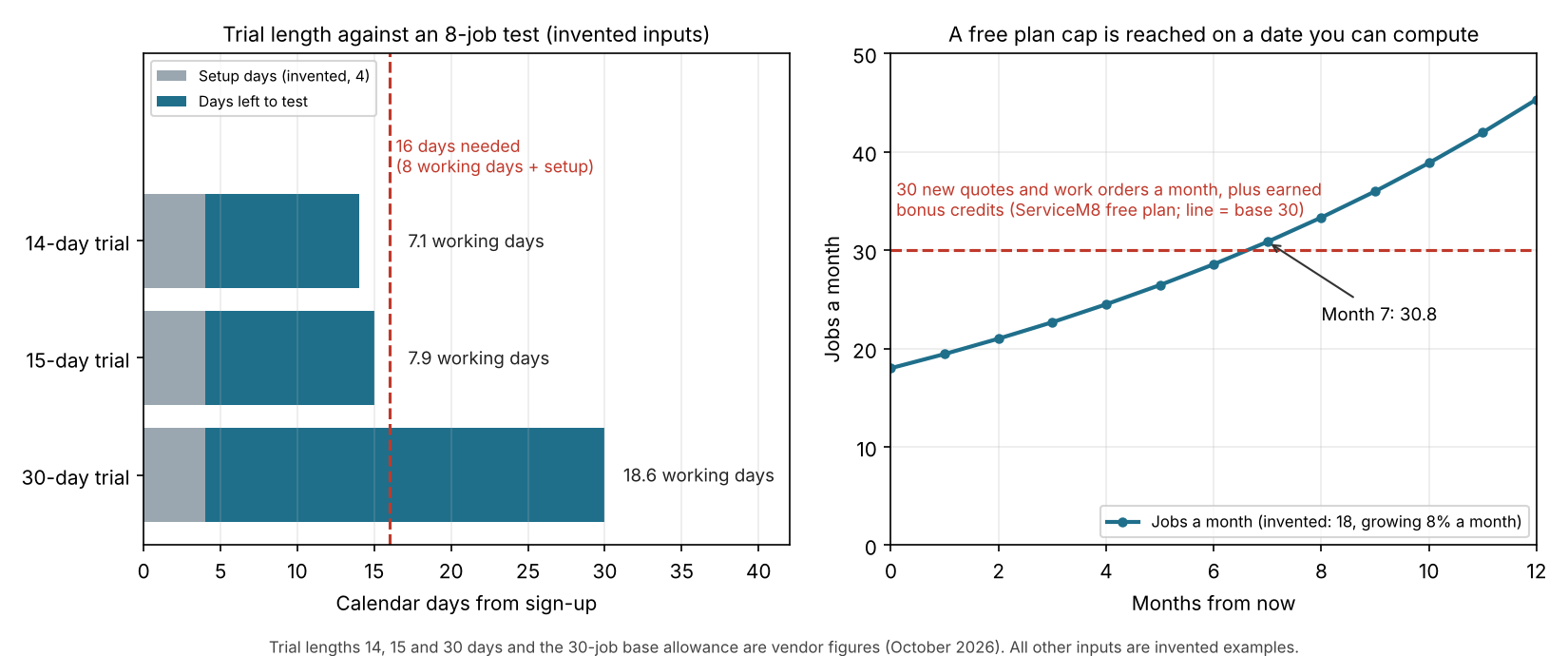
Figure 1. On example inputs, a 14-day trial leaves 7.1 working days against the 8 needed. A 30-job monthly allowance is passed in month 7.
What happens when a free trial ends?
Each company handles it differently. Four outcomes appear on the pages read, and one company’s pages state none.
- Reduced mode. PVsyst runs for "30 days" after a fresh install with "full features except for the usage of components limited to generic ones". Then it switches to Demo mode, "removing most capacities".
- Back to the previous plan. HubSpot’s subscription help page says "Trials will automatically end after 14 days". The account "returns to your previous plan", and you are not charged automatically when it ends.
- Automatic paid. OpenSolar’s help page says an API Access trial lasts 30 days, then the organisation will "automatically transition to the paid version". New projects are blocked if the wallet lacks funds.
- Back to the Free plan. Bigin’s pricing page offers a "15-day free trial". Its FAQ says you will not be charged automatically and will be moved to the Free plan.
- Not stated. ServiceM8’s pricing and free-plan pages offer a 14-day trial but do not say what follows.
A free plan can end too. The archelios PRO Free page lists "Licence validity: 1 year" and does not call it a trial. Its page body states a 9 kWp size limit.
How do you test whether a trial is long enough?
Count the days left after setup, turn them into working days, then into test jobs. If the total is below the jobs you need, the trial is too short. The test jobs needed are our rule, not a standard.
- Estimate setup days: account, data import, templates and training.
- Subtract them from the trial length to get days left.
- Working days = days left × working days per week ÷ 7.
- Test jobs = working days × jobs you can run per working day.
- Compare with the jobs you need to cover each job type you sell.
- Shortest trial = needed jobs ÷ jobs per day × 7 ÷ working days per week + setup days, rounded up.
Example inputs, example: 4 setup days, 5 working days a week, 1 test job per working day, 8 test jobs needed. The shortest trial is 8 × 7 ÷ 5 + 4 = 15.2, so 16 days.
| Trial (length as a company lists it) | Days left | Working days | Test jobs | Result on example inputs |
|---|---|---|---|---|
| 14 days (ServiceM8, HubSpot) | 10 | 7.14 | 7.14 | Short by 0.86 |
| 15 days (Bigin) | 11 | 7.86 | 7.86 | Short by 0.14 |
| 16 days (shortest that fits) | 12 | 8.57 | 8.57 | Enough |
| 30 days (PVsyst, OpenSolar API Access) | 26 | 18.57 | 18.57 | Enough |
The numbers use average working days and ignore holidays. With 2 setup days instead of 4, the 14-day trial gives 8.57 test jobs and passes. Change the inputs in the calculator below.
How do you test when a free plan cap will bite?
Apply your growth to your current volume and find the first month that passes the cap. Volume in month n = current volume × (1 + growth)^n. The cap bites in the first month where that exceeds the plan limit.
ServiceM8’s free-plan page says "Create up to 30 new Quotes & Work Orders each month, or earn unlimited jobs". ServiceM8 also gives a bonus job credit for each card payment taken through it and Stripe. After the credits run out, the page says you can "work as normal for another 7 days". Then the credits reset if your plan resets, or you are prompted to upgrade. The table treats 30 as the base allowance, before bonus credits and the 7 days. Starting volume 18 and growth 8% a month are example.
| Months from now | Jobs a month (example growth) | Against a cap of 30 |
|---|---|---|
| 0 | 18.0 | Under |
| 3 | 22.7 | Under |
| 6 | 28.6 | Under |
| 7 | 30.8 | Over |
| 8 | 33.3 | Over |
| 12 | 45.3 | Over |
Each cap counts a different unit. ServiceM8 counts new quotes and work orders. Bigin counts records, and HubSpot’s free Sales Hub caps users, templates and dashboards. Archelios caps project size in kWp. One number does not fit all of them.
Free trial and free plan cap calculator
Enter trial length, setup days and test jobs, then your cap and growth. It reproduces the two tables above.
Not showing? Open the trial and cap calculator on its own page. It warns on blank, negative, out-of-range or ambiguous numbers such as 1.000.
How solar software handles free plans and free trials
The pages differ most on how a trial ends: PVsyst falls back to Demo mode, HubSpot returns to a previous plan, and one company does not say. Pages were checked October 2026. HubSpot, ServiceM8 and Bigin are general business tools, listed because their pages state both offers.
| Tool | Free plan documented? | Free trial documented? |
|---|---|---|
| ServiceM8 (general business tool) | Yes | Yes |
| HubSpot Sales Hub (general business tool) | Yes | Partly |
| PVsyst | Partly (Demo mode after the 30-day trial) | Yes |
| OpenSolar | Yes | Yes, API Access only |
| archelios PRO Free | Yes, with a 1-year licence | Not stated |
| Bigin by Zoho CRM (general business tool) | Yes | Yes |
Not stated: the page read does not mention it. Partly: a help page names the trial but the pricing page does not, or the offer is a reduced mode, not a plan. What each page says:
- ServiceM8: Free: 1 user and 30 new quotes and work orders a month. It adds earned bonus credits and 7 extra days over the credits. AI helpers up to 10 times a day. Trial: 14 days, full access. Pages read: ServiceM8 pricing and free-plan pages (US). No date printed. The free-plan footer reads 2024.
- HubSpot Sales Hub: Free for up to 2 users, no card, 3 email templates, 10 dashboards. The pricing page names no trial. The help page gives 14 days for trials. Pages read: Sales Hub pricing page, no date printed. Subscription help page, updated 28 September 2026.
- PVsyst: 30 days, full features except generic components only, watermarked reports. Then Demo mode, "removing most capacities". Pages read: PVsyst licensing and evaluation-mode help pages, no date or version printed.
- OpenSolar: Core "will always be free". No limits listed. API Access: 30-day trial, charges from 16 April 2026 through a wallet. Pages read: Free page, modified 7 May 2026. Post, 16 February 2026. Support article, no date shown.
- archelios PRO Free: Free for designs up to 9 kWp, which the page body states several times. Licence validity 1 year. The page does not call it a trial. Pages read: Trace Software page, last modified 1 October 2025.
- Bigin by Zoho CRM: Free: 1 user, 1 pipeline, 500 records, 3 automations. Trial: 15 days, no card, then moved to Free with no automatic charge. Pages read: Bigin pricing page, no date printed. Sign-up and calculator pages agree on the 15 days.
Design tools with a free plan are in the best free solar design software. Proposal tools are in the best free solar proposal software list. A free price is not an open licence. See open-source solar software.
Common mistakes with free plans and free trials
FAQs
What is the main difference between a free plan and a free trial?
A free plan keeps running but limits what you can use. A free trial gives wider access for a set time. ServiceM8 offers both: a free plan of 1 user and 30 jobs a month, and a separate 14-day trial.
Does a free trial need a credit card?
Often not. Bigin’s pricing page says no card is requested for its 15-day trial, and ServiceM8 says the same for its 14-day trial. The PVsyst pages read do not mention a card.
What happens when a free trial ends?
It ends in different ways by company. PVsyst falls back to Demo mode. HubSpot returns to the previous plan. Bigin moves you to its Free plan, and OpenSolar’s API Access moves to paid. One company’s pages do not say.
Is a free plan really free forever?
Only if the company says so. OpenSolar says its core platform "will always be free". HubSpot’s pricing page states no time limit either way. Archelios lists a 1-year licence for its free version.
How long should a software trial be?
Long enough for your setup days plus the jobs you need to test. The pages read show 14, 15 and 30 days, and none sets a standard. On our example inputs, 8 test jobs need 16 days. Work out your own number with the calculator above.
Related terms
- Per-seat pricing: a charge per user, often the step after a free stage.
- Per-project pricing: a fee for each design or project.
- Onboarding and implementation: the setup work that uses up trial days.
- Credits in solar software pricing: prepaid units some companies sell for design and report runs.
Next step: write down your setup days and test jobs, then shortlist tools from the best free solar software.
Sources
- Inventiv: Should you offer a free plan or a free trial?, 29 March 2018, written for sellers (checked October 2026).
- ServiceM8: Pricing and Free plan, no date printed (checked October 2026).
- HubSpot: Sales Software Pricing, no date printed, and Manage your HubSpot subscription, last updated 28 September 2026 (checked October 2026).
- PVsyst: Licensing and Evaluation mode, no date or version printed (checked October 2026).
- OpenSolar: Is OpenSolar really free?, modified 7 May 2026. OpenSolar stays free, 16 February 2026. API Access trial details, no date shown (checked October 2026).
- Trace Software: archelios PRO Free, last modified 1 October 2025 (checked October 2026).
- Bigin: Pricing, sign-up and subscription calculator, no date printed (checked October 2026).
Last updated 30 October 2026. Next scheduled review: 30 January 2027.