Key takeaways
- Aurora Basic, for example, lists USD 135 per user per month on annual billing, with 50 projects a month. The page does not say whether that is per seat. We read it that way.
- On that reading, one seat at USD 135 a month costs USD 13.50 per project at 10 projects a month and USD 2.70 at 50.
- Break-even projects per month equal seats times seat price, divided by the per-project fee. Four seats at USD 135 against an example USD 25 fee break even at 21.6 projects.
- Companies differ. Solargraf bundles users and projects, Enerflo says it charges no per-seat fee, and OpenSolar lists a free core app.
- No solar company page cited here documents concurrent-user licences, so confirm them with the company before you assume them.
To shortlist design tools before you compare seat prices, see the best solar design software.
Per-seat pricing at a glance
| Item | Detail |
|---|---|
| Formula | Monthly cost = billed seats × seat price. Cost per project = monthly cost ÷ projects. |
| Price range on company pages | Design seats: USD 135 to 259 per user per month (Aurora, HelioScope). CRM seats: USD 25 to 550 (Salesforce). Checked October 2026. |
| Where it matters | Choosing a design tool, adding staff, and comparing a company quote with a per-project fee. |
| Standard or rule | No standard. Each company sets its own seat, allowance and billing terms. |
| Per-project alternative | See per-project pricing. |
Why per-seat pricing matters for installers
Seat pricing makes software a fixed monthly cost that rises with headcount, not with sales. That suits a steady team and hurts a team with a few busy months.
One USD 135 seat costs USD 13.50 a project at 10 projects a month and USD 2.70 at 50. A four-seat team at 10 projects a month pays USD 54. A quote that looks cheap per user can be dear per project when volume is low.
Seat terms also change how you hire. If each new designer or sales rep needs a paid seat, adding staff adds a software cost on top of a salary.
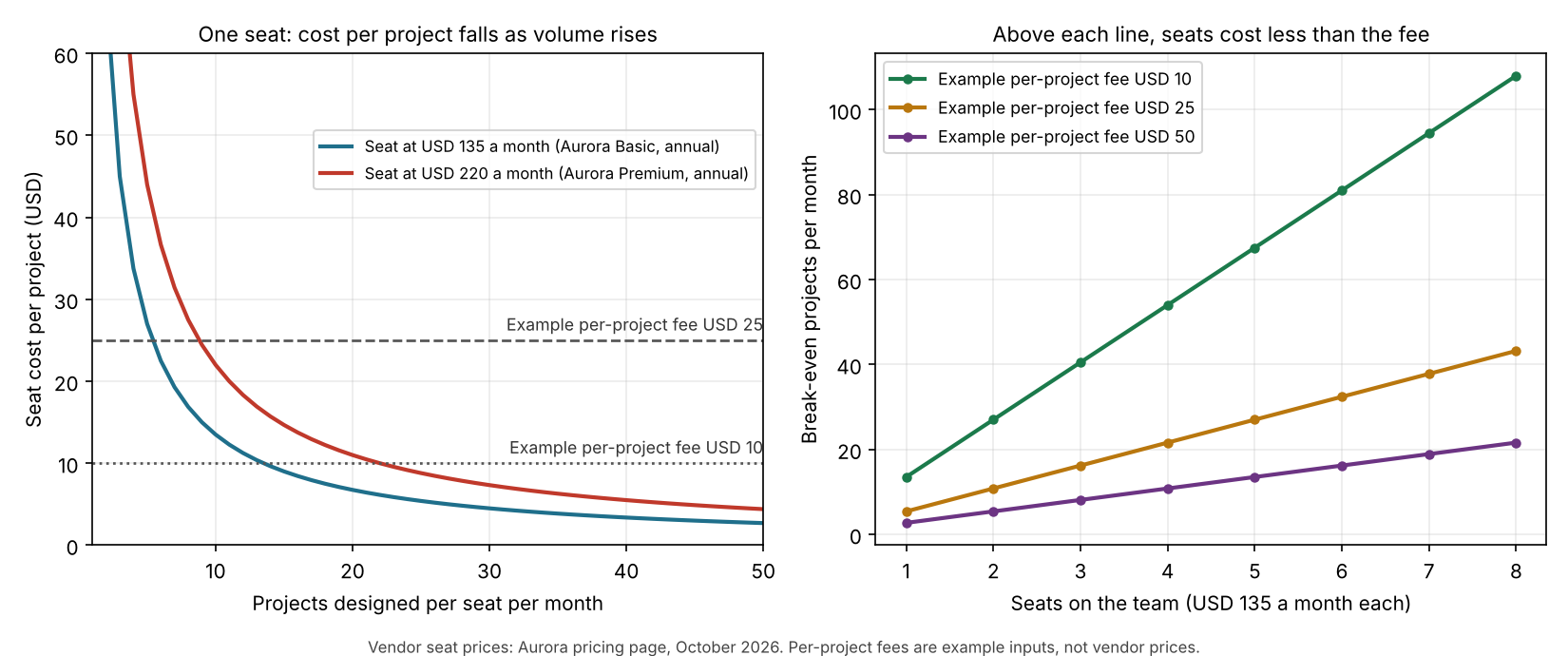
Figure 1. A USD 135 seat beats an example USD 25 fee above 5.4 projects a month. Four seats need 21.6.
How does per-seat pricing work?
You pay for each user account, usually every month or year, and the price depends on the plan tier. The plan sets what the seat includes, such as a project allowance.
- Named users: every person who logs in needs their own licence, used often or not (Inflectra, Dundas). The Aurora and HelioScope pages list their seats as "1 user".
- Concurrent users: a shared pool caps how many people use the tool at once. A seat returns to the pool at logout (Dundas). Teams in different time zones or with occasional users can need fewer seats (Inflectra). Both explainers come from other software sectors. The solar company pages cited do not document concurrent licences.
- Minimum seats: the Aurora pricing page states no minimum seat count. Solargraf starts at 2 users in its Starter plan, because the plan includes them.
- Annual vs monthly: Aurora Basic and Premium monthly plans have no minimum commitment. Annual plans carry a one-year commitment. Annual billing saves USD 288 a year on Basic and USD 468 on Premium.
- Allowances: a seat can cap projects. Aurora lists 50 projects a month with 1 user. HelioScope lists 10 projects a month, or 120 a year, with 1 user.
- Enterprise tiers: Aurora and HelioScope list Enterprise as custom per-project pricing with unlimited users. Seats stop being the unit. Both are quote only.
How to calculate the per-seat break-even
The break-even is the monthly volume at which seats and a per-project fee cost the same. Above it, seats cost less.
- Write the seat price per month, using the annual price if you will commit for a year.
- Multiply by the seats you must buy, including any company minimum.
- Divide that monthly cost by the per-project fee. The result is the break-even projects per month.
- Compare it with your real volume. Use the lowest typical month, not the best one.
- Check the allowance. If your volume is above it, add the company’s extra-project price to the seat cost.
Worked example: a four-seat design team
A team of four designers uses Aurora Basic on annual billing at USD 135 per seat per month. That is USD 540 a month. The table compares it with three example per-project fees, which are not company prices.
| Projects a month | Seat cost per project | Cheaper at USD 10 a project? | Cheaper at USD 25? | Cheaper at USD 50? |
|---|---|---|---|---|
| 10 | USD 54.00 | Per-project | Per-project | Per-project |
| 20 | USD 27.00 | Per-project | Per-project | Seats |
| 40 | USD 13.50 | Per-project | Seats | Seats |
| 80 | USD 6.75 | Seats | Seats | Seats |
At 80 projects the seats cost USD 540 a month. The same volume at USD 25 a project costs USD 2,000. At 10 projects the position reverses: USD 540 for seats against USD 250.
The project allowance matters as much as the seat price. HelioScope Basic is also USD 1,620 a year but allows 120 projects. At full use that is USD 13.50 a project. Aurora Basic at 50 a month costs USD 2.70, so the allowance changes the real rate by a factor of five. Here we read Aurora’s 50 projects as per seat.
Concurrent licences change how many seats you buy, not the unit price. Illustration only, not a company offer: at the same unit price, three concurrent seats would cost USD 405 against USD 810 for six named.
Per-seat vs per-project calculator
Enter your seat price, seats, volume and a per-project fee from a real quote. The calculator shows the monthly cost of each model and the break-even volume.
How solar software handles per-seat pricing
In October 2026, Aurora, HelioScope, Solargraf and Salesforce priced by seat or bundle on their pages, and Enerflo and OpenSolar did not. The same seat price can mean a very different cost per project, depending on the allowance.
| Software | Pricing unit on the page | Price shown |
|---|---|---|
| Aurora Solar | Per user per month | Basic USD 159 monthly, USD 135 annual. Premium USD 259 monthly, USD 220 annual. Enterprise: quote only. |
| HelioScope | Per licence | Basic USD 159 monthly, USD 1,620 yearly. Pro USD 259 monthly, USD 2,640 yearly. Enterprise: quote only. |
| Solargraf | Annual plan with included users and projects | USD 2,799, 4,799, 6,399 and 12,999 a year. Extra project USD 11, 10 or 9. Extra user USD 1,440, 1,200 or 960. Public API USD 4,000 a year below Enterprise. |
| OpenSolar | Core app free. API access and accounting connectors paid | Core app free. API and connector prices: Not stated. |
| Enerflo | Flat monthly subscription by average monthly volume | Quote only. |
| Salesforce Sales Cloud | Per user per month (a CRM seat) | Starter USD 25, Pro USD 100, Core USD 195, Advanced USD 395. Max: USD 550, billed annually. |
Seat terms and billing terms by company:
- Aurora Solar: Basic and Premium list 1 user and 50 projects a month. Extra licences: price not shown. Enterprise: unlimited users. Billing is monthly with no minimum commitment, or annual with a one-year commitment.
- HelioScope: Basic and Pro list 1 user and 10 projects a month. Enterprise: unlimited users. Billing is monthly or yearly for Basic and Pro. Enterprise terms are not listed.
- Solargraf: Starter 2 users and 240 projects. Small Business 4 and 480. Teams 6 and 720. Enterprise: unlimited users and 1,500 projects. Billed annually.
- OpenSolar: user limits are not stated on the pages cited. Connectors are billed as a monthly fee per organisation. API access is billed through a wallet from 16 April 2026.
- Enerflo: its FAQ says no charge per seat, design, proposal, contract or job. New partners get a 12-month minimum, plus a one-time implementation fee.
- Salesforce Sales Cloud: five paid editions. Starter is billed monthly or annually. Pro, Core, Advanced and Max are billed annually.
Not stated: the company page we cite does not say. Solargraf’s page does not say whether its allowances or its extra-user and extra-project prices are yearly. The page labels each plan price "annually" and the public API "annually", but gives no period for the extra-user and extra-project prices. We read them as yearly because the extra-project fees sit near each plan’s price per project (USD 11.66, 10.00 and 8.89).
Salesforce is a CRM example, not a design tool, and its page says prices are for information only and may change.
Common mistakes with per-seat pricing
FAQs
What is the difference between named and concurrent users?
A named user has a licence tied to one person, used or not. A concurrent licence caps how many people can be logged in together. Seats return to a pool at logout. The solar company pages cited list named seats only.
Is per-seat or per-project pricing cheaper?
Seats cost less above the break-even volume, and per-project fees cost less below it. With one USD 135 seat and an example USD 10 fee, the break-even is 13.5 projects a month, and it rises with every added seat. Use the steps above or the calculator with a fee from a real quote.
Does annual billing save money?
On the company pages cited, yes. Aurora Basic is USD 159 monthly or USD 135 on annual billing, a saving of USD 288 a year. HelioScope states a 15% discount for yearly billing. The trade-off is a one-year commitment on Aurora annual plans.
Is there a minimum number of seats?
The Aurora pricing page states no minimum. Solargraf sells bundles that start with 2 users. Enerflo has no seat fee but asks for a 12-month minimum contract. Confirm minimums in writing before you sign.
Does a flat-rate or free plan avoid seat costs?
It can. Enerflo says it charges no per-seat fee, and OpenSolar lists a free core app. Both can still charge elsewhere. Enerflo has an implementation fee. OpenSolar charges for API access and accounting connectors.
Related terms
- Per-project pricing: a fee for each design or project, with no seat charge.
- Quote-only pricing: a price you can only get by asking the company.
- User roles and permissions: settings that control what each seat can do.
- Solar CRM: sales software that is often priced per user.
- Credits in solar software pricing: prepaid units some companies sell for design and report runs.
- SaaS: software you rent and use in a browser or app.
Next step: to weigh a seat quote against other options, compare the best solar design software or the best free solar design software.
Sources
- Aurora Solar pricing page (checked October 2026).
- HelioScope pricing page (checked October 2026).
- Solargraf pricing page (checked October 2026).
- Enerflo FAQ (checked October 2026).
- Salesforce Sales Cloud pricing page, US (checked October 2026).
- OpenSolar: "OpenSolar Stays Free. Pay Only for API Access and App Connectors" (checked October 2026).
- Dundas: Concurrent vs. Named Users and Inflectra: The Value of Concurrent User Licensing (checked October 2026). Both are software-company explainers from other sectors.
Last updated 30 October 2026. Next scheduled review: 30 January 2027.