Key takeaways
- MIS 3002, the MCS standard for solar PV, covers systems up to 50 kWp DC (Issue 1.0, 1 January 2025).
- The pre-sale estimate is annual AC output (kWh) = kWp x Kk x SF, from MCS 032:2025 Issue 1.0.
- Invented example: 5.28 kWp, an example Kk of 850 and SF 1.00 give 4,488 kWh. With SF 0.92 the same system gives 4,129 kWh, so output moves in direct proportion to SF.
- MCS’s new installer scheme (page modified 16 October 2026) drops mandatory Consumer Code membership and has a 30-day certificate window.
- Installers move across in phases. NAPIT’s FAQ gives a March 2027 deadline, and MCS’s own page gives none.
To produce an MCS-style estimate in UK design software, see the best solar design software in the UK.
MCS certification at a glance
MCS certifies small renewable products, installers and systems in the UK. A certification body checks each installer. The installer then registers each job.
| Item | Detail |
|---|---|
| Who runs it | MCS is a trading name of The MCS Service Company Ltd (MCS homepage, modified 26 May 2026). |
| Solar PV scope | MIS 3002 Issue 1.0 covers supply, design, install, set-to-work and commissioning of grid-parallel PV on permanent buildings, up to 50 kWp DC. |
| Estimate formula | Annual AC output (kWh) = kWp x Kk x SF, where Kk comes from MCS tables (MCS 032:2025 Issue 1.0, check the current issue in the MCS library). |
| Where it matters | Export payments, other schemes that ask for MCS, customer paperwork and DNO notice. |
| In software | Design tools can make the MCS estimate table. Each tool states its own scope, so read the help page. |
Why does MCS certification matter for installers?
It decides which payments and schemes your customer can get. MCS says its mark "is a requirement for accessing many UK government incentives" (MCS consumer page, modified 23 June 2026).
For export payments, MCS lists two conditions (installer page, modified 17 August 2026). The system must be MCS certified. A smart meter must record exports. Ofgem’s guidance (December 2019) says PV of 50 kW or less needs a certified system and a certified installer. Other schemes may count as equal to MCS. Ofgem also asks for an export meter that can take half-hourly readings and an export MPAN. See Smart Export Guarantee.
MCS also touches the grid step. MIS 3002 Issue 1.0 says the MCS contractor sends the DNO notice, using G98 or G99. See DNO, G98 and G99 for the routes.
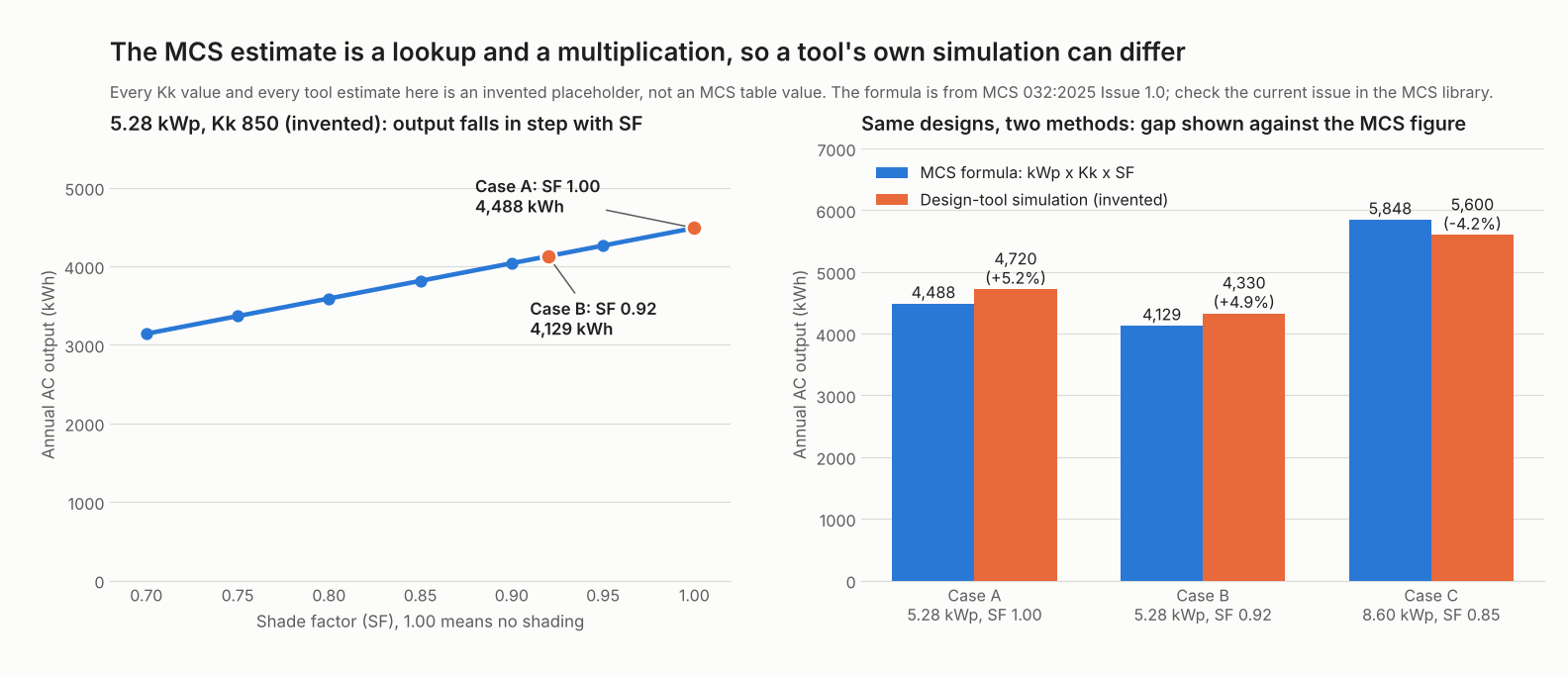
Figure 1. In the example cases the MCS formula output falls in step with shade factor. In these cases the example tool figure sits 4.2% to 5.2% either side of the formula.
How does an installer get MCS certified?
The installer applies to an independent certification body and passes a site check, and signs an Installer Agreement with MCS. MCS’s page (modified 14 October 2026) gives seven steps.
- Read the standards in the MCS library.
- Name a Main Contact, a Licensee and a Technical Supervisor. In a small firm one person can hold all three roles.
- Write down the checks that keep each job compliant.
- Apply to a certification body that covers your technologies.
- Pass the MCS business checks and the body’s assessment. You need at least one fully compliant job per technology.
- Close any non-conformities the body raises.
- Sign the Installer Agreement. You are then set up on the MCS Installations Database.
The page lists eight certification bodies and says their fees vary. It says ongoing cover includes a £30 fee for every job you register.
The scheme is changing. MCS says bodies move installers across in phases, with most moving during 2026. The listed changes are: no mandatory Consumer Code, a risk-based assessment, a 30-day certificate window and a direct Installer Agreement. NAPIT’s FAQ (undated) says its members must move at renewal and by March 2027 at the latest. If not, they will be withdrawn.
What does MCS require of a solar PV design?
MIS 3002 sets design and install rules. Issue 1.0 asks for checks on the building, roof, cables, grid and commissioning. It sets no method for the generation estimate. The clause numbers below match both Issue 1.0 and V2.0 in the PDFs on MCS’s site (details after the list).
- Building and roof: a competent person assesses the building (clause 3.1.2) and checks the roof structure (3.9.3). You need a structural engineer for odd roofs or any doubt (3.9.5).
- Cables: size AC cables to cut voltage drop as far as is reasonably practicable (3.6.8). The note suggests about 1% for typical homes.
- Grid: the MCS contractor sends the DNO notice (3.1.6).
- Handover: commissioning follows a written procedure (4.1.1). Appendix C has a model handover document that includes a PV System Verification Certificate. It has a field for estimated performance. See commissioning and handover pack.
We first took the clause numbers from Issue 1.0 (1 January 2025), then re-read the same clauses in the V2.0 PDF on 30 October 2026. The numbers and wording matched. At the time of checking, MCS’s library also listed V6.0 (current scheme) and MIS 3002:2025 V2.0 (redeveloped scheme), both dated 18 March 2026. MCS’s update page (18 March 2026) said compliance with the redeveloped version would become mandatory for MCS installers certified under MIS 3002 from 18 June 2026, a date that has now passed, so treat it as in force. It describes changes to clause 5.5.5, on mounting systems with no MCS 012 certificate. Your certification body can confirm which version applies to your jobs.
How is the MCS generation estimate calculated?
MCS 032 multiplies the array’s kWp by a Kk value from MCS tables. It then multiplies by a shade factor. The result is annual AC output in kWh. The customer gets it before signing the contract.
- Add the module data plate ratings (Wp at STC) to get kWp.
- Find the postcode region. MCS 032 uses the same zones as SAP.
- Measure tilt to the nearest 1 degree. Measure bearing from due south to the nearest 5 degrees.
- Look up Kk (kWh per kWp a year) in the MCS tables for those inputs.
- Set the shade factor (SF). Use 1.00 for a clear horizon with no near or far shade. Otherwise use the Appendix A method or an equal one.
- Multiply: kWp x Kk x SF.
MCS 032 says the Kk tables come from European Commission JRC data, multiplied by 0.8. The customer must get the result in the Table 5 layout. It carries an Important Note. The note starts: "The performance of solar PV systems is impossible to predict with certainty" and goes on from there.
The minimum papers are the module and inverter datasheets, any storage datasheet and a module layout drawing. Where SF is below 1.00 under the MCS method, add a sunpath diagram. A remote survey needs an extra note that real output may differ. For self-use, MCS 032 points to look-up tables. MGD 003 (Issue 2.0, 27 April 2022) is the guidance behind them.
Other shade methods are allowed if you can show they are equal or better. With proprietary software, SF is output with shade divided by output without. For full models, see energy yield simulation and shading analysis.
Worked example
All three cases are example. The Kk values and the tool estimates are placeholders, not MCS table values. The calculator below gives the same results.
| Case (example) | Modules (kWp) | Kk (example) / SF | MCS-style kWh | Tool kWh (example) / tool vs MCS |
|---|---|---|---|---|
| A | 12 x 440 Wp (5.28) | 850 / 1.00 | 4,488 | 4,720 / +5.2% |
| B | 12 x 440 Wp (5.28) | 850 / 0.92 | 4,129 | 4,330 / +4.9% |
| C | 20 x 430 Wp (8.60) | 800 / 0.85 | 5,848 | 5,600 / -4.2% |
Case B differs from case A only by SF, so its figure is 0.92 of case A’s. The tool gaps are made up. They show how big a gap two methods can give, not a real tool’s error. Figures are rounded to the nearest kWh. To get each gap, take the tool figure minus the MCS-style figure. Then divide by the MCS-style figure.
MCS-style output check
Enter the module count and rating, a Kk from the MCS table and a shade factor. The tool shows the formula result and the gap to your design tool.
Open the MCS-style output calculator on its own page if the frame does not load.
How solar software handles MCS
Aurora and OpenSolar each say they make an MCS estimate, and each falls back to its own method in some cases. "Partly" means the help page covers only part of the job. "Not stated": the company page we cite does not say.
| Software | Produces the MCS estimate? | Source |
|---|---|---|
| Aurora Solar | Yes | Aurora help, "MCS (UK only)", updated 6 October 2026 |
| OpenSolar | Yes | OpenSolar support, "How to use the MCS calculator", undated |
| Easy PV | Partly | Easy PV help, revision 10, no calendar date |
| Payaca | Not stated | Payaca blog, 6 July 2026 |
What each page says:
- Aurora Solar: Adds an MCS table with sections A to E to proposals. Annual output uses capacity, the MCS kWh/kWp value and a shade factor from Aurora’s own shading analysis, not the MCS method. MCS tables cover typical homes only: consumption and production under 6,000 kWh. Outside that, it falls back to the Aurora or PVWatts engine with a warning.
- OpenSolar: Says its MCS calculator "adheres to the official Microgeneration Certification Scheme (MCS) standards" for UK PV performance, for UK-designed systems only. It names MIS 3002 for generation and MGD 003 for self-use, and uses its own method when MCS conditions are not met. OpenSolar does not say which MCS document its output follows.
- Easy PV: A help page comparing MCS and Easy PV self-use says MCS uses look-up tables in MGD 003 with annual totals. The page read does not state how Easy PV makes generation or report figures.
- Payaca: the blog (6 July 2026) does not say it makes an MCS estimate. It says Payaca keeps site evidence, test results and certificates against each job.
To pick a design tool for UK jobs, see the best solar design software in the UK. For a wider suite, see the best solar software in the UK.
Common mistakes with MCS certification
MCS certification rules by region
Every rule on this page is a UK rule. It does not cover devolved grant rules or Northern Ireland grid rules. For Australia, which uses a different system, see small-scale technology certificates.
FAQs
What is MCS certification?
MCS calls itself the UK’s quality mark for small-scale renewable energy technologies. It certifies products, installers and systems. It sets standards such as MIS 3002 for solar PV. A certification body, not MCS, assesses each installer.
Do I need MCS to get Smart Export Guarantee payments?
Usually. MCS lists an MCS certified system as one condition, with a smart meter that records exports as the other. Ofgem’s 2019 guidance also asks for a half-hourly export meter and an export MPAN, and it accepts other schemes as equal. Confirm the terms with the customer’s supplier before you promise payments.
How much does MCS certification cost an installer?
MCS prints one fee: £30 for every job you register (page modified 14 October 2026). Assessment fees differ by certification body, and MCS prints none, so get current fees from your body.
Is Consumer Code membership still required?
Under the new scheme it is not mandatory. The MCS Customer Commitment takes its place. NAPIT’s FAQ says the current scheme still asks for it where it applies. Your certification body can tell you which scheme you are on.
Is the MCS estimate the same as my software’s yield?
No. The MCS figure is a table lookup and a multiplication. A simulation models weather and shade hour by hour. So the two can differ. MCS 032 allows other methods, with conditions. The customer papers still need the MCS layout.
Related terms
- Smart Export Guarantee: pay for exported power.
- DNO, G98 and G99: the grid notice routes.
- Energy yield simulation: the modelled estimate.
- IEC 61215 and IEC 61730: the module qualification and safety standards.
Next step: before your next UK quote, compare which tools in the best solar design software in the UK list make the MCS table.
Sources
Pages read October 2026. Dates are as each page prints them.
- MCS homepage, modified 26 May 2026.
- MIS 3002:2025 Issue 1.0, 1 January 2025.
- MIS 3002:2025 V2.0, March 2026 (checked 30 October 2026).
- MCS 032:2025 Issue 1.0, 1 January 2025.
- MCS standards library, modified 22 May 2026.
- MCS update to MIS 3002, 18 March 2026.
- MCS redeveloped scheme page, modified 16 October 2026.
- MCS becoming certified page, modified 14 October 2026.
- MCS export payments page, modified 17 August 2026.
- MCS consumer page, modified 23 June 2026.
- MCS news on MGD 003, 27 April 2022.
- Ofgem SEG generator guidance, December 2019.
- NAPIT redevelopment FAQs, file named August 2026, no date printed.
- Payaca blog on the new scheme, 6 July 2026.
- Aurora help, MCS (UK only), updated 6 October 2026.
- OpenSolar help, MCS calculator, undated.
- Easy PV help, self-consumption page, revision 10, no calendar date.
Last updated 30 October 2026. Next scheduled review: 30 January 2027.