Key takeaways
- Commissioning is a set of stages, not one test. Our table groups them into six, using three sources. Milestone names differ between US and European contracts.
- A capacity test compares measured power with a model. The contract sets the pass range. A 2014 SunSpec draft only gives an example, so treat it as background.
- In our invented 500 kWdc example, a light sensor that reads 5% high drops a 98.2% result to 93.5%. At an assumed 95% pass level, that is a false fail.
- In the example, at 1,000 W/m² and 40 °C, an 11.6% array shortfall hides behind the 360 kWac cap.
- Commissioning proves day one only. Its record is the baseline for O&M.
To track commissioning checks and punch lists in software, see the best solar commissioning software.
Commissioning at a glance
Commissioning is the bridge from build to operation. It ends with a signed handover and a set of records.
| Item | Detail |
|---|---|
| What it proves | Per Tigo’s glossary, a system is "installed, configured, communicating, and operating as designed" before it is handed over for normal operation. |
| Stages | Six in our table: pre-checks, de-energised tests, energisation, functional checks, performance test, handover. |
| Milestone names | US: Mechanical, Substantial and Final Completion. Europe: Provisional, Intermediate and Final Acceptance (Natural Power). |
| Standard or rule | Tests follow your contract. For IEC 62446-1 test content, see the commissioning report page. |
| In software | Device set-up apps, field and punch-list tools, and test-report tools. Few cover all three. |
Why does commissioning matter for installers?
It is the point where risk and money change hands. Natural Power says milestone payments, or release of retention, are tied to intermediate and final acceptance.
A fault found now costs a visit. A fault found after handover can cost a dispute over who caused it. Your record shows the system met its design on the day you left. It also gives the O&M team readings to compare with later. See alerts and alarms for how that turns into tickets.
What are the stages of commissioning?
No single list fits every contract. This table is our own grouping of stages named by Natural Power, a HeatSpring course outline and the SunSpec draft.
| Stage | What happens | Evidence left behind |
|---|---|---|
| 1. Pre-commissioning | Confirm the build is finished. Inspect visually, review documents, start the punch list. | Inspection notes, open-item list. |
| 2. De-energised tests | Polarity, continuity, insulation resistance and string tests. Natural Power places string-level electrical testing at Mechanical Completion. | Test records. See commissioning report and insulation resistance test. |
| 3. Energisation | Start up in a set order. Utility rules vary. HeatSpring’s outline lists safety, substation, interconnection, protection testing and SCADA. | Utility approval where required. See PTO. |
| 4. Functional checks | Inverters, trackers, monitoring and alarms work as designed. Natural Power places inverter and tracker commissioning at Substantial Completion. | Settings records, SCADA and monitoring screenshots. |
| 5. Performance test | Measured power or energy is compared with an expected value. See the next section. | Test data, the model used, the ratio. |
| 6. Handover and closeout | Close the punch list, supply documents, train the owner. Natural Power says Final Completion requires all punch-list items complete. | As-builts, test files, signed certificate. |
The order is a simplification. Contracts reorder and repeat stages. On large sites, Natural Power says a sample of each component type may be tested. HeatSpring’s outline also lists building a team of owner, lender and equipment company representatives.
Natural Power describes European Provisional Acceptance (PAC) as the point where the system is fully installed, commissioned and connected to the grid. It says Intermediate (IAC) and Final (FAC) acceptance follow "after one and two years of commercial operations, respectively". The IAC ratio test typically considers one full year of operations and the FAC test two full years. For the ratio, see performance ratio.
How does the performance test work?
A performance test compares what the plant makes with what a model says it should make in the same weather. The SunSpec draft calls the short version a capacity test: "The capacity test evaluates the system’s power generating capability."
The SunSpec draft defines its Power Performance Index as measured power divided by expected power. It says the pass range "must be defined by the contract, such as 0.9 to 1.1 allowing 10% tolerance". It says initial commissioning occurs "during 0 to 6 months of operation". This is a 2014 draft. Treat it as background, not a rule.
An NLR (formerly NREL) paper from 2019 says capacity tests such as ASTM E2848 and IEC 61724-2 are widely used in contracts and acceptance testing. Natural Power says both use a regression approach, and that short tests run 3 to 10 days. For less sunny sites it advises setting a test length and minimum light level in the EPC contract. It says a temperature correction may be prudent. ASTM E2848 reports a capacity with an uncertainty, not a pass or fail. It leaves the test conditions to the parties (iTeh sample copy). One public sample contract, Connecticut Green Bank’s Exhibit E, sets a 3% tolerance. It tests the upper confidence bound of measured capacity against the guaranteed capacity. Contracts differ, so read yours.
Pure Power Engineering’s author lists what spoils a test. Examples are sensors not calibrated or aligned, ambient sensors in direct sun (they read high) and clipping. The same author says a test needs at least 50 valid data points. That may take about a week of near-perfect weather. Winter can leave very little usable time.
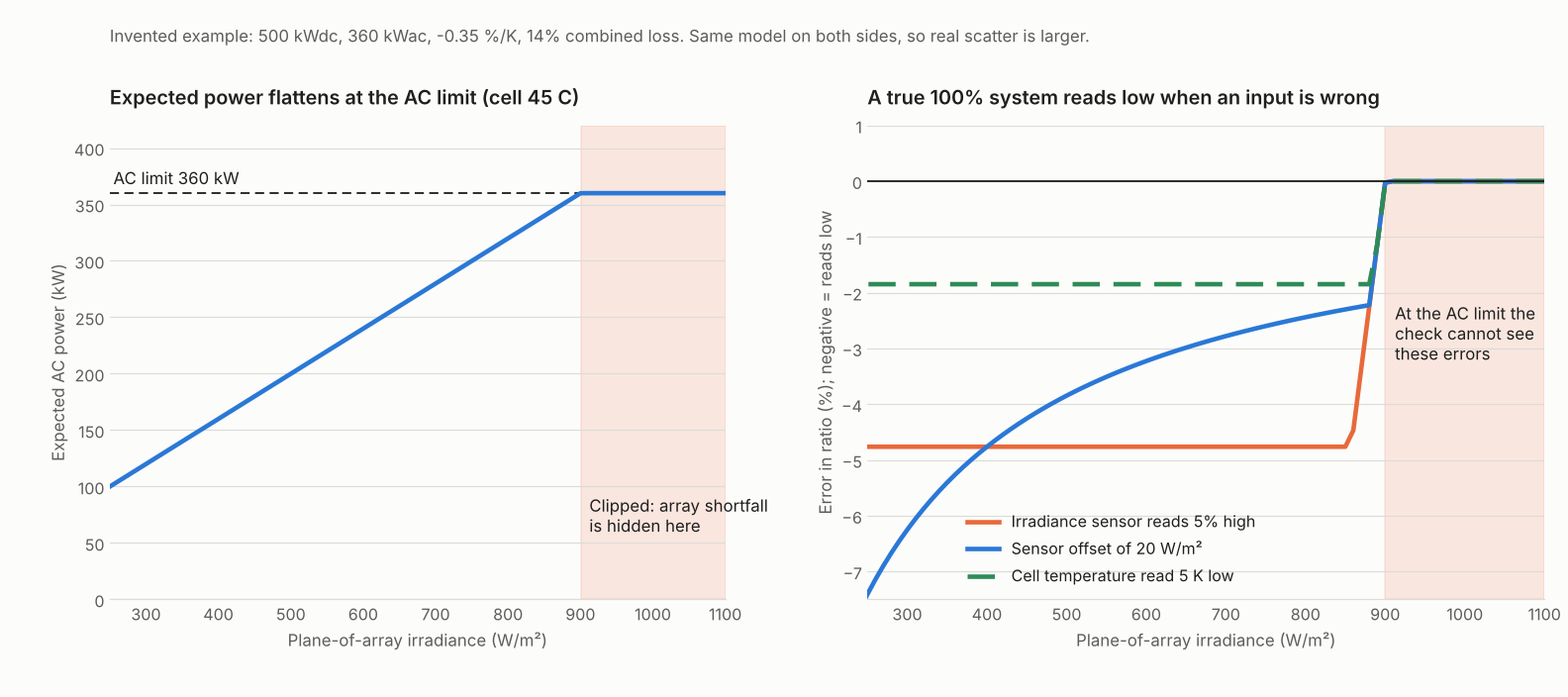
Figure 1. In our example, a sensor or temperature error of a few percent shifts the ratio by as much. Above the AC limit, the check cannot see any of it.
Worked example: a one-point expected power check
Our check scales the DC rating by light and a heat factor and takes off losses. Then it caps the result at the AC limit. It is a sanity check of our own. It is not ASTM E2848 or IEC 61724-2.
All inputs are example placeholders. They are 500 kWdc, 360 kWac (DC to AC ratio 1.39) and -0.35% per K. Losses combine to 14%, and the pass level is 95%. The "measured" readings are example too. Expected power = DC rating × (irradiance ÷ 1000) × temperature factor × (1 - losses), capped at 360 kW. The temperature factor is 1 + coefficient × (cell temperature - 25).
| Case | Irradiance (W/m²). Cell temp (°C) used | Measured. Expected (kW) | Ratio | At 95% |
|---|---|---|---|---|
| A: good day, right inputs | 850. 48 | 330. 336.1 | 98.2% | Pass |
| B: same plant, sensor reads 5% high | 892.5. 48 | 330. 352.9 | 93.5% | Fail |
| C: same plant, ambient 32 °C used as cell temperature | 850. 32 | 330. 356.5 | 92.6% | Fail |
| D: real fault, right inputs | 850. 48 | 300. 336.1 | 89.3% | Fail |
| E: near the AC limit | 1,000. 40 | 358. 360.0 (407.4 before the cap) | 99.4% | Pass |
Cases B and C fail, yet the plant is the same as in case A. Only the inputs changed. Case D is a true fault, and the ratio alone cannot tell it from B or C. Check the sensors first. SunSpec’s example range of 0.9 to 1.1 would pass B and C but fail D.
In case E the array could be 11.6% under expectation and still read about 100%. The inverter limit caps the output. Pure Power Engineering says an inverter that limits power for over half the day points to a high DC to AC ratio. See inverter clipping and DC to AC ratio.
Smaller effects use 45 °C and the same placeholders. A fixed sensor offset of 20 W/m² (our placeholder) moves the ratio by 3.8% at 500 W/m². At 850 W/m² it moves it by 2.3%. A cell temperature read 5 K low moves it by 1.8%. Both sides use one model, so real scatter would be larger.
Check your own reading
Run the commissioning check calculator to repeat the table with your own inputs. Enter the measured power, irradiance, cell temperature, DC and AC ratings, losses and pass level. It rejects blank, zero and out-of-range entries. It warns when the reading is at the AC limit or in weak light.
How solar software handles commissioning
None of the four tools covers all three commissioning jobs: device set-up, punch lists and test reports. Rows come from company pages read in October 2026, and none is dated. Not stated: the company page we cite does not say.
| Software | Device set-up and checks | Punch list and closeout | IEC 62446-1 test report |
|---|---|---|---|
| Enphase (Installer Toolkit) | Yes | Not stated | Not stated |
| Tigo EI | Yes | Not stated | Not stated |
| Sitemark | Not stated | Yes | Not stated |
| Fluke TruTest Solar | Not stated | Not stated | Yes |
What each page says:
- Enphase (Installer Toolkit): Its commissioning page lists serial-number scanning, metering set-up and "Run an IQ Gateway summary report". It calls the app the Enphase Installer App. The table label uses the older Installer Toolkit name. Page undated.
- Tigo EI: Tigo calls EI a commissioning and monitoring platform with bulk scanning of TS4 units. "System commissioning tracking" is listed for EI Professional, with no detail. Page undated.
- Sitemark: Digital punch lists "closed before handover", as-built reports and closeout packages. Names no electrical tests. Page undated.
- Fluke TruTest Solar: Creates PV inspection reports "compliant with IEC 62446-1". Downloads SMFT-1000 data. Only a footer year (2026) on the page.
None of these rows covers the stage 5 test. No company page read covers a one-point check like ours. SolarEdge’s commissioning app is not rated here. For ranked tools, see the best solar commissioning software. For project tracking, see the best solar EPC project management software.
Common mistakes with commissioning
FAQs
How long does solar commissioning take?
A short capacity test runs 3 to 10 days, per Natural Power. Whole-job time depends on size, and no neutral source for it is cited here. Pure Power’s author says 50 valid data points may need about a week of near-perfect weather.
What is the difference between commissioning and a commissioning report?
Commissioning is the whole process. The report is the written record of the checks and tests. The commissioning report page covers its contents and a Voc and Isc example.
Is commissioning the same as permission to operate?
No. Permission to operate is the utility’s approval to run the system. It is one step in start-up. Rules and timing differ by utility, so check the utility’s own page. See PTO and interconnection application.
Who carries out commissioning?
Natural Power says the EPC contractor typically does the visual and functional tests, at or before provisional or substantial completion. HeatSpring’s outline adds owner, lender and equipment company representatives to the team. The AHJ and utility may have their own steps.
What pass level should a capacity test use?
The contract sets it. The SunSpec draft gives only an example range of 0.9 to 1.1, a 10% tolerance. No source read fixes one level. The 95% in our example is a placeholder.
Related terms
- Commissioning report: the written record of tests at handover.
- I-V curve tracing: a measured curve that shows how a string performs.
- Punch list: the open items to close before final completion.
- Install stage: the on-site build from mounting to commissioning.
Next step: to compare tools for device set-up, punch lists or test reports, see the best solar commissioning software.
Sources
- Natural Power: best practices for commissioning and acceptance . PDF undated. Insight page dated 3 August 2020. Checked October 2026.
- SunSpec Alliance: Commissioning for PV Performance, Draft 1, dated 20 October 2014. Copy hosted by Solmetric. Checked October 2026.
- Tigo: PV system commissioning. Undated. Checked October 2026.
- HeatSpring: course outline, basics of commissioning on utility-scale solar, 17 April 2026. Checked October 2026.
- Pure Power: tips for passing a PV capacity test, 20 October 2022. Checked October 2026.
- NREL: Suggested modifications for bifacial capacity testing, June 2019. Checked October 2026.
- Enphase: getting started, commissioning. Undated. Checked 30 October 2026.
- Connecticut Green Bank: Exhibit E, Performance Testing, a public sample contract exhibit. This link now 404s on both ctgreenbank.com and www.ctgreenbank.com. We corroborated the 3% tolerance and upper-confidence-bound test against search-indexed copies of the same document, checked November 2026. Treat the figure as confirmed in substance but check ctgreenbank.com’s current RFP library for a live copy before citing the exhibit directly.
- ASTM E2848, sample pages hosted by iTeh. Checked 30 October 2026.
- Tigo: monitoring and commissioning. Undated. Checked October 2026.
- Sitemark: solar commissioning. Undated. Checked October 2026.
- Fluke: TruTest Solar. Undated. Checked October 2026.
Last updated 30 October 2026. Next scheduled review: 30 January 2027.