Key takeaways
- STCs = kW × zone rating × deeming years, rounded down. ACIL Allen’s January 2026 report for the CER gives the count as this product.
- This example’s 6.6 kW system is in zone 3 (rating 1.382) and installed in 2026 (5 years). It gives 45.606. That means 45 STCs. The Regulations require rounding down (reg 20(2A)(b)).
- The deeming period falls one year each year. The scheme ends in 2030 (CER, page updated 18 September 2026). The same example system installed in 2027 gets 36 STCs. That is 9 fewer.
- Clearing house pricing is capped at 40 AUD excluding GST. A CER consumer page gives a usual agent price of 33 to 38 AUD.
- These rules are for systems up to 100 kW. Mid-scale solar of 100 kW to 1 MW has other rules from 1 October 2026.
To estimate STCs inside a quote, see the best solar design software in Australia.
STCs at a glance
An STC is created under the Small-scale Renewable Energy Scheme (SRES). Owners often assign it to an agent in return for an upfront discount.
| Item | Detail |
|---|---|
| Formula | System size (kW) × zone rating × deeming period (years). Sources: Regulations reg 20(1)(b) and 19D. ACIL Allen for the CER, January 2026. |
| Unit and range | Zone ratings run from 1.185 to 1.622 (CER, as of 1 January 2020). The deeming period is 5 years for 2026 and 1 year for 2030. |
| Where it matters | Quotes with a point-of-sale discount, retailer cash flow and any job that may finish after 31 December. |
| Rule source | Renewable Energy (Electricity) Regulations 2001, compilation of 1 May 2026, and CER guidance. Australia only. |
| In software | Some Australian tools estimate the count in a quote. Others create and submit certificates. See the software section. |
Why do STCs matter for installers?
For a small system, the STC value can cut the upfront price the customer sees. The CER says a registered agent can give an upfront discount. In exchange, the agent claims the STCs.
That makes the count a quoting risk. The deeming period depends on the installation year. A job that slips from December into January loses a year of deeming. On our example system that is 9 STCs, or 20%.
It is also a cash-flow item. The CER June quarter report page says average clearing house waits increased to more than 4 weeks at the May 2026 peak. By the end of the quarter the average wait had declined to 13 days. See cash flow analysis and capex and opex for how an upfront discount changes project cost.
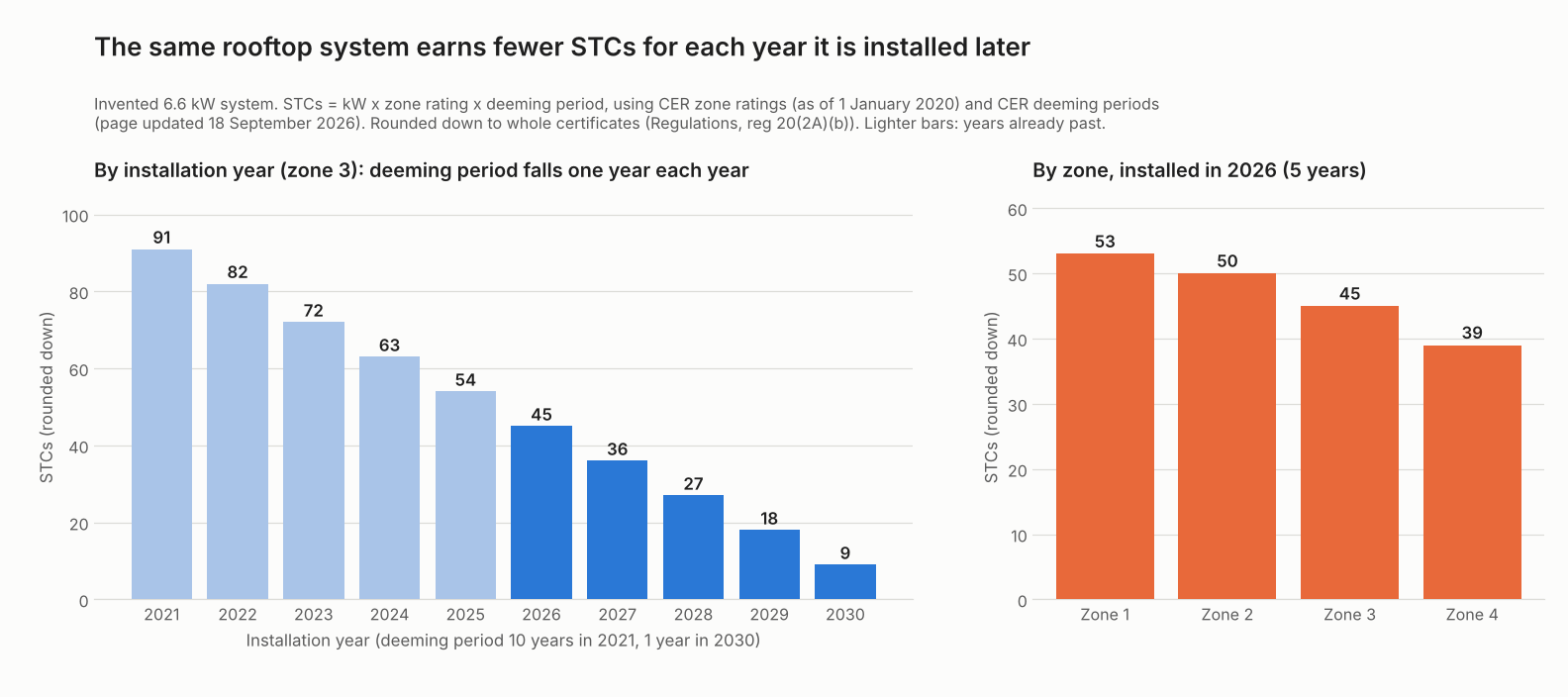
Figure 1. For the same example 6.6 kW system, each later installation year earns fewer STCs, and zone 1 earns more than zone 4.
How are STCs calculated?
The CER lists the inputs. They are system type, capacity in kW, location, installation date and how the certificates are created. ACIL Allen’s January 2026 report for the CER gives the count as a product of three terms: system size in kW, zone rating and deeming period.
- Take the rated output in kW.
- Find the postcode in the CER zone document. Read its zone rating.
- Read the deeming period for the installation year.
- Multiply the three numbers. Round down to a whole certificate (Regulations, reg 20(2A)(b)).
The CER defines the deeming period as an estimate. It counts how many years a system will make renewable energy. It says the period "decreases by one year each year until 2030 when the scheme ends." Zone ratings are CER values as of 1 January 2020. The ACIL Allen report lists the same four values, in MWh per kW.
| Installation year | Deeming period (years) |
|---|---|
| 2026 | 5 |
| 2027 | 4 |
| 2028 | 3 |
| 2029 | 2 |
| 2030 | 1 |
| Zone | Rating | Postcodes the CER document lists as examples |
|---|---|---|
| 1 | 1.622 | 0870 to 0879 |
| 2 | 1.536 | Darwin, 0800 |
| 3 | 1.382 | Sydney 2000, Brisbane 4000, Perth 6000 |
| 4 | 1.185 | Melbourne, 3000 |
The CER says each zone stands for the level of solar radiation in an area. Zones follow postcode ranges. Look up the job postcode, not the city. The CER zone document prints no unit and writes postcodes without the leading zero.
Worked example: a 6.6 kW rooftop system
Our example system has 6.6 kW, sits in zone 3 and is installed in 2026. It creates 45 STCs, from 45.606 before rounding.
| Input | Value |
|---|---|
| System size (example) | 6.6 kW |
| Zone rating (CER, zone 3) | 1.382 |
| Deeming period (CER, 2026) | 5 years |
| Calculation | 6.6 × 1.382 × 5 = 45.606, rounded down to 45 |
The value depends on the price. The three prices below are inputs, not forecasts. The 33 to 38 AUD range comes from the CER consumer page. The 40 AUD figure is the clearing house cap.
| Price per STC (AUD) | Source of the price | Value of 45 STCs (AUD, before GST and fees) |
|---|---|---|
| 33 | Low end of the usual agent price, CER page updated 18 September 2026 | 1,485 |
| 38 | High end of the same range | 1,710 |
| 40 | Clearing house cap, CER page updated 14 September 2026 | 1,800 |
The CER says it does not set the price agents use. The CER June quarter report page (updated 9 September 2026) gives the spot price as 39.85 AUD on both 30 June 2026 and 14 August 2026. That figure appears only in the alt text of its price chart. The report text says only that prices stayed close to the 40 AUD clearing house price. Check the current spot price before you rely on either figure.
Now move the installation year. Hold the zone, size and a price of 38 AUD fixed.
| Installation year | Deeming period (years) | STCs | Value at 38 AUD |
|---|---|---|---|
| 2026 | 5 | 45 | 1,710 |
| 2027 | 4 | 36 | 1,368 |
| 2028 | 3 | 27 | 1,026 |
| 2029 | 2 | 18 | 684 |
| 2030 | 1 | 9 | 342 |
Zone changes the result too. The same 2026 system gets 53, 50, 45 and 39 STCs in zones 1 to 4. These examples use the full deeming period at once. The Regulations also list a "1 or 5 years" creation period for some 2026 installations (reg 19D(2)(a)). Confirm which one applies to the job.
STC calculator
Change the size, zone, year and price. It handles systems up to 100 kW. It is a design aid, not advice.
If the calculator does not load, open the STC calculator on its own page. For a registered figure, use the REC Registry calculator linked from the CER.
Who can create and sell STCs, and how?
A system of up to 100 kW can create STCs. It must be designed and installed by a Solar Accreditation Australia accredited designer and installer. The CER eligibility page was updated 18 September 2026.
- Install the system. The CER says it must meet the SAA design and install guidelines.
- Create the STCs in the REC Registry within 12 months of installation. The owner can do this unless they have assigned the right to an agent.
- Sell them on the open market or through the clearing house.
Clearing house pricing is capped at 40 AUD, excluding GST. A transfer list holds certificates until a buyer is available. Anyone with a registered person or registered agent account can trade (CER, updated 14 September 2026).
Mid-scale solar of 100 kW to 1 MW, installed from 1 October 2026, gets a fixed 5-year deeming period. It may choose REGO certificates instead (CER, updated 7 October 2026). The CER page gives no formula yet. Home batteries create STCs under a separate calculation. This page does not cover it.
How solar software handles STCs
STC handling splits into two jobs: estimating the count in a quote, and creating and submitting certificates. On the pages read, each of the three tools below covers one job and none covers both. They were checked in October 2026.
| Software | Estimates STCs in a quote? | Creates or submits STCs? |
|---|---|---|
| OpenSolar | Yes | Not stated |
| Solar Proof | Yes | Not stated |
| Formbay | Not stated | Yes |
- OpenSolar: The count is "calculated based on the region as well as the size (kWp) of the system". The price per STC is an editable setting. Residential STCs are GST-free and commercial ones attract GST. Deeming and registration not covered. Help page, 7 May 2026.
- Solar Proof: "Small-scale Technology Certificates calculated automatically by system size and location." Zone ratings, deeming and registration not mentioned. Quoting page, no date shown (footer 2024).
- Formbay: Says that once an installation passes compliance it "creates the STCs and submits them through the REC Registry". Sale options are listed. No claim about calculating values. Features page, no date shown.
Not stated means the company page we cite does not say. None of the three pages states the zone table or deeming year it uses. Check a quote against the official calculator. Tools that estimate STCs in a quote are listed in the best solar design software in Australia.
Common mistakes with STCs
FAQs
How many STCs will a solar system get?
Multiply its kW by the postcode zone rating and the deeming period for the installation year. This example’s 6.6 kW system in zone 3, installed in 2026, gives 45.606. That is 45 after rounding down. For a real job, use the REC Registry calculator.
What is the deeming period?
The CER calls it an estimate of how many years a system will make renewable energy. It is 5 years for 2026 and falls by one year each year to 1 year in 2030.
Does the scheme end in 2030?
Yes, the deeming period decreases each year until 2030, when the CER says the scheme ends. Read the current CER pages before you quote.
Who owns the STCs, the customer or the installer?
The system owner can create them within 12 months of installation. The CER says the owner cannot do so after assigning the right to a registered agent. That is usually part of the purchase contract.
Is each STC worth 40 AUD?
No. 40 AUD excluding GST is the clearing house cap. The CER says it does not set the price agents use. It gives a usual range of 33 to 38 AUD.
Related terms
- Payback period: how a discount changes recovery time.
- Net metering: export credits.
- Commissioning: sign-off.
- Solar incentives and rebates: how schemes like STCs lower the upfront price.
- MCS certification: the UK installer scheme, shown only for contrast.
Next step: run your next quote through the REC Registry calculator, then see which tools show the STC count in the best solar design software in Australia.
Sources
- CER: Calculate small-scale technology certificate entitlements, last updated 18 September 2026 (checked October 2026).
- CER: Deeming period decline, last updated 18 September 2026 (checked October 2026).
- CER: Postcode zone ratings and zones for solar panel systems, as of 1 January 2020 (checked October 2026).
- ACIL Allen for the CER: Small-scale technology projections 2026-2035, 16 January 2026 (checked October 2026).
- Renewable Energy (Electricity) Regulations 2001, compilation No. 90 of 1 May 2026, regulations 19D and 20 (checked October 2026).
- CER: Buy and sell small-scale technology certificates, last updated 14 September 2026 (checked October 2026).
- CER: Quarterly Carbon Market Report, June quarter 2026, consumer energy resources, last updated 9 September 2026 (checked October 2026).
- CER: Rooftop solar, last updated 18 September 2026 (checked October 2026).
- CER: Small-scale renewable energy systems, last updated 18 September 2026 (checked October 2026).
- CER: Mid-scale solar, last updated 7 October 2026 (checked October 2026).
- OpenSolar help: How STCs are handled (AU), updated 7 May 2026 (checked October 2026).
- Solar Proof: solar quoting software, no date shown (checked October 2026).
- Formbay: features, no date shown (checked October 2026).
Last updated 30 October 2026. Next scheduled review: 30 January 2027.