Key takeaways
- IEC 61215-1 and IEC 61215-2 were published on 23 and 24 February 2021. IEC 61730-2 and IEC 61730-1 followed on 12 and 13 September 2023.
- The two standards answer different questions. IEC 61215 asks whether the design can take long outdoor exposure. IEC 61730 asks whether the module is safe.
- Neither is a lifetime guarantee. IEC says 61215 test results "are not construed as a quantitative prediction of module lifetime".
- Three 2025 datasheets print three different edition combinations: 2021 and 2023, 2016 and 2016, and no year at all.
- In the US, a SolarAPP+ help page asks for module certification to UL 61730-1 and UL 61730-2, or UL 1703.
To attach module certificates to permit submissions, see the best solar permitting software.
IEC 61215 / IEC 61730 at a glance
IEC 61215 is the design test (2021 edition). IEC 61730 is the safety test (2023 edition). A module datasheet usually lists both.
| Item | Detail |
|---|---|
| IEC 61215 | Design qualification and type approval of terrestrial PV modules "suitable for long-term operation in open-air climates" (IEC webstore). |
| IEC 61730 | Safety qualification. Part 1 sets construction requirements and part 2 sets the tests (IEC webstore). |
| Where it matters | Datasheet checks, module records, permit documents and purchase specifications. |
| Editions | IEC 61215-1:2021 and IEC 61730-1:2023, as the IEC webstore prints them. |
| In software | Design tools hold model and electrical data. The certificate stays in the permit file. |
Why IEC 61215 / IEC 61730 matter for installers
They are the module-level proof behind a datasheet line. A buyer, reviewer or inspector can ask to see the certificate.
The standards do not replace local rules. IEC says IEC 61730-1 "cannot be considered to encompass all national or regional codes". In the US, a SolarAPP+ help page tells contractors to give inspectors the module manual and markings. It says datasheets "should not be relied upon" for design, permitting, installation or inspection.
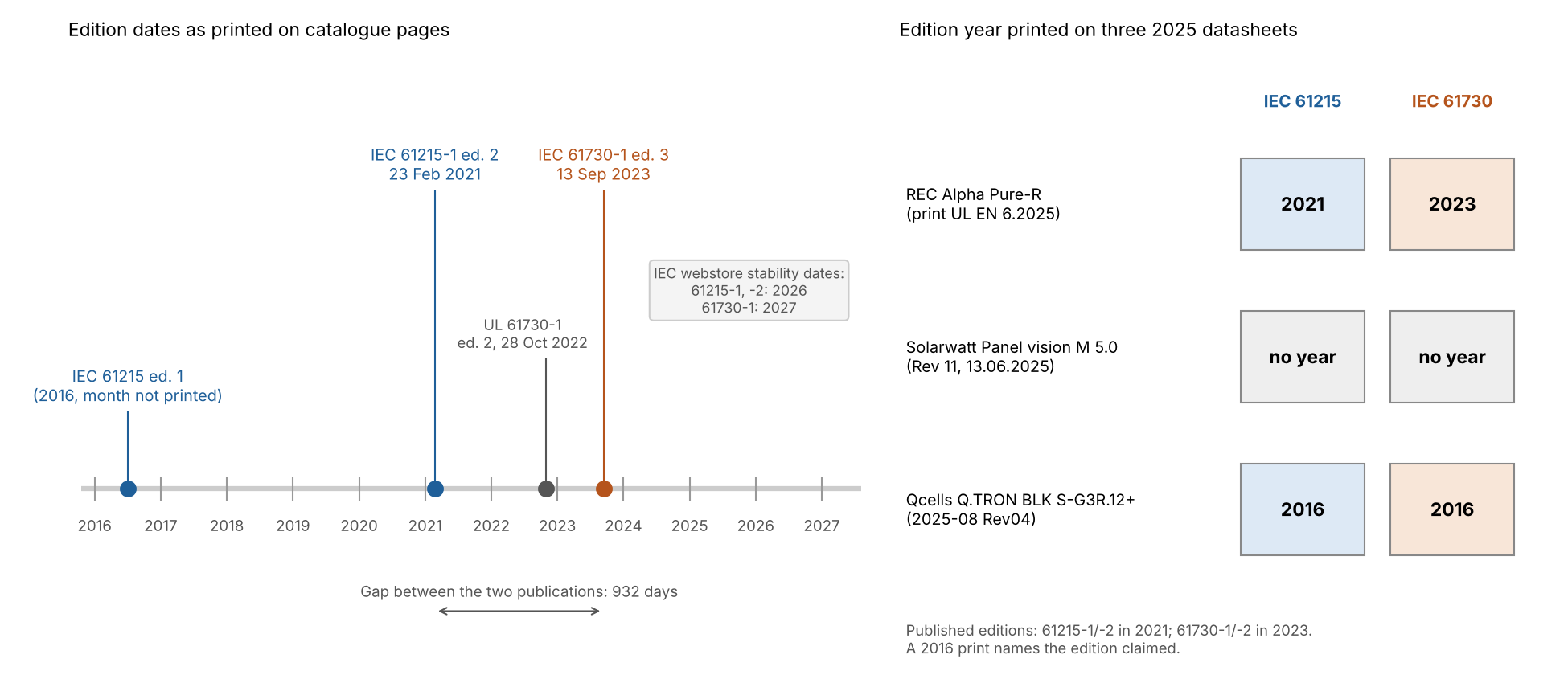
Figure 1. Edition dates are public, but three 2025 datasheets print three different edition combinations, so the year on the sheet needs a certificate behind it.
What does each standard cover?
IEC 61215 tests a design against outdoor exposure. IEC 61730 checks the build and tests it for shock, fire and injury risk. The table lists the five parts used on this page.
| Part | Title (short) | Published, as printed | What the catalogue page says |
|---|---|---|---|
| IEC 61215-1:2021 | Test requirements | 23 Feb 2021 (edition 2.0) | "Test results are not construed as a quantitative prediction of module lifetime." It covers crystalline silicon and thin-film flat plate modules. |
| IEC 61215-1-1:2021 | Special requirements, crystalline silicon | 23 Feb 2021 | Applies to "all crystalline silicon terrestrial flat plate modules". |
| IEC 61215-2:2021 | Test procedures | 24 Feb 2021 | "The objective of this test sequence is to determine the electrical characteristics of the module" and to show it can withstand prolonged outdoor exposure. |
| IEC 61730-1:2023 | Requirements for construction | 13 Sep 2023 (edition 3.0) | Assesses "the prevention of electrical shock, fire hazards, and personal injury". Covers modules with "98th percentile module operating temperatures of 70 °C or less". |
| IEC 61730-2:2023 | Requirements for testing | 12 Sep 2023 | "This document applies for safety qualification only in conjunction with IEC 61730-1." |
Other 61215-1 parts cover other cell technologies. For rear-layer and discolouration questions, see backsheet and EVA encapsulant for those layers. For the parts of a module see solar panel (module).
Which editions are current?
The IEC webstore lists as published IEC 61215-1 and -2 from 2021 and IEC 61730-1 and -2 from 2023. A third edition of IEC 61215-1 is at a working-draft stage.
IEC 61215-1:2021 replaces a first edition from 2016, per the IECEE catalogue page. The webstore prints a stability date of 2026 for IEC 61215-1 and -2, and 2027 for IEC 61730-1. The pages read showed no newer published edition at the time of checking. The gap between 61215-1:2021 and 61730-1:2023 is 932 days, about 31 months.
A Serbian standards institute project page lists IEC 61215-1 edition 3 at stage 20.99, "WD approved for registration as CD". The page gives 27 March 2026 as the stage date and lists a committee draft as the next stage. It does not say whether that stage has been reached. This is a working-draft stage, not a published standard. The IEC webstore is the place to confirm an edition before you cite it.
What do datasheets print about the two standards?
They print a standard name, and sometimes a year. Three 2025 sheets show three patterns.
- REC Alpha Pure-R, US print ("REF: PM-DS-12-06-REV-/D UL EN 6.2025"): prints "IEC 61215:2021;IEC 61730:2023;UL 61730". Also "UL 61730 Fire Type 2" and "IEC 61215:2016 Hailstone (35mm)". Both current editions and the US standard, but the hail line names the 2016 edition. Ask for the certificates, and why the hail line cites 2016.
- Solarwatt Panel vision M 5.0 (Rev 11, 13.06.2025): prints "IEC 61215 (incl. LeTID) | IEC 61730". Also "Fire class A (acc. to IEC 61730/UL 790)". Both standards are named, with no edition year. Ask for the certificate that names the edition.
- Qcells Q.TRON BLK S-G3R.12+ BFG (2025-08 Rev04, distributor-hosted copy): prints "TÜV NORD; IEC 61215:2016; IEC 61730:2016." Also "Fire Rating based on ANSI / UL 61730". These are earlier editions on a sheet dated more than four years after IEC 61215-1:2021 and nearly two years after IEC 61730-1:2023. Ask for the certificate date and whether a retest is planned.
A 2016 edition on a 2025 sheet is not proof of a fault. It may reflect when testing took place. The sheets differ in make, model and print date. This is not a quality ranking. See equipment datasheets and standard test conditions.
How solar software handles IEC 61215 and IEC 61730
Only SolarAPP+ names a module certification field among the four tools read, and it does not say it checks the certificate.
| Software | Module certification field? | What the page says |
|---|---|---|
| SolarAPP+ | Partly | Lists certification fields for modules. Does not say the tool verifies a certificate. |
| PVsyst | Not stated | The basic data page lists model, manufacturer, nominal power, technology and electrical values. No certification field is named. |
| Aurora Solar | Not stated | The Enabling Solar Components page covers module availability. It names no certification field. |
| OpenSolar | Not stated | The hardware components page names warranty, performance and region-specific specifications. It names no certification field. |
- SolarAPP+ (help article on PV module documentation, no update date printed): lists "Safety certifications" and "Certification agency" as module fields. Says modules "must be certified to UL 61730-1 and UL 61730-2 or UL 1703".
- All four pages were read in October 2026. PVsyst, Aurora Solar and OpenSolar print no date.
Not stated means the company page we cite does not say. Partly means the page names the field but does not say the tool checks the certificate. Tools that assemble permit packets are ranked in our guide to the best solar permitting software. See also permit plan set.
Common mistakes with IEC 61215 and IEC 61730
These errors recur when installers and buyers read module standards.
- Treating a standard number as proof. A datasheet line is a claim. The exact model needs its own certificate.
- Reading the year as the date of testing. The edition year is a clue, not a pass mark.
- Assuming an IEC listing meets US permit review. A SolarAPP+ help article asks for UL 61730-1 and UL 61730-2 or UL 1703.
FAQs
Is IEC 61215 the same as IEC 61730?
No. IEC 61215 is design qualification. IEC 61730 is safety qualification, split into a construction part and a testing part. IEC says part 2 applies "only in conjunction with IEC 61730-1".
Does passing IEC 61215 mean a module will last 25 years?
No. The IEC webstore says test results "are not construed as a quantitative prediction of module lifetime". Field loss is a separate question. See degradation rate.
What changed in IEC 61215 in 2021?
IEC 61215:2021 added cyclic mechanical load (MQT 20), potential-induced degradation (MQT 21) and bending tests for flexible modules (MQT 22).
The 61215-1 page adds bifacial definitions and guidance, and the 61215-2 page adds bifacial test methods. The 61215-2 page also says the bypass diode thermal test (MQT 18) selects three diodes, not all. Both pages say the nominal module operating test was dropped. See NOCT and NMOT and bifacial module.
Is UL 61730 the same as IEC 61730?
They are separate documents with separate dates. The ANSI page prints UL 61730-1 Ed. 2-2022, published 28 October 2022, saying it "is designed to coordinate with the test sequences in the IEC 61215 series". That is 320 days before IEC 61730-1:2023. REC’s sheet lists both. See UL 1741 and UL 9540 for the inverter and storage listings.
Related terms
- Solar panel (module). The full set of parts these standards test.
- Backsheet and EVA encapsulant. The laminate layers and their failure terms.
- Standard test conditions. The reference conditions behind datasheet power ratings.
Next step: before you order, request the certificate for the exact module model and compare its edition years with the datasheet. The best solar permitting software list covers tools that assemble permit packets.
Sources
All pages were checked in October 2026. The two IEC webstore pages for 61215-1 and 61730-1 were re-opened for this check.
- IEC webstore, IEC 61215-1:2021 RLV (published 2021-02-23, edition 2.0, stability date 2026).
- IEC webstore, IEC 61215-2:2021 (published 2021-02-24, edition 2.0, stability date 2026, list of significant technical changes).
- IECEE, IEC 61215-1:2021, IEC 61215-1-1:2021 and IEC 61215-2:2021.
- IEC webstore, IEC 61730-1:2023 (published 2023-09-13, edition 3.0, stability date 2027) and IECEE, IEC 61730-2:2023 (issue date 2023-09-12).
- ANSI Webstore, UL 61730-1 Ed. 2-2022 (published 28 October 2022).
- ISS (Serbia), IEC 61215-1 ED3 project page. Related project pages IEC 61215-1-4 ED3 and IEC 61215-1-6 ED1.
- SolarAPP+ help, PV module documentation.
- Datasheets: REC Alpha Pure-R, US print. Solarwatt Panel vision M 5.0. Qcells Q.TRON BLK S-G3R.12+ BFG (distributor-hosted copy).
- Tool pages: PVsyst basic data. Aurora Solar. OpenSolar.
Last updated 30 October 2026. Next scheduled review: 30 January 2027.