Key takeaways
- Design limits count optimisers and watts, not modules. In SolarEdge’s datasheet, a string of 6 fails for the S440 optimiser (minimum 8) but is allowed for the S500B and S650B (minimum 6).
- In our invented string (380 V assumed), input currents run from 2.94 A to 11.76 A. Every output carries 9.24 A. The output voltages of 42.7 V, 25.6 V and 10.7 V add up to 380 V.
- SolarEdge lists a weighted efficiency of 98.6% for the S440 and 98.8% for its S and P series. At 98.6%, our example loses 50 W of 3,560 W.
- Designs differ. SolarEdge strings run at a fixed voltage. Tigo says its optimiser output is never above the module’s Voc.
To check optimiser string limits inside a design, see the best residential solar design software.
Power optimiser at a glance
An optimiser sits between a module and the string. It tracks the module’s power point and converts the result. The string no longer forces one current on every module.
| Item | Detail |
|---|---|
| Formula | Power out = efficiency × power in. In a fixed-voltage string, string current = total power out ÷ string voltage. |
| Typical numbers | SolarEdge lists 99.5% maximum and 98.6% weighted efficiency for the S440 (datasheet, 26 November 2025). Our 12-module example: 9.24 A string current. |
| Where it matters | Roofs with mixed shade or orientation, and designs that need module-level data. |
| Standard or rule | Manufacturer string rules apply. Shutdown rules sit in the NEC. See rapid shutdown. |
| In software | Tools differ on string rules and loss modelling. See the table below. |
Why does a power optimiser matter for installers?
It changes the stringing rules you design to. The limit shifts from string voltage to optimiser count and string power. Each make has its own numbers.
It is one of several module-level options. The MLPE page has the types, shade gains and the 1% loss assumption. IBC Solar’s blog (24 August 2023) says this when the same conditions affect all modules: "the contribution of the optimiser is too small to make a difference."
How does a power optimiser work?
It does two jobs. It finds the module’s peak power. Then it converts that power to the voltage and current the string needs. See MPPT for how the tracking works.
- The optimiser holds its module at the power point. Input power is what the module gives.
- It converts that power with an efficiency loss. Power out = efficiency × power in.
- Optimisers are wired in series. In a fixed-voltage design the inverter holds one string voltage. So string current = total power out ÷ string voltage.
- Each optimiser outputs that current. Its output voltage = its power out ÷ string current.
PVsyst’s documentation says each input of a SolarEdge-type inverter "works at fixed voltage (usually 350V or 700V for most inverters)". Steps 3 and 4 fit a SolarEdge-type design only. Not every make works this way. Tigo’s FAQ says output voltage "is never higher than the PV module’s Voc". It adds that module counts per string need not change. Check your make before you copy the sums below.
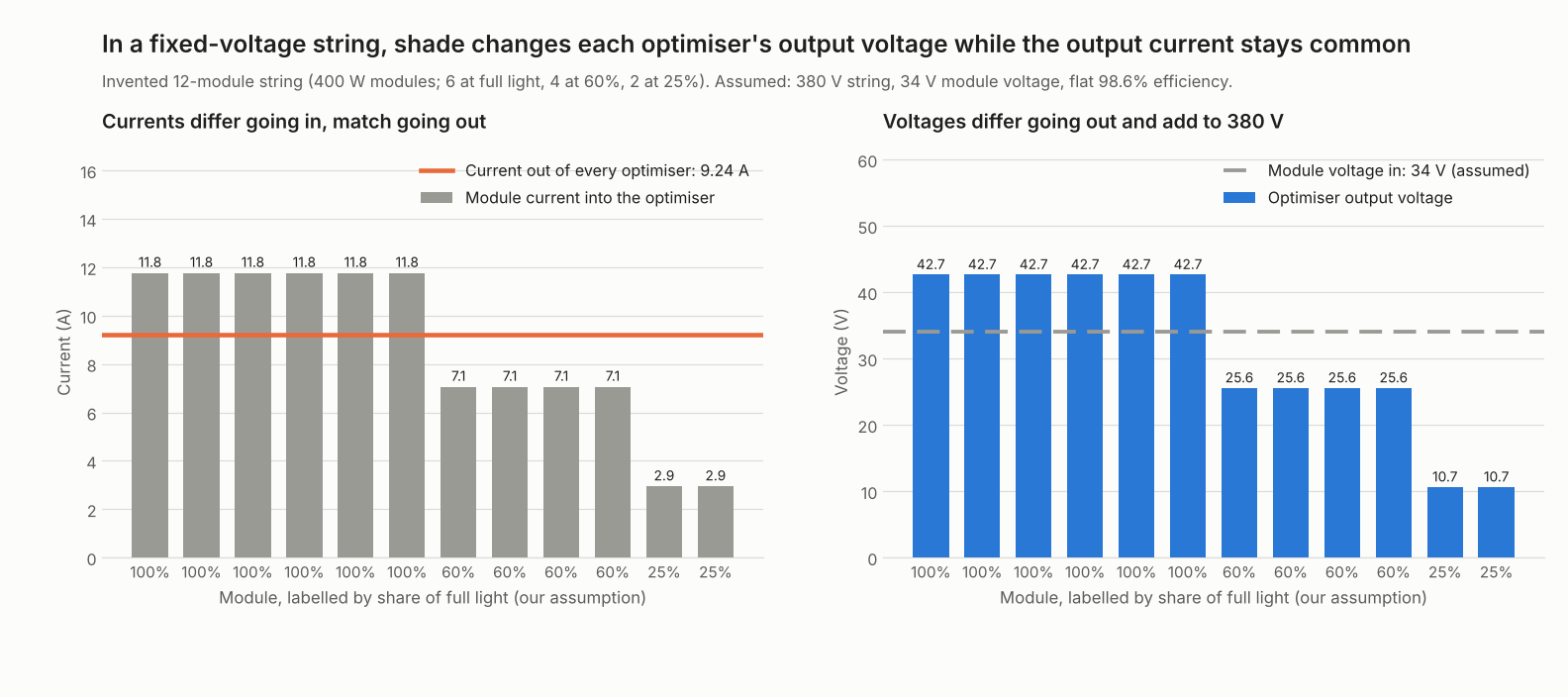
Figure 1. In our fixed-voltage model, every optimiser outputs the same current. Output voltages split the string voltage by power.
Worked example: 12 modules on two roof faces
Six modules get full light, four get 60% and two get 25%. The unshaded optimisers boost their voltage. The shaded ones lower it.
Inputs, example or assumed: 400 W modules and 34 V module voltage at every light level. Real voltage varies a little. String voltage is 380 V. Efficiency is held at 98.6%, the SolarEdge S440 weighted figure. We chose 380 V. SolarEdge’s single string note prints 15 A × 380 V for its S440 examples. Light is a plain share of full power. Each figure follows from these inputs.
| Group | Power in each (W) | Input current (A) | Output voltage (V) | Mode |
|---|---|---|---|---|
| A: 6 modules, 100% light | 400 | 11.76 | 42.7 | Boost (out above 34 V in) |
| B: 4 modules, 60% light | 240 | 7.06 | 25.6 | Buck (out below in) |
| C: 2 modules, 25% light | 100 | 2.94 | 10.7 | Buck (out below in) |
| String result | Value |
|---|---|
| Power in and out | 3,560 W in, 3,510 W out (loss 50 W, 1.4%) |
| String current (every output) | 9.24 A |
| Sum of output voltages | 6 × 42.7 + 4 × 25.6 + 2 × 10.7 = 380 V |
| Same 12 modules, all at full light | 12.45 A out, 31.7 V each |
With the more optimistic 98.8% note figure the loss would be 43 W. This is one moment, not a year of output. Real efficiency may change with the voltage ratio, as PVsyst’s page says. We held it flat. For the yield effect of module-level shade handling, see mismatch loss, the MLPE page and shading analysis.
The calculator below lets you try your own groups.
What design limits do power optimisers bring?
Limits move to the optimiser: its power, input current and string length. SolarEdge’s residential datasheet (DS-000091-ENG, 26 November 2025) lists them by inverter type.
- Module fit: the module’s STC power must not exceed the optimiser’s rated input power. Its Isc must fit too. The datasheet lists a maximum Isc of 15 A for the S440, and ties some values to install date.
- String length, single-phase Home Wave/Hub row: 8 to 25 for the S440. The S500B and S650B minimum is 6. Maximum continuous power is 5,700 W. Connected power may reach 6,000 W. That needs an install after 1 January 2025 and an inverter rated above 5,700 W AC.
- Mixing: in new installs, the datasheet bars S-series and P-series optimisers in one string.
- Standby voltage: the datasheet lists 1 ± 0.1 V per optimiser. Twelve optimisers would show about 12 V (our sum). For shutdown rules, see rapid shutdown.
The datasheet lists maximum output voltages of 60 V and 80 V without naming models. The calculator uses 60 V as a placeholder. The table tests five module counts against the S440 values. It uses an example 400 W module (10.5 A Isc, also example).
| Modules | String power (W) | Result |
|---|---|---|
| 6 | 2,400 | Fail: below the minimum of 8. |
| 12 | 4,800 | Pass. |
| 14 | 5,600 | Pass, under 5,700 W. |
| 15 | 6,000 | Conditional: above 5,700 W. Needs the 6,000 W row: install after 1 January 2025, inverter above 5,700 W AC. |
| 25 | 10,000 | Fail: within the length limit but above 6,000 W. |
For these modules, power sets the size, not the 25 limit. The inverter’s own DC/AC limit is not checked here. The note ties it to the inverter datasheet. See string sizing for voltage windows, and the MLPE page for other makes’ limits. The calculator in the worked example runs the same checks.
How solar software handles power optimisers
Only Aurora and PVsyst clearly apply the maker’s string rules, and only HelioScope and PVsyst state a loss model. All pages were read in October 2026.
| Software | Applies string rules? | Models optimiser loss? |
|---|---|---|
| Aurora Solar | Yes | Not stated |
| HelioScope | Not stated | Yes |
| OpenSolar | Partly | Partly |
| PVsyst | Yes | Yes |
| SolarEdge Designer | Partly | Not stated |
- Aurora Solar: String rules: "implements the string sizing rules provided by the manufacturers". SolarEdge and Tigo supported. Optimisers can go on selected modules. Loss modelling is not stated on the pages read. Pages read: Stringing page (no date printed). Selective Optimizers, updated 15 April 2026.
- HelioScope: The stringing page does not mention optimisers. The loss is an "Optimizer Output" loss row, normal range 0 to -2%. Pages read: Stringing in HelioScope and Loss Factors, both updated 9 July 2025.
- OpenSolar: It sets an optimiser-to-panel ratio from voltage, current and power constraints. String limits are not stated. It says optimiser loss is applied, with no value stated. Page read: Stringing page, updated 22 October 2026.
- PVsyst: It lists min and max optimisers per string for each optimiser-inverter pair, plus a string power cap. Its efficiency profile may depend on the optimising ratio. Pages read: SolarEdge architecture and management pages, undated.
- SolarEdge Designer: The product page says designs comply with "the latest SolarEdge design rules". No limits listed. Loss modelling is not stated on the page read. Page read: Product page, undated.
Not stated means the pages we read do not say, not that the feature is absent. Partly means the page covers the point in part. To compare more tools, see the best solar design software and the best residential solar design software.
Common mistakes with power optimisers
FAQs
Is a power optimiser the same as a microinverter?
No. An optimiser converts DC to DC and needs a string inverter. A microinverter converts to AC at the module. The MLPE page and the microinverter page cover both.
Do power optimisers need a special inverter?
Some do. PVsyst describes SolarEdge optimisers as feeding a proprietary inverter. Tigo says its products are "virtually compatible with any inverter", with operational compatibility to be confirmed.
How much power does an optimiser lose?
SolarEdge lists 98.6% weighted efficiency for the S440, a 1.4% loss. Its efficiency note gives 98.8% for all S and P series. These are company figures, not field tests.
Can I fit optimisers to only some modules?
Yes, on some makes. Aurora’s help describes optimisers on chosen modules in a string. Tigo allows this only when the string has its own MPPT input, and it does not support partial fits on parallel strings.
Are power optimisers worth it?
They pay off mainly on shaded or mixed-orientation roofs. They cost a conversion loss (1.4%, or 50 W of 3,560 W, in our example). IBC Solar says they add little when all modules see the same light. Test shaded roofs with a shading analysis before you quote.
Related terms
- MLPE: module-level electronics, including optimisers.
- MPPT: the control that holds an input at its best point.
- String inverter: the inverter an optimiser string feeds.
- Module-level monitoring: per-module data, which optimisers can report.
- Mismatch loss: power lost when wired modules differ.
Next step: before you quote a shaded roof, check your optimiser’s string limits in watts and count. Then see how more tools handle maker string rules in the wider best solar design software list.
Sources
Sources checked October 2026.
- SolarEdge, Power Optimizer for residential installations , DS-000091-ENG, dated 26 November 2025 (printed in the document). Rows with several values per model are not used.
- SolarEdge, Efficiency of S-Series and P-Series Power Optimizers. The official file would not open on 30 October 2026. A reseller copy (version 6, May 2023) lists a weighted efficiency of 98.8%.
- SolarEdge, Single string design guidelines, North America, the file now reads version 1.0, February 2024 (checked 30 October 2026).
- PVsyst, SolarEdge architecture and management of power optimizers, both undated.
- Tigo support, FAQ Optimizers (TS4-O), no update date shown on the page read (checked 30 October 2026).
- Aurora help, Stringing (no date printed) and Selective Optimizers, updated 15 April 2026.
- HelioScope, Stringing and Loss Factors, both updated 9 July 2025.
- OpenSolar, Stringing Micro Inverters and Power Optimizers, updated 22 October 2026.
- SolarEdge Designer product page, undated.
- IBC Solar blog, Power optimisers for PV systems, 24 August 2023.
Last updated 30 October 2026. Next scheduled review: 30 January 2027.