Key takeaways
- The limit moves from string voltage to units per AC branch. Enphase’s IQ8MC guide lists 12 units per 20 A branch at 240 V.
- At 240 V, Enphase lists 10 to 12 units by IQ8 model. APsystems lists 7 to 11 by DS3 model and cable, and the same family differs by region.
- On an invented 22-module roof, the branch count runs from 1 to 3 by model and cable. At 208 V, all four Enphase models need 3.
- On an example shade day, microinverters beat two strings by 2.4% with a chimney and a tree, and by 9.7% with a long dormer shadow.
- Rapid shutdown is a claim made product by product. Enphase’s guide names NEC 2014 to 2023. The APsystems DS3 sheet does not mention it.
To see which design tools check microinverter AC branch limits, see the best solar design software.
Microinverter at a glance
A microinverter sits under or beside its module. It tracks that module’s power point, makes AC and feeds a shared branch cable. The cable ends at a breaker. A gateway can collect data from each unit.
| Item | Detail |
|---|---|
| What it is | An inverter per module (single-input) or per pair (dual-input, such as APsystems DS3). |
| Limits designers read | Units per AC branch, module power range, DC input current, grid voltage. |
| Where it matters | Roofs with several faces or shade, module-level data, shutdown method, breaker count. |
| Standard or rule | The datasheet or manual sets the limit. Both makers below say local rules can change it. |
| In software | Branching, per-branch counts and AC wiring are documented unevenly. See the table below. |
Why does a microinverter matter for installers?
It changes the drawing set, breaker count and cable run. A wrong branch count forces rework. Design work shifts to AC branches, voltage rise and service access.
How does a microinverter differ from a string inverter?
The conversion happens at the module, not at one central box. The table below covers design points only. The MLPE page covers types and shade physics. The string inverter page covers the central box.
| Point | Microinverter | String inverter |
|---|---|---|
| DC wiring | One module, short leads. No series string. | Series strings to one or more inputs. |
| Main design limit | Units per AC branch. Module fits the unit’s DC input. | String voltage window and input current. See string sizing. |
| Power-point tracking | One per input, so one or two modules. | One per input, shared by a string. See MPPT. |
| One unit fails | One module’s output stops (a design inference, no failure rates are given here). | The whole inverter, or one input, stops. |
A power optimiser sits between the two. It tracks at module level but sends DC to a string inverter. See also the inverter page.
What limits does the AC branch bring?
The maker prints a maximum number of units per branch. It depends on the model and the grid voltage. For some makers it also depends on the cable. Use the sheet for your region and revision.
Enphase IQ8 limits, per 20 A branch (North America):
| Product | Max at 240 V | Max at 208 V | Module power range |
|---|---|---|---|
| Enphase IQ8MC | 12 | 10 | 260 to 460 W |
| Enphase IQ8AC | 11 | 9 | 295 to 500 W |
| Enphase IQ8HC | 10 | 9 | 295 to 540 W |
| Enphase IQ8X | 10 | 9 | 320 to 540 W |
APsystems limits depend on region and cable:
| Product and sheet | Grid | Max units per branch | Module power range |
|---|---|---|---|
| APsystems DS3-L, Philippines sheet (2 modules per unit) | 240 V | 11 on 10 AWG, 9 on 12 AWG | 300 to 550 Wp |
| APsystems DS3, Philippines sheet | 240 V | 9 on 10 AWG, 7 on 12 AWG | 400 to 660 Wp |
| APsystems DS3-L and DS3, APAC sheet (sheet also lists a 2.5 mm² AC bus cable) | 230 V | 6 and 5 per 20 A branch | 255 to 550 Wp and 300 to 660 Wp |
Hoymiles HMS-400-1T (APAC and Africa) limits by cable and grid voltage. The brochure lists commonly used module power as 320 to 540+ W.
| Cable | 220 V | 230 V | 240 V |
|---|---|---|---|
| 2.5 mm² | 13 | 14 | 15 |
| 4 mm² | 18 | 19 | 20 |
| 6 mm² | 22 | 23 | 24 |
The tables cover three makers. Enphase’s guide warns: "Do not exceed the maximum number of microinverters in an AC branch circuit listed in the manual". Enphase’s October 2023 manual, the APsystems sheets and the Hoymiles brochure all say local rules may change the count.
- Cable sets the limit. Hoymiles shows this too: at 220 V, 13 units on 2.5 mm², 18 on 4 mm² and 22 on 6 mm². APsystems prints 10 AWG (35 A) and 12 AWG (28 A) columns. In all six APsystems cells that can be checked, the limit is the cable or breaker current divided by the unit’s nominal current. It is rounded down. Example: 35 A ÷ 3.7 A = 9.46, listed 9. This is arithmetic, not a rule the sheets state. It uses 100% of the nominal current with no 125% continuous-load factor. The sheets name no breaker size. Enphase’s limits are for a 20 A overcurrent device, so the two are not like for like.
- Voltage rise. Enphase’s guide says it "recommends a voltage rise of less than 2%". It adds that centre-feeding the branch is best practice for a full branch. See voltage drop and wire sizing.
- DC pairing. The guide states that "There is no enforced DC/AC ratio and maximum DC input power limit". The module must still fit the voltage and short-circuit current limits. See DC/AC ratio and clipping.
- Variant match. Match the document to your grid, revision and model suffix. See equipment datasheets.
The documents behind the table:
- Enphase rows: North America guide IOM-00108-2.0-EN, December 2024 edition. All four rows come from the same guide.
- APsystems Philippines row: sheet Rev 1.3, dated 4 March 2025 on the sheet.
- APsystems APAC row: sheet Rev 1.0, dated 17 December 2021 on the sheet.
- Hoymiles table: brochure © 2024 edition, with the note "Refer to local requirements for exact number of microinverters per branch."
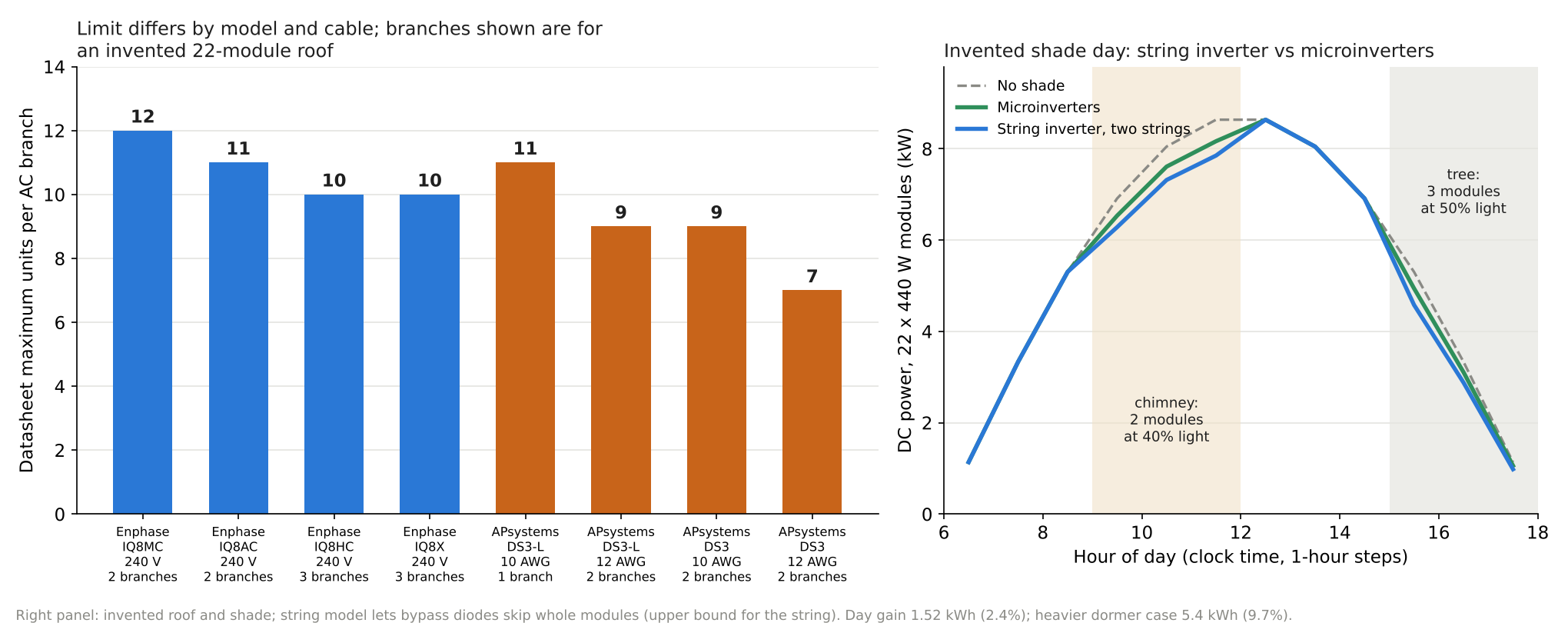
Figure 1. Branch limits come from datasheets and vary by model and cable. On the example roof and shade day, microinverters recover power only in the shaded hours.
Worked example: branches and shade on an example roof
An example 22-module roof needs 1 to 3 AC branches, depending on model and cable. Shade moves the energy gap between 2.4% and 9.7%.
Inputs, example: 22 modules of 440 W (9.68 kWp). This fits inside every power range above. Units are split evenly across the fewest branches. Enphase units are single-input, so 22 units. APsystems units are dual-input, so 11 units. Limits are the datasheet cells above, at 240 V.
| Option (240 V) | Units | Limit | Branches (even split) |
|---|---|---|---|
| Enphase IQ8MC | 22 | 12 | 2 (11 + 11) |
| Enphase IQ8AC | 22 | 11 | 2 (11 + 11) |
| Enphase IQ8HC | 22 | 10 | 3 (8 + 7 + 7) |
| Enphase IQ8X | 22 | 10 | 3 (8 + 7 + 7) |
| APsystems DS3-L, 10 AWG | 11 | 11 | 1 (11) |
| APsystems DS3-L, 12 AWG | 11 | 9 | 2 (6 + 5) |
| APsystems DS3, 10 AWG | 11 | 9 | 2 (6 + 5) |
| APsystems DS3, 12 AWG | 11 | 7 | 2 (6 + 5) |
On a 208 V supply the four Enphase limits are 10, 9, 9 and 9, so every model needs 3 branches. The IQ8MC and IQ8AC rise from 2 to 3. The IQ8HC and IQ8X stay at 3. Each extra branch adds one breaker space and one cable run.
Shade day. The same roof is compared with a string inverter on two strings of 11 modules. Assumptions, example: a clear day that peaks at 0.9 kW/m², and 12 one-hour steps from 06:00 to 18:00. Power is linear in light. Efficiency is equal. There is no temperature effect or voltage-window limit. The string model lets bypass diodes skip whole modules, so it is an upper bound for the string. So under these assumptions the microinverter gain is a lower bound. The MLPE page covers partial-module shade.
| Case (example) | No shade (kWh DC) | String inverter (kWh) | Microinverters (kWh) | Gain |
|---|---|---|---|---|
| A | 66.7 | 63.3 | 64.8 | 1.52 kWh, 2.4% of the string day |
| B | 66.7 | 55.9 | 61.3 | 5.44 kWh, 9.7% of the string day |
- Case A: chimney, 2 modules at 40% light, 09:00 to 12:00. Tree, 3 modules at 50%, 15:00 to 18:00 on the same day.
- Case B: dormer, 4 modules at 50% light, 09:00 to 16:00. Same tree.
For annual results use an energy yield simulation and a shading analysis. The mismatch loss page covers mismatch.
Microinverter branch and shade calculator
Enter your datasheet limit and roof. The defaults match the IQ8MC row and case A. The presets load case A and case B.
What else changes: shutdown, monitoring and service?
Shutdown, monitoring and service depend on the product, so each point below names its source.
- Rapid shutdown: Enphase’s guide says its units are "UL Listed as PV rapid shutdown equipment". It says they conform with "NEC-2014, NEC-2017, NEC-2020, and NEC-2023 section 690.12", with conditions. These include a 305 mm (1 ft) array boundary and mounting under the module. The APsystems DS3 sheets (Rev 1.3 and Rev 1.0) do not mention rapid shutdown. The Hoymiles brochure says "Safer for rooftop solar stations with rapid shutdown compliance and isolated transformer". It names no code. See rapid shutdown and permit plan sets.
- Monitoring: APsystems DS3 uses encrypted ZigBee to a gateway. It recommends no more than 80 units per gateway (Rev 1.3). The sheet lists a 12-year standard warranty and says eligibility needs monitoring via the EMA portal. Hoymiles’ brochure says only "Extensive warranty". Enphase’s IQ8 manual (IOM-00068-1.0, January 2024, page 13) says all 208 VAC installations need its IQ Gateway for commissioning. See module-level monitoring and the best solar inverter monitoring apps.
- Service: Enphase’s IQ8 manual (page 6) says: "Always de-energize the AC branch circuit before servicing." So for Enphase the whole branch is off while one unit is serviced. Units sit under the module, so plan how the module comes off. That access point is an inference. See O&M.
How solar software handles microinverters
Of the four design tools read, only Arka 360 documents an AC-branch limit check. The other three are rated Partly, meaning the page covers microinverters but not branch limits. The pages read cover design tools only.
| Software | Branches and limits | Page read |
|---|---|---|
| Aurora Solar | Partly | Help article on multi-input module-level electronics, New Aurora only, no date printed. |
| Arka 360 | Yes | Help article, 12 December 2024. |
| OpenSolar | Partly | Stringing Micro Inverters and Power Optimizers, no date printed. |
| HelioScope | Partly | AC Modules, 24 October 2025. AC Wiring, no date printed. |
What each page says:
- Aurora Solar: Models multi-input microinverters. AC branches and limits are not mentioned.
- Arka: "Add AC Branch" mode. The page says it checks the maximum AC branch length "depending on the microinverter that you have chosen". A new branch starts at that maximum. Wire sizing is in another Arka article.
- OpenSolar: It "automatically calculates the number of micro-inverters based on the module count". Branches, per-branch limits and AC wiring are not mentioned on the page.
- HelioScope: Microinverter products are modelled as a module plus an inverter, chosen separately. The AC Wiring page says conductors are drawn between components and does not mention microinverters or branch limits.
All checked October 2026. "Not mentioned" means not found on the pages read. PVsyst’s grid-connected system index page mentions no microinverters, so it is not rated. Enphase’s own "Designing with Enphase" page, no date printed, says the maximum per branch is in the datasheet. Its example (IQ7+, 230 V, India page) is a 7.25 kW system. It needs 25 units at 290 VA, so 2 branches when 13 fit. To compare design tools, see the best solar design software.
Common mistakes with microinverters
FAQs
Does a microinverter system need a string inverter?
No. Each unit makes AC at the module, and the branch cable goes to a breaker or load centre. Optimisers are different. They need a string inverter.
How many microinverters can go on one branch?
Enphase IQ8MC allows 12 units per 20 A branch at 240 V (IOM-00108-2.0-EN). The other IQ8 models allow 10 or 11. APsystems lists 7 to 11 on its Philippines 240 V sheet, by cable and model. Hoymiles lists 13 to 15 on 2.5 mm² for the HMS-400-1T. Use the sheet for your own model, grid and cable.
Do microinverters meet rapid shutdown?
Only if the product’s own listing says so, within its conditions. Enphase names NEC 2014 to 2023 in its guide. The APsystems DS3 sheets do not mention it. Hoymiles’ brochure claims compliance but names no code. Your AHJ’s adopted edition decides.
Do 208 V microinverter systems need a gateway?
For Enphase, yes. Its IQ8 manual (IOM-00068-1.0, January 2024, page 13) says all 208 VAC installations need the IQ Gateway for commissioning. The APsystems and Hoymiles pages read do not state a gateway rule for 208 V.
Related terms
- MLPE: module-level electronics, including microinverters and optimisers.
- String inverter: one inverter for series strings.
- DC/AC ratio: array kWp divided by inverter kW.
- Rapid shutdown: the rule that cuts module voltage fast.
Next step: write the datasheet limit for your model, grid and cable on the job sheet first. Then test it in the best solar design software.
Sources
- Enphase, IQ8MC, IQ8AC, IQ8HC and IQ8X Installation and Operation Manual, IOM-00108-2.0-EN, December 2024, North America (distributor-hosted copy, checked October 2026).
- Enphase, IQ8MC/IQ8AC/IQ8HC manual, USM-00008-1.0, October 2023, and IQ8 manual, IOM-00068-1.0, January 2024 (ManualsLib copies, checked October 2026). The IQ8 manual has its safety text on page 6 and its 208 V commissioning text on page 13.
- Enphase, Designing with Enphase (no date printed, checked October 2026).
- APsystems, DS3 series datasheet, Rev 1.3, 4 March 2025, and APAC datasheet, Rev 1.0, 17 December 2021 (checked October 2026).
- Hoymiles, microinverter and storage brochure for APAC and Africa, © 2024, no version printed (checked October 2026).
- Arka 360, How to create a PV design with micro inverters, 12 December 2024. OpenSolar, Stringing Micro Inverters and Power Optimizers. Aurora Solar, How to add Multi Input Module Level Power Electronics to a design (New Aurora). HelioScope, AC Modules and AC Wiring (checked October 2026).
Last updated 30 October 2026. Next scheduled review: 30 January 2027.