Key takeaways
- Inputs set the layout. The Fronius page lists 27.0 and 16.5 A for its 2 trackers, so a 12.98 A string fits twice on the first input and once on the second. That is 3 strings in all.
- The invented roof (E 11, W 11, S 12 modules, 14.45 kWp) fits with E and W on input 1. Put all three strings on one input and they draw 38.94 A against a 27.0 A limit.
- At example temperatures and an estimated Vmp coefficient, 10 to 21 modules per string fit the voltage window.
- In the example layout, one string inverter carries 100% of the array and an input 64.7% or 35.3%. One microinverter carries 2.9%. This is arithmetic, not failure data.
- Variants differ: an older Symo brochure prints 900 V and 25 kWpeak where the help page prints 1000 V and 15 kWpeak.
To check strings and voltage per input in software, see the best solar design software for stringing checks.
String inverter at a glance
A string inverter sits between several strings and the AC supply. Its MPPT inputs decide which strings can share a voltage.
| Item | Detail |
|---|---|
| What it does | Converts DC from strings to AC, tracks the power peak once per MPPT input and reports data. |
| Limits per input | Current, short-circuit current and a voltage window. Fronius Symo Advanced 10.0-3-M: current 27.0 / 16.5 A and short-circuit 55.7 / 34.0 A (input 1 / input 2, as we read the sheet), MPP window 270 to 800 V. |
| Standard or rule | No single design standard. The datasheet of the exact variant sets the limits. |
| In software | Tools show strings per input and warn on voltage. Current per input is the check they document least. |
Why does the choice of string inverter matter?
It sets how many strings and roof faces you can wire. It also puts the whole array behind one unit.
The US Department of Energy says string inverters connect a set of panels, a string, to one inverter. It describes a central inverter as one that every panel might attach to, at utility and community scale. DOE also says a problem on one panel reduces production on its string. With microinverters it does not affect the others. The inverter page covers the types.
How does a string inverter connect strings to MPPT inputs?
Modules wire in series to make a string. One or more strings then wire in parallel onto an input. Each input tracks one voltage for everything on it.
- Series raises voltage. The string must fit the inverter’s window. See string sizing.
- Parallel adds current. Strings on one input must stay under its current limit.
- Each input has its own tracker. See MPPT. Fronius’s SuperFlex Design page says multiple trackers allow for different module orientations or tilts.
- The unit turns the total into AC. See DC/AC ratio and inverter clipping.
That page names the Primo and SnapINverter families, not the Symo Advanced. It says: "Simply split the system among the independent trackers as needed, from a 50/50 split all the way to a 33/66 split."
Unequal strings on one input. A Fronius whitepaper (V1.0, November 2021) says uneven string lengths are "certainly possible and also useful". Its PV*SOL example puts 14 strings on one tracker: 13 of 21 modules and 1 of 22. All run at 864 V, and "only the additional PV modules would experience any yield losses". The sections available give no loss figure. The longer string is 1 module over 21 (4.8%). Layouts B and C mix 12 and 11 modules (8.3%). The MPPT page models 1 in 10 (10.0%) across two faces. So the gap size and the orientation differ.
What input limits does a string inverter datasheet give?
Six limits matter most. Fronius’s Symo Advanced 10.0-3-M help page (undated) prints them, with decimal commas.
| Limit | Printed value |
|---|---|
| Trackers | 2 |
| Current (input 1 / input 2) | 27.0 / 16.5 A |
| Short-circuit current (input 1 / input 2) | 55.7 / 34.0 A |
| Voltage window | 200 to 1000 V. MPP range 270 to 800 V (usable 200 to 800 V) |
| Start voltage | 200 V |
| Power and connections | 15 kWpeak DC, 10 kW AC, 3 + 3 DC connections |
Idc max is an operating current. The short-circuit row is a separate check. Some makers also ask for a 1.25 margin on Isc. Voltage tests are on the string sizing page.
The page does not label the two current values. They are read here as input 1 and input 2. The short-circuit row has an asterisk but no footnote text. So the example compares plain Isc and also shows a 1.25 margin.
Variants differ. The two sheets below are quoted as printed. An older brochure for the Symo 10.0-3-M-OS (v08 Aug 2017) prints 200 to 900 V, 25 kWpeak and 40.5 / 24.8 A short-circuit. Its footnote on the second current value (16.5 A) reads "14.0 A for voltages < 420 V". Match the sheet to the model on the quote. See equipment datasheets.
Worked example: three roof faces on two inputs
Three faces fit two inputs if two of them share input 1, because input 2 holds only one 12.98 A string. The roof and temperatures are example. The inverter limits are the help-page values above. That page is for a European-market three-phase unit. No US grid-code or listing check is part of this example.
| Input | Value | Basis |
|---|---|---|
| Module | Qcells Q.TRON BLK M-G2+ 425 W: Voc 39.03 V, Vmp 32.74 V, Isc 13.66 A, Imp 12.98 A. Coefficients: Voc -0.24, Pmax -0.30, Isc +0.04 %/K. | Datasheet Rev06, March 2025 (distributor copy) |
| Vmp coefficient | -0.34 %/K, Pmax minus Isc coefficient | Estimate. The sheet prints none. See Vmp and Imp. |
| Temperatures | Cold cell -10 °C. Hot cell 70 °C | Example stand-ins |
| Roof | East 11, west 11, south 12 modules, one string per face (34 modules, 14.45 kWp) | Example |
Per module, cold Voc is 42.31 V, cold Vmp 36.64 V and hot Vmp 27.73 V. Strings of 10 to 21 modules then fit the 270 to 800 V window and 1000 V limit. The window holds for a Vmp coefficient from -0.32 to -0.38 %/K. The method is on the string sizing page.
Only layout D fails, because three strings on one input draw more current than that input allows.
| Layout | Input 1 (27.0 A) | Input 2 (16.5 A) | Current, input 1 / input 2 | Result |
|---|---|---|---|---|
| A | E 11 + W 11 | S 12 | 25.96 A / 12.98 A | Pass. Equal lengths on input 1. |
| B or C | S 12 + E 11, or S 12 + W 11 | W 11, or E 11 | 25.96 A / 12.98 A | Passes the datasheet. Mixes faces and lengths. |
| D | E 11 + W 11 + S 12 | none | 38.94 A / 0 A | Fail. Current over 27.0 A. |
On the 2017 brochure, a footnote cuts the 16.5 A limit to 14.0 A below 420 V. The south string of 12 runs at 332.8 to 439.6 V Vmp, so 14.0 A applies at times. Its 12.98 A is under that. So layout A still passes on that sheet. Layout D fails on both. The help page prints no such footnote.
Current is the tight check. The 27.0 A input takes 2 strings (27.0 / 12.98 = 2.08) and the 16.5 A input takes 1 (1.27). So this inverter holds 3 strings of this module, whatever the roof. A fourth face needs a second inverter or module-level devices. Short-circuit current passes either way. Layout D reaches 40.98 A plain and 51.2 A with a 1.25 margin, against 55.7 A.
Layout A puts 64.7% of the modules on input 1 and 35.3% on input 2. That is inside the 50/50 to 33/66 range on Fronius’s SuperFlex Design page, which names other families. DC/AC is 1.445 on the 10 kW rating, under the 15 kWp cap. Layouts B and C pass the datasheet, but they put two faces and two lengths on one input. The MPPT page models the cost. Show the input map on the single line diagram.
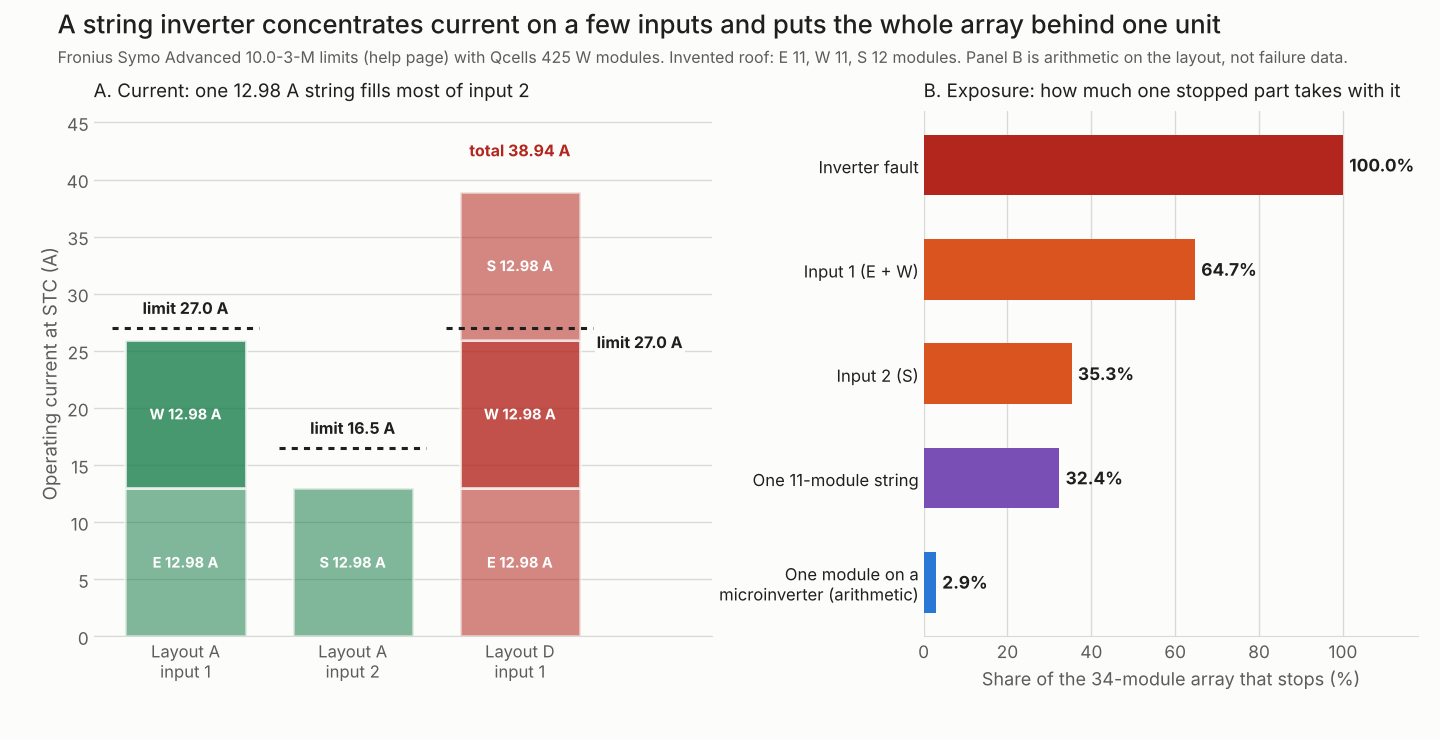
Figure 1. A layout with E and W on input 1 stays under both current limits. A single inverter still holds all 34 modules.
String inverter input planner
Enter your own module, limits and strings. The defaults reproduce layout A. The buttons load layouts B and D (layout C gives the same numbers as B).
String inverter, power optimiser or microinverter: what changes?
The change is where tracking and conversion happen. So the share lost when one part stops also changes. Figures here are arithmetic on the layout above, not failure rates.
| Question | String inverter | Power optimiser with string inverter | Microinverter |
|---|---|---|---|
| Where is the peak tracked? | Once per input. | Per module. See power optimiser. | Per module. See microinverter. |
| What does one problem panel do? | DOE: reduces its string’s production. | See the MLPE page for modelled cases. | DOE: does not affect the others. |
| What does one stopped unit take (34 modules)? | 100% for the inverter. 64.7% or 35.3% for an input. | 100% if the inverter stops, since it is still one unit. | 2.9% for one module’s unit. |
| Where are limits counted? | Per input: current and voltage window. | Per string, in optimisers and watts. | Per AC branch. |
Monitoring. The Fronius page lists Wi-Fi or Ethernet with Fronius Solar.web, Modbus TCP SunSpec and the Solar API, and a datalogger and web server. It has no row for per-input values. Confirm with Fronius which of these the portal shows. Per-module data is on the module-level monitoring page.
How solar software handles string inverter inputs
Of the four tools below, two show strings per input, and none documents a per-input current check. We looked for a view of which strings sit on which input and whether current and voltage pass on each.
| Software | Strings per input shown | Voltage check | Current per input |
|---|---|---|---|
| OpenSolar | Yes | Yes | Not stated |
| HelioScope | Partly | Yes | Not stated |
| KACO String Sizing Tool | Not stated | Yes | Partly |
| PVcase | Yes | Not stated | Not stated |
- OpenSolar: A pop-up per MPPT input shows "Number of strings connected". It shows "Voltage per string at temperature extremes" with warnings. Support page, updated 24 July 2025.
- HelioScope: Automatic dual-MPPT stringing sets string lengths. Input assignment is not described. It sizes strings that "will not exceed the MPP range of your inverter in both hot and cold conditions". Help article, updated 9 July 2025.
- KACO String Sizing Tool: The page does not mention MPPTs. It compares minimum MPP and maximum open-circuit voltage with the generator’s. It compares maximum input current with the generator current as a total. Tool page, undated. KACO inverters only.
- PVcase: It allows "selection of MPPTs and inputs per inverter" and spreads strings by size and direction. Help articles, undated. Edition not named.
Not stated: the company page we cite does not say. Partly: the page covers only some inputs or one product family. The pages were checked in October 2026 and are listed below.
The MPPT page rates Aurora Solar and SMA Sunny Design and links their documentation, so they are not repeated here. That page rates KACO’s current check for the whole generator. This table asks about each input. The PVcase articles mention fixed-tilt frames, so its ground-mount tool is linked. For tools that handle stringing across the wider field, see the best solar design software.
Common mistakes with string inverters
FAQs
How many strings can one MPPT input take?
Divide the input’s current limit by one string’s Imp and round down. Here that gives 2 on 27.0 A and 1 on 16.5 A. See MPPT.
What is the difference between a string inverter and a central inverter?
DOE describes a central inverter as one that every panel might attach to, at large scale. A string inverter takes a set of strings, so one site can use several.
String inverter vs microinverter: what is the difference?
A string inverter connects a set of panels to one inverter, and DOE says a problem on one panel reduces production on its string. With microinverters it does not affect the others. In the 34-module layout, a stopped string inverter takes 100% of the array and one microinverter takes 2.9%. No failure-rate data is used here.
Can east and west faces share one MPPT input?
Yes, when the current and voltage limits fit on that input, as in the worked example. The MPPT page models the loss for two faces on one input. String lengths matter too.
Related terms
- MPPT: the tracker on each input.
- Microinverter: a small inverter on one module.
- Power optimiser: a module-level DC-DC converter that feeds a string inverter.
- AC vs DC power: the two kinds of current in a PV system and where each sits.
Next step: divide each input’s current limit by one string’s Imp, then check your roof faces in the best solar design software.
Sources
- Fronius help centre, Symo Advanced 10.0-3-M (no date printed, checked October 2026).
- Fronius Symo 10.0-3-M-OS technical data, v08 Aug 2017 EN, distributor-hosted copy (checked October 2026, figures re-read for this check).
- Fronius, SuperFlex Design (no date printed, checked October 2026).
- Fronius whitepaper, Implications of different string lengths for an MPP tracker, V1.0, November 2021, distributor-hosted copy, partial text (checked October 2026).
- Qcells Q.TRON BLK M-G2+ datasheet, Rev06, March 2025, distributor-hosted copy (checked October 2026).
- US Department of Energy, Solar Integration: Inverters and Grid Services Basics, published 7 November 2019, last modified 31 March 2025 (checked October 2026).
- OpenSolar, inverter sizing and stringing recommendations, updated 24 July 2025 (checked October 2026).
- HelioScope, Stringing, updated 9 July 2025 (checked October 2026).
- KACO string sizing tool (undated, checked October 2026).
- PVcase, Inverters with multiple MPPTs and Inverter configuration (undated, checked October 2026).
Last updated 30 October 2026. Next scheduled review: 30 January 2027.