Key takeaways
- On three example quotes for 4 users and 30 projects a month, the lowest headline, USD 600, has the highest 36-month cost: USD 32,217.60. The cheapest costs USD 24,967.80.
- Quote B, the USD 600 flat fee, costs 49.2% more a month than its headline once you count a one-time fee, add-ons and an 8% yearly rise. The example seat quote costs 3.0% more.
- Volume decides which unit wins. On the same example inputs, the per-project quote is cheaper than the seat quote below 32.1 projects a month.
- Of five company pages read in October 2026, JobNimbus shows no plan price and Aurora shows 2 of 3. OpenSolar’s core app is free. Scanifly’s integration page and Energy Toolbase’s ETB Developer page show none, but Energy Toolbase’s Pricing page lists "As low as" prices for other packages.
- G2 found "only 4%" of profiles explicitly list prices (data as of March 2025). Dupple found 33% of 377 tools gate a tier (August 2026). They measure different things.
To shortlist companies before you ask for quotes, see the best solar design software, or the best solar CRM software for contractor CRMs.
Quote-only pricing at a glance
The quote you get may be per seat, per project or a flat fee.
| Item | Detail |
|---|---|
| Formula | All-in cost = one-time fees + months × (recurring price + add-ons), with any yearly rise applied from year 2. |
| Unit | USD per month and USD per project, over the same term for every quote. |
| Where it matters | Enterprise plans, bundled CRM and project tools, and paid add-ons such as API access. |
| Standard or rule | None. Each company sets its own quote terms. |
| On a pricing page | A button such as "Contact Sales", "Request pricing", "Book a Demo" or "Get a Quote" in place of a price. |
On Aurora Solar’s pricing page, 2 of 3 plans show a price and Enterprise says "Contact us for custom pricing".
Why does quote-only pricing matter for installers?
You cannot shortlist on price when a page shows none, and you cannot compare two quotes that use different units. That effort costs your own time before you have even seen a number.
G2 gives three reasons companies withhold prices. They are complex pricing models, sticker shock, and competitive concerns, which include protecting channel pricing. It also says buyers use price to screen options early. Late or surprising quotes add approval steps.
The practice is common in software generally, but the counts depend on how you measure it. G2 found "only 4% of G2 product profiles explicitly list prices", which is still over 9,300 profiles (as of March 2025). G2 published the article on 28 August 2025. Dupple’s August 2026 study counted 126 of 377 tools (33%) with at least one custom, quote-only or contact-sales tier. Dupple adds that it measures what companies publish, not what they charge. Both cover many software categories, not only solar.
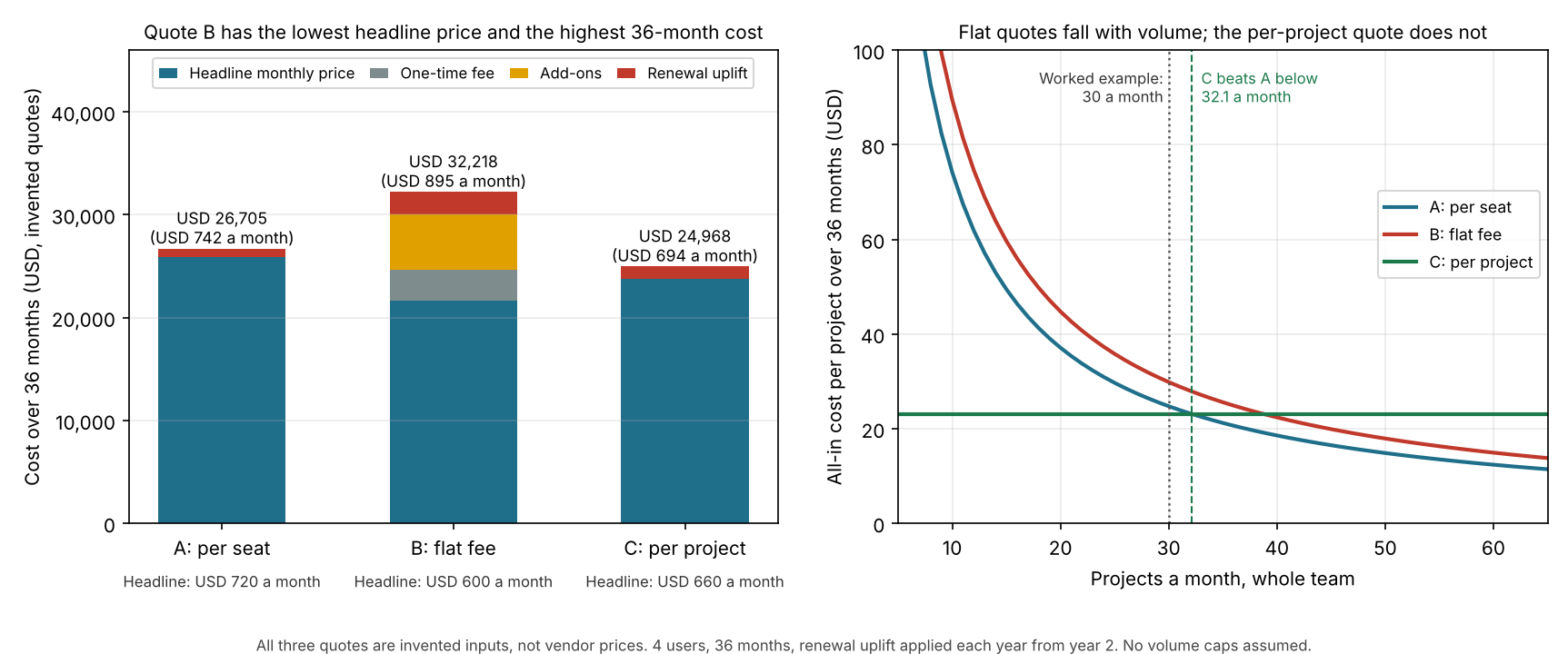
Figure 1. On three example quotes, the lowest headline price, USD 600 a month, becomes the highest 36-month cost after fees, add-ons and rises.
How do you get a comparable quote?
Send every company the same brief and ask for a written quote with each cost on its own line. Then convert all quotes to USD per month and USD per project over one term.
- Write one brief: users by role, projects a month in an average and a slow month, the term, and your must-have features.
- Ask for a written quote that separates recurring fees, one-time fees, add-ons and usage charges.
- Pick one term for all quotes, such as three years, even if a company quotes 12.
- Work out year 1, 2 and 3 separately. Apply each renewal rise from year 2.
- Add your own staff time for set-up and training. See onboarding and implementation.
- Divide the total by months and by projects. Rerun it at lower and higher volume.
What should you ask a company who will not show a price?
Ask for every line that changes the total: allowances, one-time fees, add-ons, renewal terms and exit terms. Get the answers in writing.
| Ask | Line it changes | Why, and from where |
|---|---|---|
| What do the users and monthly projects include, and what is extra? | Recurring price per project | Aurora’s page lists 1 user and 50 projects a month on Basic and Premium, and unlimited users on Enterprise. |
| Are there set-up or training fees? | One-time fee | JobNimbus says there are "no required setup or onboarding fees". Aurora lists a launch and training plan as an Enterprise add-on. |
| Which features are add-ons? | Add-ons per month | Aurora lists plan sets, engineering stamps and a design API as Enterprise add-ons. OpenSolar charges for API access and connectors. |
| What is the price in years 2 and 3, and is the rise capped? | Renewal rise | Tropic suggests a contract cap of 3% to 7% a year, or a most-favoured-nation clause if the company refuses a cap. |
| What is the minimum term, and how long is the notice to cancel? | Term and lock-in | Aurora’s annual plans need a one-year commitment. Tropic suggests a notice window of at least 60 days. Some are 30. |
| Can I cut users or volume at renewal, and what changes if I add them? | Seats and thresholds | Tropic suggests a clause allowing a 10% to 20% cut without penalty and asks about terms that change at a threshold. |
| Can I export my data if I leave? | Exit cost | Tropic suggests asking for a standard-format export within 30 days. |
The Tropic figures are one article’s suggestions (updated 19 May 2026), not a standard. Tropic does not cover implementation fees, so ask those separately.
Worked example: three example quotes
A team of 4 users runs 30 projects a month. All quote inputs below are example. Each quote is compared over 36 months, with its renewal rise applied in years 2 and 3.
| Example quote | Headline | One-time fee | Add-ons a month | Rise a year |
|---|---|---|---|---|
| A: per seat | 4 × USD 180 = USD 720 a month | USD 0 | USD 0 | 3% |
| B: flat fee | USD 600 a month | USD 3,000 | USD 150 | 8% |
| C: per project | 30 × USD 22 = USD 660 a month | USD 0 | USD 0 | 5% |
| Result (36 months) | A | B | C |
|---|---|---|---|
| All-in cost | USD 26,705.38 | USD 32,217.60 | USD 24,967.80 |
| All-in a month | USD 741.82 | USD 894.93 | USD 693.55 |
| All-in a project | USD 24.73 | USD 29.83 | USD 23.12 |
| Above the headline | 3.0% | 49.2% | 5.1% |
B ranks first on headline price and last on all-in cost. Dropping B’s USD 3,000 fee gives USD 29,217.60, still above A. Capping B’s rise at 3% gives USD 30,818.10, a saving of USD 1,399.50. B beats A only if its add-ons are dropped (USD 26,374.08 with the fee kept).
The result depends on volume. These quotes assume the flat and seat prices have no volume cap. They also assume the per-project price has no monthly minimum.
| Projects a month | A, USD a project | B, USD a project | C, USD a project |
|---|---|---|---|
| 10 | 74.18 | 89.49 | 23.12 |
| 15 | 49.45 | 59.66 | 23.12 |
| 30 | 24.73 | 29.83 | 23.12 |
| 45 | 16.48 | 19.89 | 23.12 |
| 60 | 12.36 | 14.92 | 23.12 |
C is cheaper than A below 32.1 projects a month and cheaper than B up to about 39. Above those volumes the flat and seat quotes win. See per-seat pricing and per-project pricing for the unit maths.
Comparable quote calculator
Enter up to three written quotes. The calculator returns the all-in cost, monthly and per-project figures, and the lowest quote over your term.
How solar software handles quote-only pricing
Of the five pages read, JobNimbus showed no price on any plan and Aurora showed a price on two of three. Scanifly and the ETB Developer page showed none. The table records what the pages showed in October 2026, not what the companies charge.
| Software | What the page shows | Button wording |
|---|---|---|
| Aurora Solar | Basic USD 159 and Premium USD 259 per user per month billed monthly (lower on annual billing). | "Contact Sales" on the Enterprise plan. "Get started" on Basic and Premium. |
| JobNimbus | No price on any of 4 plans: Essentials (up to 3 users), Pro (10), Premium (19) and Enterprise (20+). | "Request pricing" on every plan. A 14-day trial needs no card. |
| Scanifly | No price, plan or credit terms on the page read, which is a Scanifly and K2 Quote integration page. | "Book a Demo" in the header. |
| Energy Toolbase | No price or tiers on the ETB Developer page. The Pricing page shows "Request Pricing" for ETB Developer and "As low as" prices for other packages. | "Request Pricing" (Pricing page). "Get a Quote" form (product page). |
| OpenSolar | Core app free. API access billed through a wallet from 16 April 2026. Accounting connectors billed as a monthly fee per organisation. | Not stated (the page is an announcement, not a pricing page) |
Not stated means the company page we cite does not say. What needs a quote at each company, and which page was read, is listed below.
- Aurora Solar: What needs a quote: Enterprise ("Custom, per project", unlimited users) and its minimum commitment. Enterprise add-ons (plan sets, engineering stamps, design API, launch and training plan) have no prices. On-demand site models are from USD 9.99 on Basic and Premium. Page read: Pricing page.
- JobNimbus: What needs a quote: All plans, plus the Marketing and Communications bundles. Page read: Pricing page, no date printed.
- Scanifly: The page read is an integration page, not a pricing page, so it does not say what needs a quote. Page read: scanifly.com/?p=7386.
- Energy Toolbase: What needs a quote: ETB Developer. The Pricing page also shows "Contact Sales" for implementation and support packages. Page read: ETB Developer product page and Pricing page.
- OpenSolar: What needs a quote: No amount is stated for API access or connectors. Page read: Announcement of 16 February 2026, modified 11 March 2026.
A missing price on one page does not show a company has no public price elsewhere. JobNimbus is a contractor CRM, so see the best solar CRM software for that category.
Common mistakes with quote-only pricing
FAQs
Why do solar software companies not list prices?
Companies give general reasons, and no company page read states its own. G2 names three: complex pricing models, sticker shock and competitive concerns. Aurora’s Enterprise plan is priced "per project" with unlimited users, which does not fit a fixed list price.
Does quote-only pricing mean the software costs more?
Not necessarily. A missing price tells you only that the company chose not to publish it. Dupple says its study measures what companies publish, not what they charge. Compare quotes on all-in cost, not on whether a price was listed.
Can I get a price without a demo?
Not clearly. The quote-only plans read route you to a sales step. Aurora’s Enterprise plan shows "Contact Sales", and Scanifly shows "Book a Demo". Energy Toolbase shows "Request Pricing" and a "Get a Quote" form. No page says whether a written quote can be sent without a call. Ask for one in your first message.
How is quote-only pricing different from per-project pricing?
Quote-only describes how the price is given. Per-project describes the unit being charged. A quote-only company can quote per seat, per project or a flat fee, as in our three example quotes.
How do I compare a quote with a published price?
Put both on the same term and the same unit. Aurora Basic’s page price, for example, is per user per month, with 50 projects a month. Convert the quote to a monthly and per-project figure, then add fees and rises. The calculator above does this.
Related terms
- Per-seat pricing: a fixed fee for each person with a login.
- Per-project pricing: a fee for each design or project.
- Free plan vs free trial: a capped plan with no end date against a timed full-access trial.
- Onboarding and implementation: the set-up work, and its cost, up to go-live.
- Credits in solar software pricing: prepaid units some companies sell for design and report runs.
Next step: before you send your brief, compare the best solar CRM software, or the best solar design software for a design tool.
Sources
- Aurora Solar pricing page (checked 30 October 2026).
- JobNimbus pricing page (checked 30 October 2026).
- Scanifly page (checked 30 October 2026).
- Energy Toolbase ETB Developer page and Pricing page (checked 30 October 2026).
- OpenSolar: "OpenSolar Stays Free. Pay Only for API Access and App Connectors" (checked 30 October 2026).
- G2 Learn Hub: software pricing transparency, published 28 August 2025 (checked 30 October 2026).
- Dupple: software pricing transparency study, August 2026 (checked 30 October 2026).
- Tropic: 10 Questions to Ask a SaaS Company Before You Sign, last updated 19 May 2026 (checked 30 October 2026).
Last updated 30 October 2026. Next scheduled review: 30 January 2027.