Key takeaways
- The CFPB (7 August 2024), Aurora and Enerflo describe the fee as part of the loan principal. The customer repays it with interest.
- A fee quoted as a share of the principal is a bigger share of what you net. A 7% fee is 7.53% of the net (invented 7%).
- In an example you need 30,000 USD net. Quoting 30,000 USD nets 27,900.00, adding 7% to the price nets 29,853.00, and grossing up to 32,258.06 nets 30,000.00.
- The gross-up adds 2,258.06 USD to the principal, or 19.67 USD a month at 6.5% over 180 months.
- All five tools checked have a dealer fee field. Three print the basis on the page read.
To compare the finance tools that handle dealer fees, see the best solar financing platforms for installers list.
Dealer fee at a glance
A dealer fee turns the price you want to net into a larger loan principal. The fee is set by the lender’s programme and the loan contract.
| Item | Detail |
|---|---|
| Formula | Principal = cost ÷ (1 − fee %). Fee = principal − cost. Aurora and Enerflo help pages print this form. |
| Unit and range | A percentage of the principal, sometimes with a flat USD amount. No single range applies, and this page gives none. |
| Where it matters | Quoted price, money received from the lender, proposal monthly payment and project margin. |
| Standard or rule | No technical standard. The contract sets it. Disclosure and consumer-credit rules differ by state and change, so check the current rule. |
| In software | Loan options in proposal and finance tools. See the software table. |
Why does the dealer fee matter for installers?
It sits between the price you quote and the money you receive. If you ignore it, you lose margin or you show the customer the wrong payment.
The CFPB says lenders "frequently bake these fees" into the loan principal. The report also says salespeople "often do not explain the difference in the cash price and loan principal". In its worked example the lender pays the installer the cash price and keeps the added fee, so the installer nets the cash price. Our example below differs. There the lender takes a percentage of the whole principal, which leaves a shortfall.
For the loan payment maths, see solar loan.
On what base is a dealer fee quoted?
A fee can be a share of the principal or a share of the price added on top. The same quoted percentage gives a different amount on each base.
- Share of the principal: the fee is taken from the amount funded. Enerflo’s help says fees are "calculated as a percentage of the total cost including the fee". Aurora prints the same formula.
- Share of the price: the fee is added to the cash price. The CFPB example adds 9,000 USD to a 30,000 USD cash price, which is 30% of the price.
The table converts one base to the other. It uses illustrative inputs, not market fees.
| Quoted fee | As a share of your net, if taken from the principal | As a share of the principal, if added to the price |
|---|---|---|
| 5% | 5.26% | 4.76% |
| 7% | 7.53% | 6.54% |
| 10% | 11.11% | 9.09% |
| 20% | 25.00% | 16.67% |
| 30% | 42.86% | 23.08% |
How to calculate a dealer fee
- Find the basis in the lender’s paperwork: principal, price or both, plus any flat amount.
- Set the net you need. This is your cost plus your margin.
- For a fee on the principal, divide (net + flat fee) by (1 − fee %). The result is the price and principal.
- Subtract the net from the principal to get the total fee.
- Divide the fee by your net to see its real weight. At 7% of principal this is 7 ÷ 93, or 7.53%.
Worked example: 30,000 USD net, 7% fee
You need 30,000 USD net. The lender funds the quoted price less a fee of 7% of the principal. Every number below is example. There is no flat fee or down payment. The loan is 6.5% a year over 180 months, using the payment formula on the solar loan page.
| Approach | Price and principal (USD) | Fee withheld / you receive (USD) | Short of 30,000 (USD) | Monthly payment (USD) |
|---|---|---|---|---|
| Quote the net price | 30,000.00 | 2,100.00 / 27,900.00 | 2,100.00 | 261.33 |
| Add 7% to the price, lender takes 7% of the principal | 32,100.00 | 2,247.00 / 29,853.00 | 147.00 | 279.63 |
| Gross up: 30,000 ÷ 0.93 | 32,258.06 | 2,258.06 / 30,000.00 | 0.00 | 281.00 |
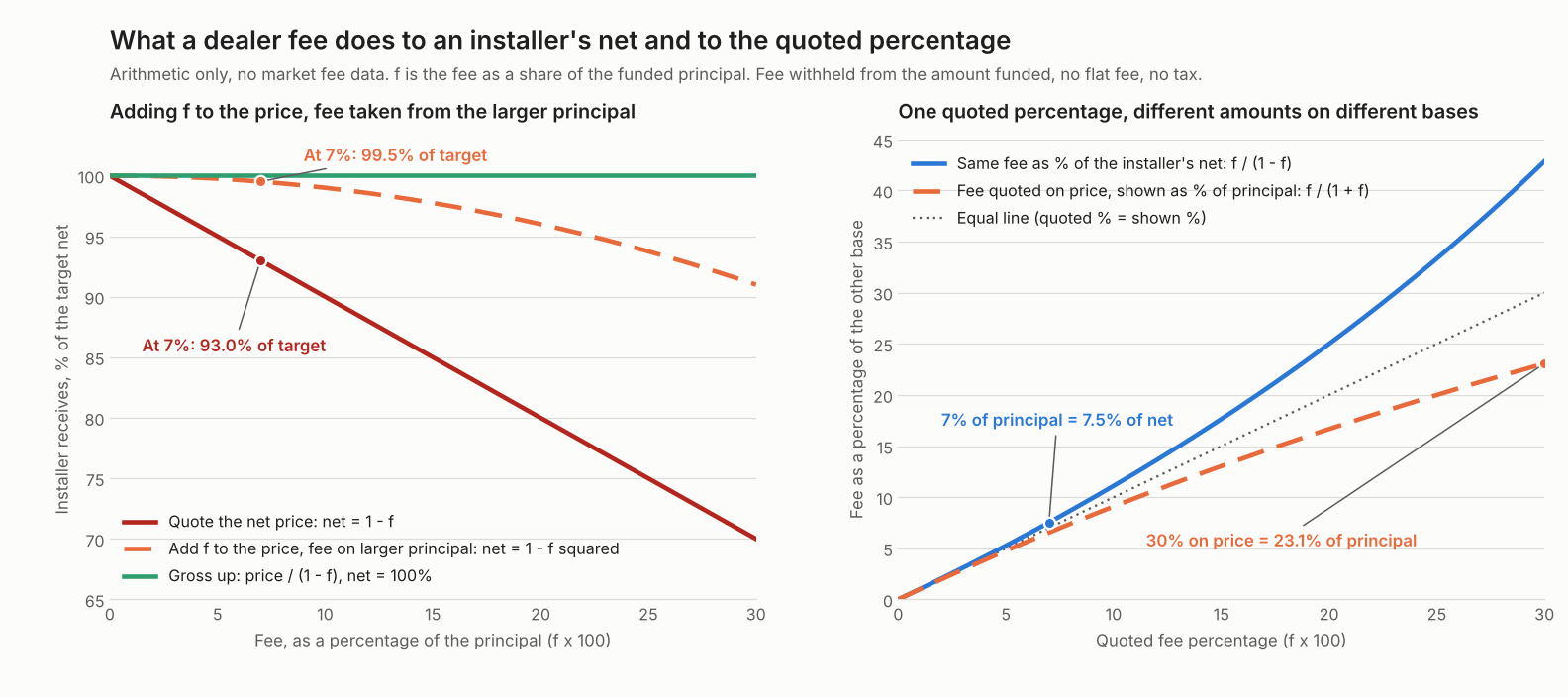
Figure 1. Adding the fee percentage to the price still leaves you short. Only a gross-up returns the target net.
Adding 7% leaves you 147.00 USD short, which is 30,000 × 0.07 × 0.07. The gross-up protects your net but raises the principal by 2,258.06 USD. The customer pays 19.67 USD more a month than at the net price. A flat fee of 500 USD on top lifts the gross-up price to 32,795.70 USD. The total fee is then 9.32% of your net.
Calculator: price, fee and net
Enter your own inputs. It shows price, fee, net received, shortfall and monthly payment for the three approaches. It warns on blank, negative, out-of-range or ambiguous values.
Not showing? Open the dealer fee calculator on its own page.
What should you ask the lender about the fee?
Put these questions to the lender before you build a financed quote, because the answers change the principal you show.
- Is the fee a share of the principal, of the price, or both, and is there a flat amount?
- Does it apply to add-ons and batteries? Enerflo has a separate help page for fees on adders.
- Do cost-based incentives count in the fee base? Aurora has a setting for this.
- Do the customer’s loan documents show the fee in the total cost of credit? The CFPB says lenders typically do not.
- What happens to the fee if the price changes after signing?
How solar software handles a dealer fee
All five tools have a dealer fee field, and three print the basis on the page read. A field alone does not tell you which base the tool uses. Ratings follow each company’s own help page, opened in October 2026.
| Software | Dealer fee field? | Basis printed on the page |
|---|---|---|
| Enerflo | Yes | Total cost including the fee |
| Aurora Solar | Yes | Loan principal |
| OpenSolar | Yes | Loan amount |
| Solargraf | Yes | Not stated |
| ARKA 360 | Yes | Not stated |
Not stated: the page we cite does not say what the fee is a percentage of.
- Enerflo. Basis: "a percentage of the total cost including the fee". Total cost = system cost ÷ (1 − fee %). The fee is entered as a decimal. Source: Enerflo help, How dealer fees are calculated, written 29 March 2026.
- Aurora Solar. Basis: "The percentage of the loan principal that the financial institution takes as a fee". Loan principal = system cost ÷ (1 − fee %). A setting applies cost-based incentives to principal plus fee. Source: Aurora help, Loan Dealer Fee and Loan Modeling Overview, no date shown.
- OpenSolar. Basis: "Percentage of the loan amount". The page formula is Standard System Price = Base System Price ÷ (1 − Dealer Fee %). Fixed amount and adjustment fields. Can gross up the standard system price so the fee does not reduce project margin. Source: OpenSolar help, How to configure a loan payment option, no date shown.
- Solargraf. Select a fee type and enter the fee. A calculations pop-up previews the fee shown on the proposal. The page does not list the fee types or their basis. Source: Solargraf help, How to set up loans, published 24 August 2022.
- ARKA. Dealer fees are listed for bullet and mortgage-style loans. The page does not say what the fee applies to. Source: ARKA 360 help, How to add a loan, 16 December 2024.
For tools that model financing, see the best solar financing platforms for installers list and the best solar financial modeling software list.
Common mistakes with a dealer fee
FAQs
Is a dealer fee the same as interest?
No. Interest is charged on the balance over time. A dealer fee is added to the principal, so it then earns interest. The solar loan page shows what that adds to the total paid.
Who pays the dealer fee?
The customer repays it through a larger principal. Who bears it beyond that depends on the programme. In the CFPB’s example the lender pays the installer the cash price and keeps the fee. In our example the lender takes a percentage of the principal, so the installer is short unless the quote is grossed up. Read each lender’s terms.
Is a dealer fee the same as an origination fee?
Similar, but names vary by lender. EnergySage’s page (last updated 14 November 2023) calls it "similar to an origination fee on a home loan". Whether a rule treats a fee as a finance charge is a legal question, so ask your adviser.
Does the dealer fee show in the APR?
Often not. The CFPB says those APRs "often do not include fees that increase the loan principal" on top of the cash price. Request a figure from the lender that includes the fee, and confirm the current rule.
Can I absorb the fee instead of passing it on?
Yes, it is a pricing choice. If you do not gross up, the fee comes out of your margin. OpenSolar’s help describes grossing up so the fee does not reduce the intended project margin.
Related terms
- Solar loan: money borrowed to buy a solar system, repaid with interest.
- Adders: priced extras on top of the base system price.
- Cost per watt: the system price divided by system size.
- Solar proposal software: tools that build the customer’s priced offer.
Next step: find out which base your lender’s fee uses, then run your next financed quote through the dealer fee calculator.
Sources
- CFPB: Issue Spotlight: Solar Financing (https://consumerfinance.gov/SolarFinancingReport), 7 August 2024 (checked October 2026).
- EnergySage: Understanding solar loan fees, last updated 14 November 2023 (checked October 2026).
- Enerflo help: How dealer fees are calculated, written 29 March 2026, and Calculating dealer fees on adders, no exact date (checked October 2026).
- Aurora help: Loan Dealer Fee and Loan Modeling Overview, no date shown (checked October 2026).
- OpenSolar help: How to configure a loan payment option, no date shown (checked October 2026).
- Solargraf help: How to set up loans, published 24 August 2022 (checked October 2026).
- ARKA 360 help: How to add a loan as a financing option, 16 December 2024 (checked October 2026).
- Calculation: SolarSoftwares fee model. Every input is an assumption.
Last updated 30 October 2026. Next scheduled review: 30 January 2027.