Key takeaways
- Our invented loan finances 25,000 USD plus an 8% dealer fee, so the principal is 27,173.91 USD. At 6.5% over 180 months the payment is 236.71 USD.
- Interest is 61.0% of the year-1 payments and 3.4% of the year-15 payments. After 60 payments, 20,847.04 USD (76.7% of the principal) is still owed.
- The fee sits inside the principal, so it earns interest. Against the same loan with no fee, it adds 2,173.91 USD to principal and 3,408.68 USD to total paid.
- A fee quoted on price differs from one quoted on principal. The CFPB’s 2024 example adds 9,000 USD to a 30,000 USD cash price. That is 30% of price and 23.1% of principal.
- Four of the six tools checked name a dealer fee field. Confirm its basis before you compare quotes.
To compare platforms that offer loans to your solar customers, see the best solar financing platforms for installers.
Solar loan at a glance
A solar loan swaps a purchase price for a debt. The borrower repays it on a schedule. A tool can work that schedule out from a few inputs.
| Item | Detail |
|---|---|
| Formula | Payment = P × r ÷ (1 − (1 + r)^−n), where P is the principal, r the monthly rate and n the number of payments. At 0% it is P ÷ n. |
| Unit and range | USD per month. Term in months. No single range applies. The CFPB (7 August 2024) describes solar-specific loans as "fixed-term, usually fixed-rate installment loans". |
| Where it matters | Proposal monthly payment, owner-side finance model, lender hand-off. |
| Standard or rule | No technical standard. The loan contract sets every term. This page is not legal advice. |
| In software | Proposal and finance tools with a loan option. Fields differ. See the software table. |
Why does a solar loan matter for installers?
The buyer compares a monthly payment, not a price. A wrong loan input changes the payment, the interest total and every chart built on them.
The principal is not always the price. The CFPB says lenders "frequently bake" fees into the principal, commonly called "dealer fees". It says they often "do not indicate that these fees are a markup". Show cash price, fee and principal on separate lines. See dealer fee.
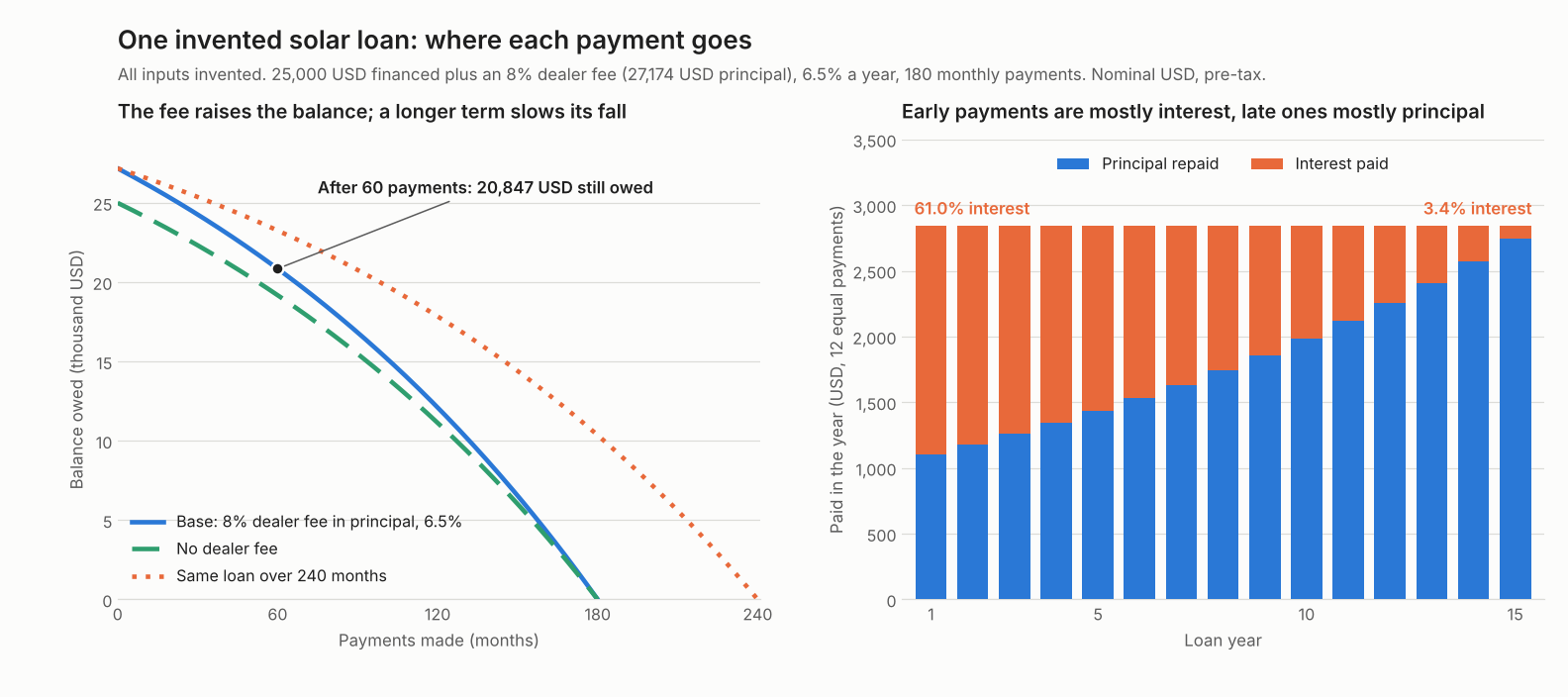
Figure 1. In this example’s loan, interest is 61.0% of year-1 payments and 3.4% of year-15 payments. The fee raises the balance by 2,173.91 USD from day one.
How does a solar loan differ from cash, a lease and a PPA?
With a loan, the host borrows, buys and owns the system. With a lease or PPA, a third party owns it. The CESA and NYSERDA guide (2016) says "the homeowner owns the installed system" with a loan.
The table below lists the inputs each structure needs. For payments, escalators and end of term, see solar lease, power purchase agreement and third-party ownership.
| Structure | Core inputs a tool needs | Cash flow table shows |
|---|---|---|
| Cash | Price. Any incentive | One outflow at year 0 |
| Loan | Principal, term, interest rate, rate type, dealer fee, down payment, payment schedule | Down payment at year 0, then loan payments split into interest and principal |
| Lease | Monthly payment, escalator, term, upfront payment | Scheduled payments to the owner |
| PPA | Price per kWh, escalator, term | Payments for energy delivered |
The contract sets a loan payment. The system’s output does not. A weak yield estimate cuts the bill offset but leaves the payment unchanged. See cash flow analysis.
What loan inputs does a proposal or finance tool need?
Seven fields shape most loan quotes: principal, term, interest rate, rate type, dealer fee, down payment and payment schedule. No tool we checked shows all seven. The last column shows what each does in our example.
| Field | What it holds | Effect in our example (example) |
|---|---|---|
| Principal | The amount borrowed, fees included | 27,173.91 USD from a 25,000 USD financed price |
| Term | Number of payments, usually in months | 120 months: 308.55 USD a month. 240 months: 202.60 USD |
| Interest rate | Annual rate. Tools convert it to a monthly rate | One point higher adds 2,734.48 USD of interest |
| Rate type | Fixed, or a rate that changes after a set period | Reset to 8.5% after payment 60: payment rises from 236.71 to 258.47 USD |
| Dealer fee | A percentage, a flat amount or both, and the basis it applies to | 8% of principal adds 2,173.91 USD. A flat 2,000 USD adds 2,000 USD, 173.91 USD less |
| Down payment | Cash paid at year 0, which cuts the amount financed | 2,000 USD paid at year 0 |
| Payment schedule | Level, interest-only start, no-payment start, step-up or lump sum | 12 interest-only months add 614.35 USD of interest |
How does software model loan cash flows?
A tool builds a month-by-month schedule from the principal, rate and term. It then adds the months into years. Interest and principal stay on separate lines.
- Fix the convention. Aurora’s help says it converts the annual rate to a monthly rate. We assume annual rate ÷ 12, paid at month end.
- Build the principal: (cash price − down payment) ÷ (1 − fee share) + flat fee. Aurora’s dealer fee page gives "Loan principal = System cost ÷ (1 − Dealer fee %)".
- Work out the payment with the formula in the glance table.
- Each month, interest = balance × monthly rate. Principal repaid = payment − interest. New balance = old balance − principal repaid.
- When the schedule changes, work out the payment again from the balance over the months left. Changes include a rate reset, a lump sum or the end of an interest-only period.
- Add twelve months for each year. Year 0 holds the down payment. Feed the yearly payments to cash flow analysis and NPV.
The balance after k payments is P(1 + r)^k − payment × ((1 + r)^k − 1) ÷ r. Project debt sized from a cover ratio works differently. See project finance model and financial modeling.
Worked example: a 27,000 USD system on a 15-year loan
This example’s loan has a 27,173.91 USD principal and a 236.71 USD payment. Total interest is 15,434.60 USD. The total of payments is 42,608.51 USD.
| Input (example) | Value |
|---|---|
| Price and down payment | 27,000 USD cash price. 2,000 USD down at year 0. 25,000 USD financed |
| Dealer fee | 8% of principal (a placeholder, not a market figure). Principal = 25,000 ÷ 0.92 |
| Rate and term | 6.5% a year, fixed. Monthly rate = 6.5% ÷ 12. 180 payments |
| Left out | Tax, incentives, bill savings, late fees, insurance, other lender fees |
Selected payments, in USD. Rows are rounded, so a total can differ by 0.01.
| Payment | Paid | Interest | Principal | Balance after |
|---|---|---|---|---|
| 1 | 236.71 | 147.19 | 89.52 | 27,084.39 |
| 2 | 236.71 | 146.71 | 90.01 | 26,994.38 |
| 12 | 236.71 | 141.71 | 95.00 | 26,067.06 |
| 60 | 236.71 | 113.59 | 123.13 | 20,847.04 |
| 120 | 236.71 | 66.45 | 170.26 | 12,098.14 |
| 180 | 236.71 | 1.28 | 235.44 | 0.00 |
| Total, 180 payments | 42,608.51 | 15,434.60 | 27,173.91 |
Our order is down payment first, then the fee. A lender that applies the fee to the full price gets 27,347.83 USD.
After 60 payments, the borrower has repaid 6,326.87 USD of principal. The balance owed is 20,847.04 USD. Each case below changes one input and keeps the rest at base:
| Case (example) | Principal | Monthly payment | Total interest | Total paid |
|---|---|---|---|---|
| Base: 8% fee in principal, 6.5%, 180 months | 27,173.91 | 236.71 | 15,434.60 | 42,608.51 |
| No dealer fee | 25,000.00 | 217.78 | 14,199.83 | 39,199.83 |
| Fee as a flat 2,000 USD (8% of the 25,000 USD price) | 27,000.00 | 235.20 | 15,335.82 | 42,335.82 |
| Term 120 months | 27,173.91 | 308.55 | 9,852.60 | 37,026.51 |
| Term 240 months | 27,173.91 | 202.60 | 21,450.42 | 48,624.33 |
| Rate 7.5% (1 point higher) | 27,173.91 | 251.91 | 18,169.08 | 45,343.00 |
The next three cases change the payment schedule instead of one input.
| Schedule change (example) | Principal | Monthly payment | Total interest | Total paid |
|---|---|---|---|---|
| Rate resets to 8.5% after payment 60 | 27,173.91 | 236.71, then 258.47 | 18,045.74 | 45,219.66 |
| Interest-only for 12 months | 27,173.91 | 147.19, then 246.77 | 16,048.95 | 43,222.86 |
| 3,000 USD lump sum after payment 12 | 27,173.91 | 236.71, then 209.47 | 13,857.80 | 41,031.71 |
The cases change different amounts, so they do not rank the options. The fee costs 3,408.68 USD in total paid. That is more than its 2,173.91 USD face value, because it accrues interest. If the 3,000 USD lump sum is paid and the payment stays at 236.71 USD, the loan ends after 151 payments instead of 180.
Calculator: payment, interest and balance after N payments
Enter your own inputs. It returns the payment, total interest, fees in principal and balance after N payments, plus a yearly table. It warns on blank, negative, out-of-range or ambiguous values. Open the solar loan calculator on its own page if the frame does not load.
How do tax and incentives enter a loan model?
A loan borrower owns the system, so owner-side incentive rules apply to the borrower. This page gives no tax advice and no credit rate.
- The CESA and NYSERDA guide (2016) says a loan customer "will be able to take direct ownership of most incentives". It came before the 2025 changes.
- IRS FAQ FS-2025-05 (21 August 2025) says the residential clean energy credit "will not be allowed for any expenditures made after December 31, 2025". An expenditure is treated as made "when the original installation of the item is completed". The test is the installation date, and the FAQ does not mention financing.
- Some tools model a lump sum sized to an incentive. Examples are Aurora’s mortgage-style loan with incentive paydown and OpenSolar’s prepayment option. Solargraf has payment types tied to a tax-credit paydown. Whether the incentive exists, and when it is paid, is a rule question.
See solar incentives and rebates and investment tax credit. A tax adviser can say how they apply to a given system.
How solar software handles a solar loan
Four of the six tools name a dealer fee field, while Scanifly and HelioScope do not. Down payment and payment schedule fields differ too. Ratings follow each company’s own help page, checked October 2026, and details are in the list under the table.
| Software | Models a loan? | Dealer fee field? | Source and date |
|---|---|---|---|
| Aurora Solar | Yes | Yes: a percentage built into principal, plus a flat fee | Aurora help, Loan Modeling Overview, updated 22 September 2026. Loan Dealer Fee, undated |
| Solargraf | Yes | Yes: dealer fee type and dealer fee | Solargraf help, How to set up loans, published 24 August 2022 |
| OpenSolar | Yes | Yes: dealer fee percentage, fixed amount and adjustment | OpenSolar help, How to configure a loan payment option, updated 2 September 2026 |
| ARKA 360 | Yes | Yes: dealer fees on bullet and mortgage-style loans | ARKA help, How to add a loan, 16 December 2024 |
| Scanifly | Partly | Not stated (an administration fee only) | Scanifly help, select a financing option, undated |
| HelioScope | Yes | Not stated | HelioScope Financial Modeling Glossary, updated 4 August 2026 |
- Aurora Solar: Principal as a percentage of system cost (100% means no money down), interest rate, duration in months, eight loan types. No down payment or rate type field.
- Solargraf: Loan term in months, an advertised rate field (labeled APR on the page), loan amount, down payment, rate type, four payment schedule types, no-payment period, interest-only option.
- OpenSolar: Interest rate, loan term, reversion rate and start, down payment percentage, solar-style or mortgage-style, promotional terms, prepayment, payment frequency. A rate type field is not listed.
- ARKA 360: Principal percentage, interest rate, loan duration, four loan types, prepayment options. Down payment is not named.
- Scanifly: Names an interest rate, a "term rate" and an administration fee. It names no dealer fee field.
- HelioScope: Down payment (fixed USD at year 0), loan terms in months, and a rate field labeled "Annual Percentage Rate". No fee field on the page.
Partly means the page lists some loan fields but not all. Not stated means the company page we cite does not say. More tools are in the best solar proposal software list and the best solar financing platforms for installers list.
Common mistakes with a solar loan
FAQs
Is a solar loan the same as a lease or a PPA?
No. With a loan, the borrower owns the system and repays money borrowed, per the CESA and NYSERDA guide (2016). With a lease or PPA, a third party owns it. See solar lease.
Is the dealer fee part of the loan amount?
Often, yes. Aurora’s help says the dealer fee is "built into the loan principal". The CFPB (7 August 2024) says lenders add such fees to the principal above the cash price. The basis a tool uses decides the principal.
How is a solar loan payment calculated?
The formula in the glance table is payment = P × r ÷ (1 − (1 + r)^−n). In this example’s loan, a 27,173.91 USD principal at 6.5% over 180 months gives 236.71 USD a month. At 0% the payment is P ÷ n.
Does a solar loan payment change if the system produces less?
No. The contract fixes the payment, so lower output does not change it. Only a rate reset or a step schedule can. Lower output cuts the bill offset, not the payment.
Related terms
- Solar lease: a contract where an owner installs solar and the host pays a scheduled amount.
- Third-party ownership: a company other than the site host owns the system, by lease or PPA.
- Dealer fee: a lender charge built into the loan principal.
Next step: price a quote at 120 and 240 months in the calculator above, then compare lenders on the best solar financing platforms for installers.
Sources
- CFPB: Issue Spotlight: Solar Financing, 7 August 2024 (checked October 2026).
- CESA and NYSERDA: Homeowner’s Guide to Solar Financing, 2016 cover date (checked October 2026).
- IRS: FAQs on changes to home energy credits, FS-2025-05, 21 August 2025 (checked October 2026).
- Company help pages: Aurora loan overview, Aurora dealer fee, Solargraf, OpenSolar, ARKA 360, Scanifly and HelioScope (checked October 2026).
- IRS FS-2025-05, FAQ 7 and the residential clean energy credit summary row, re-read 30 October 2026. CFPB report and Scanifly help page re-read the same day.
- Calculation: SolarSoftwares model. Every input is our assumption.
Last updated 30 October 2026. Next scheduled review: 30 January 2027.