Key takeaways
- Derate is the product of (1 - loss) for each of the ten losses. PVWatts V5 lists a 14% total. Chaining its ten defaults gives 14.08%, and adding them gives 15.0%.
- Names changed. PVWatts version 1 used a derate of 0.77 that included the inverter. Version 5 takes a 14% loss. It models the inverter on its own.
- A derate leaves out cell temperature, inverter efficiency and reflection.
- In our invented site, the ten percentages add to 18.5% but chain to 17.16%. On an example 10,000 kWh, adding costs 134 kWh of the result.
- To build your own, replace each default with site evidence and multiply. Label which entries are evidence and which are defaults.
To model these losses in software, see the best solar simulation software. For the shading entry, see the best solar shading analysis software.
Derate factor at a glance
A derate factor, also called overall derate or system loss factor, is a number below 1 that shrinks an energy estimate. It stands for losses the model does not work out on its own.
| Item | Detail |
|---|---|
| Formula | Derate = Π(1 - Li/100). Loss % = 100 × (1 - derate). Both are as the PVWatts V5 manual and pvlib print them. |
| Unit and default | A fraction (0.86) or a loss percentage (14%). The V5 manual lists a 14% total. The ten defaults chain to 14.08% on our arithmetic. PVWatts version 1 used a derate of 0.77. |
| Where it matters | Quick yield estimates, programme paperwork and checking a quote’s kWh |
| Standard or rule | No standard. It is a modelling input, set by the tool and the user. |
| In software | PVWatts and SAM’s PVWatts model take one total. Detailed tools take separate losses. |
Why does the derate factor matter for installers?
It sets how much of the modelled energy a customer is told to expect. A derate that is too kind inflates every kWh figure in a proposal.
Programmes can ask for it. The New Jersey Clean Energy Program page on PVWatts lists "System Losses % (DC-to-AC Derate Factor)" as an as-built input. It asks for one per array plane (page undated as read). Check each programme’s own rule before you change a default.
For the full list of loss steps, see the system loss diagram page.
What goes into a derate factor, and what stays out?
PVWatts V5 lists ten components. The NLR (formerly NREL) manual says the input covers "Losses in the system that are not explicitly modeled". Inverter efficiency and cell temperature are not part of it.
| Component | What the V5 manual says it covers | Default |
|---|---|---|
| Soiling | Dirt and dust on the modules. See soiling. | 2% |
| Shading | The default covers far features that block the horizon, such as large buildings. For nearby trees or structures, the manual says to raise it using shading software or an on-site survey. | 3% |
| Snow | Snow cover on the modules. | 0% |
| Mismatch | Differences between modules in the array. See mismatch loss. | 2% |
| Wiring (DC and AC combined in V5) | All wiring losses in one line. | 2% |
| Connections | Electrical connections. | 0.5% |
| Light-induced degradation (LID) | Power lost on first sun exposure. The manual calls 1.5% "a typical value" and says some modules are lower or higher. | 1.5% |
| Nameplate rating | The gap between a module’s rated and actual output. | 1% |
| Age | System ageing. The manual mentions about 0.5% a year of long-term degradation. | 0% |
| Availability | Time the system is not working. | 3% |
Source: PVWatts Version 5 Manual, NREL/TP-6A20-62641, September 2014, Section 11 and Table 6. pvlib’s pvwatts_losses prints the same ten defaults and cites that manual.
Three things stay outside. The manual says inverter efficiency "is not included in the system loss". It is a separate input. Cell temperature comes from its thermal model. PVWatts models reflection on its own (angle-of-incidence correction, Section 8). See temperature coefficient and inverter clipping.
An old derate can mislead. The V5 manual says PVWatts V1 "used a DC-to-AC derate factor with a default value of 0.77". Enphase’s July 2014 V1 table lists an inverter and transformer factor of 0.92. It sits inside a 0.770 total. The manual turns a 14% loss into 0.86, multiplies by a 0.96 inverter efficiency and prints 0.825 as the V1-style equivalent. Never mix a V1-style derate with a V5-style loss. If you do, the inverter is counted twice or not at all.
How is a derate factor different from performance ratio?
A derate is a model input for some losses. Performance ratio (PR) is an output that includes all of them. They match only if nothing else cuts energy, which is rare.
PR divides AC energy by nameplate power times sunlight on the array. So it also carries temperature. It carries reflection, inverter efficiency and clipping too. A pvlib 0.16.1 run used its bundled typical-year weather file (Greensboro, North Carolina TMY3). The array was an example 10 kW system. It had a derate of 0.828, a -0.35% per kelvin coefficient (assumed), a 96% nominal inverter and a DC/AC ratio of 1.2.
The model gave a PR of 0.750. The other factors were temperature 0.958, reflection 0.987 and inverter with clipping 0.956. The four rounded factors multiply to about 0.748, and the model’s unrounded values give 0.750. Another tool, site or loss set will split it differently.
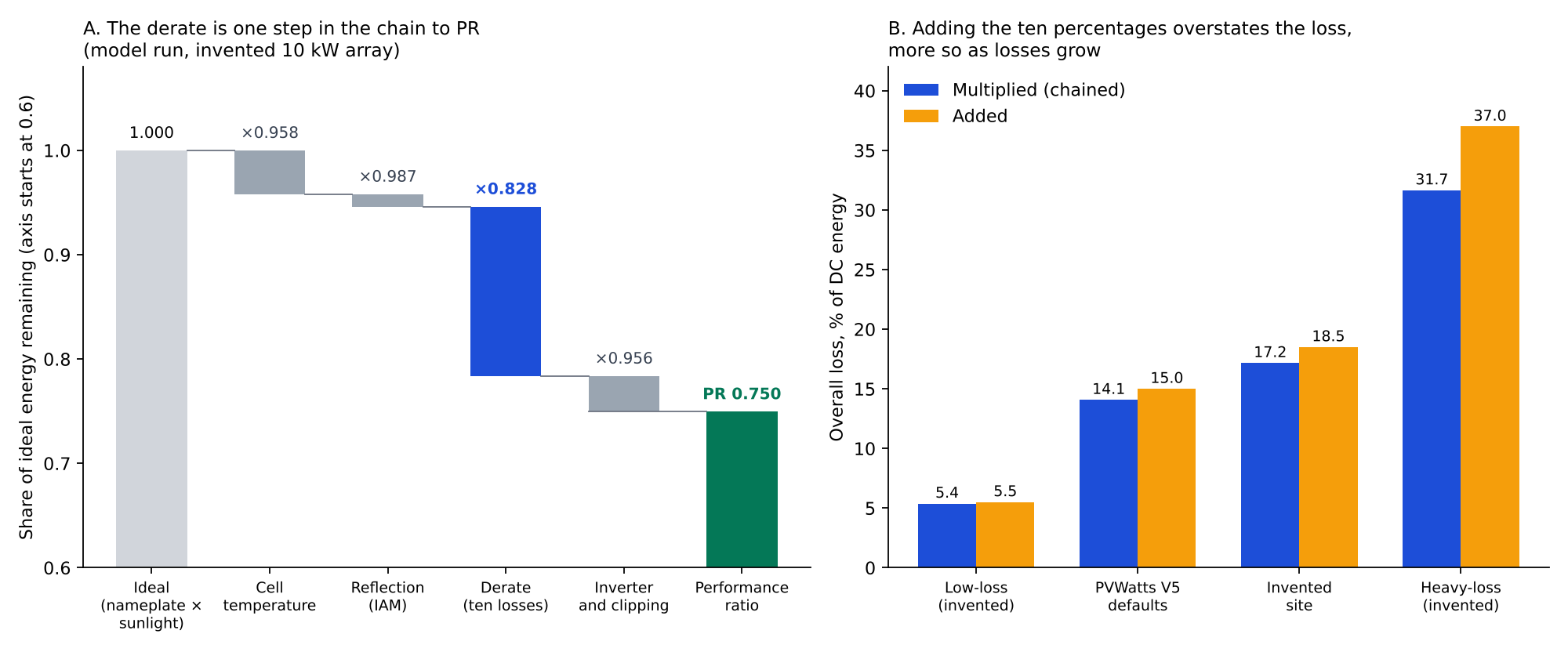
Figure 1. In an example model run a derate of 0.828 becomes a performance ratio of 0.750. Adding the ten percentages overstates the loss in all four sets.
A SAM forum moderator answered the same question in January 2021: "PVWatts does not report the performance ratio." That reply is not documentation. It does match the manual. See performance ratio for the measured form.
How do you build your own derate factor?
List the ten components. Replace each default you can back with site evidence. Then multiply the factors. Keep the rest as labelled defaults.
- Write each loss as a percentage. Turn it into a factor: 1 - L/100. A 4% loss is 0.96.
- Take shading from a survey or shading analysis, not the default. The manual says its 3% suits far horizon features only.
- Set soiling, snow and availability from local conditions and your service plan.
- Set nameplate and mismatch from the module datasheet tolerance and the string layout.
- Multiply all ten factors. Convert back with loss % = 100 × (1 - derate).
- Check the result against the tool’s own total. To find one missing part, use 1 - target ÷ (product of the others).
If your tool models the inverter and temperature, leave them out. If it does not, apply them on their own. Do not fold the inverter into the derate. The exception is a tool whose input says it includes it.
Worked example: multiply or add?
The ten losses below are example for a new roof system. They are not measurements. They are not NREL defaults.
| Component | Loss (example) | Factor | Running derate |
|---|---|---|---|
| Soiling | 4.0% | 0.960 | 0.960 |
| Shading | 6.0% | 0.940 | 0.902 |
| Snow | 1.0% | 0.990 | 0.893 |
| Mismatch | 1.5% | 0.985 | 0.880 |
| Wiring | 1.5% | 0.985 | 0.867 |
| Connections | 0.5% | 0.995 | 0.862 |
| LID | 1.5% | 0.985 | 0.850 |
| Nameplate rating | 0.5% | 0.995 | 0.845 |
| Age | 0.0% | 1.000 | 0.845 |
| Availability | 2.0% | 0.980 | 0.828 |
The chained derate is 0.828, a loss of 17.16%. The ten percentages add to 18.5%. Adding overstates the loss by 1.34 points.
| Method (example 10,000 kWh DC) | Overall loss | Energy after derate |
|---|---|---|
| Multiplied | 17.16% | 8,284 kWh |
| Added | 18.50% | 8,150 kWh |
The added method gives 134 kWh less, 1.6% below the correct figure. The same arithmetic on PVWatts’ ten defaults gives 14.08% chained against 15.0% added. With mismatch set to 0 it gives 12.32%. OpenSolar’s help page quotes "approximately 12.32%" for microinverter systems. That matches.
The same sums test a quote. A proposal with a derate of 0.80 implies an extra 3.42% loss on top of these ten entries, and the extra needs an explanation. A derate of 0.86 implies 3.82% more energy than they support.
Derate factor calculator
Enter the ten losses. The calculator returns the derate, the loss percentage and the kWh left after derate.
If the calculator will not load, open the derate factor calculator on its own page.
How solar software handles the derate factor
Three of the six tools we read in October 2026 take one overall loss. Aurora Solar and HelioScope list separate losses, and OpenSolar mentions a default only.
| Software | One overall derate or loss input? | Page read |
|---|---|---|
| PVWatts | Yes | NREL API page for V8 (undated). V5 manual, September 2014 |
| SAM | Yes | PySAM Pvwattsv8 module page (undated) |
| pvlib python | Yes | pvlib documentation, "latest" page, a 0.16.2 development build. Our run used 0.16.1 |
| Aurora Solar | No | System Losses, updated 29 June 2026 |
| HelioScope | No | Loss Factors in HelioScope (no date shown) |
| OpenSolar | Partly | Energy Production Calculators in OpenSolar (no date shown) |
No means the page lists separate losses and no single input. Partly means the page mentions a default derate but no editable input.
How and where each tool takes losses:
- PVWatts: Version 8 API: required parameter "losses", described as "System losses (percent)", range -5 to 99, no default printed. The V5 manual’s default is 14%.
- SAM: The PVWatts model has a "DC system losses [%]" input, range -5 to 99. The page lists no components.
- pvlib python:
pvwatts_lossesturns the ten losses into one total by the product formula. - Aurora Solar: Separate inputs by group, such as soiling 2%, shading 3%, mismatch 2%, availability 3%. It says losses are multiplicative. No single derate is described.
- HelioScope: Loss factors such as soiling (default 2%) are set in the Condition Set. The page describes no single derate.
- OpenSolar: Says PVWatts "applies default system derating assumptions", fixed by system configuration. It does not describe an editable derate.
PVsyst’s array and system losses page lists 15 loss types. It has no single derate input (page undated). The best solar simulation software list ranks the tools that model these losses.
Common mistakes with the derate factor
FAQs
What is a good derate factor?
PVWatts V5 defaults to a 14% loss, a derate of 0.86, but no source we read gives a single good derate. The manual calls its shading default suitable for far features only. Replace the shading and soiling entries with site evidence, and judge the rest the same way.
Is derate the same as system losses?
They are two views of one number. Derate is 1 minus the loss, so a 14% loss is 0.86. Clean Power Research’s developer page writes it as 100 minus system losses in percent. Tools differ on whether an input means the multiplier or the loss.
Does the derate include the inverter?
In PVWatts V5, no. The manual says inverter efficiency is a separate input, default 96%. The older V1 derate of 0.77 did include an inverter factor.
Can I use one derate for a microinverter system?
You can, but change the mismatch entry. Enphase’s July 2014 brief for PVWatts V1 advises a mismatch factor of 1.00. Check the company’s current advice for your tool and version.
Does the derate change over the system’s life?
Only through the age component, which defaults to 0%. The V5 manual mentions about 0.5% a year of long-term degradation. See degradation rate.
Related terms
- System loss diagram: each loss step drawn in order.
- Performance ratio: AC energy against nameplate times sunlight.
- Energy yield simulation: the model that the derate feeds.
Next step: list your ten loss entries and mark which are site evidence. Then test your usual derate in a simulator with itemised losses from the best solar simulation software. Replace the shading default using the best solar shading analysis software.
Sources
- Dobos, PVWatts Version 5 Manual, NREL/TP-6A20-62641, September 2014 (UNT web archive copy, checked October 2026).
- Dobos, Freeman and Blair, Improvements to PVWatts for Fixed and One-Axis Tracking Systems, NREL/CP-6A20-74097, June 2019. It says the system loss defaulted to 14% in versions 5 and 6 (checked October 2026).
- pvlib documentation: pvwatts_losses (checked October 2026).
- NLR (formerly NREL): PVWatts V8 API. PySAM Pvwattsv8 module (checked November 2026, confirmed live, losses parameter has no default and a -5 to 99 range).
- Aurora help, System Losses. HelioScope help, Loss Factors. OpenSolar support, Energy Production Calculators. PVsyst help, array and system losses (checked October 2026).
- Enphase, Guide to PVWatts Derate Factors, July 2014. A company brief for PVWatts V1 (checked October 2026).
- Clean Power Research developer page, Terms and Concepts (undated, checked October 2026).
- New Jersey Clean Energy Program, PVWatts instructions (undated as read, checked November 2026, URL updated after njcleanenergy.com started redirecting here).
- SAM forum, performance ratio vs total system loss, reply of 11 January 2021 (checked October 2026).
- Arithmetic and model run (analysis script, pvlib 0.16.1, TMY3 file 723170), October 2026.
Last updated 3 November 2026. Next scheduled review: 3 February 2027.