Key takeaways
- One coefficient can be printed several ways. For an invented 600 W module, -0.30 %/°C, -0.0030 per °C and -1.80 W/°C all give 528.0 W at a 65 °C cell.
- Example coefficients of -0.30 (Pmax), -0.25 (Voc) and +0.05 (Isc) %/°C cut power 12.0% at 65 °C. They lift Voc 8.75% at -10 °C.
- Three real sheets use three layouts. Astronergy (2015-05-29 code) prints %/K for all three values. Maxeon 5 (REV C) prints -136 mV/°C and 5.7 mA/°C.
- One absolute line gives different percentages. The Maxeon 5 sheet’s -136 mV/°C is -0.262 to -0.266 %/°C across its three watt columns.
- A unit slip is costly. Typing -0.0030 into a %/°C field leaves 599.3 W at 65 °C (example module), not 528.0 W.
Convert a datasheet coefficient between %/°C, W/°C and mV/°C in the converter below. Then pick a design tool that takes your unit from the best solar simulation software list.
Temperature coefficient at a glance
A coefficient turns a datasheet value at 25 °C into a value at the cell’s real temperature. Heat is the usual concern for power. Cold is the usual concern for voltage.
| Item | Detail |
|---|---|
| Formula | Value at T = STC value × (1 + coefficient × (T − 25)), with the coefficient as a fraction per °C. A Pmax coefficient of -0.30 %/°C is -0.0030. |
| Unit / typical range | %/°C or %/K (the same number), 1/°C, or absolute W/°C, V/°C, mV/°C, A/°C and mA/°C. On the three sheets below, Voc is -0.32 %/°C on one, -136 mV/°C on another and a mix of units on the third. |
| Where it matters | Hot-day power, cold-day string Voc, and any library entry copied from a datasheet. |
| Standard or rule | The PVMET wiki cites IEC 60891 for its translation equations. This page does not quote the standard. |
| In software | Fields differ by unit. PV*SOL takes mV/K or %/K. PVsyst takes Isc in mA/K or %/K. pvlib wants fractions or A/°C. |
Why does a temperature coefficient matter, and what are the three kinds?
Pmax, Voc and Isc each have one. Together they show how a module’s power, voltage and current drift away from the datasheet as cells heat or cool.
Penn State’s AE 868 course (no date shown) defines it as "the rate of change of a parameter with respect to the change in temperature". It adds that datasheets specify these for "the power, Voc, and Isc under STC conditions". The PVMET wiki (last edited 1 March 2022) calls them relative coefficients. It writes the translation as Pmax,c = Pmax [1 + κ(T2 − T1)], with α for Isc and β for Voc. Sandia’s PV Array Performance Model page calls αIsc "the normalized temperature coefficient for short circuit current". Its units are 1/°C.
| Value | Symbols seen | Sign | Used for |
|---|---|---|---|
| Pmax | κ (PVMET). Gamma or muPmpp (PVsyst help). Gamma_pdc (pvlib) | Negative | Hot-day power |
| Voc | β (PVMET, Sandia). MuVoc, "often named Beta" (PVsyst help) | Negative | Cold-day string voltage |
| Isc | α (PVMET, Sandia). MuIsc, "often named Alpha" (PVsyst help) | Small, positive | Input current |
The sign test is simple. Voc falls as cells warm, so it rises as they cool: -0.25 %/°C × (-10 − 25) gives +8.75%. Vmp and Imp have their own coefficients. See Vmp and Imp.
How do the units differ, and how do you convert them?
Convert every format to a fraction per °C, then to the one you need. An absolute coefficient is the relative one multiplied by the STC value.
The table uses an example 600 W module with 66 cells in series, 49.5 V Voc and 15.2 A Isc. Its coefficients are -0.30, -0.25 and +0.05 %/°C. It is not a product.
| Format | Example module | To get %/°C |
|---|---|---|
| %/°C or %/K | Pmax -0.30 | Already there. A 1 K step equals a 1 °C step. A per-°F value is 5/9 of the per-°C value (-0.30 %/°C is -0.167 %/°F). |
| Fraction per °C | -0.0030 | Multiply by 100. |
| W/°C, per module | -1.80 W/°C | -1.80 ÷ 600 × 100 = -0.30. |
| V/°C, per module | -0.12375 V/°C | -0.12375 ÷ 49.5 × 100 = -0.25. |
| mV/°C, per module | -123.75 mV/°C | Divide by 1,000 first, then as V/°C. |
| mV/°C, per cell | -1.875 mV/°C | Multiply by 66 cells, then as mV/°C per module. |
| mA/°C, per module (Isc) | +7.6 mA/°C | 7.6 ÷ 15,200 × 100 = +0.05. |
Penn State’s course page says the unit "can also be given per cell (not the per module!)". Adjust for the cells in series. pvlib shows how one library mixes formats. Its 0.16.1 docstrings give gamma_pdc in 1/°C, Aisc in 1/°C and Bvoco in V/°C. In calcparams_cec, alpha_sc is in A/C.
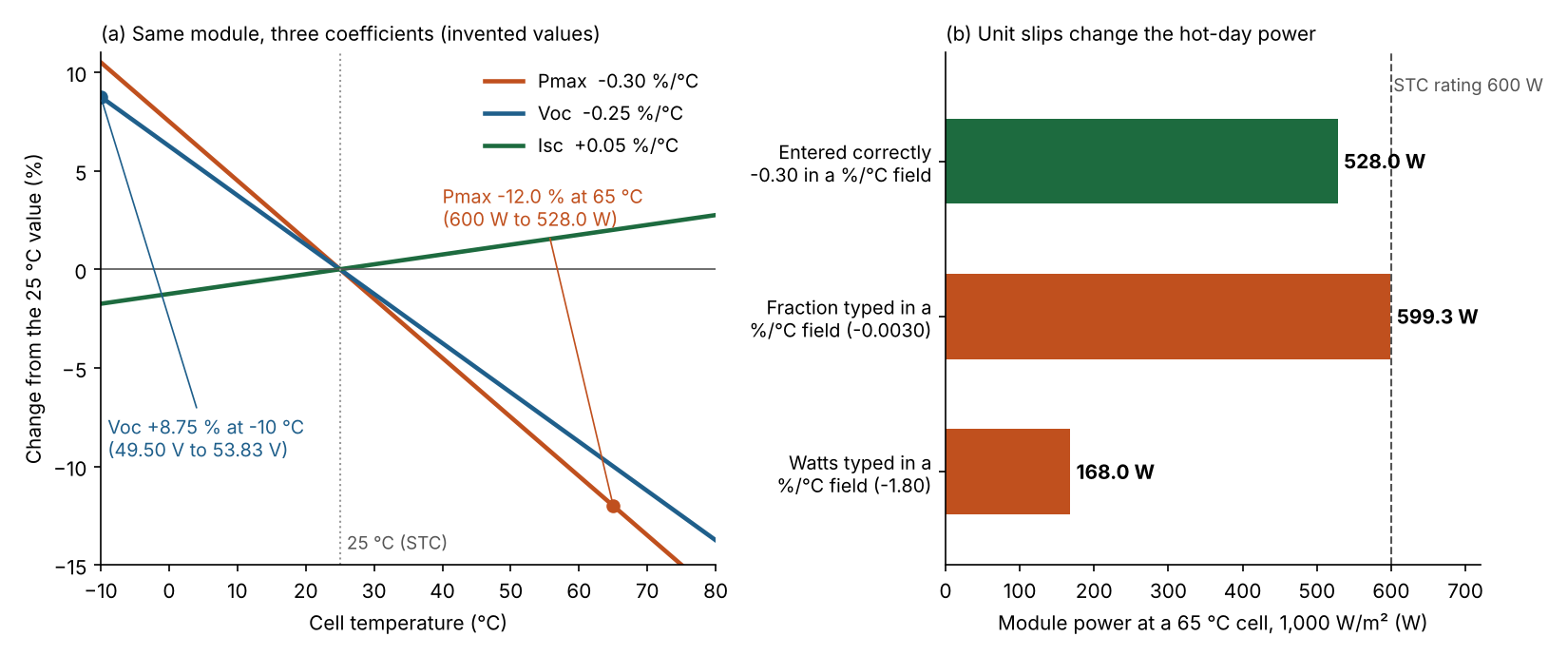
Figure 1. The same example -0.30 %/°C costs 12.0% at a 65 °C cell. A unit slip gives 599.3 W or 168.0 W instead of 528.0 W.
All inputs below are example. The hot cell is 65 °C and the cold cell is -10 °C, both example. The formula is linear.
| Check | Working | Result |
|---|---|---|
| Power at 65 °C, from %/°C | 600 × (1 − 0.0030 × 40) | 528.0 W (72.0 W lost) |
| Power at 65 °C, from W/°C | 600 − 1.80 × 40 | 528.0 W |
| Voc at -10 °C, from %/°C (for cold-day strings see Voc and Isc) | 49.5 × (1 + 0.0025 × 35) | 53.83 V (+8.75%) |
| Slip: -0.0030 typed in a %/°C field | 600 × (1 − 0.000030 × 40) | 599.3 W (13.5% too high) |
| Slip: -1.80 (watts) typed in a %/°C field | 600 × (1 − 0.018 × 40) | 168.0 W |
| Slip: -0.30 typed in a fraction field | 600 × (1 − 0.30 × 40) | -6,600.0 W |
How do three real datasheets print the coefficients?
No two of these three prints use the same layout. Read the unit on each line before you copy a number into a tool.
| Print (code, date) | Pmax | Voc | Isc |
|---|---|---|---|
| Astronergy ASM6610P(BF), "ASM6610P(BF)_TD_ ENG_2015-05-29" | -0.42 % / K | -0.32 % / K | +0.059 % / K |
| SunPower Maxeon 5 COM, "535619 REV C / A4_EN", June 2020 | -0.29% / °C | -136 mV / °C | 5.7 mA / °C |
| SunPower Maxeon 3, "536423 REV B / A4_AU", July 2020 | -0.27% / °C | "-0.236% mV / °C" | "0.058% mA / °C" |
- Astronergy, Voc in the other format: 265 Wp column, Voc 38.12 V: -121.98 mV/K. Per cell, if all 60 are in series: -2.03 mV/K.
- SunPower, first print, Voc in the other format: 430 W column, Voc 51.2 V: -0.266 %/°C. The 450 W column (51.9 V): -0.262.
- SunPower, second print, Voc in the other format: read as percent, the 400 W column (75.6 V) gives -178.4 mV/°C.
The Astronergy labels read "Temperature coefficient (Pmpp)", "(Isc)" and "(Voc)", beside a NOCT of 46 °C ± 2 °C. The Maxeon sheets use "Power Temp Coef.", "Voltage Temp Coef." and "Current Temp Coef." in an electrical data block.
One Maxeon 3 sheet prints "-0.236% mV / °C", which mixes percent and millivolt units. Read as millivolts, -0.236 mV/°C would be -0.0003 %/°C for a 75.6 V module, which is implausible. The percent reading gives about -1.7 mV/°C per cell on 104 cells. The Maxeon 5 sheet gives about -1.9 on 72 cells. Both assume every cell is in series. If a library entry depends on the line, ask the maker.
The Maxeon 5 sheet prints one voltage line for three watt classes (450, 440 and 430 W). So its percentage is -0.262, -0.263 or -0.266 %/°C, depending on the column. Each print also carries a revision code. A later print can change a coefficient. See equipment datasheets.
How do design tools use them for hot-day power and cold-day Voc?
A tool multiplies the STC value by (1 + coefficient × (T − 25)). The cell temperature is calculated or entered. The number you key in must match the field’s unit.
- Hot-day power: pvlib’s pvwatts_dc uses Pdc = G ÷ 1000 × Pdc0 × (1 + gamma_pdc × (Tcell − Tref)). It calls gamma_pdc "typically -0.002 to -0.005 per degree C". The Qcells worked case is on the STC page.
- Cold-day Voc: string length uses the Voc coefficient at the design low. See Voc and Isc, cold temperature voltage correction and string sizing.
- Which cell temperature: see ambient and cell temperature. A derate factor is a single multiplier, not a per-degree slope.
PVsyst’s help says muPmpp is "normally a result" of its one-diode model. A correction called muGamma can steer it towards the specified value. It says muVoc "cannot be specified" and is not used in the simulation. It matters in sizing, where you may use the datasheet value instead. Sandia’s model lets the Voc coefficient vary with irradiance: βVoc = βVoc0 + m(1 − Ee), with βVoc0 at 1,000 W/m².
Temperature coefficient converter
Convert a temperature coefficient between %/°C, W/°C and mV/°C: pick each coefficient’s unit and read every format at once. The defaults are the example module. Three buttons load the datasheet values above. For more free tools, see the best free solar calculators for installers.
How solar software handles temperature coefficients
Four of the six tools below document a coefficient input with its unit. Two name a coefficient without showing the input field, and a wrong unit gives a wrong answer. Ratings test the help page, not the model.
| Software | Documents a coefficient input? | Method |
|---|---|---|
| PVsyst | Yes (Isc only, Pmax is a model result) | Modelled |
| PV*SOL | Yes | Modelled |
| pvlib python | Yes | Library you code against |
| SAM | Yes | Modelled |
| HelioScope | Partly | Modelled |
| OpenSolar | Partly | Modelled |
Partly: the company page names a coefficient but shows no input field.
- PVsyst: The module data page lists muIsc as "Temperature coefficient on Isc [mA/K] or [%/K]". The basic data page gives %/°C and says "When not known, it can be taken as about 0.05%/°C." Another page says muVoc "cannot be specified". It also says muPmpp "is normally a result of the one-diode model". Three module pages, no date shown, checked October 2026.
- PV*SOL: Further Parameters lists "Voltage Coefficient (Uoc) [mV/K]", "Current Coefficient (Isc)[mA/K]" and "Output Coefficient [%]". "Enter values either in mV/K or in %/K." The power field takes only [%]. Help page "PV Module Parameters", no date shown, checked October 2026.
- pvlib python: pvwatts_dc: gamma_pdc in 1/°C. calcparams_cec: alpha_sc in A/C. sapm: Aisc in 1/°C and Bvoco in V/°C. Docstrings, 0.16.1, checked October 2026.
- SAM: The 2024.12.12 notes list "Rename temperature coefficient of power variable from ‘gamma_r’ to ‘gamma_pmp’ to be more consistent with industry standard." for Detailed PV. A forum moderator’s reply (12 Sep 2024) says "’gamma_r’ is the temperature coefficient of power in %/°C." for the unit. Sources: NLR release notes (December 2024 release) and SAM forum, checked October 2026.
- HelioScope: The comparison page says to click "Edit model Coefficients" to verify the temperature coefficients match PVsyst. Fields and units are not shown. "HelioScope vs PVsyst", no date shown, checked October 2026.
- OpenSolar: The Voc and Vmp page says a formula "applies a temperature coefficient specific to each panel to adjust the Voc and Vmp values". No field or unit is named. Support article, no date shown, checked October 2026.
Tools that model hot-day power from these coefficients are compared in the best solar simulation software.
Common mistakes with temperature coefficients
FAQs
Is %/K the same as %/°C?
Yes, numerically. A 1 K step is the same size as a 1 °C step, so -0.32 %/K equals -0.32 %/°C. A per-°F value is 5/9 of the per-°C value.
What is a good temperature coefficient for solar panels?
Closer to zero is better, because the module loses less power when hot. Over a 40 K rise, the printed -0.27 %/°C (Maxeon 3) loses 10.8%. The printed -0.42 %/K (Astronergy) loses 16.8%. That gap is 36 W on a 600 W module. This is a linear estimate of two different products and ignores every other loss.
Does the coefficient change with irradiance?
Not on a datasheet, which prints one value, at STC. Sandia’s array model lets the Voc coefficient vary with effective irradiance. So a single number is an STC figure, not a law.
Which temperature coefficient matters most for string sizing?
The Voc coefficient does. String length uses it at the design low temperature. Cold cells raise Voc, so the cold case sets the limit. See Voc and Isc.
Related terms
- Voc and Isc: the open-circuit voltage and short-circuit current that the Voc and Isc coefficients move.
- Vmp and Imp: the peak-power voltage and current, with their own coefficients.
- Standard test conditions: the 25 °C, 1,000 W/m² reference every coefficient starts from.
Next step: before you key a coefficient in, confirm which unit your design tool expects, using the best solar simulation software list.
Sources
- Penn State AE 868, Temperature and PV Performance Optimization (no date shown) (checked October 2026).
- PVMET wiki, Temperature coefficients (last edited 1 March 2022) (checked October 2026).
- Sandia PVPMC, PV Array Performance Model (metadata updated 2 January 2026) (checked October 2026).
- pvlib 0.16.1 docstrings for pvwatts_dc, calcparams_cec and sapm (checked October 2026).
- Datasheets (checked October 2026): Astronergy ASM6610P(BF), SunPower Maxeon 5 COM and SunPower Maxeon 3, distributor copies.
- PVsyst help (no dates shown, checked October 2026): main interface, basic data and temperature coefficients.
- Other company pages (checked October 2026): PV*SOL module parameters, HelioScope vs PVsyst, OpenSolar, SAM release notes and SAM forum thread. The forum has moved from sam.nrel.gov to sam.nlr.gov since the lab’s December 2025 rename to the National Laboratory of the Rockies.
Last updated 30 October 2026. Next scheduled review: 30 January 2027.